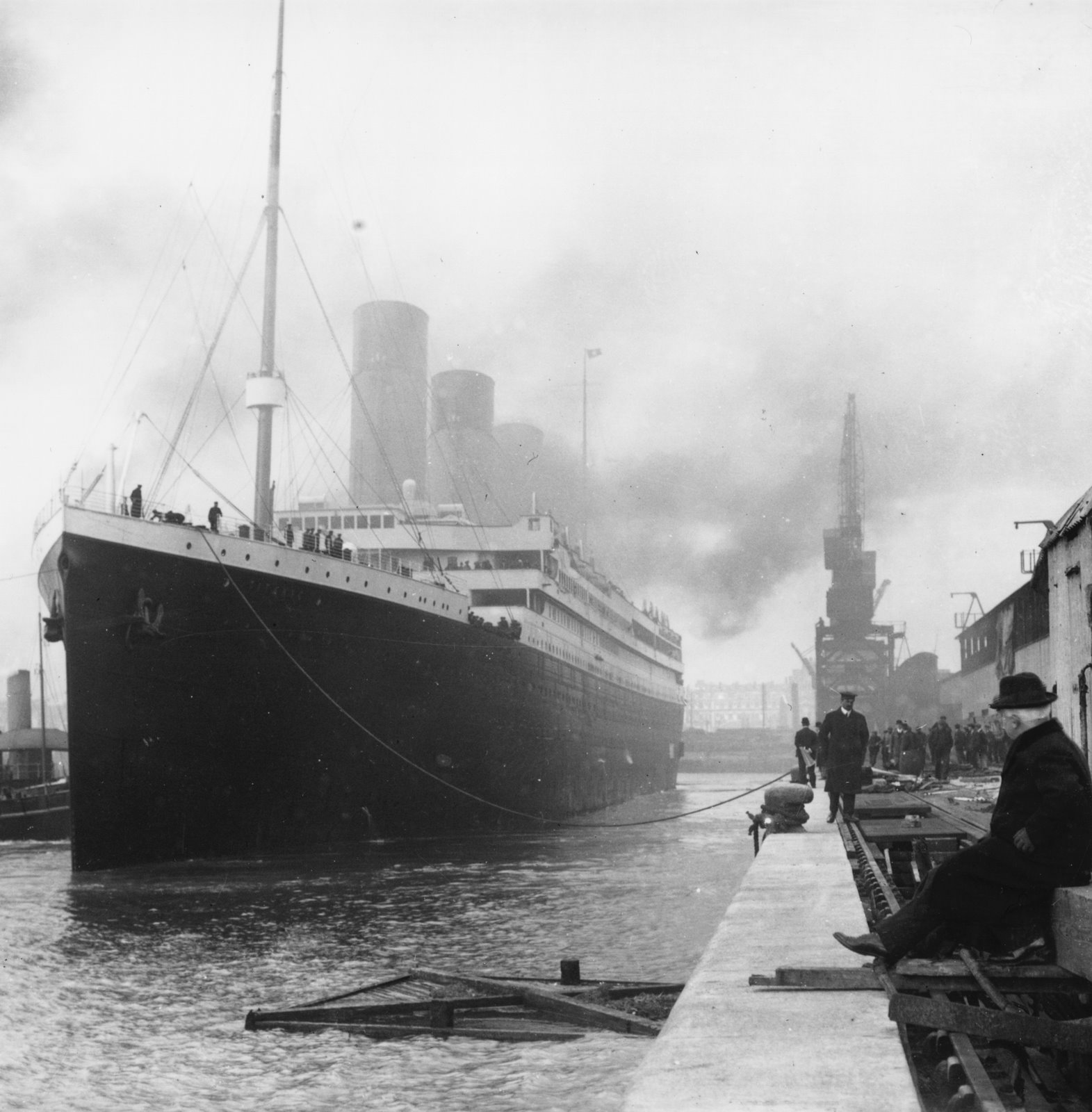
Titanic is a history to remember. Today, 99 nine years ago one of the worst maritime tragedies happened in the Atlantic Ocean. Passenger ship RMS Titanic hit an iceberg and sank into the cold sea. Because it was her maiden voyage from Europe to the New World, it attracted the attention of all mass media on both sides of the Atlantic and from around the world. The luxurious passenger liner the Titanic sank with more than 1500 passenger and crew that died with her. However, there are not many pictures left about how the largest ship that belonged to White Starline looked like when it was sinking.
In 1985, wrecks of the steam ship was discovered by Robert Ballard and his expedition team. The discovery enables us to get Titanic pictures that were taken underwater. The pictures gave us a lot of information about the current condition of the passenger liner that is now lying on the sea bed. The damage on the ship's hull which was around 12 square feet in size was later analyzed using computer model to study how sea water entered the hull and sank the ship.Even though a lot of books, as well as scientific articles have been written about the ship, the sinking of Titanic ship will continue to attract the attention of ship enthusiasts and naval architect forever.Also read: The Sinking of Titanic Ship
Showing posts with label Titanic. Show all posts
Showing posts with label Titanic. Show all posts
Wednesday, April 13, 2011
Tuesday, April 12, 2011
Titanic - a history to remember
This morning is 13 April 2011, tomorrow ninety-nine years ago RMS Titanic collided with an iceberg on her maiden voyage to New York into the Atlantic Ocean. RMS means Royal Mail Steamer. She was a vessel that was meant to carry postal mails across the Atlantic. Titanic was a passenger liner. Even though it was considered as a luxurious vessel, it was not a cruise ship like the Oasis of the Seas. Cruise ships do not see speed as an important factor in their services. Cruise ships emphasize their services on entertaining their passengers and on providing itinerary to places that have been famous as tourist destinations. It was the worst maritime accident in the peace time. We still remembere how the accident was relived in the film starred by Leonardo DiCaprio, Jack and Kate Winslett as Rose. Actually, naval architects who designed the passenger ship had divided the vessel into 16 main compartments and double bottom. The 16 compartments had also been divided into 44 watertight compartments. Meaning that when the doors of the compartments were closed, water could not enter. However, the temperature of the sea that was very cold had changed the structure of the ship's hull. The steel plate of the hull became harder when it was in cold water and lost its ductility. As a result the hull plate of the Titanic had been more brittle in icy water. When she collided with the iceberg, it buckled the ship's hull plate and broke the rivets allowing sea water to flow into the watertight compartments.
The tragedy of the Titanic ship was a great lessons for all of the people who were working in the maritime industry. Safety has now become the main priority of the operation of ships around the world. The lifeboats that are installed in every ship now have to be able to carry all the passengers and crews in case when the ships experience emergency situation at sea. Radio equipment has to be manned 24 hours a day when the ship is sailing and lifeboat drills have to be conducted on every voyage.
We have got a lot of lessons learned from the sinking of Titanic. Now the maritime technology is more advanced and the rivet joints in ship's hull have long been replaced by welded joints. Inflatable boats have been invented too. These improvements in shipbuilding technique should reduce the number of ship accidents. However, the challenge to the safety of passengers and crews of ships is increasing. Piracy is considered a serious threat for ships. Merchant ships that sail near the Somali waters and Malaka straits are now becoming the main targets for the pirates. Dealing with piracy, international community through IMO give green light to governments to protect their ships with navy personnel and naval ships. Even though the sinking of large ships have greatly been reduced, we must not ignore the pirates and other threats. Never forget that the seemingly calm surface of the blue sea does not reflect that our ocean is always at peace. by Charles Roring
The tragedy of the Titanic ship was a great lessons for all of the people who were working in the maritime industry. Safety has now become the main priority of the operation of ships around the world. The lifeboats that are installed in every ship now have to be able to carry all the passengers and crews in case when the ships experience emergency situation at sea. Radio equipment has to be manned 24 hours a day when the ship is sailing and lifeboat drills have to be conducted on every voyage.
We have got a lot of lessons learned from the sinking of Titanic. Now the maritime technology is more advanced and the rivet joints in ship's hull have long been replaced by welded joints. Inflatable boats have been invented too. These improvements in shipbuilding technique should reduce the number of ship accidents. However, the challenge to the safety of passengers and crews of ships is increasing. Piracy is considered a serious threat for ships. Merchant ships that sail near the Somali waters and Malaka straits are now becoming the main targets for the pirates. Dealing with piracy, international community through IMO give green light to governments to protect their ships with navy personnel and naval ships. Even though the sinking of large ships have greatly been reduced, we must not ignore the pirates and other threats. Never forget that the seemingly calm surface of the blue sea does not reflect that our ocean is always at peace. by Charles Roring

Friday, April 8, 2011
Titanic
In my previous article entitled: The Sinking of Titanic Ship and Lessons Learned from It, I describe some improvements in maritime regulations that are now practiced by ship crews. Titanic ship is the name of a passenger liner that sank into the Atlantic Ocean on her maiden voyage, shortly after midnight on 15 April 1912 from Queenstown harbor in Ireland to New York in the United States of America. More than 1500 passengers and crews died during the accident which was caused by the collision between the ship and an iceberg. The rivet joints under the water were broken when the ship's hull plate buckled after the collision leaving significant gap between the shells where sea water began to enter. Even though many passengers had life-jackets, the temperature of the sea which was 28 degrees F (- 2 degrees Celcius) was unbearable for those who were floating on the sea surface. Many died of hypothermia.

In addition to the improvements in the number of boats, the sub-division of ship's hull into smaller watertight compartments have been strictly enforced to avoid rapid sinking of ships when they collide with other ships or experience grounding with coral reef in shallow waters.
Maritime accident such as what the RMS Titanic had faced must not happen again. However no one can guarantee that all ships at sea are now completely safe. We still receive news on television where ships sank due to human error or bad weather. The recent one is the sinking of a refugee boat between Libyan and Italian waters where a lot of people have been missing until now. RMS stands for Royal Mail Steamer meaning the ship was powered by steam engine. Mail steamer was a vessel that carried postal mails. A ship with that name must be a fast ship. That's the impression which we can get from the three letters of RMS.
Titanic is now at the bottom of the Atlantic Ocean, pictures about her have been published on televisions and newspapers. A lot of new regulations have been made to improve the safety of life at sea and still a lot of ships sink.
Today, the largest cruise ship in the world, such as the Oasis of the Seas can carry more than 6,000 people. She is equipped with modern navigational devices, and manned by experienced crews. As the ship sails around the Caribben waters, the lessons learned from the sinking of the Titanic must continue to remind people who operate the Oasis of the Seas to run their ship carefully until it arrives safely on her next port of call. by Charles Roring
Also read: Oasis of the Seas and Titanic Cruise Ships Size Comparison
source: Irish Titanic Historial Society - http://www.iths.ie/
Years after the worst maritime disaster, people still remember about the accident due to a lot of publications about the ship. There are books, news articles and films (documentary and fiction) that have been created about the most modern passenger ship of that time. Some websites even sell Titanic models to those who are interested in buying them and put them at homes or offices. Naval architects and marine engineers now have to implement certain technical rules stipulated by IMO (International Maritime Organization) and varoius classification societies to ensure that such accident will not happen again in the future. At the present moment, all of the passenger ships and cruise ships have to carry boats that can save all of the passengers and crews.In addition to the improvements in the number of boats, the sub-division of ship's hull into smaller watertight compartments have been strictly enforced to avoid rapid sinking of ships when they collide with other ships or experience grounding with coral reef in shallow waters.
Maritime accident such as what the RMS Titanic had faced must not happen again. However no one can guarantee that all ships at sea are now completely safe. We still receive news on television where ships sank due to human error or bad weather. The recent one is the sinking of a refugee boat between Libyan and Italian waters where a lot of people have been missing until now. RMS stands for Royal Mail Steamer meaning the ship was powered by steam engine. Mail steamer was a vessel that carried postal mails. A ship with that name must be a fast ship. That's the impression which we can get from the three letters of RMS.
Titanic is now at the bottom of the Atlantic Ocean, pictures about her have been published on televisions and newspapers. A lot of new regulations have been made to improve the safety of life at sea and still a lot of ships sink.
Today, the largest cruise ship in the world, such as the Oasis of the Seas can carry more than 6,000 people. She is equipped with modern navigational devices, and manned by experienced crews. As the ship sails around the Caribben waters, the lessons learned from the sinking of the Titanic must continue to remind people who operate the Oasis of the Seas to run their ship carefully until it arrives safely on her next port of call. by Charles Roring
Also read: Oasis of the Seas and Titanic Cruise Ships Size Comparison
Monday, April 4, 2011
The Sinking of Titanic Ship and Lessons Learned from it.
Cruise ships are not unsinkable. That's what we must always remember. A cruise ship how modern and advanced her technology is such as the Oasis of the Seas has to abide by the rules set by IMO and other maritime authorities related to safety of life at sea. Titanic ship sank on 15 April 1912. It was 99 years ago. The sinking of this passenger liner was one of the worst maritime disasters in modern shipping history. The "unsinkable" vessel demised into the Atlantic ocean after colliding with an iceberg. Carpathia, a small and slow mediteranian cruise liner, could only rescue 705 passengers and crews from the sea whereas more than 1500 had been lost to the sea. The passenger ship that belonged to White Star line is now lying two and a half miles below the surface of the Atlantic ocean.
One year after the maritime tragedy, people working in passenger shipping industry and Atlantic crossing business gathered in London for the first International Convention for Safety of Life at Sea. From this convention some rules were made for the safety operation of ships. The rules require that:
I remembered my personal experience when going to the sea by a small wooden boat to supply food (provision) to a giant container ship Global Bonanza one day after a huge earthquake and tsunami hit the eastern coast of Japan. For the container vessel, the remnants of tsunami waves that reached the northern coast of Manokwari were only ripples on the surface of the blue sea of Papuan waters but for a small boat where I was on board, the waves caused violent rollings. The boat did not have GPS equipment at all. When it was still in the Dore bay protected by two small islands, Mansinam and Lemon, the waves were not dangerous. After it went to an open sea behind these islands, the crews who operated the boat said that the waves were dangerous. As soon as we reached the port side of the container vessel, I climbed the hull through the rope ladder. When we were unloading the food and water for the crews of Global Bonanza container vessel, I received a call from my friends in the small boat requesting the big ship to rotate a little bit to protect the wooden boat from sea current that was entering the Manokwari bay. After several failed attempts in informing the deck crews about the request due to language barrier. They speak Chinese and their English was not clear enough, I was invited to go to the bridge to talk directly with the captain.
One year after the maritime tragedy, people working in passenger shipping industry and Atlantic crossing business gathered in London for the first International Convention for Safety of Life at Sea. From this convention some rules were made for the safety operation of ships. The rules require that:
- Every ship has to be equipped with enough lifeboats for every passenger and crew working on the ship.
- Wireless or communication devices have to be manned 24 hours a day
- Lifeboat drills have to be conducted on every voyage.
source of the photograph: titanicuniverse.com
The rules are still valid until today. In addition, more technical regulations and improvements concerning the sub-division of ship's hull under the main deck into several smaller watertight compartments have been developed by classification societies that deal with rules regarding the safety of ships' structure. Today, modern cruise ships, ferry, and yachts have better navigational equipments that are supported by satellites such as GPS devices. Ship crews can easily inform their exact location (or coordinates) to the nearest maritime authorities and their shipping company if they face an accident at sea. I remembered my personal experience when going to the sea by a small wooden boat to supply food (provision) to a giant container ship Global Bonanza one day after a huge earthquake and tsunami hit the eastern coast of Japan. For the container vessel, the remnants of tsunami waves that reached the northern coast of Manokwari were only ripples on the surface of the blue sea of Papuan waters but for a small boat where I was on board, the waves caused violent rollings. The boat did not have GPS equipment at all. When it was still in the Dore bay protected by two small islands, Mansinam and Lemon, the waves were not dangerous. After it went to an open sea behind these islands, the crews who operated the boat said that the waves were dangerous. As soon as we reached the port side of the container vessel, I climbed the hull through the rope ladder. When we were unloading the food and water for the crews of Global Bonanza container vessel, I received a call from my friends in the small boat requesting the big ship to rotate a little bit to protect the wooden boat from sea current that was entering the Manokwari bay. After several failed attempts in informing the deck crews about the request due to language barrier. They speak Chinese and their English was not clear enough, I was invited to go to the bridge to talk directly with the captain.
It was easy to talk to the captain because he spoke good English. He rotated his ship to starboard direction to block the sea current and waves from hitting the small boat. This dangerous mission was finally accomplished. While inside the bridge of this container ship, I saw that it was equipped with modern navigational equipment. Radar, and GPS were two important devices that I noticed in the room. The small wooden boat that was unloading the food for this big ship did not have such devices. In addition, the small boat were not adequately divided into smaller watertight compartments. The crews of the boat had to rely on their personal experience when operating their small wooden boats. Fortunately we could return to Manokwari harbor again. We left at 4 p.m. and we returned at 10.30 p.m. This small boat was nearly capsized but the experienced boat driver did his job well. He knew when to accelerate the boat's engine and when to slow down. Although the sea is a dangerous environment, I will never stop sailing. by Charles Roring
Also read:
Saturday, April 2, 2011
Titanic ship sea accident and how to avoid it from happening again
Royal Mail Steamer (RMS) Titanic sank in April 1912. It was a tragic maritime accident which took the live of 1,517 people (data from Wikipedia) into the deep dark blue water of the Atlantic ocean. All of us hope that such case will not happen again. Titanic was a modern passenger ship of her time. However on her maiden voyage, it sank due to human error. A lot of people died in the accident because the number of passengers was higher than the available lifeboats and rafts. Although the passenger vessel had been divided into smaller watertight compartments to improve her insubmersibility properties, most of the compartments were broken and were not watertight anymore when she struck an iceberg. They began to receive cold sea water immediately after the collision. As a result, the Titanic passenger ship did not have enough buoyancy to support her on the sea surface. Insubmersibility can be defined as the ability of a ship to remain afloat when one or more of her compartments are flooded with sea water. Buoyancy is the force or pressure on the surface of the ship's hull that causes the ship to float.

 Last week I traveled with four tourists from the Czech Republic to Numfor island. We went there by a small ferry boat KM. Kasuari Pasifik IV from Manokwari city - the capital of West Papua province. As somebody who used to study naval architecture, I observed that this ferry boat is not equipped with adequate number of life saving equipments. Based on the general arrangement drawings that I saw on the walls of this ship, I noticed that the ferry was constructed to carry both passengers and motorized vehicles such as cars and trucks. However, this ferry, during most of her voyages, carries more people than cars.
 To prevent the loss of human life if the case of Titanic passenger liner happens again to this small ferry boat (I hope not), the number of lifeboats, rafts and life jackets should be added to a capacity of 300 to 500 people. I personally do not know the maximum capacity of this ferry if she only carries passengers with no cars on the main deck. Since the draft of the ferry is small and the main deck has large open space for trucks and cars (or usually passengers), the operator of the boat must not take any risk of carrying a lot of passengers during rough weather. In addition, in order to avoid any sea accident similar to Titanic passenger vessel, crews of the boat must regularly carry out training to simulate any possible sea accidents while the ship is sailing in the middle of the sea. by Charles Roring
Also read: Oasis of the Seas and Titanic Cruise Ship Size Comparison
Titanic Ship at sea - Source: Titanic.com
A.N. Krylov, a Russian naval scientist, developed the theory of insubmersibility to improve Russian warships following the loss of the entire Russian naval fleet in the battle of Tsushima strait against the Japanese navy in May 1905. So, the division of ship's hull below the main deck into several watertight compartments such as what we had seen in Titanic vessel was not a new invention. However, when she collided with the iceberg most of her watertight compartments were broken. As a result, the Titanic passenger ship did not have adequate insubmersibility properties anymore. 

Also read: Oasis of the Seas and Titanic Cruise Ship Size Comparison
Subscribe to:
Posts (Atom)


