Authors note: In order to do this film true justice, any discussion of it must be candid. Therefore, the following review will contain SPOILERS. If you have not seen Inglourious Basterds, please do not read this review. In fact, please turn of your computer altogether. Then, go out and buy a ticket and see this movie.
Then come back and read the review.
Genre: War Drama, Black Comedy
Director: Quentin Tarantino
Starring: Brad Pitt, Mélanie Laurent, Christoph Waltz, Michael Fassbender, Diane Kruger, Eli Roth, Daniel Brühl, Til Schweiger
Running Time: 149 minutes (plus trailers)
“You probably heard we ain't in the prisoner-takin' business; we in the killin' Nazi business. And cousin, business is a-boomin'.”
 In a case of life imitating art, I’ve decided to begin this review in the same way that Quentin Tarantino begins many of his movies: with a little vignette of self reflection. I feel that it is poor film criticism to refer excessively to other movies in the course of a review. All films, good or bad, new or old, should be able to stand on their own, and through comparison we often inadvertently pay disrespect to the film that is actually the topic of discussion. It’s a problem that I as a fledgling film reviewer often have, a problem that I am slowly trying to overcome. That being said, it would be (to quote Mia Wallace) “an exercise in futility” to try and discuss Inglourious Basterds without referring to Tarantino’s previous films. Because if there is one thing that characterizes the works of Tarantino, it is that they are always going to be discussed. I don’t think I’ve ever met anyone with a reasonable knowledge of film who is indifferent to Quentin Tarantino. Love or you hate him, his movies have an effect. They cause emotion, whether that emotion be admiration, repulsion, amazement or contempt. And more importantly, they generate conversation. And not just about the particular film in question, but about all of his films, and moreover, about cinema itself, both as an art form and as a contemporary means of entertainment. Therefore, the conclusion I have come to at the end of this piece of self reflection is that to talk about a movie of Tarantino’s in a vacuum, without drawing comparisons to his other films, would be utterly pointless, and a disservice to those few people who actually read my reviews.
Of course, that could all just be an excuse for why I don’t really have anything unique or interesting to say about this film. Who knows.
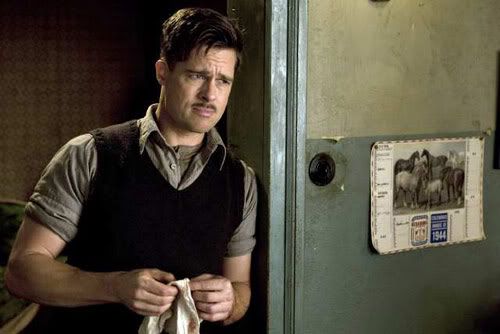
 With all that said, I would like to submit to you that Inglourious Basterds feels like a combination of three of Tarantino’s previous films: Reservoir Dogs (1994), Kill Bill (2003-2004) and Death Proof (2007). Like Reservoir Dogs (and I suppose to a certain extent Pulp Fiction), Inglourious Basterds is dialogue based, character driven film masquerading as an action movie. Anyone who goes into Inglourious Basterds not knowing who was behind it, expecting firefights and Mexican standoffs, is going to be deeply disappointed. This is classic Tarantino, filled with wordy characters that make the mundane seem fascinating, turning sentences into poetry without sacrificing the “fuck yous”. As in Dogs, the films lead characters – The Basterds – are uncouth, unkind and unpleasant, and yet we take perverse delight in listening to them speak, and watching them carry out unspeakable acts of mutilation and violence. The difference? There is no good intentioned Mr. Orange amongst the Basterd ranks, no noble Mr. White. Lt Aldo Raine, played with a convincing lack of refinement by Hollywood megastar Brad Pitt, is the leader a battalion made up entirely of Mr. Blondes – all of them gleefully sadistic and morbidly funny. Amongst the heroes in this film are a sociopathic serial killer played by Til Schweiger (who ironically gives one of the pictures more retrained performances) and an unhinged, obnoxious, baseball bat swinging psycho played by Hostel director Eli Roth (who does a surprisingly impressive job with only a handful of lines). None of the Basterds are good people, but they are all of them intensely enjoyable to watch on screen.
 Secondly there is the Kill Bill connection. Mercifully unspoiled by any of the marketing material is the Shoshanna story arc, which actually feels more like the main narrative than anything involving The Basterds themselves. Tarantino doesn’t even attempt to visit new ground here – much like Beatrix Kiddo’s, Shoshanna’s story is a classic tale of revenge. French actress Mélanie Laurent is a real discovery, and does a terrific job of handling the films few emotional moments. She is especially impressive in the scene in which she comes face to face once more with her families killer – they way she subtly portrays fear in those moments was very impressive. But it is the man who inspires that fear – Col. Hans Landa – who is the real star of this film. Played with polite, soft spoken menace by Austrian actor Christoph Waltz, Landa is the ultimate Tarantino character – articulate, sinister, selfish and extremely dangerous, a man capable of charming and amusing you with witty wordplay only to strangle you to death with his bare hands a moment later. Tarantino reportedly considered Leonardo DiCaprio for the part, and I personally would have loved to see him take it on. But it’s hard to imagine anyone being as good as Waltz, whose win for Best Actor at the Canne Film Festival was very well deserved – as will be his inevitable nomination come Oscar season.
 Finally, we have the comparison to Death Proof, Tarantino’s contribution to the double feature Grindhouse, which he co-directed with Robert Rodriguez. A lot of people seem to dislike Death Proof – personally I think it only works in its shorter form when viewed as part of the whole Grindhouse package (as opposed to the extended version that was released separate from Grindhouse here in Australia). Death Proof really feels like the culmination of Tarantino’s love for movies; it is silly, campy, exploitative fun, and in that way, it is not dissimilar to Inglourious Basterds. There is definitely that same sense of pulp in Tarantino’s latest – the old Universal Studio’s logo, the awesome soundtrack (what a surprise) made up of Ennio Moricone music taken from classic B movies; the glorious cut scenes featuring narration by Samuel L. Jackson (of all people!) One gets the impression from all of Tarantino’s movies that he wishes he had been making films in the 1970’s, and his attempts to somehow realize this dream are particularly apparent in Grindhouse and Inglourious Basterds. Scenes like the rock star introduction to Hugo Stiglitz or the extended cameo performance from Mike Myers are utterly absurd, and feel totally out of place in a modern film. But Inglourious Basterds is not a modern film. It is homage, it is tribute; it is everything that Tarantino does, and once again, somehow, he makes it work.
 But can he keep it up? That is the question I was left with as I exited the theatre. I unabashedly loved Inglourious Basterds, but I don’t think it is as good as any of the films I have compared it to. And more significantly, I don’t think it is nearly as good as Tarantino thinks it is. After all the praise I’ve given him, now it’s time to come down on the man like a ton of bricks. The last line of this film is “I think this just might be my masterpiece”; Jesus Christ Quentin; you weren’t feeling particularly subtle on the day you wrote that line, were you? Pulp Fiction is a masterpiece – Inglourious Basterds (as great as it is) is not. And this is the thing that is going to lead to Tarantino’s eventual undoing. We saw it a little bit in the Kill Bill movies and a little more in Death Proof – this man is overly indulgent, arrogant and has very little self control. Scenes that only need to go for ten minutes end up going for twenty or thirty. His throwbacks to exploitation cinema seem silly and over the top. Now because he writes such fantastic dialogue and has such a wonderful visual style, you usually don’t mind. But I have this impending sense of doom that one day – it could be his next movie, it could be the one after – but one day, he is going to screw it all up. The movie is going to be too campy, or too wordy, or too long, or too laden with pop culture references. And when that happens, his career is going to implode. I am huge fan of this man’s work; I disagree with the haters who call him a pretentious hipster, or accuse him of glorifying violence. But if he doesn’t find some temperance, and fast, he is going to end up proving all the dissenter right.
 So those are my views on the direction of Quentin Tarantino’s career; take them however you want. Now for the thing that everyone wants to talk about. The ending. If you’ve ignored my warning and read this far without having seen the film, please turn back now. Because this movie may contain the ultimate twist ending – an ending that defies not only reason and logic, but history itself. It is one of the most unbelievable, unprecedented, ballsy moments in the history of cinema, and I’m almost afraid to articulate here, in case I only imagined it. But here goes…
…
They kill Hitler. The Basterds end the war.
Moronic?
Brilliant.
 I actually wrote in my review of Valkyrie that this would have been a great way for director Bryan Singer to pay off on what I thought was a very thrilling film. However, I was sort of joking – after all, what kind of idiot would put that ending in a major motion picture? Clearly, the kind of idiot whose name is Quentin Tarantino. I should be using this moment to reiterate my belief that the man has lost all ability to self moderate. But there’s no way I’m going to do that, because, let’s face it: this ending is just too freaking awesome! What better way to surprise the audience than to go directly against one of the most well documented pieces of information in human history? And the best thing about it was how sudden it was. It literally happened in a flash, and I had to turn to the guy next to me for confirmation that what I thought had happened had actually occurred. Unfortunately, Tarantino returns to the opera box moments later to give us a close up of the Fuhrer’s face being riddled with bullets, which, in my opinion, greatly lessened the effect. But in a film filled with Jewish heroes and actors, that moment must have been the ultimate form of wish fulfilment, so I suppose I can forgive them that little indulgence.
 There is actually more to the ending of Inglourious Basterds than the ridiculous rewriting of history. And specifically, I want to address the violence in the final chapter of this film, and how for the first time in any of Tarantino’s movies, I didn’t like it. And once again, I’m going to use his other films as a point of comparison. Probably the most iconic moment of violence in any of his movies is the ear cutting scene in Reservoir Dogs. That is a scene in which all the actual violence happens off camera, but because the idea of it is so horrific, it can’t help but have a lasting effect. Jump forward to climax of Kill Bill Volume 1 (which by the way is my favourite Tarantino movie after Pulp Fiction). That film ends with a half hour sword fight in which countless limbs are severed, and hundreds of litres of blood is spilled. And yet, it is almost beautiful. That film is a piece of art; stylized and bizarre, and the bloodshed is an integral part of the compelling aesthetic. The violence in Reservoir Dogs and Kill Bill is completely different, but in both cases it has a purpose, and is effective in that purpose. Therefore, I feel it is justified.
 In the climax of Inglourious Basterds however, the violence felt a lot shallower. The build up to the ending is terrifically suspenseful – Raine has been taken hostage, the bombs are ticking, and Shoshanna’s plan is minutes from being put into action. In a moment of directorial brilliance, flames begin to engulf the theatre, and Shoshanna, her face ethereally projected through the smoke, begins to laugh. But then the bloodbath begins. The Basterds, in a ridiculously gratuitous extended sequence, burst into the theatre and start pumping round after round into the fleeing Nazi officials. As I previously stated, I’m not one to be put off by graphic violence in films when it serves a purpose, but that scene was literally like shooting fish in a barrel, and given that Tarantino has repeatedly proven that he can use violence well, the whole thing felt beneath him. I also thought the same thing about the final moments of the film, in which Raine carves a Swastika into Landas' head. It wasn’t actually a bad scene, but imagine how much better it would have been if the movie had ended just a few minutes earlier, with the line “I bet you were planning on taking off your uniform”. That’s the kind of wit I expect from Tarantino, and the fact that he felt he had to go that little bit further seems like another indication that he’s losing a handle of what works and what doesn’t.
 But at the end of the day, these are minor complaints, and all of them are outweighed by some very heavy positives. Unsurprisingly, the soundtrack is fantastic, the dialogue is pitch perfect (and often times hilarious), and opening credit sequence is totally awesome. Tarantino’s usual editor Sally Menke does a great job as always, and as I already mentioned, every member of the cast excels. The reason I haven’t addressed these things in enormous detail is because, well, it’s a Tarantino movie; of course all those things are good. And that is really what this review comes down to. Inglourious Basterds is a Tarantino movie, so of course it’s good. The man doesn’t make bad movies. He makes divisive movies, he makes bizarre movies, and one day soon, I’m afraid that he’s going to make a spectacularly awful movie. But it sure as hell isn’t Inglourious Basterds. In my introduction, I talked about how you can pay disservice to a film by comparison. And that’s what I’ve done here. Inglourious Basterds isn’t as visually impressive as Kill Bill. Nor is it as witty or well written as Reservoir Dogs or Pulp Fiction. And although it does have the directors signature throwbacks to classic films, it doesn’t have same nostalgic camp or good time fun as Grindhouse did. Ultimately I feel that Inglourious Basterds is one of Tarantino’s lesser films. But a lesser Tarantino film is still a Tarantino film. And all comparisons aside, this movie is excellent.

Inglourious Basterds is in cinemas now

LAMBScore:

Then come back and read the review.
Genre: War Drama, Black Comedy
Director: Quentin Tarantino
Starring: Brad Pitt, Mélanie Laurent, Christoph Waltz, Michael Fassbender, Diane Kruger, Eli Roth, Daniel Brühl, Til Schweiger
Running Time: 149 minutes (plus trailers)
“You probably heard we ain't in the prisoner-takin' business; we in the killin' Nazi business. And cousin, business is a-boomin'.”
 In a case of life imitating art, I’ve decided to begin this review in the same way that Quentin Tarantino begins many of his movies: with a little vignette of self reflection. I feel that it is poor film criticism to refer excessively to other movies in the course of a review. All films, good or bad, new or old, should be able to stand on their own, and through comparison we often inadvertently pay disrespect to the film that is actually the topic of discussion. It’s a problem that I as a fledgling film reviewer often have, a problem that I am slowly trying to overcome. That being said, it would be (to quote Mia Wallace) “an exercise in futility” to try and discuss Inglourious Basterds without referring to Tarantino’s previous films. Because if there is one thing that characterizes the works of Tarantino, it is that they are always going to be discussed. I don’t think I’ve ever met anyone with a reasonable knowledge of film who is indifferent to Quentin Tarantino. Love or you hate him, his movies have an effect. They cause emotion, whether that emotion be admiration, repulsion, amazement or contempt. And more importantly, they generate conversation. And not just about the particular film in question, but about all of his films, and moreover, about cinema itself, both as an art form and as a contemporary means of entertainment. Therefore, the conclusion I have come to at the end of this piece of self reflection is that to talk about a movie of Tarantino’s in a vacuum, without drawing comparisons to his other films, would be utterly pointless, and a disservice to those few people who actually read my reviews.
Of course, that could all just be an excuse for why I don’t really have anything unique or interesting to say about this film. Who knows.
 With all that said, I would like to submit to you that Inglourious Basterds feels like a combination of three of Tarantino’s previous films: Reservoir Dogs (1994), Kill Bill (2003-2004) and Death Proof (2007). Like Reservoir Dogs (and I suppose to a certain extent Pulp Fiction), Inglourious Basterds is dialogue based, character driven film masquerading as an action movie. Anyone who goes into Inglourious Basterds not knowing who was behind it, expecting firefights and Mexican standoffs, is going to be deeply disappointed. This is classic Tarantino, filled with wordy characters that make the mundane seem fascinating, turning sentences into poetry without sacrificing the “fuck yous”. As in Dogs, the films lead characters – The Basterds – are uncouth, unkind and unpleasant, and yet we take perverse delight in listening to them speak, and watching them carry out unspeakable acts of mutilation and violence. The difference? There is no good intentioned Mr. Orange amongst the Basterd ranks, no noble Mr. White. Lt Aldo Raine, played with a convincing lack of refinement by Hollywood megastar Brad Pitt, is the leader a battalion made up entirely of Mr. Blondes – all of them gleefully sadistic and morbidly funny. Amongst the heroes in this film are a sociopathic serial killer played by Til Schweiger (who ironically gives one of the pictures more retrained performances) and an unhinged, obnoxious, baseball bat swinging psycho played by Hostel director Eli Roth (who does a surprisingly impressive job with only a handful of lines). None of the Basterds are good people, but they are all of them intensely enjoyable to watch on screen.
 Secondly there is the Kill Bill connection. Mercifully unspoiled by any of the marketing material is the Shoshanna story arc, which actually feels more like the main narrative than anything involving The Basterds themselves. Tarantino doesn’t even attempt to visit new ground here – much like Beatrix Kiddo’s, Shoshanna’s story is a classic tale of revenge. French actress Mélanie Laurent is a real discovery, and does a terrific job of handling the films few emotional moments. She is especially impressive in the scene in which she comes face to face once more with her families killer – they way she subtly portrays fear in those moments was very impressive. But it is the man who inspires that fear – Col. Hans Landa – who is the real star of this film. Played with polite, soft spoken menace by Austrian actor Christoph Waltz, Landa is the ultimate Tarantino character – articulate, sinister, selfish and extremely dangerous, a man capable of charming and amusing you with witty wordplay only to strangle you to death with his bare hands a moment later. Tarantino reportedly considered Leonardo DiCaprio for the part, and I personally would have loved to see him take it on. But it’s hard to imagine anyone being as good as Waltz, whose win for Best Actor at the Canne Film Festival was very well deserved – as will be his inevitable nomination come Oscar season.
 Finally, we have the comparison to Death Proof, Tarantino’s contribution to the double feature Grindhouse, which he co-directed with Robert Rodriguez. A lot of people seem to dislike Death Proof – personally I think it only works in its shorter form when viewed as part of the whole Grindhouse package (as opposed to the extended version that was released separate from Grindhouse here in Australia). Death Proof really feels like the culmination of Tarantino’s love for movies; it is silly, campy, exploitative fun, and in that way, it is not dissimilar to Inglourious Basterds. There is definitely that same sense of pulp in Tarantino’s latest – the old Universal Studio’s logo, the awesome soundtrack (what a surprise) made up of Ennio Moricone music taken from classic B movies; the glorious cut scenes featuring narration by Samuel L. Jackson (of all people!) One gets the impression from all of Tarantino’s movies that he wishes he had been making films in the 1970’s, and his attempts to somehow realize this dream are particularly apparent in Grindhouse and Inglourious Basterds. Scenes like the rock star introduction to Hugo Stiglitz or the extended cameo performance from Mike Myers are utterly absurd, and feel totally out of place in a modern film. But Inglourious Basterds is not a modern film. It is homage, it is tribute; it is everything that Tarantino does, and once again, somehow, he makes it work.
 But can he keep it up? That is the question I was left with as I exited the theatre. I unabashedly loved Inglourious Basterds, but I don’t think it is as good as any of the films I have compared it to. And more significantly, I don’t think it is nearly as good as Tarantino thinks it is. After all the praise I’ve given him, now it’s time to come down on the man like a ton of bricks. The last line of this film is “I think this just might be my masterpiece”; Jesus Christ Quentin; you weren’t feeling particularly subtle on the day you wrote that line, were you? Pulp Fiction is a masterpiece – Inglourious Basterds (as great as it is) is not. And this is the thing that is going to lead to Tarantino’s eventual undoing. We saw it a little bit in the Kill Bill movies and a little more in Death Proof – this man is overly indulgent, arrogant and has very little self control. Scenes that only need to go for ten minutes end up going for twenty or thirty. His throwbacks to exploitation cinema seem silly and over the top. Now because he writes such fantastic dialogue and has such a wonderful visual style, you usually don’t mind. But I have this impending sense of doom that one day – it could be his next movie, it could be the one after – but one day, he is going to screw it all up. The movie is going to be too campy, or too wordy, or too long, or too laden with pop culture references. And when that happens, his career is going to implode. I am huge fan of this man’s work; I disagree with the haters who call him a pretentious hipster, or accuse him of glorifying violence. But if he doesn’t find some temperance, and fast, he is going to end up proving all the dissenter right.
 So those are my views on the direction of Quentin Tarantino’s career; take them however you want. Now for the thing that everyone wants to talk about. The ending. If you’ve ignored my warning and read this far without having seen the film, please turn back now. Because this movie may contain the ultimate twist ending – an ending that defies not only reason and logic, but history itself. It is one of the most unbelievable, unprecedented, ballsy moments in the history of cinema, and I’m almost afraid to articulate here, in case I only imagined it. But here goes…
…
They kill Hitler. The Basterds end the war.
Moronic?
Brilliant.
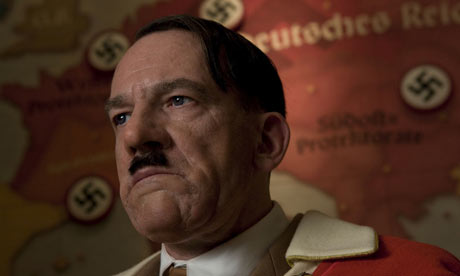 I actually wrote in my review of Valkyrie that this would have been a great way for director Bryan Singer to pay off on what I thought was a very thrilling film. However, I was sort of joking – after all, what kind of idiot would put that ending in a major motion picture? Clearly, the kind of idiot whose name is Quentin Tarantino. I should be using this moment to reiterate my belief that the man has lost all ability to self moderate. But there’s no way I’m going to do that, because, let’s face it: this ending is just too freaking awesome! What better way to surprise the audience than to go directly against one of the most well documented pieces of information in human history? And the best thing about it was how sudden it was. It literally happened in a flash, and I had to turn to the guy next to me for confirmation that what I thought had happened had actually occurred. Unfortunately, Tarantino returns to the opera box moments later to give us a close up of the Fuhrer’s face being riddled with bullets, which, in my opinion, greatly lessened the effect. But in a film filled with Jewish heroes and actors, that moment must have been the ultimate form of wish fulfilment, so I suppose I can forgive them that little indulgence.
 There is actually more to the ending of Inglourious Basterds than the ridiculous rewriting of history. And specifically, I want to address the violence in the final chapter of this film, and how for the first time in any of Tarantino’s movies, I didn’t like it. And once again, I’m going to use his other films as a point of comparison. Probably the most iconic moment of violence in any of his movies is the ear cutting scene in Reservoir Dogs. That is a scene in which all the actual violence happens off camera, but because the idea of it is so horrific, it can’t help but have a lasting effect. Jump forward to climax of Kill Bill Volume 1 (which by the way is my favourite Tarantino movie after Pulp Fiction). That film ends with a half hour sword fight in which countless limbs are severed, and hundreds of litres of blood is spilled. And yet, it is almost beautiful. That film is a piece of art; stylized and bizarre, and the bloodshed is an integral part of the compelling aesthetic. The violence in Reservoir Dogs and Kill Bill is completely different, but in both cases it has a purpose, and is effective in that purpose. Therefore, I feel it is justified.
 In the climax of Inglourious Basterds however, the violence felt a lot shallower. The build up to the ending is terrifically suspenseful – Raine has been taken hostage, the bombs are ticking, and Shoshanna’s plan is minutes from being put into action. In a moment of directorial brilliance, flames begin to engulf the theatre, and Shoshanna, her face ethereally projected through the smoke, begins to laugh. But then the bloodbath begins. The Basterds, in a ridiculously gratuitous extended sequence, burst into the theatre and start pumping round after round into the fleeing Nazi officials. As I previously stated, I’m not one to be put off by graphic violence in films when it serves a purpose, but that scene was literally like shooting fish in a barrel, and given that Tarantino has repeatedly proven that he can use violence well, the whole thing felt beneath him. I also thought the same thing about the final moments of the film, in which Raine carves a Swastika into Landas' head. It wasn’t actually a bad scene, but imagine how much better it would have been if the movie had ended just a few minutes earlier, with the line “I bet you were planning on taking off your uniform”. That’s the kind of wit I expect from Tarantino, and the fact that he felt he had to go that little bit further seems like another indication that he’s losing a handle of what works and what doesn’t.
 But at the end of the day, these are minor complaints, and all of them are outweighed by some very heavy positives. Unsurprisingly, the soundtrack is fantastic, the dialogue is pitch perfect (and often times hilarious), and opening credit sequence is totally awesome. Tarantino’s usual editor Sally Menke does a great job as always, and as I already mentioned, every member of the cast excels. The reason I haven’t addressed these things in enormous detail is because, well, it’s a Tarantino movie; of course all those things are good. And that is really what this review comes down to. Inglourious Basterds is a Tarantino movie, so of course it’s good. The man doesn’t make bad movies. He makes divisive movies, he makes bizarre movies, and one day soon, I’m afraid that he’s going to make a spectacularly awful movie. But it sure as hell isn’t Inglourious Basterds. In my introduction, I talked about how you can pay disservice to a film by comparison. And that’s what I’ve done here. Inglourious Basterds isn’t as visually impressive as Kill Bill. Nor is it as witty or well written as Reservoir Dogs or Pulp Fiction. And although it does have the directors signature throwbacks to classic films, it doesn’t have same nostalgic camp or good time fun as Grindhouse did. Ultimately I feel that Inglourious Basterds is one of Tarantino’s lesser films. But a lesser Tarantino film is still a Tarantino film. And all comparisons aside, this movie is excellent.
Inglourious Basterds is in cinemas now
LAMBScore:


