Genre: Drama, Horror
Director: Lars von Trier
Starring: Willem Dafoe, Charlotte Gainsbourg
Running Time: 104 minutes (plus trailers)
 “Chaos reigns”
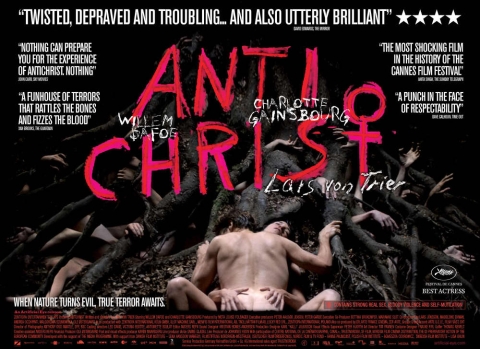
Antichrist, the new horror film from acclaimed Danish director Lars von Trier, won two awards at this year’s prestigious Cannes film festival. The first was the Best Actress award, given to Charlotte Gainsbourg for her remarkable performance as a mother driven mad by fear and anguish. The second award was a special “anti-award”, bestowed to the film by the festivals ecumenical jury along with a declaration that it was “the most misogynist movie from the self-proclaimed biggest director in the world”. Now the first award is undoubtedly deserved; whether the second one was is harder to say. The film is already infamous for its graphic scenes of sexual violence, including no less than two moments of genital mutilation. Reactions to the film have been hugely divisive, with audience members having booed, laughed, applauded and even fainted in screenings around the world. For me, Antichrist proved to be an unpleasant but undeniably captivating film; a gorgeously visceral work of art that seems to revel in the discomfort of everyone watching.
The movies prologue is absolutely stunning. Set to the reverberations of a elegant Handel aria, the five minute long sequence in shot monochromatically and in slow motion, and depicts the two nameless protagonists, played by Willem Dafoe and Charlotte Gainsbourg, fornicating passionately in their apartment. We watch mesmerized in horror as their intensity increases, whilst in the other room their infant son Nic opens his baby gate, climbs onto a window sill and falls several stories to his death. This scene will burn itself into your brain, and it also sets the films tone perfectly; harrowing visuals, pornographic sexual content and a narrative focused entirely on the misery of both its characters and the audience. Undoubtedly, von Trier plays his strongest card first.
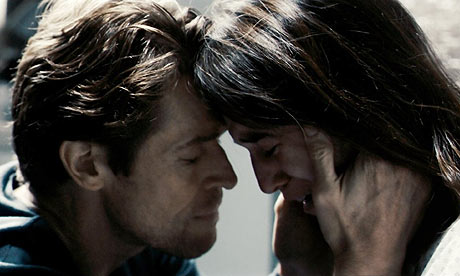
 The movie then moves into its first chapter, entitled “Grief”, wherein Gainsbourg’s character (referred to in the films credits only as “She”) suffers a mental breakdown following her son’s funeral. Her husband, “He”, a psychiatrist, decides to treat her himself and orders her to dispose of her medication. During their sessions together she tries to numb her pain with sex, but eventually he discovers that she has grown to fear the woods that surround the family cabin that she visited the previous summer with Nic. Convinced that the only way to cure her is to make her face her fear, he decides to travel with her to the cabin (named Eden of all things) and begin an intense program of exposure therapy. And as you might be able to guess, things do not go well.
With the exception of a few laughably awful individual moments, the first hour of Antichrist is within the realm of a true masterpiece. Von Trier chooses at times to abandon his Dogme method in favour of a hyper-stylized technique of film-making, crafting imagery, filled with biblical and apocalyptic omens, that is absolutely unforgettable (and some credit must go to cinematographer Anthony Dod Mantle). At other times, the director’s minimalistic style shows it strength, the hand-held camera providing many of the emotional scenes between the films only actors with an enhanced level of exposure and believability. Say what you will about his personality, I must admit that von Trier is clearly an accomplished director, and despite my apprehensions about his topic matter (which seems to rarely stray from human misery and suffering – Antichrist being no exception), I am extremely interested in exploring his body of work further (his other films include Dancer in the Dark, Dogville and Breaking the Waves).
 Moreover, the incredible psychological power of these first two chapters is unlike anything I have ever seen. Both actors do terrific work, but quite frankly Dafoe has no hope whatsoever of keep up with Gainsburg, whose raw, all encompassing and oftentimes degrading performance is a feat of the first order. Essentially, the first hour of Antichrist is an examination of grief and the human capacity to withstand it, and it is in equal parts horrifying, engrossing and intense, with a lead performance to match. Had the film maintained this level of excellence for its entire runtime it would be probably be my favourite movie of the year, and perhaps even amongst my favourite horror films of all time, on par with the likes of The Exorcist or Stanley Kubrick’s The Shining (to whose jaw dropping images Antichrist can be compared). But sadly, it just couldn’t last.
In perhaps one of the most gobsmackingly poor decisions I have ever witnessed, von Trier, starting with the beginning of chapter three (“Despair (Gynocide)”), transfers to trauma from the psychological plane to the physical, and from there the film quickly descends into what can only be described as an arthouse version of torture porn. Ironically, the thing that initially made me want to see the film (yes I’m talking about the genital mutilation - as if you weren't curious yourself) proves to be its biggest blunder. You don’t need (or want) to know the specifics of what takes place, but let it be said that it is not only unnecessarily graphic, but utterly illogical. Perhaps von Trier’s is soarrogant overconfident that he believes his film has transcended the need to follow basic narrative progression, but I can assure you that this is not the case. The sudden shift in Gainsbourg’s character is contextually ridiculously, and the only explanation we are offered as to why she acts this way is as unsubtle and clichéd as, well, your average horror film.
 But to be fair, Antichrist is still miles above your average horror film. Even when it passes this turning point, it remains as engrossing and terrifying as ever. But there is nothing more disappointing than the indefinable suddenly becoming something you can (to a degree) recognize. And what is most frustrating is that I cannot comprehend why von Trier’s chose to do this to his own film. When this movie is so psychologically brilliant, suddenly throwing in graphic violence is a massive disservice to himself, his actors, and his audience. I’m willing to give him the benefit of the doubt and assume he wanted to do more than simply shock us, but I cannot for the life of me figure out what he was trying to say. And I don’t think it’s because I missed some subtlety in the storytelling either; after all, what is subtle about a naked woman masturbating furiously on the forest floor? Honestly, the only conclusion I can come to is that this movie has no real purpose other than to be an exercise of therapy for the director himself, who was reportedly suffering from clinical depression as he wrote and directed the film.
Antichrist ends with a moment of emotional vacancy; a hollow, faceless epilogue that concludes a story of grief and pain with a message of nothing. This film, that inspired emotions ranging from wonder to repulsion to even anger, ultimately left me feeling completely emotionless. Perhaps this is von Trier’s intention, but again, I ask “why?” Part of me thinks I should have watched the movie a second time before trying to write comprehensively about it. But a much larger part of me isn’t convinced that I ever want to watch Antichrist again. With its incredible imagery and extraordinary performances, I can say with little doubt that, at least from a technical standpoint, the movie is excellent, and indeed it is a must see for anyone interesting in film-making or the workings of the human mind. For everyone else, I will simply say that Antichrist is a one of a kind film that at the very least will stick with you long after you’ve seen it. Whether you want it to is an entirely different matter.

Antichrist has played at various film festivals around the world, including the Melbourne International Film Festival. It will open in limited release in the United State on October 23rd and in Australia on November 26th

Director: Lars von Trier
Starring: Willem Dafoe, Charlotte Gainsbourg
Running Time: 104 minutes (plus trailers)
 “Chaos reigns”
Antichrist, the new horror film from acclaimed Danish director Lars von Trier, won two awards at this year’s prestigious Cannes film festival. The first was the Best Actress award, given to Charlotte Gainsbourg for her remarkable performance as a mother driven mad by fear and anguish. The second award was a special “anti-award”, bestowed to the film by the festivals ecumenical jury along with a declaration that it was “the most misogynist movie from the self-proclaimed biggest director in the world”. Now the first award is undoubtedly deserved; whether the second one was is harder to say. The film is already infamous for its graphic scenes of sexual violence, including no less than two moments of genital mutilation. Reactions to the film have been hugely divisive, with audience members having booed, laughed, applauded and even fainted in screenings around the world. For me, Antichrist proved to be an unpleasant but undeniably captivating film; a gorgeously visceral work of art that seems to revel in the discomfort of everyone watching.
The movies prologue is absolutely stunning. Set to the reverberations of a elegant Handel aria, the five minute long sequence in shot monochromatically and in slow motion, and depicts the two nameless protagonists, played by Willem Dafoe and Charlotte Gainsbourg, fornicating passionately in their apartment. We watch mesmerized in horror as their intensity increases, whilst in the other room their infant son Nic opens his baby gate, climbs onto a window sill and falls several stories to his death. This scene will burn itself into your brain, and it also sets the films tone perfectly; harrowing visuals, pornographic sexual content and a narrative focused entirely on the misery of both its characters and the audience. Undoubtedly, von Trier plays his strongest card first.
 The movie then moves into its first chapter, entitled “Grief”, wherein Gainsbourg’s character (referred to in the films credits only as “She”) suffers a mental breakdown following her son’s funeral. Her husband, “He”, a psychiatrist, decides to treat her himself and orders her to dispose of her medication. During their sessions together she tries to numb her pain with sex, but eventually he discovers that she has grown to fear the woods that surround the family cabin that she visited the previous summer with Nic. Convinced that the only way to cure her is to make her face her fear, he decides to travel with her to the cabin (named Eden of all things) and begin an intense program of exposure therapy. And as you might be able to guess, things do not go well.
With the exception of a few laughably awful individual moments, the first hour of Antichrist is within the realm of a true masterpiece. Von Trier chooses at times to abandon his Dogme method in favour of a hyper-stylized technique of film-making, crafting imagery, filled with biblical and apocalyptic omens, that is absolutely unforgettable (and some credit must go to cinematographer Anthony Dod Mantle). At other times, the director’s minimalistic style shows it strength, the hand-held camera providing many of the emotional scenes between the films only actors with an enhanced level of exposure and believability. Say what you will about his personality, I must admit that von Trier is clearly an accomplished director, and despite my apprehensions about his topic matter (which seems to rarely stray from human misery and suffering – Antichrist being no exception), I am extremely interested in exploring his body of work further (his other films include Dancer in the Dark, Dogville and Breaking the Waves).
 Moreover, the incredible psychological power of these first two chapters is unlike anything I have ever seen. Both actors do terrific work, but quite frankly Dafoe has no hope whatsoever of keep up with Gainsburg, whose raw, all encompassing and oftentimes degrading performance is a feat of the first order. Essentially, the first hour of Antichrist is an examination of grief and the human capacity to withstand it, and it is in equal parts horrifying, engrossing and intense, with a lead performance to match. Had the film maintained this level of excellence for its entire runtime it would be probably be my favourite movie of the year, and perhaps even amongst my favourite horror films of all time, on par with the likes of The Exorcist or Stanley Kubrick’s The Shining (to whose jaw dropping images Antichrist can be compared). But sadly, it just couldn’t last.
In perhaps one of the most gobsmackingly poor decisions I have ever witnessed, von Trier, starting with the beginning of chapter three (“Despair (Gynocide)”), transfers to trauma from the psychological plane to the physical, and from there the film quickly descends into what can only be described as an arthouse version of torture porn. Ironically, the thing that initially made me want to see the film (yes I’m talking about the genital mutilation - as if you weren't curious yourself) proves to be its biggest blunder. You don’t need (or want) to know the specifics of what takes place, but let it be said that it is not only unnecessarily graphic, but utterly illogical. Perhaps von Trier’s is so
 But to be fair, Antichrist is still miles above your average horror film. Even when it passes this turning point, it remains as engrossing and terrifying as ever. But there is nothing more disappointing than the indefinable suddenly becoming something you can (to a degree) recognize. And what is most frustrating is that I cannot comprehend why von Trier’s chose to do this to his own film. When this movie is so psychologically brilliant, suddenly throwing in graphic violence is a massive disservice to himself, his actors, and his audience. I’m willing to give him the benefit of the doubt and assume he wanted to do more than simply shock us, but I cannot for the life of me figure out what he was trying to say. And I don’t think it’s because I missed some subtlety in the storytelling either; after all, what is subtle about a naked woman masturbating furiously on the forest floor? Honestly, the only conclusion I can come to is that this movie has no real purpose other than to be an exercise of therapy for the director himself, who was reportedly suffering from clinical depression as he wrote and directed the film.
Antichrist ends with a moment of emotional vacancy; a hollow, faceless epilogue that concludes a story of grief and pain with a message of nothing. This film, that inspired emotions ranging from wonder to repulsion to even anger, ultimately left me feeling completely emotionless. Perhaps this is von Trier’s intention, but again, I ask “why?” Part of me thinks I should have watched the movie a second time before trying to write comprehensively about it. But a much larger part of me isn’t convinced that I ever want to watch Antichrist again. With its incredible imagery and extraordinary performances, I can say with little doubt that, at least from a technical standpoint, the movie is excellent, and indeed it is a must see for anyone interesting in film-making or the workings of the human mind. For everyone else, I will simply say that Antichrist is a one of a kind film that at the very least will stick with you long after you’ve seen it. Whether you want it to is an entirely different matter.

Antichrist has played at various film festivals around the world, including the Melbourne International Film Festival. It will open in limited release in the United State on October 23rd and in Australia on November 26th


