Running Time: 121 minutes
Australian Release Date: 28 October 2010
Review by Tom Clift
 While it was his frenetic visual style that made Fight Club one of the definitive pictures of the nineteen-nineties, recent years have seen David Fincher take on an increasingly controlled and reflective approach to movie-making. His latest undertaking – a follow-up to the Academy Award nominated The Curious Case of Benjamin Button – is The Social Network, an enthralling tale of betrayal and intellectual property theft based loosely on the real life founding of the massively popular internet website, Facebook. Adapted from perhaps one of the best scripts in living memory by West Wing scribe Aaron Sorkin, the movie is a stunningly absorbing and superbly acted drama with a flawless pace and mesmerizing aesthetic. It is a film that offers a brutal critique of one of its most influential figures of the internet age, and one that sees Fincher’s evolution as both a storyteller and an artist come magnificently to a head.
The Social Network is definitely Fincher’s most subdued film to date, especially from a visual standpoint. The overt technical wizardry that shook the celluloid in Fight Club is all but gone, replaced by a steady and restrained technique that is never-the-less every bit as exhilarating as any of his previous efforts. The cinematography is meticulous; cold and strikingly dark, reflecting the scrupulous inner workings of Facebook founder Mark Zuckerberg’s psyche. Likewise, the fantastic score from Atticus Ross and Nine Inch Nails front-man Trent Reznor (the first motion picture project undertaken by the latter) is perfectly in tune with the impatient potential and emotional frailties of the films various characters. Through a combination of electronic beats and humming strings mixed with simple, vulnerable piano chords, Reznor and Ross have crafted a soundtrack that is simultaneously edgy, urgent and ethereally beautiful.
Naturally Fincher has not abandoned his toys entirely; for example, a particularly memorable college rowing sequence utilizes sharp and soft photography set to a hyper-synthesized rendition of In the Hall of the Mountain King, the result of which is so potent that it threatens to burst and crackle from the screen. For the most part however, Fincher wisely chooses to rein himself in, letting the narrative, rather than his camera, provide the thrills. And what a thrilling narrative it is – Sorkin uses two lawsuits that the Facebook CEO finds himself embroiled in to frame the story, setting a majority of the action in flashbacks as we witness the birth of a social phenomenon from a dorm-room at Harvard University. A year ago, no one could have foreseen that “the Facebook movie”, as it was derisively referred to by film fans around the globe, would be one of the most gripping, entertaining and insightful movies of 2010. Yet that is exactly what it is.
At the centre of the film is a trio of young male actors, each of whom deliver potentially career making performances. Andrew Garfield provides the story with much of its emotional core and is absolutely phenomenal as Zuckerberg’s best friend and Facebook co-founder Eduardo Saverin, while Justin Timberlake (in an ironic piece of meta casting) plays Napster founder Sean Parker; the pop-star turned actor capturing perfectly the arrogance of the twenty-first century entrepreneur. Most compelling of all is Jesse Eisenberg as Zuckerberg, whose work here is nothing short of a revelation. The Facebook CEO as portrayed by Eisenberg is a character for the ages; quick witted, abrasive, socially inept and unexpectedly ruthless – essentially every characteristic we would associate a youth who makes a life for himself online. Eisenberg deserves every accolade, including the Academy Award for Best Actor, for a performance that represents the bile of an entire generation, yet never once breaches the borders of disbelief.
It also helps that Eisenberg and company are working from what I consider one of the best written scripts in decades. From the opening scene to the closing credits, Sorkins dialogue is rapid-fire and razor-sharp, and is delivered with the kind of blithe sarcasm and detached irony that is characteristic of internet users all around the world – albeit ones several hundred times more witty than the likes of you or I. The characters in this film talk and argue with a fluency that real people can only dream of, producing some of the most inspired one-liners and devastating comebacks you will ever hear. On a personal note, as a writer, the impeccable structure and seemingly effortless expression of this screenplay is both awe-inspiring and wholly depressing; Sorkin exhibits a level of eloquence here that seems all but unattainable.
Of course eloquence only counts for so much, and the fact that Sorkins screenplay is based on a book – Ben Mezerich’s The Accidental Billionaires – known to be rife with factual inaccuracies adds a troubling undercurrent to the entire production. Many Facebook staffers including Zuckerberg himself have come out in protest of both the book and the film, and while the movie never technically claims to be accurate, I can certainly understand why Zuckerberg would be upset by his fictional character biography as depicted in The Social Network – in a movie populated almost entirely by unlikeable characters, Zuckerberg comes across as the most selfish, misogynistic and petty-minded of them all. There is certainly an interesting moral debate to be had on this issue – if the screenwriter and director are going to be using the real names and events, should they be beholden to the facts, or should creating a good story be their only aim?
Regardless of how accurate the film is, there can be no doubt that in creating a good story at least, Fincher and Sorkin have more than succeeded. The Social Network transcends the realm of movie based on true events; it is a masterpiece of modern screenwriting, a veritable acting clinic and a maturely made and subtly gorgeous aural and visual experience. It is also one of the most discerning movies yet made in and about the internet era. David Fincher ended the nineteen-nineties by producing one of its most important films; with The Social Network, he has started the twenty-tens in a similar fashion.

Australian Release Date: 28 October 2010
Review by Tom Clift
 While it was his frenetic visual style that made Fight Club one of the definitive pictures of the nineteen-nineties, recent years have seen David Fincher take on an increasingly controlled and reflective approach to movie-making. His latest undertaking – a follow-up to the Academy Award nominated The Curious Case of Benjamin Button – is The Social Network, an enthralling tale of betrayal and intellectual property theft based loosely on the real life founding of the massively popular internet website, Facebook. Adapted from perhaps one of the best scripts in living memory by West Wing scribe Aaron Sorkin, the movie is a stunningly absorbing and superbly acted drama with a flawless pace and mesmerizing aesthetic. It is a film that offers a brutal critique of one of its most influential figures of the internet age, and one that sees Fincher’s evolution as both a storyteller and an artist come magnificently to a head.
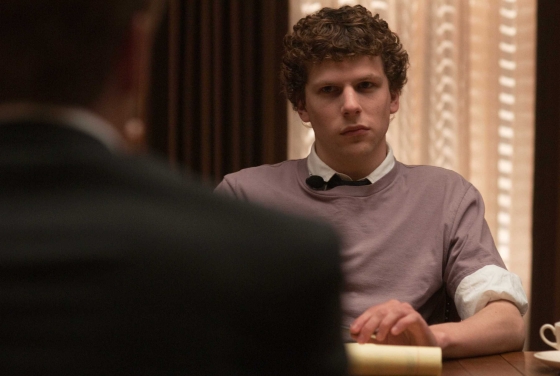
The Social Network is definitely Fincher’s most subdued film to date, especially from a visual standpoint. The overt technical wizardry that shook the celluloid in Fight Club is all but gone, replaced by a steady and restrained technique that is never-the-less every bit as exhilarating as any of his previous efforts. The cinematography is meticulous; cold and strikingly dark, reflecting the scrupulous inner workings of Facebook founder Mark Zuckerberg’s psyche. Likewise, the fantastic score from Atticus Ross and Nine Inch Nails front-man Trent Reznor (the first motion picture project undertaken by the latter) is perfectly in tune with the impatient potential and emotional frailties of the films various characters. Through a combination of electronic beats and humming strings mixed with simple, vulnerable piano chords, Reznor and Ross have crafted a soundtrack that is simultaneously edgy, urgent and ethereally beautiful.
Naturally Fincher has not abandoned his toys entirely; for example, a particularly memorable college rowing sequence utilizes sharp and soft photography set to a hyper-synthesized rendition of In the Hall of the Mountain King, the result of which is so potent that it threatens to burst and crackle from the screen. For the most part however, Fincher wisely chooses to rein himself in, letting the narrative, rather than his camera, provide the thrills. And what a thrilling narrative it is – Sorkin uses two lawsuits that the Facebook CEO finds himself embroiled in to frame the story, setting a majority of the action in flashbacks as we witness the birth of a social phenomenon from a dorm-room at Harvard University. A year ago, no one could have foreseen that “the Facebook movie”, as it was derisively referred to by film fans around the globe, would be one of the most gripping, entertaining and insightful movies of 2010. Yet that is exactly what it is.
At the centre of the film is a trio of young male actors, each of whom deliver potentially career making performances. Andrew Garfield provides the story with much of its emotional core and is absolutely phenomenal as Zuckerberg’s best friend and Facebook co-founder Eduardo Saverin, while Justin Timberlake (in an ironic piece of meta casting) plays Napster founder Sean Parker; the pop-star turned actor capturing perfectly the arrogance of the twenty-first century entrepreneur. Most compelling of all is Jesse Eisenberg as Zuckerberg, whose work here is nothing short of a revelation. The Facebook CEO as portrayed by Eisenberg is a character for the ages; quick witted, abrasive, socially inept and unexpectedly ruthless – essentially every characteristic we would associate a youth who makes a life for himself online. Eisenberg deserves every accolade, including the Academy Award for Best Actor, for a performance that represents the bile of an entire generation, yet never once breaches the borders of disbelief.
It also helps that Eisenberg and company are working from what I consider one of the best written scripts in decades. From the opening scene to the closing credits, Sorkins dialogue is rapid-fire and razor-sharp, and is delivered with the kind of blithe sarcasm and detached irony that is characteristic of internet users all around the world – albeit ones several hundred times more witty than the likes of you or I. The characters in this film talk and argue with a fluency that real people can only dream of, producing some of the most inspired one-liners and devastating comebacks you will ever hear. On a personal note, as a writer, the impeccable structure and seemingly effortless expression of this screenplay is both awe-inspiring and wholly depressing; Sorkin exhibits a level of eloquence here that seems all but unattainable.
Of course eloquence only counts for so much, and the fact that Sorkins screenplay is based on a book – Ben Mezerich’s The Accidental Billionaires – known to be rife with factual inaccuracies adds a troubling undercurrent to the entire production. Many Facebook staffers including Zuckerberg himself have come out in protest of both the book and the film, and while the movie never technically claims to be accurate, I can certainly understand why Zuckerberg would be upset by his fictional character biography as depicted in The Social Network – in a movie populated almost entirely by unlikeable characters, Zuckerberg comes across as the most selfish, misogynistic and petty-minded of them all. There is certainly an interesting moral debate to be had on this issue – if the screenwriter and director are going to be using the real names and events, should they be beholden to the facts, or should creating a good story be their only aim?
Regardless of how accurate the film is, there can be no doubt that in creating a good story at least, Fincher and Sorkin have more than succeeded. The Social Network transcends the realm of movie based on true events; it is a masterpiece of modern screenwriting, a veritable acting clinic and a maturely made and subtly gorgeous aural and visual experience. It is also one of the most discerning movies yet made in and about the internet era. David Fincher ended the nineteen-nineties by producing one of its most important films; with The Social Network, he has started the twenty-tens in a similar fashion.


