Showing posts with label 1001 Movie Club. Show all posts

Saturday, February 27, 2010

1001 Movies You Must See Before You Die: "Naked Lunch" (1991)

The 1001 Movie Club is a conglomerate of film bloggers inspired by the phenomenal book 1001 Movies You Must See Before You Die, the title of which is fairly self explanatory. A tome of cinematic information and recommendation, it is a bible for movie buffs, and the 1001 Movie Club is made up of people dedicated to watching and reviewing the acclaimed films that can be found within its pages. Be sure to visit the club’s site where the reviews will be collected and an aggregate score bestowed, and if you are so inclined, feel free to join in on the fun.

NAKED LUNCH (1991)
Genre: Mystery, Science Fiction
Director: David Cronenberg
Starring: Peter Weller, Judy Davis, Ian Holm, Julian Sands, Roy Scheider
Running Time: 115 minutes (plus trailers)

"Exterminate all rational thought"

Canadian film-maker David Cronenberg is no stranger to the visceral and the bizarre. A landmark science fiction and horror director, his films often deal with graphic bodily transformation – in The Fly we witness Jeff Goldblums slow transformation into a hideous mutant fly, whilst Videodrome sees James Wood’s abdomen give way to a bloody cavity halfway between a vagina and a VCR. Cronenbergs obsession with metamorphosis is just as apparent in Naked Lunch, part biography of author William S. Burrows and part adaptation of his controversial novel with which the film shares its title. To try and explain the plot would be as difficult as it would be pointless; the film is a hallucinatory experience that is either a sci-fi detective story, a metaphor for homosexual repression or, most likely, the drug induced fantasy of its central character.

The movie seems to begin with a bug exterminator, William Lee, who accidentally murders his wife and flees the country. But whilst there is some semblance of normality in this initial premise, the story soon descends into an indecipherable blend of giant insects, domineering German housekeepers, lesbian drug cabals and sexually promiscuous typewriters all mixed together with a great deal of fluid. There was not a single moment in the film, save for perhaps the first seven or eight minutes that I was not in a state of utter confusion. But it was an interested confusion, and whilst I had no better understanding of the film after watching it than I did before it began, I certainly don’t regret checking it out.
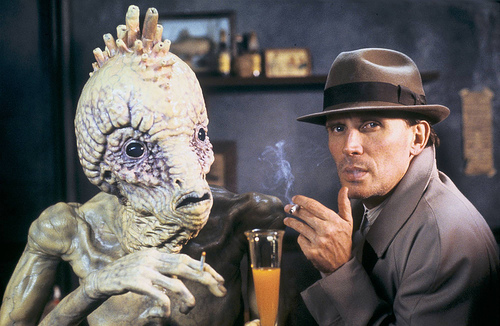
The most impressive aspect of Naked Lunch is it’s visuals; Cronenbergs use of uncomfortably real looking puppetry and make-up effects, as well as stylish costume and set deisgn help to create a genuine sense of location, whether that location be noir-ish New York City, the Arabic inspired Interzone or an enormous parrot cage in which a gigantic centipede copulates with a helpless human victim before ripping his face off with its razor sharp legs.

Did I mention this movie was weird?

Peter Weller gives a great performance as Lee, a man in a constant state of bewilderment, but who nevertheless possesses a hard boiled charm that makes him a great protagonist to watch. The other big highlight is the freeform saxophone score from Howard Shore and Ornette Coleman, a great collection of riffs that match the seemingly improvisational nature of the plot itself.

The actions of the characters (both human and insect) never much sense to me, and the final reveal, which may have been intended as a shocking twist barely registers given all the narrative gibberish that came before it. But while the story is baffling (and largely unsatisfying as a result), the tantalizing mystery aspects, impressive practical effects, excellent lead performance and jazzy score make Naked Lunch an interesting film to watch, even if you have no idea what it is you are watching. And at the very least, it probably features the most emotionally effective monologue delivered about a talking arsehole that you will ever hear.

Score
7/10

So does it deserve to be in the book?
It deserves to be in a book; whether it’s this one I’m not sure. I think it’s interesting enough to qualify as a movie worth seeing, but I don’t know if anyone needs to see it before they kick the bucket. And I know that many of the clubs other members actively wish they hadn't; check out everyone elses take on Naked Lunch here.


Large Association of Movie Blogs

Sunday, January 31, 2010

1001 Movies You Must See Before You Die: "Deliverance" (1972)

The 1001 Movie Club is a conglomerate of film bloggers inspired by the phenomenal book 1001 Movies You Must See Before You Die, the title of which is fairly self explanatory. A tome of cinematic information and recommendation, it is a bible for movie buffs, and the 1001 Movie Club is made up of people dedicated to watching and reviewing the acclaimed films that can be found within its pages. Be sure to visit the club’s site where the reviews will be collected and an aggregate score bestowed, and if you are so inclined, feel free to join in on the fun.

DELIVERANCE (1972)
Genre: Drama
Director: John Boorman
Starring: Jon Voight, Burt Reynolds, Ned Beatty, Ronny Cox
Running Time: 109 minutes

"Insurance? I never been insured in my life. There's no risk"

John Boorman’s infamous film Deliverance tells the story of four white collar workers who find themselves fighting for their lives about being attack on a caning trip by a couple of vicious hillbillies. It’s a frightening film, but it’s not a horror movie. It’s a tense film, but it’s not really a thriller either. It even has elements of unpleasant humour, but it is most certainly not a comedy. I've classified it above as a drama, but even that broad term somehow fails to do it justice. A tale of violence, cowardice and compromise, Deliverance is almost impossible to summarize; the best I can do is to call it a brutally human story about evil and mans reaction when faced with it.

I thought Deliverance was a very good film, despite the fact that it often seemed rather dated. The acting isn’t all that great and the sound quality (at least on my copy of the film) was very poor. But it is the actions of the characters in the film that make it so engrossing. We watch as these normal men do things they would never normally do; as they compromise their morals in order to cope with their horrific situation, we find ourselves wondering if we would do the same. One complaint I do have of the film is that it’s not long enough; we see them make these choices, but I would have liked to see the lasting effect their guilt has on them, something that is only hinted at in the movies haunting final scene.

The other terrific thing about the film is a mood it is able to maintain, something that I credit to two major aspects of the production. First we have the setting. The gorgeous yet isolated Georgian woods seem fraught with peril even when there is none; as the unsuspecting travelers made their way down the river, I was reminded of many a Vietnam War films, and could sense the danger lurking in the tree. The other thing that one must mention when discussing the film is the music; the use of banjo, particularly in the iconic main theme, is both farcical and terrifying; sometimes laconic and other times frenzied, a tense and creepy yet incredibly catchy set of chords that can signify violence, fear or any number of other emotions. For such a minimalistic score, it is bizarre how effective it is.

I am always fascinated by Lord of the Flies style story; about the depths that men will sink to when cut off from society. I mentioned how Deliverance reminded me of Vietnam War films; personally, I think it would make an excellent double feature with Michael Cimino’s The Deer Hunter, as both films lay bare a brutal and terrifying side of human behavior. Cimino’s movie definitely benefits from far better performances; the expression of fear on DeNiro’s face is far more palpable that on Voight’s. Even so, Deliverance is a film that should be sought out. I do want to clarify; I’ve talked about the compromising of morals a lot of this review. Just to be clear, the actions of the hillbillies are obviously horrific. But personally, I had far more questions of the victims than I did of the perpetrators by the time the end credits roled.

Score
8/10

So does it deserve to be in the book?
Yes. Honestly, it's not like any film I've ever really seen. From a production standpoint it's far from perfect, but the question it raises for me make me suspect that I will be pondering it for a very long time.

Check out what the rest of the club thinks of Deliverance here.


Large Association of Movie Blogs

Tuesday, December 1, 2009

1001 Movies You Must See Before You Die: "Requiem for a Dream" (2000)

The 1001 Movie Club is a conglomerate of film bloggers inspired by the phenomenal book 1001 Movies You Must See Before You Die, the title of which is fairly self explanatory. A tome of cinematic information and recommendation, it is a bible for movie buffs, and over the next few days, myself and the other members of the club will be reviewing four of the acclaimed films that can be found within its pages. Be sure to visit the club’s site where the reviews will be collected and an aggregate score bestowed, and if you are so inclined, feel free to join in on the fun.

REQUIEM FOR A DREAM (2000)
Genre: Drama
Director: Darren Aronofsky
Starring: Jared Leto, Ellen Burstyn, Jennifer Connelly, Marlon Wayans, Christopher McDonald
Running Time: 102 minutes

Based on the 1978 novel of the same name, Darren Aronofsky’s follow up to his debut feature Pi is a dark and distressing tale about the perils of addiction, and is undoubtedly one of the most visually and aurally distinctive films of the past decade. Requiem for a Dream follows four Coney Islanders – Harry, his girlfriend Marion, best friend Tyrone and mother Sara – over three seasons – summer, fall and winter – as they attempt to live with their addictions before finally being overwhelmed by the unforeseen yet inevitable consequences of their decisions. Dealing with themes of desperation, delusion, selfishness and human weakness, Requiem for a Dream is at times unflinchingly bleak; it’s depiction of the horrors of drug use will put you on the straight and narrow faster than any afterschool special. In all honestly, it may well be one of the most depressing movies ever made. It is also one of the best.

The movie opens with Harry stealing his mother television set so that he can afford to buy heroin. As we soon come to understand this is not the first time this has occurred, with even the pawnbroker from whom Sara is forced to buy back her set time and time again advising her to go to the police. But of course she does not. This is Requiem in a nutshell; a vicious cycle in which desperation causes people to turn on those they love just to feed their habit. Harry and Tyrone decide to go into the drug trade, with Harry planning to use his share of the profits to help Marion start up her own fashion store. But with the three junkies burning quickly through their own supply, it’s not long before the seasons begin to turn for the young entrepreneurs and they find themselves going to more and more desperate lengths to find a fix.

Leto, Connelly and Wayans as Harry, Marion and Tyrone respectively all give career best performances as the three young heroin addicts. But they are all of them overshadowed by Ellen Burstyn as Harry aging mother Sara, a lonely widow with an addiction of a very different kind. Spending her days watching infomercials and talking to her dead husband Seymour, Sara’s life is changed dramatically when she gets a phone call telling her she “has already won”. Now with the chance to appear on television herself, Sara decides to start taking diet pills and quickly becomes lost in a terrifying world of hallucinations. Burstyn’s characterization of Sara will break your heart. The scene in which Harry comes to visit her and she explains that the television and the red dress give her “a reason to get up in the morning” is one of the finest pieces of acting I have ever seen.

Of course that scene is also notable for its distinctive lack of cuts and edits, something that is certainly atypical for this film. Aronofsky’s directorial approach in Requiem is unique; extreme close ups, split screen, time lapse, smash cuts and frantic split second editing all give the viewer the sensation of “pushing off” with the films characters. The obvious similarities between Harry and Tyrone’s heroin use and Sara’s addiction to television are highlighted by similarities in the editing and sound effects when, as they reach for the needle, she reaches for the remote. And of course, Clint Mansell mesmerizing score is probably one of the most recognizable film scores ever written, and its presence in the film always indicates that tragedy is just around the corner. On top of the moving story and the magnificent acting, Requiem for a Dream is a full blown sensory experience, and will leave viewers disoriented and afraid. Having never used hard drugs I cannot say how well the film replicates heroin use, but along with maybe Trainspotting, Requiem for a Dream is the most frightening depiction of drug use I have ever seen.

As I’ve said, this might be one of the most despairing films ever made. Aside from the tragedies that befall the four lead characters, the movie is filled with selfish, parasitic minor characters who represent the absolute worst of human behavior. The doctor who prescribes Sara her weight loss pills without even looking up from his clipboard (and the cynical irony of the line “I can see you’re a little overweight”). The pimp who tells Marion will foul certainty that he will “see you Sunday” after he humiliates her by trading drugs for oral sex. Even the friendly Mr. Rabinowitz, sympathetic to Sara, is not above purchasing her stolen television and then selling it back to her at an inflated price. Finally there is what I cite as one of the most telling moments in the entire film, when a doctor, after examining Harry’s arm which has become severely infected from incorrect needle technique, chooses to hide the narcotics in his office and call the police. This is not a film where people help each other.

The worst thing of all is that none of the main characters are bad people. As is made very clear early in the film, Harry and Marion truly love each, and make plans for a bright future, and while even though Harry does steal from his mother, he always tries to make it up to her. But the problem is that he and all of the others are weak, and none of them are ever willing to take responsibility. Marion begs Harry to let her get high of of their working drug load, and then blames him when they don’t have any the next day; of course, his only response is that how he could he be expected to watch her shoot up and not push off himself? Sara chooses rather than to stick with her diet to take drugs, and Harry, after visiting her and witnessing her near emotional breakdown, does what? Does he stay and comfort her, or try and get her off the pills? No. Instead he shoots up in the back of a cab, and spends the ride home blank faced and hollow eyed. No, these are not evil people. What they are is weak and selfish, and this is what destroys them.

As the story reaches its climax, the editing becomes faster and faster, cutting between images more and more brutal, before Harry finally disappears into a dream. What then follows is one of the best sequences ever put to film. The final montage, in which each of the characters curls up into the fetal position before Sara finally gets her moment on stage, is as close to emotional perfection as any film has ever gotten. You cannot watch the end of Requiem for a Dream and then just move on with you life; this movie will leave you devastated. I love stylish film making, and along with Fight Club and Eternal Sunshine of the Spotless Mind, I would put Requiem up there as a movie I could watch once a day just to appreciate what Aronofsky does with the camera. But if I ever tried, I have no doubt that I would slit my wrists before the week was out. Never the less, Requiem for a Dream is one of the most effective, powerful and impressive movies of the modern era.

Score
10/10

So does it deserve to be in the book?
Without question. Not only is it, I feel, one of the best movies ever made, it is also a hullucinatory experience unlike no other. There are so many aspects of the film that make it brilliant; the acting, the direction and of course the story itself. The is one of the most important films you will ever see.


Large Association of Movie Blogs

Please note: seeing as my copy of Raising Arizona did not arrive in time, I will not be reviewing it. Thus this ends my commitment this month to the 1001 Movie Club. I hope you have enjoyed reading my reviews and I encourage you to check out the other members of the club for some different perspectives.

1001 Movies You Must See Before You Die: "Vampyr" (1932)

The 1001 Movie Club is a conglomerate of film bloggers inspired by the phenomenal book 1001 Movies You Must See Before You Die, the title of which is fairly self explanatory. A tome of cinematic information and recommendation, it is a bible for movie buffs, and over the next four days, myself and the other members of the club will be reviewing four of the acclaimed films that can be found within its pages. Be sure to visit the club’s site where the reviews will be collected and an aggregate score bestowed, and if you are so inclined, feel free to join in on the fun.

VAMPYR (1932)
Genre: Horror
Director: Carl Theodor Dreyer
Starring: Julian West, Rena Mandel, Sybille Schmitz, Jan Hieronimko, Maurice Schutz, Albert Bras
Running Time: 83 minutes

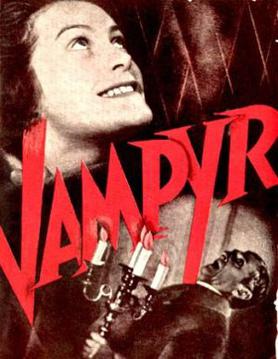
Released in 1932 and directed by beloved Danish director Carl Theodor Dreyer, Vampyr is an early filmic telling of the legend of vampires. The film is a mystical, nightmarish tale that follows a student of the occult, Alan Gray, who is drawn to a small village in France that is plagued by one of the eponymous beasts. Originally intended as a silent movie, Vampyr eventually became Dreyer’s first feature to incorporate sound, and so the film provides contemporary audiences with both a fascinating look at the early vampire myth, as well as an insight into the attempts of a critically acclaimed director to explore an entirely new medium of storytelling, albeit with only limited success.

While I had never seen a Dreyer film before, his reputation as one of the greatest directors of all time preceded him, and upon diving into this movie I could certainly understand how his had garnered this praise. Vampyr is, visually, a very well made film; the mysterious dancing shadows cast on a wall without owners, the expression on the face of a newly transformed vampire as she gazes hungrily at her sister, and the villain’s final and somewhat bizarre demise suffocating in a flour mill are just a few of the highlights of the film, whilst then extended nightmare sequence in which Alan Gray dreams of being buried alive is so creepy and unsettling, and filmed in such a masterful way, that it is impressive even by today’s standards of film making. The cinematography is often slightly blurred or unfocused, giving the entire picture a dreamlike quality that keep the audience in a perpetual state of disquiet. Admittedly, the films actual story is quite weak and slow moving, but Dreyer puts more than enough on screen to keep a dedicated viewer compelled.

However, whilst the film is visually striking, Dreyer’s use of sound leaves far more to be desired. Vampyr was the directors’ first foray into sound features, and unfortunately it is indicative of a filmmaker who was either unwilling or unsure of how to fully utilize the new technology. The movie still makes use of title cards, a special effect usually reserved for silent features, and the dialogue is sparse and largely uninspired. What’s more, the film was original recorded in English, French and German (although only the German print remains) and so what dialogue there is was redubbed, which only further detracts from the already wooden performances from the cast of non-actors – the acting from the film’s star (and interestingly, producer) Nicolas de Gunzburg (credited as Julian West) was particularly poor. To give Dreyer credit, in contrast to the dialogue, the use of eerie background music is very absorbing, and the absence of the score in certain key scenes adds enormously to the films tension. But overall, as the movie unfolded, I couldn’t help but think that it would have worked far better as a silent feature, where Dreyer’s legendary skills as a visual artist would not have been hampered by his somewhat amateurish attempts to cross over into the world of sound.

Perhaps the most interesting thing about this film from the modern perspective is seeing an earlier take on the vampire mythos. With the popularity of vampires in contemporary entertainment at an all times high, it is somewhat ironic that this film was itself inspired by the rousing success of theatrical productions of Dracula in the late 1920’s; apparently blood suckers never go out of style. But while today’s creatures of the night are of the more brooding, sparkling variety, vampires in Dreyer’s film are the bodies and souls of the dead who on the full moon rise from the grave and feast on the blood of children. Some aspects remain the same, such as the transformative powers of the vampires bite, but the only way to kill these demons is a stake through the heart, not of wood but of iron, tying them to their graves forever. Additionally, the seductive, sexualized undertones of the vampire legend can be seen even in this film, and whilst Dreyer’s was by no means the first vampire movie, it is still fascinating to see how the mythology has evolved since this film’s release.

On its initial release, Vampyr was met with a largely negative public and critical reception, and it took Dreyer a full eleven years before attempting to make another film. It seems that the films ethereal visual style and surreal, slow moving story made it largely inaccessible to audiences of the time, and to be honest the same will probably be true of most modern viewers. From my own point of view, the film held my interest not because of it’s story or even its style, but because of my own interest in cinematic technique and history, and so there is probably little to be found here unless you hold those same interests. Likewise, although the film does provide an interesting perspective on vampires, it seems unlikely to me that anyone who is a fan of the modern day equivalent would find any enjoyment in Dreyer’s work. Sorry ladies; these vampires don’t sparkle.

Score
5/10

So does it deserve to be in the book?
I would say yes, less as a movie but more as a historical document. I didn't find it to be a particuarly memorable viewing experience, but I can certainly appreciate it as an important entry into a sub genre of horror films that continues to fascinate moviegoers even today. I am usually very wary of giving older films a 'free pass' simply because they're old, but Vampyr, despite it's flaws, earns it's place.


Large Association of Movie Blogs

Sunday, November 29, 2009

1001 Movies You Must See Before You Die: "The Apartment" (1960)

The 1001 Movie Club is a conglomerate of film bloggers inspired by the phenomenal book 1001 Movies You Must See Before You Die, the title of which is fairly self explanatory. A tome of cinematic information and recommendation, it is a bible for movie buffs, and over the next four days, myself and the other members of the club will be reviewing four of the acclaimed films that can be found within its pages. Be sure to visit the club’s site where the reviews will be collected and an aggregate score bestowed, and if you are so inclined, feel free to join in on the fun.

THE APARTMENT (1960)
Genre: Comedy, Drama
Director: Billy Wilder
Starring: Jack Lemmon, Shirley MacLaine, Fred MacMurray, Jack Kruschen
Running Time: 125 minutes

Winner of five Academy Awards including Best Picture, Billy Wilder’s The Apartment tells the story of C.C. Baxter (played by beloved Hollywood leading man Jack Lemmon). A low level employee at a New York City insurance firm, Baxter has put his career on the fast track by lending out the key to his apartment to his superiors so that they can go about their extra-marital activities without fear of being caught by their significant others. Unfortunately for Baxter, this arrangement often leaves him without a place to sleep, and is ruining his reputation with his neighbours. To make matters worse, one of the women being wooed in his apartment is Fran, the elevator operator from his work with whom Baxter is smitten.

The Apartment spends most of its first half as a comedy, following poor Baxter as he attempts to juggle his various “appointments” whilst trying to woo Fran and get ahead in the workplace. But in the second half the film changes tone, morphing into a drama about love and dependence. The best thing about The Apartment is the way that is moves so gracefully between genres, and uses humour to tackle weighty issues such as suicide, adultery and relationships, giving the picture far more depth than it might at first appear.

Fran (played by Shirley MacLaines) initially seems like your typical sassy leading lady, quick tongued and very pretty. But in a stunning scene in a Chinese restaurant, she is revealed as a real life character, foolish and vulnerable, carrying on her affair with the sleazy Mr. Sheldrake despite knowing that he will never leave his wife. Likewise, Baxter may seem like sympathetic schmuck who just wants to please everyone, but ultimately he is also a man unwilling to take responsibility for his actions, choosing instead to play along and get ahead rather than stand up and fight for what he truly wants.

Those of you who have heard me on the LAMBcast will know that I am by no means a Billy Wilder expert, but his direction here truly is first rate, and the black and white cinematography is gorgeous (fun piece of trivia, this was the last Best Picture winner to be shot entirely in black and white). That being said, if it wasn’t shot in black and white, one could easily mistake The Apartment as a contemporary film, as it deals with its subject matter with surprising frankness. (there was probably only one moment in the entire movie, involving Baxter going through Fran’s personal file, that seemed dated). The script is very well written, with Lemmon delivering his lines, especially the comedic ones, with perfect timing.

Honestly though, I don’t consider The Apartment to be anything that remarkable. It’s a very solid film, with strong performances and some excellent dialogue, but it never really captivated me. It’s not that I didn’t like it, but I probably would never have picked it as a Best Picture winner had I not already known. I’d recommend the movie to anyone who thinks it sounds interesting, but don’t expect it to change your life

Score
7/10

So does it deserve to be in the book?
I think most of the club members will disagree with me, but I have to say no. It’s a good film, but it struck no particular resonance with me. I’m sure I’ll watch it again at some point and maybe I’ll have newfound appreciation for it, but until then I wouldn’t consider The Apartment a movie I had to see before I died.


Large Association of Movie Blogs