Showing posts with label 3½ Stars. Show all posts

Saturday, November 20, 2010

Movie Review - Harry Potter and the Deathly Hallows Part 1


Director David Yates has been at the reigns of the Harry Potter series since 2007’s Order of the Phoenix, and for my money has been responsible for the drastic rise in quality the movies have experienced since then. Matching the increasingly mature themes found in Rowling later books, the Yates films have featured chilling visuals, gripping action, and have facilitated the evolution of stars Radcliffe, Watson and Grint from cringe-worthy children reading scripts to genuine dramatic performers. With last year’s Harry Potter and the Half Blood Prince, Yates delivered far and above the best film of the lot, scored Academy Award nominations for the pictures beautiful cinematography and visual effects, and set the stage for the long awaited two part finale: Harry Potter and the Deathly Hallows.

While this franchise has long since departed from the wheelhouse of children’s movies, Deathly Hallows Part 1 is the film that moves the series into truly adult terrain. From the opening scene, the story dives headfirst into allegories of fascism, racism and oppression, as our heroes find themselves out of school and on the run, pursued by a hostile Ministry of Magic now controlled by the malevolent forces of the evil Lord Voldemort. The films dark and haunting composition, every bit as evocative as the previous film, is punctuated by moments of frantic and often brutal action. Yates also never shies away from depicting the consequences of the violence, leading to some very upsetting and effective moments of bloodshed.

The biggest problem with Deathly Hallows Part 1 is the same problem that plagued the first half of the book. Without the iconic setting that is Hogwarts School of Witchcraft and Wizardry, the stories pacing, especially after the opening act, is extremely uneven. Character spend a large amount of time camping in the woods, moving formulaically from one location to another as they attempt to locate and destroy the remaining fragments of Voldemort’s soul. The absence of Hogwarts also means that the screen-time of some of the franchises best actors gets seriously culled; Alan Rickman (Snape), Robbie Coltrane (Hagrid) and Brendan Gleeson (Mad-Eye) only get about a dozen lines between them, and Maggie Smith’s delightfully stern Professor McGonagall doesn’t appear at all.

However, whilst much of the adult cast gets short shrift, the three young leads – now adults themselves – do marvelous work carrying what is now the seventh multi-million dollar film to rest on their shoulders. In the early films it was the performances of the child actors that really held the series back, but in the more recent entries, Daniel Radcliffe, Emma Watson and Rupert Grint have all come into their own. The friendship between the central trio is the corner-stone on which the entire saga is based, and although some of the conflicts that arise seem a little repetitive after seven films, the performances have never been stronger.

Indeed, some of the movies best moments include an early sequence in which Hermione erasers herself from her parent’s memories, and a devastating scene where Ron innermost fears, so often overlooked by the franchises need for him to serve as comic relief, are laid bare. Watson and Grint are both spectacular in these moments, and despite the misgivings I felt as ten year old watching Philosophers’ Stone, Daniel Radcliffe now embodies Harry Potter every bit as much as Elijah Wood embodies Frodo Baggins, or Mark Hamill embodies Luke Skywalker. The only disappointment when it came to the young stars was that Tom Felton (Draco Malfoy) was not given enough time on screen, a real shame given his fantastic performance in Half-Blood Prince.

Of course the other big complaint I have of Deathly Hallows Part 1 is that it has no real ending. While each of the previous entries have told a largely self-contained story, this film feels distinctly incomplete. At least in the novel, the lagging middle chapters were setting up for a pay-off that we would reach by the end of the book, but here we are torn from the story at a fairly derivative mid-point, asked to be content with an abrupt and lukewarm cliffhanger that left me feeling quietly unsatisfied. That being said, there is no way that this book could have been condensed into one film while still delivering either the subtler moments I have praised or the plot points that the fans demand.

While the ending of Half-Blood Prince prepared us for an epic final showdown, Deathly Hallows Part 1 essentially continues that same preparation. This is only half a film, and in that regard it is not as strong as either of Yates’ previous efforts. Ultimately, Deathly Hallows Part 1 is a movie doomed to be judged on what it doesn’t offer: an ending. What it does offer however is more than enough to recommend it: three excellent central performances, several thrilling action sequences, wonderfully sinister sensibilities, and a guarantee that Yates and company will have the running time and the budget to pull out all the stops on Part 2, and deliver a conclusion that is every bit as satisfying, brooding and operatic as this series deserves.


Harry Potter and the Dealthy Hallows Part 1 is in cinemas now.

Thursday, April 29, 2010

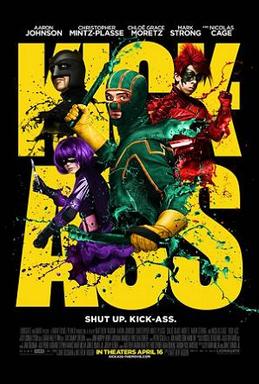
Movie Review - Kick-Ass

Genre: Superhero, Black Comedy
Director: Matthew Vaughn
Starring: Aaron Johnson, Chloë Grace Moretz, Christopher Mintz-Plasse, Nicolas Cage, Mark Strong
Running Time: 117 minutes (plus trailers)

“With no power comes no responsibility”

Dave Lizewski doesn’t have super strength. Nor does he have accelerated healing or the power of flight. And he certainly doesn’t have enormous stockpiles of money, martial arts training, a two-ton rocket-powered tank and an English butler who doubles as a field medic. What he does have is a diving costume, a MySpace page, an encyclopedic knowledge of comic books…and a dream of becoming a superhero. Not dissuaded like so many would be by his total lack of combat training or intergalactic ability, this bespectacled teenager dons a makeshift uniform, fashions himself a weapon and takes to the streets as “Kick-Ass”, an amateur masked avenger determined to protect the unprotected. But after word of mouth of Kick-Ass’s exploits reaches the real life criminal underworld, Dave finds himself caught up in a frenzy of genuine heroes, genuine villains and genuine and deadly violence. Not to mention some very inappropriate language.

Directed by Matthew Vaughn (Layer Cake, Stardust) from a series of graphic novels from Mark Millar (Wanted, Superman: Red Son), Kick-Ass was sold as a superhero movie with a difference: a bloody, profane, adults only version of the comic-book origin story we have seen so many times before. For my own part, the moment I saw a trailer that showed us a ninja-sword wielding eleven year old swearing like a sailor Jason Soto of Invasion of the B Movies, I knew Kick-Ass was a movie I wanted to see. I even went so far as to call it my most anticipated movie of 2010. In this regard I suppose I was setting myself up for disappointment, although to be fair, the movie does deliver everything the marketing material promised; there’s tons of violence, plenty of black humour and that little girl does say “fuck”. A lot.

While I left the theatre a tad disappointed, this is a very fun and very entertaining movie, thanks mostly to the supporting characters. Nicholas Cage plays Big Daddy, a caped crusader whose costume reminds us of Christian Bale’s Batman but whose speech pattern is undeniably Adam West. Now I think a big part of why his character works is because you know it’s Nicolas Cage under that mask and glue-on moustache, but he is great all the same. So too is Mark Strong as sleazy gangster Frank D’Amico, a man who microwaves his henchmen and has a vendetta against the masked vigilantes threatening to bring down his criminal empire. Christopher Mintz-Plasse is also entertaining as another costumed hero, although he’s doing nothing to escape his Superbad persona; “Red Mist” is basically McLovin in a cape.

But as we all hoped, it is thirteen year old actress Chloe Moretz as miniature warrior woman Hit-Girl who steals this film from its stars. Every moment she is on screen is an absolute blast; most of the movies wonderfully ridiculous action centres around her, and over the course of the film she stacks up a body count more than the rest of the characters combined (and this includes the villains). Kick-Ass proves that Moretz is going to be one of the best actors of her generation, and any sequel film should be focused around her rather than this film’s title character. No discredit to Aaron Johnsons, who does do a good job as Dave, but Kick-Ass as a character is simply no match for the outlandish father/daughter duo of Hit-Girl and Big Daddy. This movie works best when it’s in full blown live-action cartoon mode, guns blazing and blood spraying, all to the sound of its ironically, almost irritatingly upbeat and infectious soundtrack.

What I was hoping for in Kick-Ass was for some kind of revolutionary superhero film; I wanted it to really offer me something I’d never seen before. But for all the severed limbs and C-bombs throughout, it ultimately doesn’t do that. In fact when you look at it, this movie is basically Spiderman. Dave’s journey; his home and school situation, hopeless love life and early days as a superhero essentially mirror those of Peter Parker. Now admittedly the Kick-Ass screenwriters have added their own little twisted twists; Peter Parkers first confrontation with bad-guys doesn’t end with him getting stabbed; nor does Mary Jane only want to hang out with him because she thinks he’s gay. But while the content is definitely amped up to what is well beyond politically correct, (including a marijuana smoking scene that seems to exist solely to push that one remaining boundary – I object not on moral grounds, but simply because it felt totally pointless) the plot itself covers very little new ground.

Still, it’s probably a little unfair of me to expect Vaughn and co. to totally reinvent the genre; it’s impressive enough that they managed to put together $40 million to make this film without studio backing (ironically the reason no one would finance it is because they found Hit-Girl too extreme). This movie is definitely entertaining and I recommend checking it out before it leaves theatres; I think the reason I couldn’t quite fall in love with it (aside from overhyping it in my own mind before hand) is because it seems to be trying to offer both a believable superhero story through Dave and an unashamedly absurd Kill Bill style splatterfest through Big Daddy and his purple haired princess. It absolutely succeeds at the latter, and so I must conclude that the thing really holding Kick-Ass back is Kick-Ass himself. Show me the Hit-Girl movie and I’ll have no reservations.


Kick-Ass is in cinemas now


Large Association of Movie Blogs

Saturday, February 27, 2010

1001 Movies You Must See Before You Die: "Naked Lunch" (1991)

The 1001 Movie Club is a conglomerate of film bloggers inspired by the phenomenal book 1001 Movies You Must See Before You Die, the title of which is fairly self explanatory. A tome of cinematic information and recommendation, it is a bible for movie buffs, and the 1001 Movie Club is made up of people dedicated to watching and reviewing the acclaimed films that can be found within its pages. Be sure to visit the club’s site where the reviews will be collected and an aggregate score bestowed, and if you are so inclined, feel free to join in on the fun.

NAKED LUNCH (1991)
Genre: Mystery, Science Fiction
Director: David Cronenberg
Starring: Peter Weller, Judy Davis, Ian Holm, Julian Sands, Roy Scheider
Running Time: 115 minutes (plus trailers)

"Exterminate all rational thought"

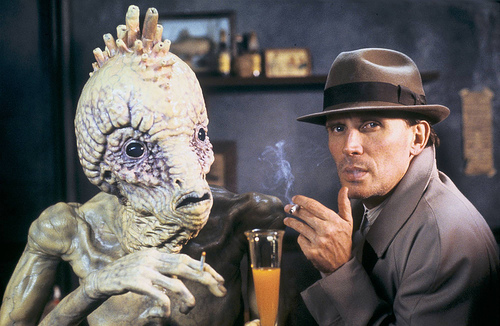
Canadian film-maker David Cronenberg is no stranger to the visceral and the bizarre. A landmark science fiction and horror director, his films often deal with graphic bodily transformation – in The Fly we witness Jeff Goldblums slow transformation into a hideous mutant fly, whilst Videodrome sees James Wood’s abdomen give way to a bloody cavity halfway between a vagina and a VCR. Cronenbergs obsession with metamorphosis is just as apparent in Naked Lunch, part biography of author William S. Burrows and part adaptation of his controversial novel with which the film shares its title. To try and explain the plot would be as difficult as it would be pointless; the film is a hallucinatory experience that is either a sci-fi detective story, a metaphor for homosexual repression or, most likely, the drug induced fantasy of its central character.

The movie seems to begin with a bug exterminator, William Lee, who accidentally murders his wife and flees the country. But whilst there is some semblance of normality in this initial premise, the story soon descends into an indecipherable blend of giant insects, domineering German housekeepers, lesbian drug cabals and sexually promiscuous typewriters all mixed together with a great deal of fluid. There was not a single moment in the film, save for perhaps the first seven or eight minutes that I was not in a state of utter confusion. But it was an interested confusion, and whilst I had no better understanding of the film after watching it than I did before it began, I certainly don’t regret checking it out.

The most impressive aspect of Naked Lunch is it’s visuals; Cronenbergs use of uncomfortably real looking puppetry and make-up effects, as well as stylish costume and set deisgn help to create a genuine sense of location, whether that location be noir-ish New York City, the Arabic inspired Interzone or an enormous parrot cage in which a gigantic centipede copulates with a helpless human victim before ripping his face off with its razor sharp legs.

Did I mention this movie was weird?

Peter Weller gives a great performance as Lee, a man in a constant state of bewilderment, but who nevertheless possesses a hard boiled charm that makes him a great protagonist to watch. The other big highlight is the freeform saxophone score from Howard Shore and Ornette Coleman, a great collection of riffs that match the seemingly improvisational nature of the plot itself.

The actions of the characters (both human and insect) never much sense to me, and the final reveal, which may have been intended as a shocking twist barely registers given all the narrative gibberish that came before it. But while the story is baffling (and largely unsatisfying as a result), the tantalizing mystery aspects, impressive practical effects, excellent lead performance and jazzy score make Naked Lunch an interesting film to watch, even if you have no idea what it is you are watching. And at the very least, it probably features the most emotionally effective monologue delivered about a talking arsehole that you will ever hear.

Score
7/10

So does it deserve to be in the book?
It deserves to be in a book; whether it’s this one I’m not sure. I think it’s interesting enough to qualify as a movie worth seeing, but I don’t know if anyone needs to see it before they kick the bucket. And I know that many of the clubs other members actively wish they hadn't; check out everyone elses take on Naked Lunch here.


Large Association of Movie Blogs

Monday, January 25, 2010

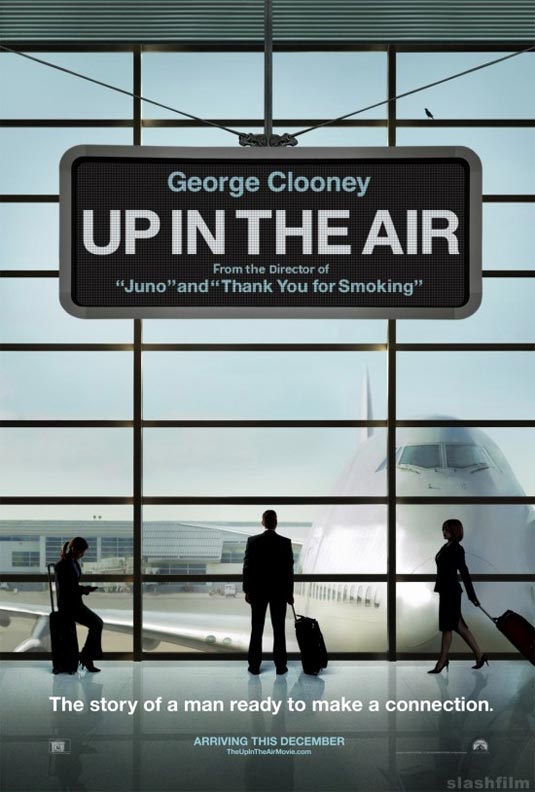
Movie Review - Up in the Air

Genre: Drama
Director: Jason Reitman
Starring: George Clooney, Vera Farmiga, Anna Kendrick, Jason Bateman
Running Time: 109 minutes (plus trailers)

“How much does your life weigh?”

Ryan Bingham (George Clooney) is a man who lives his life with as little human connection as possible; something that he is very proud of. He works as a corporate downsizer, a man whose job it is to fly all around the country and fire people, for bosses unwilling to do the dirty work themselves. He also gives the occasional motivational speech, preaching his philosophy of anonymity and freedom from relationships. But Ryan’s world view is soon challenged when two women are introduced into his life. The first is Rachel (Anna Kendrick), a young ambitious coworker determined to change the way Bingham does business; the second is Alex, a woman who’s beliefs are so similar to Bingham’s own that they may be destined for one another. Directed by Jason Reitman’s, who previously made Juno and Thank You For Smoking (the latter a recent inductee into my Top 10 films of the Decade), Up in the Air once again demonstrates his enormous talents as both a screenwriter and a director, providing us with one of the most mature and insightful (if, dare I say it, a tad over-rated) films of the past twelve months.

Up in the Air has received enormous amounts of critical attention and praise – so much so that there is a list on Wikipedia dedicated solely to the awards and nominations received by Up in the Air. The aspect of the film that has been most lauded is the script; adapted by Reitman and Sheldon Turner from the book by Walter Kirn, the screenplay has won more than a dozen critics guild awards, took home the Golden Globe for Best Screenplay, and is virtually guaranteed to receive a nomination and a win for Best Adapted Screenplay at this year’s Academy Awards. I however am always unsure; when you praise a script, what exactly are you saying? Are you praising the dialogue or the structure; the way each individual scene is put together, or the overarching story and characters?

Individually, each scene is incredibly well written. The dialogue is almost universally terrific, providing both humour and emotional insight. Clooney’s voiceover adds a lot; he makes Ryan Bingham, a man who lives a life that so few of us can identify with, feel like a real, well rounded person. Likewise, Anna Kendrick is sensational as Rachel; a young woman whose determined professional demeanor hides a more vulnerable core, who finds herself faced with a choice: get out now or risk becoming like her mentor. Both Clooney and Kendrick deserve (and will probably receive) Oscar nominations for their work in this film. Additionally, there is a lot of depth here in many of the themes the movie explores; relationships, isolation, the impersonal nature of technology and of course the economic crisis. The film is subtle enough not to hit you straight over the head with these things, but I certainly left Up in the Air thinking hard about my own philosophy for life.

It’s not all good though. I have three rather large complaints about the script/story of Up in the Air; three complaints that hold it back in my mind from being one of the best films of 2009. Firstly, in terms of A to B plot, it’s very predictable. You generally know where the story is going to go, you sometimes see the payoffs coming long before they actually arrive and the reveal involving Vera Farmiga’s character was not at all surprising. My second complaint is of Vera Farmiga’s character in general; Alex describes herself in one scene to Bingham as “like you, but with a vagina” and nothing could be more accurate. She is extremely important to Bingham’s growth in the film, but the problem is that I never felt she had any purpose or personality outside of their relationship. It was perhaps unavoidable; this is after all Bingham’s story not hers, and so we can hardly expect to spend as much time with her. Never the less, I can’t help but feel that she was more a plot point than an actual person.

My third complaint is one that I struggled with for some time; there was something about the film as I was watching it that bothered me, but it took me quite a long time to figure out what it was. Finally I stumbled upon it. Early on in the film, Rachel introduces the concept of using internet conferencing as a means of firing people, essentially making Bingham’s job obsolete. The rest of the film deals primarily with Rachel and Bingham on the road, making layoffs and slowly introducing the new technology. There is essentially no conflict. Although Bingham puts up a brief fight in an earlier scene, the introduction of the technology is inevitable; this movie is simply the man’s last few weeks on the job. I’m not even entirely convinced this is a complaint, but it’s so strange watching a film in which the main character has no real overarching goal or purpose (other than his strange quest to achieve ten million frequent flyer miles).

Like so many, I’ve spent a great deal of time talking about the script, so let me now briefly address a few other points. Reitman’s direction is excellent as always; the aerial photography is terrific, but even when filming something as mundane as a conference room or office block the movie looks beautiful. This is a film that captures the ordinary with a simple and beautiful grace you rarely see. My one complaint of the cinematography would be the use of handheld video during a wedding scene, although I understand why it was done. The soundtrack is strong, and as I previously mentioned, the acting is terrific – even Farmiga playing a fairly shallow character is completely believable. The excellent supporting cast includes two of Reitman’s favourites (and my own) Jason Bateman and JK Simmons, as well as Danny McBride in a surprisingly effective dramatic turn, and extended one-scene cameos by the always excellent Sam Elliot and promising newcomer Zach Galifianakis.

Up in the Air is a film that I know has had a great emotional effect on a lot of people, and is frequently ranking amongst the favourites of critics for the year 2009. Although it wasn’t one of the standouts for me (you can see my Top 10 of 2009 here), it is definitely a movie worth watching. I almost feel that I’m ranking it too low, and I suspect on repeat viewings I will like it more. Maybe it’s my age; this is a movie about maturing relationships, about how you live your life; many of the struggles Bingham and the other characters face I simply cannot identify with (I’ve never had the displeasure of being fired). Never the less, there is a genuine human feel to this story that everyone can relate to.


Up in the Air is in cinemas now

P.S. What follows is one of my favourite trailers of the past twelve months. I'm thinking about writing something about the best trailers of the year (this blog is called Plus Trailers after all). Who'd be interested?


Large Association of Movie Blogs

Friday, December 4, 2009

Movie Review - Zombieland

Genre: Action, Comedy
Director: Ruben Fleischer
Starring: Jesse Eisenberg, Woody Harrelson, Emma Stone, Abigail Breslin
Running Time: 81 minutes (plus trailers)

"Time to nut up or shut up!"

Can I put a question to my US readers real quick? Are Twinkies really that amazing? I’ve noticed that in a lot of movies and TV programs that are beamed to us from your shores, this desert snack is treated with an almost religious reverence. Aren’t they just kind of a sponge cake wrapped around whipped cream? Don’t get me wrong, I like sugar just as much as everyone else, but come on! They don’t even have chocolate in them! Surely they’re not all that? I’d appreciate any feedback you might have (or if you want to send me one in the mail, feel free)

Now onto my review of Zombieland.

The story in a nutshell follows four survivors of a recent zombie apocalypse: the gangly phobic teen Columbus (Jesse Eisenberg), zombie hating badass Tallahassee (Woody Harrelson), sexy con artist Wichita (Emma Stone) and her twelve year old sister Little Rock (Abigail Breslin). The film follows these four unlikely heroes as they try and cross the country and find safe haven from the creatures that have turned the United States of America into the United State of…well, take a guess what they call it.

A fair amount of the humour in Zombieland comes from watching the flesh hungry fiends get killed ridiculous and very bloody ways. So if like me you are the kind of person who can laugh at a zombie getting shot, stabbed, run over or crushed by a piano, then this is the kind of movie for you. I thought this is a very funny film, with excellent performances across the board. Woody Harrelson is probably the highlight as the borderline insane zombie hunter, but the rest of the cast hold their own, and Eisenberg’s neurotic voiceover actually really helps keep the movie grounded in some kind of emotional reality…as much as you want it to at least. The script is great with some very amusing dialogue and a lot of movie and pop culture references (that actually felt organic and not shoehorned in) that I could appreciate.

Zombieland also felt like a very efficient film. It’s extremely well paced, with no scenes that felt too long or unnecessary. It’s only eighty minutes and change, but director Ruben Fleischer has done a great job in covering all his bases and making sure everything clicks. There’s plenty of humour, plenty of action, a little bit of romance and actually some pretty badass female characters meaning it can appeal to more than just guys. Add to that the very likeable cast, a brilliant surprise celebrity cameo and healthy dose of good old fashioned gore and Zombieland has something to appeal to pretty much any fun loving audience discounting the overly squeamish - the violence, while funny, is also pretty bloody (and that’s not a criticism).

It’s not exactly a movie that going to change the world and I don’t think it’s anywhere near as good as the first two thirds of Shaun of the Dead (which I personally think is a brilliant movie that goes into the toilet once they reach the Winchester – but that’s a different review. But while I’m on the topic of Shaun, Zombieland might just challenge it for the best zombie movie opening credit sequence). I was kind of hoping for a bit more satire than just straight up gore based comedy, but never the less Zombieland is very entertaining film that I think a lot of people are going to really enjoy. It’s one of those movies that you can take your friends to and just have a good time without having to do much thinking. So my final recommendation? Get your mates together, maybe grab something to eat and go rent Drag Me To Hell, which is hands down the best horror-comedy of the year!

After that though, it wouldn’t be a bad idea to head down to the local cinema and check out Zombieland as well.


Zombieland is in theatres in Australia now


Large Association of Movie Blogs

Sunday, November 29, 2009

1001 Movies You Must See Before You Die: "The Apartment" (1960)

The 1001 Movie Club is a conglomerate of film bloggers inspired by the phenomenal book 1001 Movies You Must See Before You Die, the title of which is fairly self explanatory. A tome of cinematic information and recommendation, it is a bible for movie buffs, and over the next four days, myself and the other members of the club will be reviewing four of the acclaimed films that can be found within its pages. Be sure to visit the club’s site where the reviews will be collected and an aggregate score bestowed, and if you are so inclined, feel free to join in on the fun.

THE APARTMENT (1960)
Genre: Comedy, Drama
Director: Billy Wilder
Starring: Jack Lemmon, Shirley MacLaine, Fred MacMurray, Jack Kruschen
Running Time: 125 minutes

Winner of five Academy Awards including Best Picture, Billy Wilder’s The Apartment tells the story of C.C. Baxter (played by beloved Hollywood leading man Jack Lemmon). A low level employee at a New York City insurance firm, Baxter has put his career on the fast track by lending out the key to his apartment to his superiors so that they can go about their extra-marital activities without fear of being caught by their significant others. Unfortunately for Baxter, this arrangement often leaves him without a place to sleep, and is ruining his reputation with his neighbours. To make matters worse, one of the women being wooed in his apartment is Fran, the elevator operator from his work with whom Baxter is smitten.

The Apartment spends most of its first half as a comedy, following poor Baxter as he attempts to juggle his various “appointments” whilst trying to woo Fran and get ahead in the workplace. But in the second half the film changes tone, morphing into a drama about love and dependence. The best thing about The Apartment is the way that is moves so gracefully between genres, and uses humour to tackle weighty issues such as suicide, adultery and relationships, giving the picture far more depth than it might at first appear.

Fran (played by Shirley MacLaines) initially seems like your typical sassy leading lady, quick tongued and very pretty. But in a stunning scene in a Chinese restaurant, she is revealed as a real life character, foolish and vulnerable, carrying on her affair with the sleazy Mr. Sheldrake despite knowing that he will never leave his wife. Likewise, Baxter may seem like sympathetic schmuck who just wants to please everyone, but ultimately he is also a man unwilling to take responsibility for his actions, choosing instead to play along and get ahead rather than stand up and fight for what he truly wants.

Those of you who have heard me on the LAMBcast will know that I am by no means a Billy Wilder expert, but his direction here truly is first rate, and the black and white cinematography is gorgeous (fun piece of trivia, this was the last Best Picture winner to be shot entirely in black and white). That being said, if it wasn’t shot in black and white, one could easily mistake The Apartment as a contemporary film, as it deals with its subject matter with surprising frankness. (there was probably only one moment in the entire movie, involving Baxter going through Fran’s personal file, that seemed dated). The script is very well written, with Lemmon delivering his lines, especially the comedic ones, with perfect timing.

Honestly though, I don’t consider The Apartment to be anything that remarkable. It’s a very solid film, with strong performances and some excellent dialogue, but it never really captivated me. It’s not that I didn’t like it, but I probably would never have picked it as a Best Picture winner had I not already known. I’d recommend the movie to anyone who thinks it sounds interesting, but don’t expect it to change your life

Score
7/10

So does it deserve to be in the book?
I think most of the club members will disagree with me, but I have to say no. It’s a good film, but it struck no particular resonance with me. I’m sure I’ll watch it again at some point and maybe I’ll have newfound appreciation for it, but until then I wouldn’t consider The Apartment a movie I had to see before I died.


Large Association of Movie Blogs

Friday, August 21, 2009

Movie Review - Coraline


Genre: Stop-Motion Animation, Fantasy Adventure
Director: Henry Selick
Starring: Dakota Fanning, Teri Hatcher, John Hodgman, Keith David, Robert Bailey Jr.
Running Time: 100 minutes (plus trailers)

"You could stay here forever if you want to. There's one tiny little thing we need"

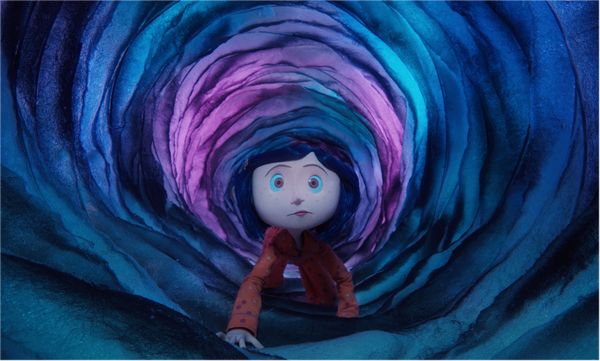
If there is one thing that director Henry Selick probably hates, it’s being mistaken for Tim Burton. In 1993, Selick directed the first ever stop motion animation film to be backed by a major American studio. That film was A Nightmare Before Christmas, and it was produced and co written by Tim Burton, the director of films such as Beetlejuice (1988), Edward Scissorhands (1990) and Sweeney Todd (2007). But he did not direct Nightmare. The reason I want to make this clear is because I believe in giving credit where credit is due. I am not a Tim Burton fan – I find his overly gothic, morbid fairytale quirk to be, more often than not, very irritating. But after watching Coraline (I haven’t actually seen Nightmare), I am now a fan of Henry Selick. His animation and his storytelling is what I would characterize as Burton-lite – a little bit of eccentricity, without going overboard. Coraline is a decidedly fun film filled with astonishing animation, and whilst I didn’t love it as much as I know a lot of people (most of them Burton fans) will, I still think it’s one of the better kid’s movies of the year.

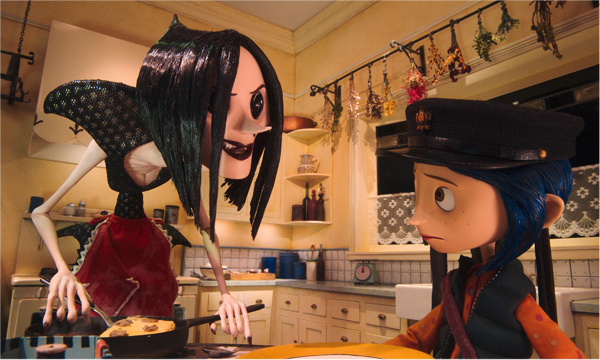
The movie follows a young girl named Coraline, whose family has recently moved town. Alone and friendless in a strange new house, with her emotional distant parents completed uninterested in her life, Coraline spends her days roaming the halls and gardens of the house while avoiding the exasperating neighbours. But then one day, Coraline discovers a secret door that, via a Being John Malkovich style porthole, transports her to a bizarre other world, where dinner is always delicious, the neighbours are always fun and her parents seem to care about her. There’s just one little catch. Her “other mother” is actually…wait for it…evil, and wants nothing more than to sew buttons into her eyes. With her real parents missing, it’s up to Coraline (and her feline sidekick) to beat the demon at her own game, and bring the sinister other world to an end.

Hands down the best thing about Coraline is the animation, which is absolutely wonderful. I don’t how much of it was CGI and how much of it was stop motion, but however they did it, it’s clear that the filmmakers put enormous time and effort into getting everything just right. The look of the film has a really genuine quality to it that even Pixar hasn’t yet managed to achieve. Don’t get me wrong, I loved Pixar movies, and WALL-E especially is absolutely stunning to look at. But the animation in Coraline somehow feels more heartfelt. Just like in Mary and Max (which as of now remains my favourite film of the year), the handcrafted nature of Coraline reflects the labour and the dedication of everyone involved, and as a member of the audience, you feel it. I also thought the voice work was excellent, especially (and I never thought I’d say this) Dakota Fanning as the eponymous character, who really does a great job.

The movie starts with a fantastically creepy credit sequence, which sets up the style and tone of the entire film. I loved this opening, and it certainly helped raise my expectations. However, after that, the movie lost me for a good twenty minutes. It was sort of an unavoidable – before delving into the mystical world, we needed to be introduced to the mundane. We follow Coraline around the house, meeting all the characters one by one – her emotionally distant parents, the anti-social German gymnast who lives in the attic, the pair of senile, retired actresses on the floor below. This part of the film helps us gain an appreciation of Coraline’s frustration, and as such it was entirely necessary. Unfortunately, it just wasn’t very interesting, and I felt my inner child getting impatient.

On top of being a little dull, I also found the first act of the film to be quite annoying. Like the main characters in a lot of children’s movies, Coraline herself starts off a whiny little brat who I disliked intensely. As the film progresses she proves herself to be very clever and resourceful, and ultimately she was quite a strong lead. But in those initial scenes, I just wanted to slap her. The minor characters in the movie also bothered me – they weren’t bad, but they felt a bit one-dimensional, as if they’d been taken straight out of an oddball catalogue (the same catalogue that Burton subscribes to). Finally, the music. The main Coraline theme was interminably irritating, and was the epitome of “alternative quirk” that I despite so much. All in all, by around the half hour mark, I was ready to give up on Coraline altogether.

However, once the mystical happenings begin, Coraline picks up considerably. The magical other world gives the animators the chance to shine, and I was soon swept away by the beauty and creativity that was displayed on screen in the latter parts of the film. Once it gets going, this movie is a hell of a lot of fun for young and old; the story is exciting, the characters entertaining and the animation – I cannot express how amazing it looks. And the best thing about it – it’s sort of scary. I mean, not to me, but for a kids movie it’s rather creepy and suspenseful, which makes for a great change when compared to the normal affairs from DreamWorks (or even, dare I say it, Pixar). I might actually recommend that very young children stay away from Coraline because of some of the frightening imagery - it’s got a PG rating, so parents can decide for themselves (and hey, I don’t think there are any parents who read my reviews anyway).

Before I conclude, I need to talk about the 3D. Selick employs the technology a lot more subtly than most film makers – instead of just having things flying out at your face, he uses the extra dimension to give the film additional depth. That’s admirable, but unfortunately, I’m still not satisfied. The Rick Astley style “Real D” glasses are an improvement on the blue and red cardboard variety, but they’re still overly bothersome. And science is yet to find a way to combat the headaches that they cause. I love the idea of 3D filmmaking, but we’re not there yet. And until we are, I say if you’re going to see Coraline, see it in a regular theatre.

There were definitely parts of Coraline that annoyed me. But overall, I still enjoyed it. On top of the animation, the highest praise that Coraline deserves is that it doesn’t talk down to kids. I’m tired of unintelligent children’s movies that don’t offer anything above spectacle (what Transformers 2 did for teenagers and adults). As a lover of movies since a very young age, I believe that kid’s films should aim to do more than simply hold the attention of their target audiences for an hour and a half. Coraline aims to do more. It’s mature, creepy, and absolutely beautiful to behold. At the end of the day, my problems with Coraline indicate that it probably isn’t a movie for me, but if you’ve got kids on your hand, or if you’re into that…sigh…Burton-esque style, then it’s almost certainly a movie for you.


Coraline is playing in both regular and 3D cinemas in Australia now.

Large Association of Movie Blogs

Tuesday, July 7, 2009

Movie Review - Disgrace


Genre: Drama
Director: Steve Jacobs
Starring: John Malkovich, Jessica Haines, Eriq Ebouaney
Running Time: 120 minutes (plus trailers)

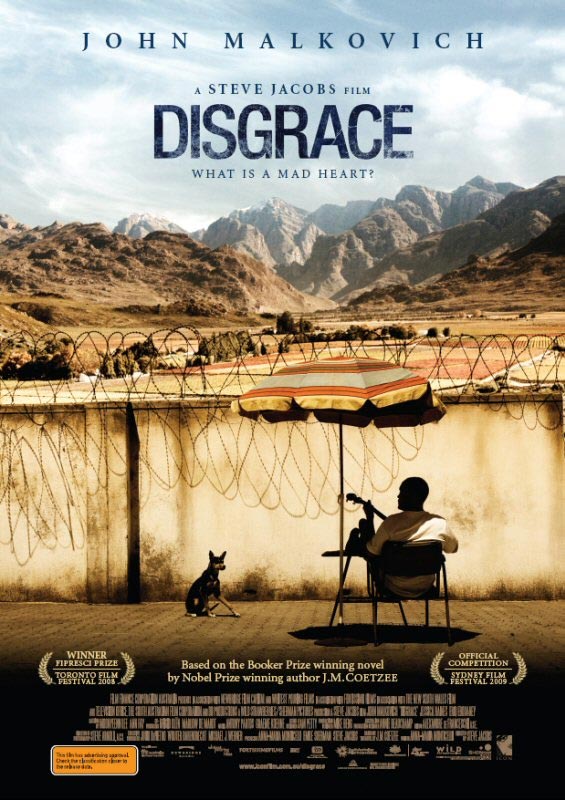
Based on the critically acclaimed novel of the same name, Disgrace is not a pleasant movie to watch. In the vein of films by Ken Loach, it is a depressing tale of people suffering incredible hardships without any real hope for change or redemption. John Malkovich stars as David Laurie, a poetry professor at a Cape Town University who is disgraced after his affair with a female student becomes public knowledge. Wanting to escape the city, he goes and stays with his daughter Lucy on her small farm, where he helps her maintain a kennel. But after a vicious attack by a local gang, both their lives are thrown into turmoil.

Aside from a few key conflicts, nothing much actually happens in this movie. There isn’t really any narrative drive or tension in the story; instead, Disgrace is more of an exploration of people and ideas. Because of this, the films success hinges almost entirely on the believability of its characters, and thankfully all the performances are excellent. Malkovich and Haines are both terrific in their roles and the strained father-daughter relationship between them is utterly convincing. Indeed, every member of the cast embodies their characters with such skill that we soon forget that we are watching actors at all (this feat is especially remarkable for Malkovich, a man with such a distinctive physical appearance and voice).

The directorial approach taken by first time Australian filmmaker Steve Jacobs is one of simple observation. With a steady and mature hand that one would attribute to a more experienced director, Jacobs has successfully captured the desolate and uninviting nature of the South African plains that reflect the films tone perfectly. Jacobs’s minimalist technique means that nothing ever separates his audience from the characters and events on screen; the editing and camerawork never draws attention to itself, functioning only to serve the story. My only complaint in terms of the production was that the picture quality was sometimes very poor (although I suspect this was due to budget constraints and shoddy cameras rather than artistic choice.)

There is a drawback to this ponderous style: the movie is slow and sometimes dull, especially in the very disjointed opening scenes. Disgrace is a film that gets better and better as we become more and more invested in its characters, and as such the early parts of the film didn’t always hold my interest. However as the story progressed I found myself being drawn in, engrossed by its mesmerising bleakness and complicated characters. Disgrace is not really a movie one enjoys – rather, one is morbidly fascinated by it. There is something compelling about the utter hopelessness that is portrayed on screen, and whilst at times it is deeply unpleasant, it is also undeniably powerful.

At the same time, I’m still not entirely convinced of the value of Disgrace. It has no use as entertainment, nor does it seem to possess any greater meaning. There is no moral to this story and the ending is neither happy nor satisfying – not that you should have expected anything else. Disgrace is two hours of wallowing in despair, and whilst it will make you think, it’s unlikely to inspire you to do anything, or have any lasting effect on your life at all. And so while by its technical merits it is a good film; well directed and scripted, with a gripping story and superb acting, I am still torn as to whether I think it’s worth seeing. A recommendation seems to imply that I think you will enjoy it, but it’s hard to imagine anyone enjoying Disgrace.

Obviously Disgrace has a very specific demographic (hint: if you even considered seeing Transformers 2, then this movie is not for you). And, quite franky, if you do fall into this movies demographic then you probably don’t care what I, a seventeen year old movie blogger who actually saw Transformers, has to say about it (come to think of it, you probably don’t even read this blog). For anyone who is reading, I leave you with these ambiguous final words: if you are the kind of person who is inclined to view this type of depressing cinema, then you will probably appreciate Disgrace. But no, you won’t enjoy it.


Disgrace is in cinemas in Australia now. It will be released internationally over the coming year.
Large Association of Movie Blogs

Saturday, June 27, 2009

Movie Review - The Hangover


Genre: Comedy, Mystery
Director: Todd Phillips
Starring: Bradley Cooper, Ed Helms, Zach Galifianakis, Heather Graham, Justin Bartha
Running Time: 100 minutes (plus trailers)

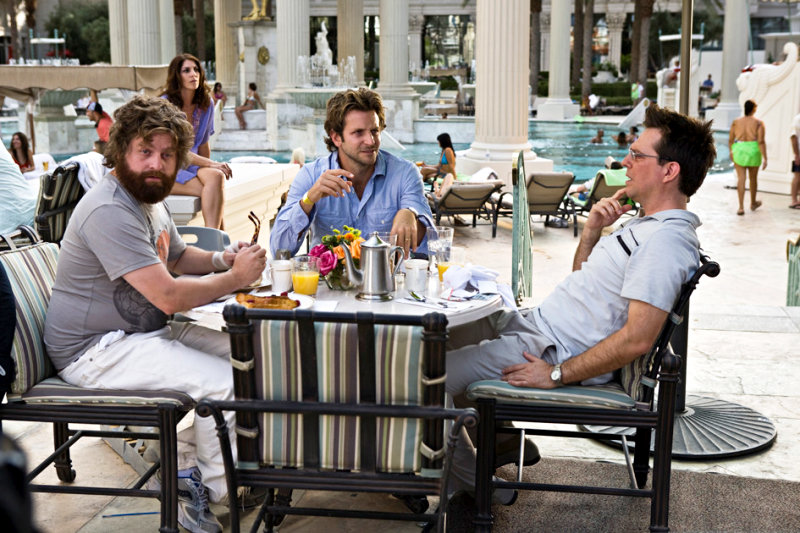
When Phil (Bradley Cooper), Stu (Ed Helms) and Alan (Zach Galifianakis) take their buddy Doug (Justin Bartha) to Las Vegas for his bachelor party, they declare it will be a night they will never forget. But when they wake up the next morning, their hotel room is trashed, the groom is missing and none of them have any idea what transpired the previous night. With the wedding scheduled for the very next day, the bumbling threesome have to race against the clock to uncover what they did, and more importantly, what they did with Doug. Clues include a stolen cop car, a tiger and a baby, and their hunt for answers leads them down an increasingly bizarre path involving drug dealers, effeminate Asian gangsters and former heavyweight champion Mike Tyson.

The Hangover is funny. Not hilarious, but definitely funny. The best things about it are the performances by the three leads who are perfectly cast in their respective roles. Galifianakis gets the most laughs as the idiotic Alan – he definitely has a bright future ahead of him playing the retarded side kick. I was a little disappointed that Jeffrey Tambor (of Arrested Development fame) was criminally underused. He only appears in two scenes but is terrific in both. The other waste of talent was Heather Graham, who has the absolutely thankless task playing the stripper with a heart of gold. For the most part however, the minor characters are great, especially Ken Jeong as Mr Chow (you'll know him when you see him.)

The other thing that makes The Hangover work is the structure of the script. We find things out at the same time as the characters, and so we get to share their surprise. As the movie goes on, things get more and more ridiculous, but the audience accepts this because the characters are as confused as we are. The way the movie openly acknowledges its own absurdity ironically keeps it grounded in reality. None of the gags are particularly inspired, as the movie basically hits all the beats that you would expect from a comedy set in Las Vegas – from the Rain Man parody to the sub-plot involving Stu’s drunken marriage to a stripper. No, it's not original. But that doesn’t mean it isn't funny.

This movie isn’t going to blow peoples minds. It is a film that fits very neatly into that ever growing list of raunchy adult comedies being put out by the Hollywood system. It’s amusing but predictable, filled with offensive humour that won’t actually offend anyone. The music choices are obvious and the direction is sometimes pretty standard. But ultimately none of that really matters. The best way to describe The Hangover is to say that everyone involved does exactly what is required of them, and while it’s not going to have you shooting milk out of your nose, it will make you laugh pretty consistently. Which is all you should have been expecting in the first place.


The Hangover is in cinemas now

Large Association of Movie Blogs

Saturday, March 21, 2009

Movie Review - W.


Please Note: If in the following review you notice a level of writing fluency (not to mention political knowledge) far superior to what is normally contained on this blog, it is because this review was co-written and edited by the future Prime Minister of Australia, Christopher Weinberg.

Genre: Dramatic Biopic, Political Satire
Director: Oliver Stone
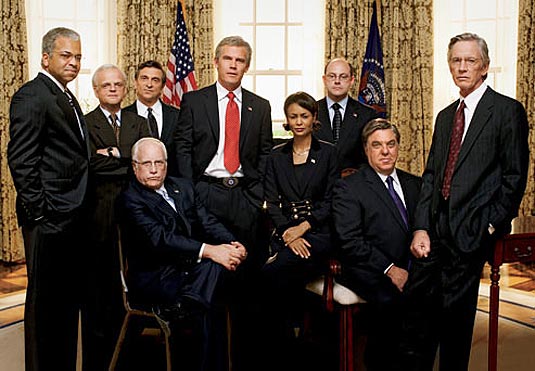
Cast: Josh Brolin, James Cromwell, Richard Dreyfus, Thandie Newton, Elizabeth Banks, Toby Jones, Jeffrey Wright
Running Time: 129 minutes (plus trailers)

When it was announced that Oliver Stone, the controversial left-wing director behind JFK, Platoon and Natural Born Killers was making a film about the life and presidency of George W. Bush, many people sat up in eager anticipation. As everyone’s favourite gun-toting Texan departed the Oval office for the last time there was a great amount of interest in both the political and the film community as to how Stone would portray this influential figure, generally considered to be America’s most hated president. Released in the USA just a couple of weeks before the 2008 election, in which Bush’s legacy was harshly rebuked with the inauguration of Barack Obama, I think most people were expecting an out and out slamming of Bush along the lines of Fahrenheit 9/11. Instead, W. is a remarkably kind portrait of George Bush, depicting him not as evil or stupid, but as a good intentioned if naïve man who was unsuited to leadership, but always did what he thought was right.

The key to the film’s success is the impressive ensemble cast, which one enormous exception. Josh Brolin is undoubtedly one of the most versatile actors of this decade, going from an innocent cowboy in No Country for Old Men, to a simple and tortured politician in Milk. In W. he shows an immense amount of devotion to the role; his accent is sublime and epitomises the Texan nature of Bush, and he was criminally overlooked for a Best Actor nomination at the Oscars. James Cromwell is amazing as the overbearing and conservative Bush Sr., and the scenes between the father and son provide us with a fascinating look into Bush’s personal identity: a boy who never had his father’s approval. Richard Dreyfus embodiment of Dick Cheney is pitch perfect. With a striking physical resemblance, Dreyfus conveys Cheney’s speech structure incredibly well and really gives the sense of a crazed hunter in a suit. Elizabeth Banks is wonderful, although slightly underused as Laura Bush, as are veteran actors Toby Jones, Ellen Burstyn, Scott Glenn and Jeffrey Wright as Karl Rove, Barbara Bush, Donald Rumsfeld and Colin Powell respectively. At the other end of the spectrum, Thandie Newton as Condoleezza Rice is atrocious. Along with her "performance" in RocknRolla, she has recently proven herself to be one of the weakest actresses of our time, and her portrayal of the National Security Advisor comes across like a bad sketch. Seriously, she is unfathomably bad.

The film’s non linear timeframe is a mixture of Bush’s formative years, his ascension to Governor of Texas and then finally the war in Iraq as was crafted by the inner sanctum of the Administration. Strangely, Stone and screenwriter Stanley Weiser (The Queen) chose to exclude several key moments in Bush’s career, most notably the contentious 2000 election. When looking back on what is covered in the film, it seems that Stone has decided to examine moments in Bush’s life in which he was in control of. Additionally, he spends a lot of time exploring the various people that influenced Bush; the relationship between Bush Jr. and Bush Sr. is the foundation on which the film is based. Constantly, Bush Jr. is seen trying to win his father’s approval and gain respect in the face of low expectations. It’s interesting to see that it was the younger Bush, Jeb, who was considered the heir to the Bush legacy. It proves that W had some strength and capability to achieve the title of President, something Stone tries to weave in throughout the film. The other major influence that is seen to be immense is that of Dick Cheney In order to make Bush identifiable, Cheney is depicted as the devil, using the president to further his own agenda, driving the country closer and closer to war.

The best scenes in the film are the ones that occur during Bush’s actual presidency, being both impressively accurate and brilliantly satirical. The movie opens with a great scene in which Bush and his advisers coin the term ‘Axis of Evil.’ Another such flash of brilliance comes when during a luncheon with Cheney, Bush signs off on a change in defence policy. Whilst seemingly unremarkable, it is to allow for rendition of ‘enemy combatants’. This change to allow for America to torture alleged terrorists highlights the extreme power of the Presidency. Over a burger and fries, one man can determine whether his nation engages in grievous moral acts or not in order to preserve the security of millions of people. Furthermore, the ‘final confrontation’ in which the decision to go to War in Iraq is given, highlights the nature of the First Bush Cabinet, the inherent conflicts within it, and the nature of Bush as a leader. In it we see Colin Powell, Secretary of State, vehemently advocate for not going into Iraq, suggesting it would be a diplomatically, economically and socially costly engagement. As Powell’s arguments become more legitimate in the mind of Bush, we see Cheney take control and clearly lay out the reasons for going into Iraq, a certain substance known as Black Gold. In the end, we see Bush agree to war and then leads his Cabinet in prayer.

However, while individual scenes such as those listed above are great, the overall structuring really holds this film back. While almost everything shown is at least interesting, I really didn’t care that much about his alcohol problems or college years (also, as good as Brolin is, he cannot play a 25 year old.) Every time we cut to another flashback, I was frustrated, wanting to get back to the politics rather than the ‘touchy feely’ family moments. Honestly, I think I would have preferred for the film to begin with his election, and just go on from there. The other screenwriting problem is the inclusion of the famous ‘Bushisms.’ Every time we hear one of his real life idiotic remarks, it takes us out of the film, and does not gel at all with Stone’s sympathetic vision of the president. Even so, this movie is general well written, and the last twenty minutes, starting with the realisation that Iraq does not possess WMD’s, are a brilliant combination of sharp satire and emotional drama.

W. is a portrait of man whose life takes on an incredible transformation. In the beginning, Stone shows us a drunken idiot, shameful in the eyes of his father. By the end we see him a born-again Christian, leading the free world. And yet he can never win his father’s complete admiration; during the course of the war, Bush suffers a nightmare in which his father verbally and physically assaults him, blaming him for the desecration of the Bush legacy. Stone takes great effort to portray the man behind the speeches, and proves him to be nothing but an ordinary American caught in an uncertain life, seeking direction and approval. I’m not sure who exactly the target audience of this film is: Pro-Bushies will hate it for it’s liberal sensibilities, and Anti-Bushies will leave disgusted that this film actually made them feel sorry for the man. However, if you can leave your political beliefs at the door, this film proves to be worth the watch.


W. will be released on DVD in Australia at some point in 2009.