Showing posts with label urban poverty. Show all posts

Wednesday, March 25, 2009

Q&A with the “Mayor” of Opportunity City


MILWAUKEE, March 32, 2010 (IP*) – Ronald Dykes is executive director of Opportunity City, a non-profit organization dedicated to fighting poverty in Milwaukee. Housed in what was once a sprawling steel fabrication plant in the heart of one of the city’s poorest neighborhoods, the organization is generating lots of buzz in policy and academic circles across the country for its innovative initiatives.

Q. Opportunity City isn’t a city; it’s a non-profit group. Everyone calls you “mayor,” but your title is executive director. What’s up with the city shtick?

A. We are like a city. Inside this old factory space, we house staff for the 27 different anti-poverty programs that we run. A few are big programs; many are small. About 475 people work here, and we get about the same number of clients and visitors coming through every day. There’s a lot of human bustle in here. The office cubicles are arranged in blocks like a street grid. There’s a big thoroughfare we call Main Street, and there’s Coffee Alley and an area we call The Park where we have big staff meetings. And…


Q. So, you’re like a city because you’ve arranged your cubicles a certain way? That’s a pretty shallow metaphor isn’t it?

A. Well, if you’d let me finish…We don’t just look like a city; we act like one in some important ways. We intentionally created Opportunity City to try to capture the agglomeration effects that flow from the concentration of resources and functions in cities. Everyday, there are lots of low-income people here. Everyday, there are lots of people in here helping them directly or indirectly. In house, we’ve got people working on solving child care, transportation, housing, food and health care problems for individuals. We’ve got labor market analysts, administrators and support staff, employment recruiters, job trainers and representatives from apprenticeship programs working with individuals and on policy-level changes. There are also policy designers, grant writers, program evaluators and various academic interlopers. They’re all here, everyday. In close proximity. Trouble-shooting problems. Bouncing ideas off each other. Able to shout over the cubicle wall to get help. Coordinated complexity happening in close quarters is not a bad description of what a city is, and it’s what we are doing at Opportunity City.


Q. Agglomeration effects. Coordinated complexity. Fancy talk. Please tell us in plain English what the hell you’re talking about.

A. It’s simple, really. It’s just what I said a second ago: if you can get a lot of people working closely together on a set of related problems, you can be more effective at solving problems, at being productive. Density and proximity make it easier, more likely for people to problem-solve effectively in real-time. That’s the essence of these concepts. They’ve been at the heart of understanding why people and firms locate in cities.

Q. For a non-profit, you seem very well funded indeed. Where does all the money come from?

A. We’ve been blessed with very extravagant donations from a few wealthy benefactors in town. Our policy innovations have attracted grants from national foundations. And, of course, we’ve been fortunate to get funding from the new federal block grant programs for workforce development and affordable housing.

Q. You sound excited. Knowing the history of anti-poverty efforts, aren’t you setting yourself up for disappointment?

A. First, hold on a minute. Anti-poverty efforts often get a bad rap they don’t deserve. Social Security keeps lots of elderly folks out of poverty. If that’s a failure, give me more. The Earned Income Tax Credit has helped millions of low-income working families make work pay enough to afford housing and groceries. That’s a success story in my book, and so is the fact that many low-income folks have gotten good jobs through some of the better job training and placement programs. So, no, I don’t think we’re setting ourselves up for disappointment. In fact, this is one of the most exciting times in American history to be involved in the fight against poverty. Thanks to the new national health care program, every American now has affordable health insurance. This is a huge boost to low-income people. And there’s the new Skill Net program. Under this program, every American worker gets financial help to keep their job skills up-to-date and, when a job is lost, gets decent wage insurance payments to bridge over periods of unemployment without having to plunge into poverty to qualify for help. For struggling low-income workers, this new program will help keep them attached to jobs and prevent them from cycling in and out of poverty and low wage work.

Q. You like what the Obama administration has done to help fight poverty. Understood. But what are you doing locally at Opportunity City?

A. What the feds are doing is really important to our efforts. Because federal efforts will help keep many low-income families and workers from falling back into poverty so easily, at the local level we can focus on harder problems like helping people with few skills and little-to-no job experience get jobs and rebuilding distressed neighborhoods. That’s what we’re doing at Opportunity City.

Q. Nice generalities. Any specifics?

A. Sure. We’ve just launched an experimental program called Project Search and Employ. Basically, the program aims to create a group of companies with a strong profit incentive to recruit poor people with few job skills and successfully place them in real jobs with good wages and benefits. It works like this. There’s a big pot of money—all from a very generous private donor—controlled by a team of investors. The investors are a bunch of experts—experts in things like training workers, analyzing businesses, understanding industry sectors and supply chains, poverty policy, mentoring and coaching, and program evaluation. What they do is invest in proposals to create what we call search and employ companies or SECs. The SECs—each using different strategies, but all working within the same set of very high poverty census tracks—go out and find poor people who don’t have much work history, but are able to work, and hire them for a job with the SEC that involves them being trained for a real job. The SEC job is real enough, too. The recruits get paid a decent wage and benefits, and pay taxes and can be fired at the will of the employer. Anyway, if and when the SEC gets the recruit a real job—not with the SEC—then, our investors pay the SEC a big bonus. And if the recruit stays employed long enough, they get an even bigger bonus. If the SECs don’t get people good jobs for long enough, they’ll fail as businesses. Even though a program like this will work best when the labor market improves, we’re excited to get started on it because it not only gives a lot of poor people jobs right away—the SEC training jobs—but it also incentivizes lots of creative thinking about how to turn low-skilled people into stable employees.

Q. Profit from poverty. Isn’t that morally yucky?

A. Don’t try to be cute. The profits come from increasing employment and reducing poverty.


Q. Fair enough. What else are you doing?

A. Running programs is not all we do. We also try to push larger systems—like schools, chambers of commerce and city governments—to do things that help fight poverty. For example, we’re trying to create a fairly dense walkable low-income neighborhood where there are currently lots of boarded-up houses and very few businesses. To do this, is going to require help from everybody. We’ll need good schools. Grocery stores and other businesses willing to look with fresh eyes on the economic prospects in low-income neighborhoods. New zoning ordinances allowing for mixed use. And more.


Q. Now, it’s your turn to hold on a minute. Isn’t “walkability” code for gentrification?

A. It can be, sure. But first you need to understand that walkable neighborhoods can really help make life much easier and more affordable for low-income people. Think of the transportation costs and life-hassles you can avoid if child care, schools, grocery stores, places of employment, government offices, parks and transit stops are located within walking distance. The gentrification concern comes in because more and more of what we used to call yuppies like this stuff too and are willing to pay a premium to live in such places and drive up costs for everybody. But our plan is keep these neighborhoods affordable for the people who already live there. And we’re doing that with a range of programs including generous low income housing tax credits, land trusts, and value-latching which taps into any rise in property values to pay for programs that keep housing affordable. We’ve structured all this so that, over time, property values will be able to return to their real market values but only as long as the neighborhood maintains enough affordable housing capacity, too.

Q. You’re smiling. How is that possible with all the misery, all the failure of the American Dream you see every day?

A. Yes, poverty is terrible. And, yes, it’s heartbreaking to see what it does to people. But as I said before, this is a very promising moment for America. There’s a new sense that we’re all in this together, and a new willingness to work for the common good. For me, in the context of the fight against poverty, it’s especially wonderful to see Americans rediscover the natural strengths of cities, to see cities once more as the engines of growth and opportunity they are.

Interview confabulated, condensed and edited by Dan Lorentz.

*IP is an acronym for Imaginary Press, a wire service providing factually dubious news and feature stories to credulous media outlets worldwide.

--- --- ---


Note:
This will be my last post as a regular Where contributor. My experience here has inspired me to continue to blog about city issues, except that now I want to concentrate on a more local project. In mid-April, I hope to launch My Athens, a blog about my new hometown, Athens, Georgia. [Note: This note and the note it’s embedded in are true, unlike most of the fiction that precedes it.]

(Photos--in the order they appear--from Flickr users craigallyn, opendemocracy, Matthew Shelley. The original full-sized color version can be viewed by clicking the photo.)

Tuesday, January 20, 2009

Posh to be Poor?


I've been reading a lot of articles lately, and as wrong as it may sound, it seems as though poor is the new black in the Western World. Now I don't mean more people are becoming poor, because that's obviously true, but it seems that lately a lot of professionals have drawn inspiration from the condition. For example, the Times ran an article about architect Teddy Cruz and his social housing experiment in the Hudson River Valley. The development, which features a modern day mesh of architectural elements, draws inspiration and, at times, form, directly from favelas.


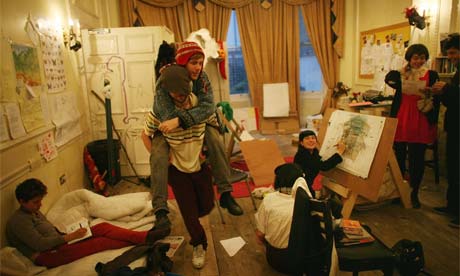
Another prime example is seen in the press that a group of British artists received when they essentially hijacked a vacant multi-million dollar mansion. Late last year, the artist collective Da! moved their group into 18 Upper Grosvenor Street, one of London's more exclusive neighborhoods. They lived and worked here for at least a month with no word from the owners and no word from the cops. I can see this becoming a trend in America, with so many mansions going into foreclosure or sitting on the open market. Perhaps there will be a slight role reversal, where the homeless end up taking over these huge mansions because nobody can afford them or to maintain them. I mean, you can already get 3000 sq ft of 1920's craftsmanship for under 100k in Detroit, why even waste your time with money anymore? Just move in! Some cities are even working on programs to move the homeless into foreclosed homes, according to Fox News. If you want a mansion for nothing, now just may be your chance.

Finally, one of my favorite artists/designers just released a transportable abode for the homeless. I know this has been an ongoing project in every architecture school in the world for the last 50 years, but nobody does it quite like James Westwater. There is something compelling about his project, "homeless chateau," and the idea of living in a rectangular prism in an abandoned warehouse. How different is this from living in a warehouse loft? Having neither heat nor electricity would be rough, but you're not paying $3000 a month. Anyways, I'm not really suggesting these are real lifestyle choices that will become widely popular anytime soon; I'm simply suggesting these ideas are growing in popularity.

In order to dig further into this idea that we are being inspired by the conditions of being poor -- conditions that will increasingly affect the middle class worldwide -- I will investigate 3 divisions of urban planning which directly connect to choices in lifestyle and are dictated by income. Those divisions are Transportation, Food, and Shelter. Over the next 2 weeks I will dive into each category and explore the trends that are leading to a more frugal lifestyle for citizens of big cities.


(Photo from NYT, Gurdian, and James Westwater. The original full-sized color version can be viewed by clicking the photo.)
Tuesday, November 18, 2008

O'Reilly Talks San Francisco Values


I haven't been to San Francisco yet myself, and I have heard tell of their massive homeless population, but this all seems a bit...skewed. Especially considering the source. It's an interesting piece of propaganda, though, and it speaks volumes about the far right's conception of cities. What I find most interesting is the attempt to paint New York as tame and orderly in opposition to San Fran's off-the-wall liberal madness. Seems to say more about New York than it actually does about San Francisco.

Thoughts?

Wednesday, October 15, 2008

Section 8 Everywhere

Mixed-income neighborhoods are part of the urban planning canon and will make any good urbanist’s list of prescriptions for an ailing city.  The potential benefits are overwhelming: better job and school access for the poor, increased diversity of residents and services, reduced crime and class animosity, etc.  Most importantly, they are the exact opposite of “concentration of poverty,” the case against which has been made many, many, times (pdfs). Unfortunately mixed-income neighborhoods have proven difficult to achieve, and the degree to which our cities remain segregated by class is easily visible in the geographic distribution of per capita income of any major city, such as for Los Angeles at right.

Los Angeles map showing per capita income as intensity with a donut-shaped distribution, poorest at city core
Section 8 was supposed to fix this. Not fix poverty or make every block magically diverse, but de-concentrate poverty and create less daunting occurrences.  Not so, enclaves of extreme poverty remain; Section 8 has duplicated many of the problems of traditional public housing.  Why?

Currently through Section 8 (less popularly know as the Housing Choice Voucher Program) the US government subsidizes up to about 70% of the rent of low-income families. Landlords may make their building a project and receive payments through the local public housing authority or accept individual tenants who pay part of their rent with government vouchers.  This is the first problem.

Landlords may accept vouchers, but they also may not; participation has always been voluntary.  This has very effectively curtailed the range of housing options available to poor folk, in some cases leaving them with privately-owned ‘public’ housing as their only choice.  Responding to this issue, New Jersey, New York City, & DC have all enacted laws to prohibit landlords from discriminating based on income source, meaning that they can’t refuse a renter because they will pay with government vouchers. Giving low-income renters the opportunity to live where they choose is certainly a positive step that should be emulated elsewhere, even if the non-discrimination laws prove difficult to enforce.

As problematic as the legal barriers to allowing Section 8 tenants to move out of poor areas are, the social barriers are more intractable.  Moving To Opportunity is a test program to study the results of moving people out of low-income neighborhoods.  It suggests that even when given the option, many do not or cannot take advantage.  As summarized at The American Prospect:
“Many families offered the opportunity to move chose to stay. Others relocated but then returned to their old neighborhoods. When families did move, many youths remained strongly attached to their old neighborhoods. Most participating families who did move ended up in relatively nearby, majority-minority communities that were safer and modestly more prosperous than their old neighborhoods. Unfortunately, many of these receiving neighborhoods…themselves have relatively low-quality, racially segregated schools…children didn't show much academic improvement.”
So: how do you get people to move when your “concentration of poverty” is their lifelong home?  When they have a community of support they clearly value more than school quality?

Money is one answer: Government could provide a stipend or mandate that a landlords provide one to entice Section 8 tenants out of low-income areas.  Zoning is another: restrictions could be placed on the quantity of Section 8 housing available in low-income areas (something that has local political support in some poor areas).  Either way, it seems illegitimately paternalistic to attempt to manipulate low-income folks into deconstructing their communities - it’s based on the assumption that they can’t properly evaluate their housing choices.

Mixed-income neighborhoods remain a venerable goal.  Certainly laws should facilitate their formation rather than hinder.  However, the focus on where cities should stock their poor is misplaced, especially in the context of the choice of actual low-income people.


(Photos from Flickr user The Voice of Eye and Radical Cartography. The original full-sized versions can be viewed by clicking the photo.)

Taking the "I" out of "AID"

USAID headlines its Web page on Urbanization and Poverty with these words:

"In the next 30 years the world's population will grow by 2.2 billion people. Of these, 2.1 billion will be born in cities. 2.0 billion will be born in the world's poorest cities. Over 1 billion people will be born in slums if we don't do something now."

The text goes on to paint a tragic picture of an impoverished populace facing an "uncertain existence... surrounded by uncollected garbage... without the capital necessary to pull themselves out of poverty." While most poor people in cities do live in deplorable conditions and face colossal disadvantages, this apocalyptic call to action - typical of most outside aid efforts to developing countries - smacks of a dangerous noblesse oblige.

Painting the poor as victims and the rest of us as saviors ends up incapacitating the poor. With such a vision underlying global aid missions, efforts become based on outside interventionism and don't make much room for including the poor themselves.

The fact that attempts to impose Western programs usually do more harm than good is well known. In my own experience working on shelter issues in India, I have heard of laborers who have never set foot in a classroom falling asleep during extended training sessions, international donors demanding receipts from illiterate women's collectives, and fancy water pumps lying dormant because the technology to repair them is unaffordable. These anecdotes represent the ineffectiveness and unsustainability of programs that aren't rooted in the realities of urban poverty in specific local contexts. Outside programs can be worse than ineffective, though - many call them a softer form of colonialism.

While acknowledging our collective complicity in supporting systems that produce poverty, and our responsibility to be part of the reform process, we have to take a more humble approach. Poor people have been coming up with intricate survival strategies all along: constructing affordable housing, locating unoccupied crevices in the city, and developing dynamic neighborhoods. Development will only truly be equitable and sustainable when those of us on the outside support the agency of the poor to produce their own solutions.

Of course, "capacity-building" and "empowerment" are now trendy terms in the development business, but it's rarely more than lip service. Real participation entails letting poor people be involved in setting priorities, defining strategies, and managing projects. To genuinely address the crisis of urban poverty, we have to be willing to let our ego take the back seat and acknowledge that we may not, in fact, know best.