Showing posts with label housing. Show all posts

Thursday, February 26, 2009

Housing Post-Disasters

In 1999, the state of Orissa in eastern India was hit by a “super-cyclone” that devastated its cities and villages. Millions were left homeless. Poor and marginalized populations, who make up a disproportionate part of Orissa's population, were particularly affected. In the wake of the storm, relief agencies appeared on the scene to offer much-needed post-disaster aid. For emergency needs like food, clothing, medication and basic provisions, the welfare model employed by these organizations worked well. However, for all its good intentions, this model — in which outside agencies are providers and the poor are beneficiaries — needs re-evaluation when it comes to housing.


The difference between housing built for people and by people is clear in Mundasahi in Cuttack and Chandrabhaga in Konark - two "urban villages" that suffered in the cyclone. In each of these settlements, the Lion’s Club International Foundation, based in Oak Brook, Illinois, built around 20 uniform, ground-floor, one-room structures under their Orissa Cyclone Rehabilitation Programme. These were among 360 rehabilitation housing units for which the club donated US$500,000 in 2000.

These are essentially boxes with cookie-cutter designs that appear to have been air-dropped in the settlements. Designs lack provisions for a toilet or kitchen area. They are totally out of touch with local lifestyles and livelihoods: In the fishing village of Chandrabhaga, there is no room for storing or processing fish. In Mundasahi, a tribal settlement, there is provision for a traditional outdoor earthen stove. The houses are small compared to area standards. In Chandrabhaga, two families must split a house no bigger than 150 square feet, at least half the size of typical huts. Based on community norms, sharing a house undermines the status of these households. In Mundasahi, the structures are nine-feet short of the size of the plot that households hold — a terrible waste when every inch counts. Inside, the NGO erected a simple partition that does not use space well. Taken as a whole, the standardized structures give an impression of lifelessness compared to the rich atmosphere of the organic villages. As a result, many of the houses lie vacant. In Mundasahi, where they are somewhat better integrated, households have done their best to adapt the structures by building extensions.

In the same sites, homes that residents themselves designed and built after the disaster stand as a vibrant counterpoint. Some of these houses were built with the support of loans from the Orissa Slum Dwellers Federation and Mahila Milan, grassroots group of the poor who, with the support of an NGO, manage savings groups and slum surveys, take on precedent-setting housing and infrastructure projects and negotiate with the government about evictions, basic services and other shelter and planning issues. In this case, households took out loans against their own savings, designed their homes (many learned affordable construction techniques through exchanges with peers in other cities and a few worked through a participatory process with a volunteer architect) and hired local labor for construction — contributing plenty of sweat equity of their own.

By any standard, these are better homes. The families use space in a way that maximizes its efficiency according to the family's structure, activities and culture. A home in Mundasahi includes a covered stoop used for storage and traditional cooking. There is also a kitchen, a toilet area and a courtyard at the back. The interior is also organized in a way that considers the sleeping arrangements, privacy and storage needs of the family. It connects onto a communal roof terrace used for drying laundry, storage, livelihood activities and festivals. These homes become an important asset for the family.

They can be extended over time, as the household grows and more finance becomes available. Because the family helped pay for and design the home themselves, it's a marker of pride and status. Individualized, crafted with attention to aesthetics and in tune with the local typologies, these houses make for better maintained, more interesting, and thereby better functioning neighborhoods. They adapt better to the climate and use money well, as people know what materials are available at what prices.


Post-disaster situations, in which large amounts of relief funding must be spent quickly and affected populations are viewed as victims, accelerates the tendency to build from the top. This will become a bigger issue as climate change increases the frequency and intensity of large-scale calamities. However, the model of addressing shelter deprivations by treating the urban poor as beneficiaries is not limited to post-disaster situations. Many government schemes and development programs are oriented around this paradigm.

One can argue that beggars can't be choosers, but that's missing the point. Poor people aren't beggars, and they have the skills and knowledge to produce the housing solutions that work best for them; in fact, self-construction has always been the primary way of producing affordable housing, despite lack of access to housing finance and rights to land.

Although the cyclone left people in a terribly difficult situation, a crisis is often the perfect opportunity to build or strengthen community-led efforts. The available pools of money are the perfect chance to invest in sustainable and affordable housing — which was an issue before the disaster ever hit. Money is wasted if houses are left vacant or will be obsolete tomorrow. Orienting funding and systems towards supporting local construction processes — before or after the storm — is a more cost-effective investment, creates better homes and neighborhoods and does more to create sustainable shelter and lift families out of poverty.

Photos by Katia Savchuk

Tuesday, January 20, 2009

Posh to be Poor?


I've been reading a lot of articles lately, and as wrong as it may sound, it seems as though poor is the new black in the Western World. Now I don't mean more people are becoming poor, because that's obviously true, but it seems that lately a lot of professionals have drawn inspiration from the condition. For example, the Times ran an article about architect Teddy Cruz and his social housing experiment in the Hudson River Valley. The development, which features a modern day mesh of architectural elements, draws inspiration and, at times, form, directly from favelas.


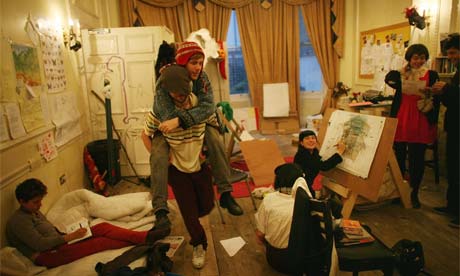
Another prime example is seen in the press that a group of British artists received when they essentially hijacked a vacant multi-million dollar mansion. Late last year, the artist collective Da! moved their group into 18 Upper Grosvenor Street, one of London's more exclusive neighborhoods. They lived and worked here for at least a month with no word from the owners and no word from the cops. I can see this becoming a trend in America, with so many mansions going into foreclosure or sitting on the open market. Perhaps there will be a slight role reversal, where the homeless end up taking over these huge mansions because nobody can afford them or to maintain them. I mean, you can already get 3000 sq ft of 1920's craftsmanship for under 100k in Detroit, why even waste your time with money anymore? Just move in! Some cities are even working on programs to move the homeless into foreclosed homes, according to Fox News. If you want a mansion for nothing, now just may be your chance.

Finally, one of my favorite artists/designers just released a transportable abode for the homeless. I know this has been an ongoing project in every architecture school in the world for the last 50 years, but nobody does it quite like James Westwater. There is something compelling about his project, "homeless chateau," and the idea of living in a rectangular prism in an abandoned warehouse. How different is this from living in a warehouse loft? Having neither heat nor electricity would be rough, but you're not paying $3000 a month. Anyways, I'm not really suggesting these are real lifestyle choices that will become widely popular anytime soon; I'm simply suggesting these ideas are growing in popularity.

In order to dig further into this idea that we are being inspired by the conditions of being poor -- conditions that will increasingly affect the middle class worldwide -- I will investigate 3 divisions of urban planning which directly connect to choices in lifestyle and are dictated by income. Those divisions are Transportation, Food, and Shelter. Over the next 2 weeks I will dive into each category and explore the trends that are leading to a more frugal lifestyle for citizens of big cities.


(Photo from NYT, Gurdian, and James Westwater. The original full-sized color version can be viewed by clicking the photo.)

Friday, December 5, 2008

Revisiting The Radiant City


A note accompanies this photo in Le Corbusier’s The Radiant City (1933):

“outside our apartments in the Radiant City: we come home from work and change; our friends are there waiting. High spirits, physical activity. And then we can go on to think about the 'serious' things afterwards."

I can see myself now, coming home after a long day's work and running the steeplechase with my neighbors. :) Le Corbusier’s plans, while at times charmingly unrealistic, are also blamed for inspiring the spread of giant housing projects in cities around the world. But is there enduring value in his thinking?

Two possibilities come to mind: 1) his embrace of new technology to improve living conditions, and 2) his use of space to minimize the ground cover of buildings.

As for technology, Le Corbusier tended to adopt ideas of mass production uncritically. However, his thoughts on prefabricated structures have great potential. As evident in the recent exhibition Home Delivery: Fabricating the Modern Dwelling, the featured houses in Dwell Magazine, and the assembly of LivingHomes, prefab architecture is coming into its own. What if we could design our own houses from components displayed online? Would this result in monstrosities or homes well-adapted to our needs? Could this be a way of realizing some of the building ideas in Christopher Alexander’s Pattern Language?

While Le Corbusier's use of space wouldn't work for everyone, tall buildings on pilotis with roof gardens would minimize the acreage occupied by our homes. This could bring benefits associated with energy efficiency, biodiversity, carbon sequestration, and (provided that amenities are within walking distance) reduced dependence on automobiles. I don't suggest that everyone should live in this kind of building, and the architecture could use rethinking; still the idea of freeing up space for agriculture, forests, and recreation sounds promising.

Although we might not find spontaneous track meets in our yards, I think Le Corbusier was on to something.

(Photo of runners scanned from The Radiant City. Photo of the Swiss Pavillion from www.culture.gouv.fr)

Wednesday, October 15, 2008

Is Urban Poverty An Acquired Taste?

"The whole idea of de-concentrating poverty was supposed to be that you would pick up middle-class values. But all it's doing is urbanizing the suburbs." [Emphasis added.]

That's what a suburban activist said about Section 8, a major U.S. government rent subsidy program for low-income people. The quote comes from a Cincinnati Enquirer article about how the program is creating clusters of low-income housing in the suburbs as poor people from Cincinnati's inner city move there.

My first reaction—a knee-jerk urbanist reaction—to the quote was: "Good! Suburbs are fake; cities are real. A shot of poverty will make the suburbs more real."

But then I realized I had accepted a questionable assumption: that poverty is somehow inextricably linked to and emblematic of urban life.

Do I actually believe that?

In America, poverty is more concentrated in urban areas. Still, there's lots of rural poverty in America and elsewhere. In European cities the poor tend to live in the suburbs, while the well-off inhabit the central city. And I know, of course, that cities are engines of economic growth. So, while the urban/poverty association does make some sense, it's also clear cities don't have a monopoly on poverty.

There's something else right about the linkage. I think it's this: Unlike some suburbs and gated communities, it's not as easy for cities to exclude undesirable things like poverty. And it is this vulnerability to what's in the world—including poverty—that gives cities more authenticity.

Cities—with their layers of old and new, their sediments of success and failure, their grime and glitter, their wealth and poverty—are real places par excellence. This authenticity is a meaningful part of why I like living in a city. Poverty is a sign you're living in a real place.

But where this idea could lead freaked me out.

Does appreciating the authenticity of cities entail liking failure, grime and poverty? If we eliminated poverty would cities bore us? Do city-lovers love cities because they're difficult to love? Because they enable the flexing of snob muscles?

The idea that savoring city life might mean acquiring a taste for poverty—because that's one of the spices required for the full flavor of authenticity—is revolting.

Thankfully, I don't think anybody has to buy this noxious idea.

Here's why not: There's nothing wrong with the desire to live in the real world—even a world that includes poverty and failure. Just as you can love your family even when it includes your depressed, grouchy sister and not have to love depression, you can take pride in cities even when that pride is partly based on an authenticity that includes poverty (something you don't have to feel proud about.)

Nor does being proud about city life mean you're obligated to regard poverty as an eternal feature of the human condition. We can—and should—fight poverty even though it's a tenacious and complex problem. Like your sister's depression, poverty might be preventable—and, at the very least, is certainly worth controlling and ameliorating.

For the record, I bet that people not distracted by the misery of poverty will contribute more excitement to cities, not less.

Let's return to what the suburban activist said. While there is evidence that moving out of poor city neighborhoods into middle-class suburban neighborhoods does benefit some poor people, the activist is right that poverty's problems won't just blow away in the fresh suburban air. Still, the claim that poverty is for cities not suburbs strikes my urban-biased mind as a very suburban attitude. Which is to say, fearful and irresponsible—and definitely not something to be proud about.

Wednesday, August 6, 2008

You Have to Earn It

(Cross-posted from the Neighbors Project blog)I'm moving out of my current apartment at the end of the month. When I go, the next people to live here will be paying literally almost twice as much as I currently pay in rent. My neighborhood -- on the border of Wicker Park and the Ukranian Village in Chicago -- is being gentrified. I feel weirdly responsible, even in my leaving of the place. Since I don't have any control over the management company, I'm not really doing anything, per se; but as it turns out, that's exactly the problem.

Moving to a new neighborhood does not guarantee that you will be welcomed into the existing community -- especially when the neighborhood in question is going through large-scale change. I was reminded of this fact this morning while researching today's Neighbor News post. I came across this story from Pittsburgh, where a team of young urban farmers has created a working farm in one of the poorer areas of the city, bordered by one of its most infamous ghettos, The Hill. One of these people articulated quite nicely the idea that first got me involved with Neighbors Project last fall: "We're aware we didn't grow up in the Hill," she said. "We have to earn a place here."

When anyone, young or old, moves to a new neighborhood, they become agents of change. There will be things that we make worse for some people, and things that we make better for others. Few people can claim to wield the power of a developer or city councilman; indeed, our impact on a new neighborhood, as individuals, is small, but it is still important. The choice that we are each presented with is: will I merely pass through this neighborhood, or will I earn a place here?

I'll let you in on an embarrassing little secret: I never really earned a place in the community that I'm moving away from. I had originally intended to stay longer than I'm going to wind up staying, so I'd just assumed I'd get more involved in the future. I heard about neighborhood meetings and saw people out on their stoops, but I was always in a hurry. Even working closely with a group like Neighbors Project, it was easy to feel too busy to engage with my own block.

And now I can't help but wonder if, had I gotten to know the people living around me, I might have been able to find a way to keep my apartment affordable. Maybe one of my neighbors has a relative or a friend moving to town, and I could have re-signed my lease and subletted the apartment. It's a pretty fruitless line of thinking, really, since the past is the past and the rent has already been hiked. Still, it's disturbing to see how much impact a lack of effort can have, and it's made me remember why it's important to slow down and engage with my surroundings.

When you move to a neighborhood, and are immersed in a new community, remember that doing nothing within that community is doing something.

-----------

I wrote this post recently for the blog of Neighbors Project, a nonprofit that I've become more and more involved with since I first reported on it a year ago. I've been working for NP over the summer and recently joined the National Board of Directors, and I figured that, since I can put a little of the blame on NP for the lack of posts on Where, I'd cross-post to share a bit of what I've been up to. As for Where, there are big changes on the horizon. More on that later. For now, get out and earn your place in your neighborhood.

Monday, July 21, 2008

Creative Density

A trailer park, inserted neatly into a long central lot on an oversized block in Bangor, Maine. It looks a bit like a zipper, no?

Sunday, April 13, 2008

Urbanffffinds 026

So what I actually meant when I said "no new posts" was "no new long, fancy-pants psuedo-philosophical ramblings." Urbanffffinds is too fun to put on hiatus. Besides, the crop this week is hot. And so:


And the Winner is...

"As a way of improving safety and bridging the gap between the city core and the bulging periphery, the city has launched a Defense of Modern Ruins program, stringing together blighted sights that range from industrial sights to downtrodden art-déco buildings to bureaucratic baroque whales. The program includes low-rent housing schemes, urban wilderness tours and itinerant party circuits."

Congratulations to H.B., whose entry in the Blogedanken contest recieved almost a full 50% of the public vote.

Many thanks to all of the participants for making this a fun impromptu blog-event. Note to the winner: shoot me an email and your copy of Hyperborder will be in the mail.

Friday, April 4, 2008

WEEKEND READING: March 29-April 4, 2008

First things first: MONU has put out a Call for Submissions for their upcoming issue on "Exotic Urbanism." Sounds freaking brillaint. Now, on to this week's cream o' the crop.

ITEM ONE: New-ish blog Boredom Is Always Counter-Revolutionary with a cutting rant about advertisements, architecture, and envisioning the city of the future.

ITEM TWO: Lee Bey has his own cutting rant this week, this one zeroing in on race, crime, and public housing in Chicago. Spot-on.

ITEM THREE: Switching gears a bit, MNP's post on suburb-eating robots will blow your mind and tickle your funny bone. (Photo credit)

ITEM FOUR: Interchange blogger Scott Page on DIY Urbanism and the upcoming Wicker Park Bucktown workshops in Chicago.

ITEM FIVE: CS Monitor examines Hugo Chavez's plan to build a Venezuelan Brasilia of sorts. Welcome to Caribia, the 21st Century Socialist City.

ITEM SIX: Some eye candy from The Map Room -- a collection of late 19th and early 20th century maps of Latin American cities.

ITEM SEVEN: More humor to cap things off this week. The Onion features an hilarious exposé on the aristocrization of gentrified neighborhoods in American cities (via Super Colossal).

Adios, compadres. See you next week!

Tuesday, April 1, 2008

Blogedanken Public Poll

Here are my favorite entries from each of the six Blogedanken participants who submitted full responses. Take a quick read-through, pick the one you think is the most interesting, and vote in the public poll at the bottom of the post. One-two-three, and by April 10th we'll have a winner! That person will then recieve a copy of Hyperborder, courtesy of PA Press.

Patrixbanx
(Portland, Maine, USA)
It sure would be nice to have a suburban commuter rail network in southern Maine. It would be even nicer if the commuter rail stations weren’t sited in the middle of vast parking lots, especially closer to the urban core. So why not allow development to cluster around those stops, like say Morrill’s Corner? And by development, I mean dense development. We’ll need to reform our zoning to encourage such growth, of course – not just by creating incentives for density but by creating disincentives for sprawl as well. Oh, and remember – this is Maine, a land that get’s pretty damn cold over the course of our long winters, and global warming hasn’t turned us into South Carolina just yet. Yet I hear tell of other cities even further north that are colder and get more snow than us, yet still manage to have a vibrant street life even in depressing old February. We gots to have that. I don’t know how exactly but if we’re going to discourage driving so we can have more walkable and transit oriented neighborhoods, we might as well make the streets of Portland a pleasant place to be in the depths of winter – bike and pedestrian friendly snow clearance, warm transit shelters, fun festivals, whatever it takes.

Medea
(Medellin, Colombia)
24 hour public transportation makes shifts easier to stagger, so bus drivers are not competing with each other in hazardous maneuvers. Every bus and taxi driver will receive mandatory drivers ed and courses on politeness and good manners. If they are rude or customers complain, their punishment won´t be a fine, but they´ll have to do public service hours cleaning the riverbanks.

M.B.
(Mexico City, DF, Mexico)
As a way of improving safety and bridging the gap between the city core and the bulging periphery, the city has launched a Defense of Modern Ruins program, stringing together blighted sights that range from industrial sights to downtrodden art-déco buildings to bureaucratic baroque whales. The program includes low-rent housing schemes, urban wilderness tours and itinerant party circuits.

T H Rive
(Victoria, BC, Canada)
Wireless capable crosswalks.
Edit: *apologies for the absolute shortness of mine. explanation: The crosswalk I was requesting was the ones that go green on ALL sides so that diagonal crossing is validated. It's quicker. The wireless part was more outdoor, cafe oriented Etc green wireless spaces. The result of the mixup?>> Wireless Crosswalks. Still a good idea. (4/1/08 5:38 PM)

Dan Lorentz
(Lexington, Kentucky, USA)
Organize a strong city-wide neighborhood group to promote mixed-use planning that supports street-level vitality, and make the first priority of that group the reweaving of the city's street web to create more corners for mixed-use development.

Petersigrist
(Cambridge, England, UK)
Hovering leisure boats with transparent roofs and floors, which hover about twenty feet in the air and provide lifts around town above underwater gardens with glass walls at street level as well as terraces, balconies, shops, and restaurants that open onto the streets and river


Remember: vote or die! (Hah. Always wanted to use that in context).

Friday, February 22, 2008

WEEKEND READING: February 16-22, 2008

You know how once a month or so Weekend Reading starts off with me getting all excited and writing something along the lines of "OMG you guys this week is SO GR8!! Read all of these they are AMAZIN! FURRILZ!"? Well, this is one of those weeks.

Read all of these. They are amazing. For reals.

ITEM ONE: Tijuana's enterprising spirit influences the design of a new affordable housing project in Hudson, NY.

ITEM TWO: Airoots features another great post about resistance to the Dharavi Redevelopmet Project in Mumbai, this time focusing on the efforts of the fiercely independent neighborhood of Koliwada.

ITEM THREE: Hayley Richardson on the obnoxious futility of twenty- and thirtysomethings bemoaning the loss of "authentic New York," a place that most of them never really knew in the first place.

ITEM FOUR: All About Cities pulls some great Lewis Mumford quotes, including the following gem: "The chief function of the city is to convert power into form, energy into culture, dead matter into the living symbols of art, biological reproduction into social creativity."

ITEM FIVE: A spectacular and almost disturbingly detailed map of London, reimagined as an island. (Photo credit)

ITEM SIX: Part IV highlights some recent articles about the Untergunther, a subgroup within les UX, which is itself a group of people "who are on a mission to uncover and exploit the city’s neglected cultural underworld."

ITEM SEVEN: AdaptiveReuse.net is a blog about creative adaptive reuse projects around the world (natch).

See, what did I tell you? That's some good stuff right there. See you next week!