Showing posts with label cities. Show all posts

Wednesday, July 8, 2009

Coming Back to the City


The American city has taken quite the rollercoaster ride over the past 70 years. For the half century following World War II, anti-urban sentiment managed to keep pace with the United States’ unprecedented affluence, creating glistening suburban landscapes that surrounded increasingly troubled urban cores. Eight of the ten largest US cities in 1950 recorded their historical population peaks that year (only New York and Los Angeles continued to grow after that census).

This trend has reversed itself in the past couple of decades, of course, and most cities have benefited from the newly widespread appeal of urban living. As Mark Twain reminds us, though, history tends to rhyme rather than repeat itself, and the rebirth of cities is no exception.


A few months ago, Marc described a phenomenon he called Earbud Urbanism. Contemporary technology as epitomized by the iPod, he wrote, now allows us to replace our actual surroundings with personalized content, one sense at a time. Kazys Varnelis made a similar point last week, just before the 30th anniversary of the Sony Walkman. The Walkman, he wrote, symbolizes the recolonization of US cities just as boomboxes (perceived as “sonic assault devices”) symbolized the height of urban tension and decay.

Why, then, did cities become more appealing in the 1980s and 1990s? Perhaps Earbud Urbanism contributed by making it easy to ignore the unsavory elements of urban environments. In the 19th and early 20th centuries, cities teemed due to lack of choice: If you wanted to do certain things you needed to be in the city. Now, our choices have increased exponentially, and comparatively few people truly need to be located at any one place in order to do something. Everyone’s loved ones are just a virtual arm’s reach away, consumer products can be delivered to some of the most remote places on earth, and one can practically run a business without rolling out of bed. The physical locations of jobs seem to follow people to where they’ve decided to live, instead of the opposite.

Perhaps the suburban fortess mentality of the postwar era gave way to a subtler kind of fortress mentality. The affluent who have chosen to return to the city have come back on their own terms, not the city’s. Many inhabit condos that are sealed off from the surrounding urban environment, with plenty of parking infrastructure to facilitate driving everywhere else. The same high-end chain stores, also with ample parking, have even filled in the formerly industrial spaces of many cities (Chicago’s Clybourn Corridor, for example). And when we do have to venture outside of our comfort zones on foot, of course, we have our iPods to keep us company.


(Photo from Flickr user fensterbme.)

Friday, April 3, 2009

Regional Distributions

Photo of suburban housesMuch has been made of suburban change in light of the subprime mortgage crisis. Articles such as What Will Save the Suburbs? and The Next Slum? offer new ways of looking at suburbs, with important implications for cities. A post at Design Observer by Andrew Blauvelt (co-curator of the Worlds Away: New Suburban Landscapes exhibition currently on view at the Yale School of Architecture) offers an interesting perspective on these issues.

Blauvelt finds that suburbs are taking on qualities commonly associated with cities, and vice versa. For example, suburbs see increasing diversity, congestion, and poverty as cities experience gentrification, detached housing, and chain stores. Blauvelt considers cities and suburbs mutually dependent, both from physical and psychological perspectives. He explains that "[c]ity dwellers and suburbanites need each other to reinforce their own sense of place and identity despite ample evidence that what we once thought were different places and lifestyles are increasingly intertwined and much less distinct."

While ideas about cities and suburbs take many evolving forms, their spatial relationship is fairly constant. At a basic level, suburbs are defined by their location on the outskirts of cities. They could be thought of as a gradient between areas of more and less human density. Modern transportation spreads this gradient, like spray-painting a dot on the wall from a distance. What if the density equation were inverted to resemble a spray-painted ring? Or if we were dispersed like stars across the sky? What cultural and ecological changes might take place in the absence of dense urban centers?

(Photo credit: East Hampton Historical Society)

Friday, March 6, 2009

Introducing Urbanism: Top Books for Curious Novices


In January, I asked Where readers and contributors what books they’d recommend to introduce the basic concepts of urbanism to curious, non-expert friends. I asked for a short list of accessible, concise books.

Since the initial query more than 30 titles have been suggested. Because I was already familiar with only a handful of the books, I headed to the library to get better acquainted with at least some of the other suggestions.

Based on that library visit, on posted comments from readers, on behind-the-scenes advice from Where contributors and my interpretation—from my own very amateurish (and American) perspective—of what counts as “accessible” and “concise,” here are five books about the basics of urbanism that I’d now recommend to relatively clueless, but curious friends.

Almost all of the links in this post connect to Google Book Search.

The Top 5

1. The Death and Life of Great American Cities by Jane Jacobs (1961). At about 450 pages, “concise” is probably not the most apt description of this book. But, as this is the single best written, most accessible, most compelling book I’ve ever read about cities, I’m willing to forsake the concision criterion even in my first recommendation. If you want to know what can make cities pleasant, safe and interesting places to live, read this book. If you want to read one of the best non-fiction prose stylists of our time, read this book. It’s a classic, and deservedly so. As one Where reader put it: “It’s a great book for explaining why we care about all of this.”

2. The Option of Urbanism by Christopher Leinberger (2007). While not as fun to read as The Death and Life of Great American Cities or The Geography of Nowhere (see below), this slender volume briskly highlights difference between drivable sub-urban development and walkable urban development, and does a good job of explaining the benefits of walkable city neighborhoods. It’s good primer on the basics of density, zoning and the hidden subsidies fueling drivable sub-urban development.

3. The Geography of Nowhere by James Howard Kunstler (1993). This book is an exploration—and excoriation—of the rise of suburbia and sprawl. It also explains how the more traditional patterns and places of city life and country life are superior to the “geography of nowhere.” Accessible and ferocious.

4. Cities Back from the Edge by Roberta Gratz, with Norman Mintz (1998). According to a Where reader, this book is “in the spirit of Jacobs” and discusses “how existing cities can be improved with citizen participation in contrast to destructive master plans.” The book is filled with lots of specific ideas about how to improve downtown areas, all of them lavishly illustrated with real life examples from successful efforts in dozens of cities.

5. How Cities Work by Alex Marshall (2000). Squarely aimed at the lay person, this book seeks to discover what forces shape places and cities—and finds that one of the most powerful forces is political choices, particularly those having to do with transportation policy. A Where reader gave this recommendation: “It’s not comprehensive, of course, but it’s a good snack, possibly the kind that could interest a person in a larger meal.”

A Tall Stack of Other Suggestions

Many other titles were suggested. They’re all listed here in no particular order, with quoted comments—when available—from the Where readers and contributors who recommended them.

Cities of Tomorrow by Peter Hall is “a great history of urban planning, knowledge of which is essential for understanding modern cities.”

The Last Landscape by William Whyte “focuses on the benefits of relatively dense urban form.”

Good City Form by Kevin Lynch is a “very engaging overview of urban history and theory” with “compelling ideas for developing vibrant cities.”

The Granite Garden by Ann Whiston Spirn “introduces thoughtful ways of improving the relationships between cities and the ecosystems in which they’re built.”

Building Suburbia by Dolores Hayden covers the sociology and history of suburbia. “It's written in a way a layperson…can understand.”

Till We Have Built Jerusalem: Architecture, Urbanism, and the Sacred by Philip Bess “does a nice job” explaining “exactly why urban design matters.” It may not be a simple primer, but “a few of the chapters are perfect intros to the subject.”

The Old Neighborhood: What We Lost in the Great Suburban Migration, 1966-1999 by Ray Suarez is an “excellent introduction to the challenges experienced in aging, post-industrial cities, including Chicago, Cincinnati and Philadelphia.”

Building the Dream: A Social History of Housing in America by Gwendolyn Wright is “an essential resource for understanding the social movements and political processes that have shaped urban/suburban cultural landscapes.”

The Culture of Cities by Louis Mumford is a “great classic” by an “exceptional writer.” The book includes introductions to the ideas of Ebenezer Howard and Patrick Geddes, two influential early modern urban planners.

Crabgrass Frontier by Kenneth Jackson “does a great job of explaining how we ended up with the urban landscape we have,” and is “very accessible, too.”
http://books.google.com/books?id=On0iJsl0HY4C

The Power Broker by Robert Caro, while “not short at all, reads like a novel” and “illustrates the state of city administration and urban planning during the past century better than anything else I’ve ever read.”

Delirious New York by Rem Koolhaas and “On Liberty” by John Stuart Mill are good to read together because Koolhaas’s book “provides an essential perspective on why contemporary urbanism discussions are where they are today,” and Mill’s essay is a “classic for anyone who wants to learn about living with other people, things and places.”

Who's Afraid Of Niketown? by Friedrich von Borries “investigates the contemporary effect of global corporations on public space and urbanism.”

Books, essays, articles by J.B. Jackson because his “short, easily digestible” work “looks at cities and other environments in such a different way,” and “inspires people to think beyond the clichés.”

Psychogeography by Will Self is an “interesting anecdotal urbanist book.”

Nature's Metropolis: Chicago and the Great West by William Cronon is “longish,” but provides historical perspective on urbanism issues.

The Essential William H. Whyte as a substitute for the out of print City: Rediscovering the Center by William H. Whyte.

"Junkspace" an essay by Rem Koolhaas.

A Better Place to Live: Reshaping the American Suburb by Philip Langdon.

Poetics of Cities: Designing Neighborhoods that Work by Mike Greenberg.

The Living City: Thinking Big in a Small Way by Roberta Gratz.

To Scale: One Hundred Urban Plans by Eric Jenkins.

American Project: The Rise and Fall of a Modern Ghetto by Sudhir Venkatesh.

Off The Books: The Underground Economy of the Urban Poor by Sudhir Venkatesh.

(Photo from Flickr users danlorentz and docman. The original full-sized color version can be viewed by clicking the photo.)

Thursday, January 22, 2009

Posh to be Poor? Transportation

Over the last few years there has been a surge away from motorcar transportation towards public transportation and the bicycle. This can in part be attributed to the sustainable movement as well as the growth of our urban cores. In 2008, the number of people living in cities eclipsed rural dwellers for the first time. As cities become more dense, the efficiency of traffic becomes increasingly important and for residents, it becomes faster to take public transportation. Now, aside from public transportation, the bicycle is also seeing a boom in popularity as a primary mode of transportation for many city dwellers.


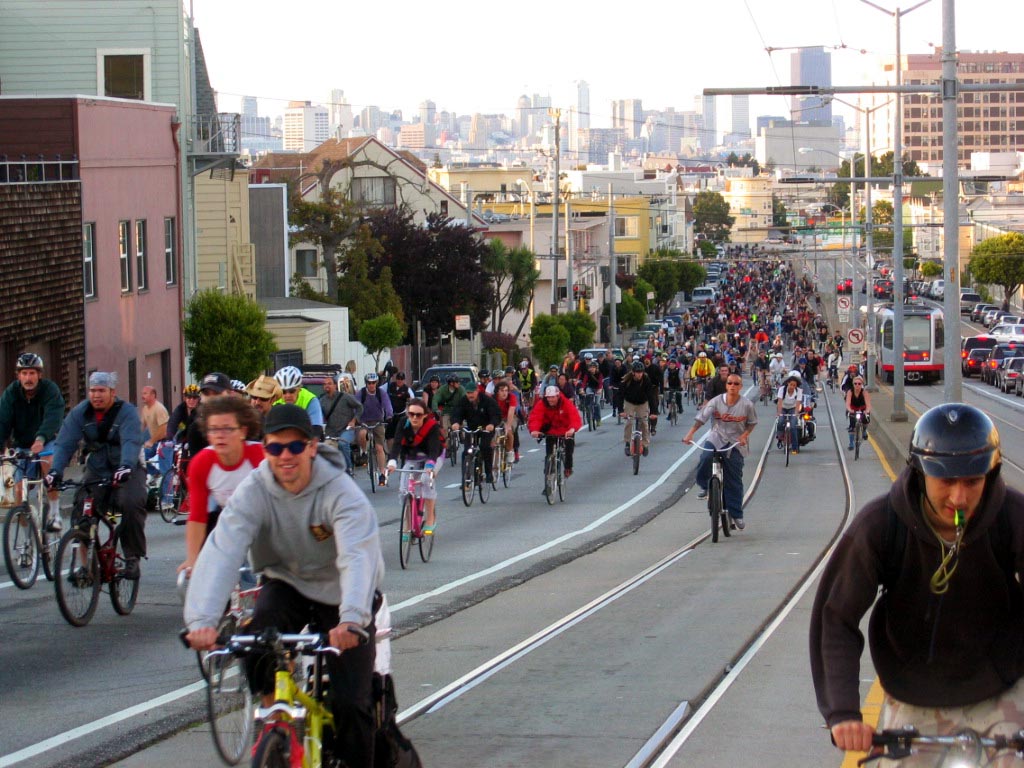
The bicycle is rapidly becoming the popular mode of transportation in large urban cores. It is cheap, you can find a decent used bike for 25 bucks that will get you around the city fairly well. Bikes are easy to maintain and aren't subject to expensive repairs as they age. No need to buy insurance either, or fill up on gas. These qualities make it a very attractive option for those who are strapped for cash. Also, it is environmentally friendly due to the lack of emissions and lower embodied energy than the automobile. So, this is an important turning point as people begin to look away from a more expensive, more convenient mode of transportation, to one that is significantly more affordable. In fact, New York city saw a 35% increase in people biking to work in 2008. Unlike public transportation though, biking has become a trend with thriving organizations such as Critical Mass advocating for increased ridership. It has become cool to ride a bike as demonstrated by the many celebs recently caught on 2 wheels. Lance Armstrong may have sparked a national movement toward road bikes, but the many bike messengers roaming our urban cores have sparked a fixed gear revolution. Once seen as tacky or radical, the bike messenger style has invaded western culture influencing clothing, style (messenger bag anyone??), and heck, transportation!


So why does this mean it's becoming posh to be poor? Well, because it's a move away from expensive transportation options, toward more affordable and accessible option. It's a move away from $30,000 SUV's toward $125 bikes (these are both averages of course.) Low income residence take public transit, they ride bikes, and they hop trains; 3 methods of transportation that will see a steep increase in 2009. As we enter into an age of frugality, where we find pleasure in the simple aspects of life, people will worry less about luxury and more about experience, an idea which has grown in prominence over the past few years.


Posh to be Poor? Introduction

(Photo from Treehugger The original full-sized color version can be viewed by clicking the photo.)
(Photo from SFGate The original full-sized color version can be viewed by clicking the photo.)
(Photo from Wikipedia The original full-sized color version can be viewed by clicking the photo.)

Thursday, January 15, 2009

Wanted: Best Books for Introduction to Urbanism


Let’s say you have a friend who wants to know what you’re talking about when you toss out phrases like “multiuse zoning,” “sprawl,” “density,” “urban infill,” “interconnected street girds.” Your friend also wants to know why you care about all this.

Let’s also stipulate that your friend doesn’t want to listen to yet another lecture from you on the subject.

What books would you recommend to this friend of yours?

Post your suggestions—any number of them—as comments to this post. Try to include a sentence or two about why you’re recommending a particular book.

Remember these are supposed to be books you’d recommend to a curious, non-expert friend with only a limited amount of time he or she is willing to devote to the subject—so think of concise, introductory-level books and keep your list short.

Next month, after soliciting advice from my fellow Where contributors (including any of their own suggestions), I’ll post a list of the top recommendations.

(Photo from Flickr user Dan Lorentz. The original full-sized color version can be viewed by clicking the photo.)

Friday, December 5, 2008

Revisiting The Radiant City


A note accompanies this photo in Le Corbusier’s The Radiant City (1933):

“outside our apartments in the Radiant City: we come home from work and change; our friends are there waiting. High spirits, physical activity. And then we can go on to think about the 'serious' things afterwards."

I can see myself now, coming home after a long day's work and running the steeplechase with my neighbors. :) Le Corbusier’s plans, while at times charmingly unrealistic, are also blamed for inspiring the spread of giant housing projects in cities around the world. But is there enduring value in his thinking?

Two possibilities come to mind: 1) his embrace of new technology to improve living conditions, and 2) his use of space to minimize the ground cover of buildings.

As for technology, Le Corbusier tended to adopt ideas of mass production uncritically. However, his thoughts on prefabricated structures have great potential. As evident in the recent exhibition Home Delivery: Fabricating the Modern Dwelling, the featured houses in Dwell Magazine, and the assembly of LivingHomes, prefab architecture is coming into its own. What if we could design our own houses from components displayed online? Would this result in monstrosities or homes well-adapted to our needs? Could this be a way of realizing some of the building ideas in Christopher Alexander’s Pattern Language?

While Le Corbusier's use of space wouldn't work for everyone, tall buildings on pilotis with roof gardens would minimize the acreage occupied by our homes. This could bring benefits associated with energy efficiency, biodiversity, carbon sequestration, and (provided that amenities are within walking distance) reduced dependence on automobiles. I don't suggest that everyone should live in this kind of building, and the architecture could use rethinking; still the idea of freeing up space for agriculture, forests, and recreation sounds promising.

Although we might not find spontaneous track meets in our yards, I think Le Corbusier was on to something.

(Photo of runners scanned from The Radiant City. Photo of the Swiss Pavillion from www.culture.gouv.fr)

Friday, November 21, 2008

Human Nature

Photo of the Portland skyline, trees, and Mt. Hood“[It] appears that we must recognise at least two principal meanings in the word 'nature.' In one sense, it means all the powers existing in either the outer or the inner world and everything which takes place by means of those powers. In another sense, it means, not everything which happens, but only what takes place without the agency, or without the voluntary and intentional agency, of man. This distinction is far from exhausting the ambiguities of the word; but it is the key to most of those on which important consequences depend.” John Stuart Mill, On Nature, 1874

Nature as a term can be inclusive and exclusive. It may include everything in existence or exclude products of human agency (e.g. cities, corn fields, art, technology, pollution) from the rest of the world (e.g. old-growth forest, boulders, elephants, fire, snowfall). Photo of Dolly the cloned sheepThe distinction is blurred when we think of tree farms, artificial lungs, and cloned sheep. Many words have dual meanings, but perceptions of nature can influence our place in the world. When nature is viewed exclusively, where does this leave humans?

The city is often considered separate from the natural world. As a remedy, some call for the integration of nature (usually trees) into urban settings. While I consider this a good thing, the terms imply that cities are not already part of nature. When people use these terms, they don't necessarily intend to be exclusive. It just reflects a deeply ingrained idea of nature without a clear alternative. According to inclusive views, cities are no less natural than birds' nests. Both are constructed by animals with material derived from the Earth. This is not a justification for environmental abuse, but simply an understanding of human activity as within the scope of nature.

Photo of Earth seen from spaceI like the idea that we are arrangements of atoms -- the same atoms that constitute the world around us. Some arrangements result from human action while others may result from the actions of bears, rain, or geological faults. Fortunately we are capable of conscious decisions, which can and should include a sense of responsibility for environmental well-being.

Perhaps it is enough to refer to streams, flowers, jets, and sculptures individually, reserving nature to describe the whole. All of the examples above are human concepts, and all are composed of material from the (natural) world. If this view of nature is too inclusive to be useful, is there a simple way to distinguish beehives from buildings, ponds from swimming pools, sunsets from street lights ... ?

(Photo of Portland from Adrian's Photo Blog; Photo of Dolly from Next Nature; Photo of Earth from Wikimedia Commons)