Showing posts with label development. Show all posts

Friday, July 17, 2009

The New High Line

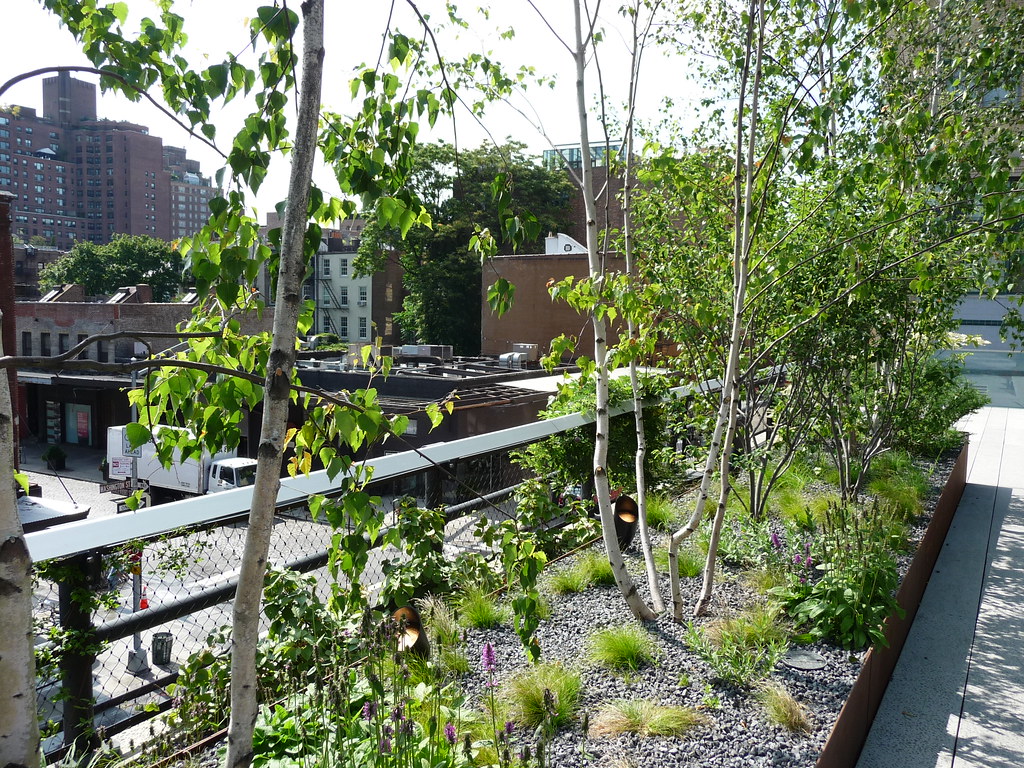
Photo of the High Line pathway

The High Line is an elevated park that runs along a portion of Manhattan's west side. It was once a railway, in use from 1934 until 1980. As vegetation took over, it became an informal and (not completely) inaccessible greenway above the streets. Neighborhood residents Joshua David and Robert Hammond started Friends of the High Line in 1999, hoping to save the structure from demolition and build support for the park idea. The city approved funding in 2004, and the lower section (from Gansevoort to 20th Street) opened in June.

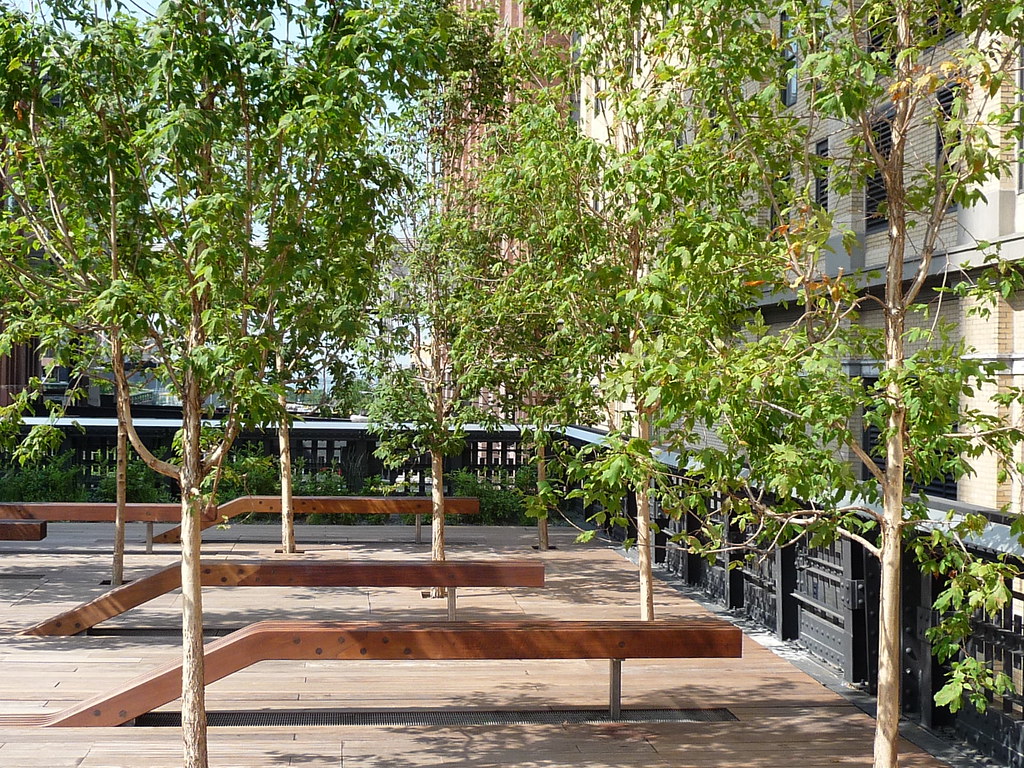
Photo of trees and benches along the High Line

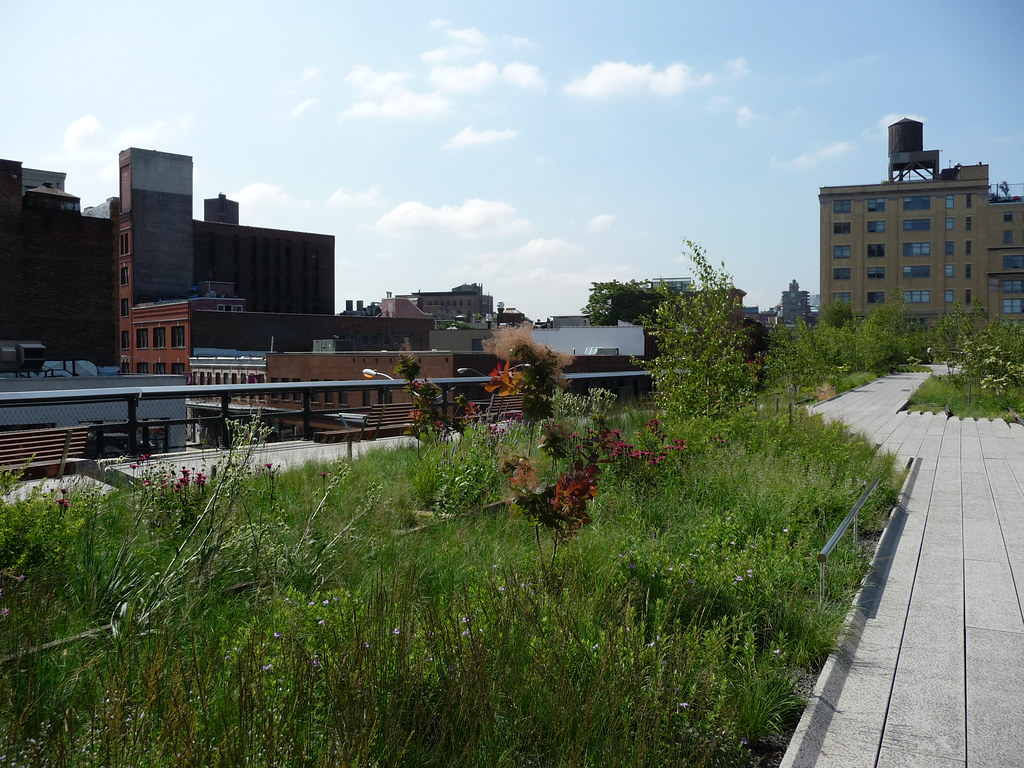
The park was designed by James Corner Field Operations, Piet Oudolf, and Diller Scofidio + Renfro. It is made up of pathways that weave through the original train tracks, as well as diverse plants inspired by those that grew in the absence of maintenance. The city plans to continue the park along the Hudson Yards to the Javits Convention Center. According to Mayor Bloomberg, the first section has sparked considerable neighborhood development, with more than 30 new plans now in the works. The Whitney Museum is building an extension by Renzo Piano at the Gansevoort entrance.

Photo of plantings along the High Line

On a recent visit, I was impressed by the High Line's varied landscape and playful atmosphere. It offers a different perspective on the city, where things come into view that are usually hidden from street level. The path moves along and through buildings, creating excitement in the discovery of new environments.

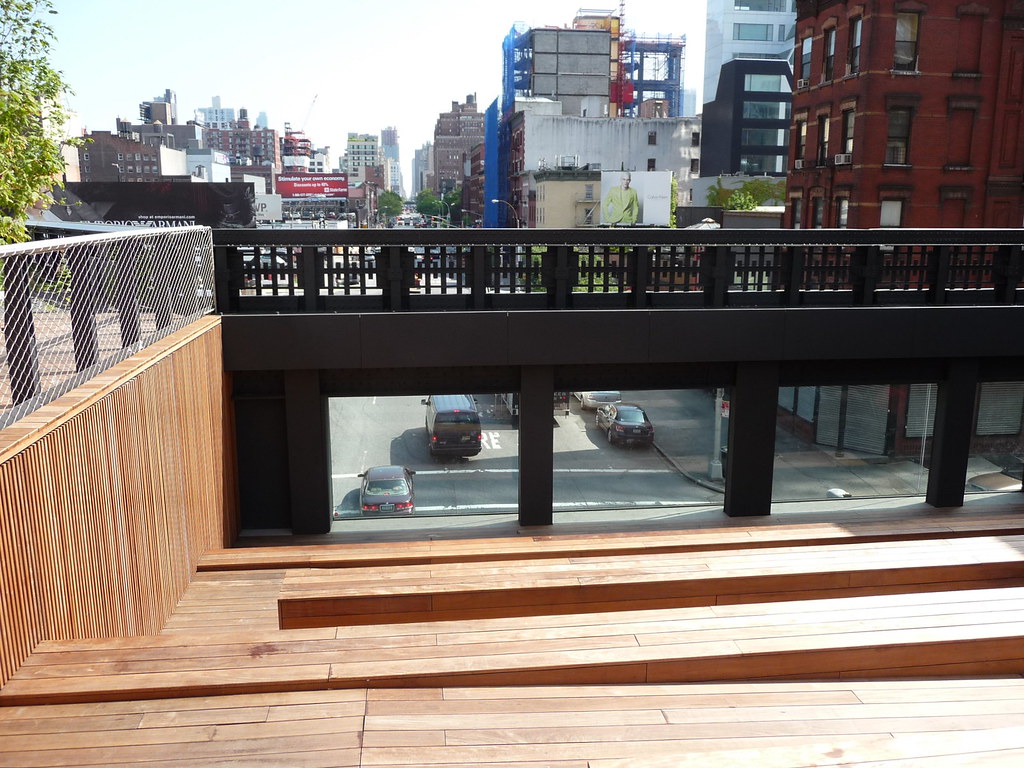
Photo of the theater onto the street at the High Line

The architecture is kind of slick, but it also has a relaxed, inventive feel that plays well against the seasoned ruggedness of its surroundings. I really like the idea of including the original train tracks. This might be even better if their continuity could somehow be maintained. They currently seem like set pieces rather than historically integrated parts of the neighborhood. I loved the rolling chairs on tracks, and the vegetation is tough and beautiful. The spectator windows onto the street (or into the park) are an interesting concept, framing everyday life as entertainment. However, I'm not sure the frames and stepped seating add much to the view, and they seem to draw energy away from the path. These opinions, however, are especially inconsequential in light of the overall greatness of the park.

Photo of rolling chairs on tracks at the High Line

The High Line is a wonderful part of the city's changing ecology, one that builds upon the old in shaping the new. I recommend starting with the exhibition Mannahatta/Manhattan: A Natural History of New York City at the Museum of the City of New York. It includes detailed reconstructions of the island before modern development, giving a sense of how our current moment fits within the area's unfolding story.

(Photos by Peter Sigrist)

Thursday, June 18, 2009

Networked Urban Politics


"Participation is war. Any form of participation is already a form of conflict", says architect and activist Markus Miessen, following Chantal Mouffe: "It is very important to envisage the task of democracy in terms of creating the institutions that will allow for conflicts between adversaries." Mouffe, a Belgian political theorist, has theorized on the notion of a "conflictual consensus", in which only a minimum common aim (democracy, equality, justice, etc.) needs to be settled and agreed upon within a society. The means for reaching this aim and even the meaning of the aim itself, on the other hand, can and should be disputable.

Miessen is more concerned with the spatial effects and possible materialization of these conflictual consensuses, particularly by way of everyday urbanisms: "When participation becomes conflict, conflict becomes space. Re-inserting friction and differences into both the scale of the institution and the city bears the potential of micro-political forces that render conflict as practice. In this context, participation becomes a form of non-physical, productive violence. Micro-political action can be as effective as traditional state political action."

- - -

Technologies that enable participation have become a staple of contemporary life, overcoming distance, economic limitations and even political constraints. Teens in Ciudad Neza are glued to their cell-phones just like their counterparts in Midtown Manhattan (though they might be planning a stickup instead of a cocktail soiree). ICTs have become so important to the functioning of societies that mobile phones are being handed out by governments along with food stamps and the One Laptop Per Child project seems demure compared to the aggressive downward pricing spirals of the netbook market. Today, 24/7 global connectivity is closer to practical reality than to some outlandish fiction.

- - -

From the nineteenth-century barricades to the revolts of 1968 to the social disruptions of the early 1990s, The Street was always an ideal escape valve for urban tensions and the preferred site of high profile (spectacular) political and social demonstrations. The Street was the perfect set for frictions. But if, as we’ve said before, The Street has systematically been loosing relevance, doesn't it make perfect sense that The Web take its place in this sense too?

- - -


The political perceptions and consequences of The Web and networked urbanisms differ intensely according to specific geographical contexts.

Here in Spain — not quite the First World, but still — there is a bubbly enthusiasm over new technologies and the promise of what they might deliver: salvation from impending economic fallout, a new dawn of proactive citizenship, gaining a steadier foothold in the Developed Nations club (after the brick-setter, real-estate-speculator and tour-guide triad has been widely acknowledged to be a flop as far as development schemes go), etc. Lethargic institutions, burned-out public universities, covetous town halls and ailing private companies are all eager to jump on the digital bandwagon here. The government is lending money for laptops, funding mediateques and data centers, talking Citizenship 2.0, etc. Hopes are high and the atmosphere is cheery, but approaches remain largely superficial or are limited to insiders, specialists and bureaucrats.

This is not the case in the Third World.

- - -

My browser is stuffed with Tehran bookmarks. Just like Cuban bloggers sneaking into Havana hotels to post their thoughts and opinions on the web or massive reactions to government corruption cases prompted by unofficial on-line reports in China, web activists and connected common-folk in Iran are opening channels for a new understanding of urban (networked) politics — proving at the same time that networked urban realities are far from being pretty or easy to grasp. The Street (Web) resistance that is shaking Iranian cities along with our reductive and jaundiced perception of Iran (Remember the days when thanks to George W. Bush — and to a lesser degree, Sally Field — Iran rarely evoked something other than a helplessly closed and traditional society?) is one of those events that change people’s gut perception of history in the making. But there is an additional element here. Like the Obama election or the global response to the Swine Flu affair, the unfolding of these fundamentally urban episodes and our reactions to them cannot be separated from the presence of digital technologies.


(Photos from Flickr user misterarasmus. The original full-sized color version can be viewed by clicking the photo.)

Friday, June 5, 2009

Forest and the Fast Lane

Photo of a metro station in MoscowWhen it comes to transition, it seems there is a lot to learn in Moscow. I'm currently writing from there, after a day of walking around and taking a few pictures. The things that really stand out are the lasting marks left on the city from very different governing ideas: ornate metro stations, trees everywhere, aging apartment blocks, modernist masterworks, cars racing down streets that take an incredibly long time to cross. Everything Stalinist is gigantic.

Many public works have aged remarkably well. The metro stations are efficient and well maintained. The ones in the center of town have all kinds of architectural touches usually reserved for mansions, theaters, monuments, city halls, and museums. There is a basic sturdiness that prevents them from seeming too extravagant. Public green space lines the streets and fills the insides of apartment blocks. It’s very refreshing on summer days. Parks are full of young couples, new families, and elders reading or just watching people pass by. The ones I’ve seen so far have been clean but not highly manicured, which gives them a kind of wilderness atmosphere.

Photo of a park near Moscow State UniversityThe trains and parks seem like lasting gifts from the past, although they’re surely changing with today’s frenetic market experimentation. The giant streets are much less successful from a pedestrian’s point of view -- like highways running through city neighborhoods. If they were narrowed and filled in with plantings, spacious sidewalks, and small businesses, the improvement for walkers would be significant. I can’t quite see this happening, as the young and wealthy seem to really love these roadways. They're good for drag races at night and 360 skids in the middle of the day. It all makes Moscow an interesting mix of values and ideas, like any city, but multiplied by something extreme.

(Photos by Peter Sigrist)

Sunday, May 31, 2009

Where is The Digital?


Digging into the Where archive, I found Brendan asking himself:

As the internet becomes increasingly ubiquitous and reality moves toward the virtual, the emergent Cyberspace will almost certainly take on an urban form -- though it remains to be seen whether it will lean more heavily on the physical or virtual world. Either way, geography will become less and less binding as cities learn to connect in ever more complex ways, and we will likely come to understand urbanism as something very different from what it is now.

Only a couple of years later, we're already there. Maybe it's time we started thinking of ways to answer these questions. Here go my two cents:

1. Marshall Berman's All That is Solid Melts Into Air is a double ode to Modernism and The Street. The Modernist Canon includes Dostoyevsky and Joyce, of course, but also Jane Jacobs. Urban vitality is supposed to culminate Modernism. Despite Jacobs and her followers (sometimes because of them), today The Street keeps loosing ground, through stale, celebratory urbanities. The Street is not only displaced or attacked anymore; it is manicured, mercantilized, neutered, over-regulated. Today, The Street is no longer The Street. The Street is The Web.

2. The Web has not only added to Modernist/Urban Canon. It is constantly reworking and dissolving it. The Web Canon is nothing like the usual Canon. The Web Canon is not about authorship. It is about the dissolution of Authorship, swaying back to a wilder communal mode or spirit (or rather a bunch of different communal modes and spirits bumping against each other constantly). (This is one of those eras of cultural dispersion we're entering, like the days of oral tradition or pamphleteering or independent broadcasting). What is Canon one day is forgotten the next. Some Canon never makes the cut, until it does. The Canon swallows every Canon before it. The Canon is The Web itself.

3. Anything cyber — cyberspace, cyberpunk, etc — reeks of Future Anterior and has a bit of that nostalgic (conservative) retraction from reality, even when dreaming up alternative realities. Incursions into cyber-whatever (Second Life urbanisms, virtual reality, etc.) are as much the future of The Web as digital renderings, parametric design and Dubai are the future of architecture and urbanism. Depending on where you stand, this means either everything or close to nothing.

4. Even when embracing and exploiting and dwelling on The Digital, any Networked Urbanism should recognize itself as deeply entrenched in everyday, physical, political, social and cultural realities. It should also acknowledge that it has significant, explicit, lasting effects on these realities.

5. I don't think geography has become "less binding". On the contrary, it's probably only starting to reveal its complexities. This is a matter not only of physical geography or distance we're talking about, but also of political and cultural geographies and distances.

6. The Web Canon might seem Western, but it's definitely not.

7. In one of the hundreds of Web Canon Classics (someone should start collecting them), Kevin Kelly discusses the production and spreading of digital content. He states that the impact of digitization will likely be most significant not in the Developed World (despite the abundance of resources, technical knick-knacks and gadgetry) but in the Third World, in areas that are practically bookless, or at least don't have an Amazon branch.

Something similar might happen with Networked Urbanisms. In the Developed World, Networked Urbanisms' potential might very well fade out under the weight of control and commercialization. The Kindle and the iPhone are the McMansions of Digital Urbanity. Networked Urbanisms could certainly profit from the chronic instability, forced flexibility, selective implementation, DIY and everything-up-for-grabs mindset, creative reuse and living-off-scraps culture of Third World urban realities as much as it already does from its pools of skilled tech workers, cheap manufacturing and shady practices like piracy and copyright infringements. The “digital breach” doesn’t necessarily follow the North-South divide.

8. The Plaza Meave is a huge semi-formal electronics bazaar in the heart of Mexico City’s Centro Histórico, or Historic Quarter. It’s a piece of urban infrastructure straight out of Sci-Fi: an anonymous, damp, smelly and seemingly innocuous building where people hawk and hustle pirated software, stolen or scavenged electronics, tuned hardware, abandonware, orphaned technology, and any random techno-spoils you can imagine. The market often spills over onto the street, and the tech stands mix in with food stalls.

9. I hate the “digital skin” metaphor. There is no such thing as an ICT blanket that just comes and covers or supplants “traditional” urban dynamics. If you’re going to use the usual cheap organicist metaphor, why not say “digital lymphatic system” or something like that?

10. Most of us are too quick to associate technological change with the brave and the new. But to me, one of the most interesting aspects of the digital onslaught is the novelty with which it feeds the past into the present and therefore the future. The Digital has an uncanny historical bent. It allows for and thrives on richer, more intense and diverse readings of the past. We are unburying the marginal, the secondary, the almost forgotten, the populist, the failed, the ephemeral, the quaint, the curious, the quotidian, the small, the foreign, the frilled, and so on and so forth, and inserting everything into our steady and active forward marches. The Angel of History doesn’t have to fly with its back turned to the future anymore. It can just gaze at the past on its iPod.


(I don't remember if I got the photo from Flickr or from Mark the Cobrasnake. If it's your's, please let me know!)
Friday, May 22, 2009

Transition States

Photo of transitional space in Harlem, by Camilo Jose VergaraDevelopment, use, abandonment, reuse, demolition, redevelopment. Transition states. It seems that everything is in transition, but here I'd like to focus on the span of time between clearly defined places like factories and forests.

Development includes combining separate elements into new forms, like making something out of legos. Materials are assembled into buildings, which in turn form cities. This may fulfill a need or function based on reactions to things that came before. In this sense, new things embody the past.

When a thing no longer serves its purpose, it is often abandoned. At this point it can be reused in its current form, reassembled into something new, or destroyed. But it can never really be destroyed. Nearly imperceptible parts remain in circulation. They integrate with other things. They may haunt us in ways more tangible than the ways we haunt places. Smoke can be like a ghost that haunts us.

Photo of plants growing on an abandoned houseIf left abandoned, things are said to return to nature. Not that they ever left, but they can again be transformed into something else. There is a period of transition. For a building, this may be when weeds start to grow around and within it, or when other life forms make it their home. Eventually it may be enveloped by a forest.

Plants are often considered therapeutic, like Mandela's prison garden. They are also zoned and regulated. We put them in our cubicles, malls, streets, airports, and they represent healthier locations. Why are the places we work not healthy in their own right? How did the real or perceived separation between healthy environments and work environments come about? What was the transition like? And how do we alter the resulting state?Photo of Nelson Mandela in his prison garden

We might consider what happens to the things we develop and abandon. Ideally they are reclaimed, reassembled, or disposed of with care. This is how we prevent a haunted world. Maybe this will help us improve the quality of work sites, or even change the nature of our work. As unhealthy places are abandoned, there is hope for transition. What will this transition be like?

In animation, creating a transition requires a momentary destination state. Maybe we can learn from this. If we envision a solution to each problem that confronts us, clearly defining our origin and destination, we should find improved transitions. Many people are doing this through ecologically oriented design, entrepreneurship, policy, architecture, education, activism, engineering, and other pursuits. Inclusive planning can help us work towards well conceived destination states. We'll still face the unexpected, but we can keep experimenting and solving problems as we move closer to where we hope to be.

(Credits: Photo of transitional space in Harlem by Camilo Jose Vergara of Invincible Cities. Photo of plants growing on an abandoned house from Houses of Tung Ping Chau. Photo of Nelson Mandela in his prison garden from City Farmer News.)

Friday, May 15, 2009

A New Urban Environmentalism?

Photo of Van JonesI'm not sure if there's anything left to say about Van Jones, the Obama administration's special adviser on green jobs. An article by Elizabeth Kolbert details his efforts to address urban poverty and global warming by putting people to work on green infrastructure projects. Jones explains his plans in a recent NPR interview. His work has captured the imagination of many, but does it represent a promising new form of urban environmentalism?

Jones is a political star. After graduating from Yale Law School in 1993, he moved to the Bay Area and began advocating for human rights in urban communities. He fought effectively to keep people out of jail, in gainful employment, and safe from police brutality. Jones traces his environmental interest to a talk by Julia Butterfly Hill, explaining that he admired and identified with her efforts to save a redwood tree. Photo of Julia Butterfly Hill in a redwood treeThe two found common ground in helping people and things considered disposable.

At a meeting with Nancy Pelosi in 2007, Jones brought up the need for a Clean Energy Jobs Bill. The idea caught on and was included in the Energy Independence and Security Act less than a year later. He has since published a book called The Green Collar Economy: How One Solution Can Fix Our Two Biggest Problems. In today's political climate of economic crisis and recovery, this concept makes environmental concern more politically viable. It has rallied unions, corporations, politicians, and local activists behind alternative energy as an agent for job creation.

Still, there is skepticism about the merits of combined solutions to global warming and poverty. Some see a lack of environmental concern among less affluent communities as a major impediment. Photo of smoke stacksOthers point out that environmental conservation places disproportionate strain on people living in poverty. Some policy experts see the two problems as too distinct to be addressed with a joint solution. Jones responds by explaining the benefits of a holistic approach that encourages combined efforts. He considers poverty alleviation without environmental consideration a short-term fix, resulting in greater problems down the road. He adds that people living in poverty will support environmental causes that address their most pressing needs.

Jones looks for points of agreement and makes the most of them. He peppers his speech with clear and memorable phrases that express shared interests, often playing with different meanings of the word green. At the same time, he's not shy about applying pressure against powerful opponents (skills sharpened fighting police brutality in the 1990s). Of course, it will take more than consensus and coercion for his current efforts to succeed. The jobs will have to be efficient and provide better sources of energy. A certain amount of financial loss is acceptable in return for long-term gains, but the gains have to materialize. Given the widespread support for these ideas, the timing is right to make them work.

Photo of Milton FriedmanSo, is Jones at the forefront of a new urban environmentalism? His work is different from environmental justice movements that have fought to improve ecological conditions in marginalized communities. Jones adopts the discourse of sustainable development, with a focus on poverty alleviation. He aims for consensus around human needs, rather than proposing a radical alternative to current forms of environmental management. As far as labels go, his ideas integrate three potentially conflicting -isms: social, capital, and environmental. His emphasis is clearly on the social, but only in the sense of prioritizing human concerns. If this renders him a socialist, then even Milton Friedman would be socialist. In reference to the urban, now that Jones is advising on green jobs for the entire country, his focus will have to expand to include suburban and rural communities. He has successfully articulated a vision that links inclusive economic prosperity with long-term environmental care. While this isn't new urban environmentalism, it is something more comprehensive and very worth pursuing.

(Credits: Photo of Van Jones from Green for All; Photo of Julia Butterfly Hill from Earthfirst; Photo of smoke stacks from the Hunter College Department of Geography; Photo of Milton Friedman from In Defense of Liberty)

Friday, May 8, 2009

Sitte in a Digital World

Photo of the Piazza dei Signori VicenzaCamillo Sitte thoughtfully explained the interior qualities of his favorite public spaces. Though generally open to the sky, they were surrounded by varied building types and furnished with stairways, arches, and sculptures. They were intimate and often irregular, with engaging views on all sides. He lamented the abandonment of plazas as daily life moved increasingly indoors.

Today life moves increasingly online, but the places we inhabit -- whether physical or virtual -- are no less important. Even looking out the window affects our state of mind. This is hard to measure, but it's fairly clear when we feel comfortable, depressed, inspired, fearful, or healthy in response to our surroundings.

Sitte envisioned outdoor space that didn't feel desolate. When we think of The Great Outdoors, we usually mean forests, mountains, rivers -- not cities. But in many ways forests have more in common with cities than with prairies or deserts. Drawing of the Piazza dei Signori from City Planning According to Artistic Principles, by Camillo SitteThey are full of proximate activity, and contain many unique places. I wonder how cities might eventually be considered part of The Great Outdoors.

It would be a stretch to think of online places in Sitte's terms, unless we include video games. Many games offer convincing and imaginative environments. They might help us understand the way people interact with physical spaces before building them. Although it doesn't seem possible to get a feel for a place before it is built, studying people's use of virtual settings can inform key decisions. This sounds expensive, but could save money in the long run.

Whether physical, virtual, or somewhere in between, environments affect the quality of our lives. Considering the factors that contribute to positive experiences, as Sitte did, is of great value. His observations have inspired generations of architects, planners, and concerned citizens to create and preserve beloved places.

(Photo of the Piazza dei Signori Vicenza from Flickr user Albert dj; Drawing scanned from p. 378 of Camillo Sitte: The Birth of Modern City Planning, by George R. Collins and Christiane C. Collins)

Friday, May 1, 2009

One Place at a Time

Photo of people working with bricks in DharaviAesthetics seem completely subjective. Although some people have similar tastes (based partially on shared experience?), variation is more the rule. So when it comes to the look of common spaces, attempting to please everyone may not be the best approach.

Quality might be a better standard. By quality I'm thinking of things like healthy environments, strong materials, ease of use, sound construction, and responsiveness to changing needs. Maybe quality can be attended to by governing bodies, but the direction must come from those who live in an area.

Shared space reveals distinct and often conflicting values. There are many who aren't concerned with the quality of urban settings. They may be more interested in maximizing profits, or just surviving from day to day. At the same time, they may have a high degree of influence over the way cities take shape. This combination often leads to inhospitable environments.

Part of the appeal of suburbs must lie in the provision of small plots of land over which we have control, places we can maintain, separate from the disorder of the commons. It's more difficult to care for areas shared by many people with different sensibilities and ways of doing things.

Although everyone's ideas for better cities are subjective and often conflicting, this doesn't mean we shouldn't gather as many people and resources as possible to realize them. I'm inspired by people who take account of their surroundings and make improvements one place at a time. While the improvements may be valued only by those who make them, their ideas will be tempered by the ideas of others, and the results will always be subject to change.

When it comes to shaping environments into places we love, it's up to us to care enough to make this happen. Those who aren't concerned with the quality of urban settings are pursuing their interests, so there must be others who will counter these interests. It takes people like Arthur Ziegler, urban farmers, and squatters to reshape cities.

But how can we find the time? Ideally, this would be something rewarded, or at least facilitated, on a societal level. As things stand, we have to make a living. The work that takes most of our energy is usually disconnected from the places we live. Unless we start some kind of enterprise dedicated to improving our surroundings, we have to struggle to find time in between other commitments.

If we don't have time, we can still support those who are working to realize ideas we believe in. Neil Smith has said that many people support movements for change when they feel desperate or when they see a chance of success. What would it take for us to get involved in improving our surroundings? And what would this improvement mean?

(Photo of Dharavi residents by Peter Sigrist)

Friday, April 17, 2009

Tending to Cities

Photo of the Plaza de la Constitucion de Oaxaca (Zocalo)Does it matter how a city or neighborhood looks? Many would say it does, though much less than, say, health or safety. So if it matters to some extent, what makes a place visually attractive? Are there any common characteristics, or is it only in the eye of the beholder?

Maybe "looks" is the wrong word. How about the way a place feels? This would include all the senses -- the different variables that make an area appealing. Of course, people have unique tastes and I don't know if there are any qualities loved by everyone. However, there are places generally considered attractive. They are usually in wealthier districts, but should extend to poorer communities as well. If we work towards achieving this throughout our cities, without displacing low-income groups, we might look back some day and wonder how we ever lived in some of the neglected areas we know today.

Maybe we can start by identifying the places people value most, why they are valued, and how to preserve them. (I'm not sure how best to do this. A popular vote doesn't seem practical, but maybe it would work. I wonder which areas would win out? Greenwich Village, for example, or Times Square?). We could go through a similar process for areas that people find unappealing, focusing on improvement. This might be considered a form of public participation in city planning. At the very least we would find out if there are any shared values among urban populations. If this kind of study reveals anything useful, it might inform the design of new places.

Photo of PittsburghA recent article on preservation in Pittsburgh shows how the adaptive reuse of urban areas can be an effective means of environmental sustainability. Cities are environments, and great urban settings should be valued and protected in a way similar to national parks. This is not a call to restrict new designs, but we can work to make sure the results are worth preserving. Setting standards for the quality of building materials might help. Design standards are another possibility, although that seems kind of arbitrary and stifling to creativity.

I wonder if there could be periodic review processes for all planned and existing development, assessing its contribution to the urban environment and how it might be improved. These reviews could address aesthetics as well as health and safety issues. Public funds might be used to make improvements. Sometimes small changes can make a big difference. A new paint job or facade can transform an area with minimal destruction of existing buildings. In other cases, shoddy construction can be removed to make way for something better. Would we be able to agree on what improvements to make? Who would be involved in the review process? How would we deal with the legal issues surrounding private property? There are many reasons why this would be difficult or impossible, but it would be great to set up a continuous process of developing healthy and attractive environments.

(Photo of Plaza de la Constitucion de Oaxaca (Zocalo) from The Project for Public Places. Photo of Pittsburgh from Statepa.org)

Friday, April 10, 2009

Considering Programmed Housing, Continued

Yesterday, Where featured a post about a proposed development in Albany that would provide affordable urban artist housing while providing valuable cultural services to the existing community by having the residents create and teach free and low-cost art classes, building a community service program into the rental agreement. But artistic development is not the only service that could be programmed into a housing development. In fact, when tax revenue is being used to stimulate the economy and efficiency has become the golden rule, programmed housing stands to give taxpayers a lot of bang for their buck by tackling multiple social problems at the same time.

Foreclosures have become headline news over the past year, and affordable housing has rocketed from being an oft-maligned political quagmire to being an oft-maligned political quagmire in the national spotlight. Public opinion of public and affordable housing is, as Where has argued before, not anywhere near as high as it needs to be at a time when millions of people are in dire need of a place to stay. The central problem here, from a PR perspective, seems to be that Americans assume all residents of public housing are lazy, riding on the government's coattails to avoid working or paying rent. Of course, access to jobs is one of the central reasons for why people actually need affordable housing, particularly in urban areas. Irony is, as the saying goes, a bitch.

To complicate matters further, the Brookings Institution announced the results of a new study on what they have termed "job sprawl" earlier this week. The study confirmed what many already knew: jobs have followed people out to the suburbs. Nearly every city in America has seen its share of the total metro population shrink drastically over the past half century, and now Brookings has hard numbers to illustrate just how drastically this has affected those cities' share of the job market, as well.

According to the study, the Virginia Beach-Norfolk metro area has the highest percentage of residents working within a mile of the city's central business district, at just 36.4%. New York City, with its infamous hyper-concentration of office space, only managed to come in second with just 34.8% of the metro workforce commuting to its CBD each day. That means that, in the best cases, only a third of people are working in downtown areas, which inevitably have the highest concentration of transportation options.

Transportation is the glue that binds these two problems -- a lack of affordable housing and access to increasingly spread-out job opportunities -- together. Affordable housing is only useful to workers if it is available in a location that allows them reasonable commute times to places where jobs are actually available. Many people in the States are finding themselves rather suddenly without a job or a home, much less the funds to drive around the city looking for either, or to drive an hour each way every day to work a part-time job for $8 an hour (if that).

With the need for affordable housing at an all-time high and urbanists hoping for a stimulus-funded urban renaissance, it only makes sense that we should be presenting decision makers at the Federal level with projects, like Albany's Academy Lofts, that can weave solutions to multiple problems together as efficiently and creatively as possible. Programmed housing has the potential to provide job-seekers with affordable housing while simultaneously providing them with an opportunity to continue building work experience, through participation in community programs, while they continue their search for paid gainful employment. Not only that, but since the work done at programmed housing developments would be on-site, transit costs would be accordingly lowered for residents.


The arts are an obvious starting point, but there's no reason why housing developments couldn't be built around legal clinics to provide students fresh out of law school (and saddled with the accordant debt) with a chance to cut their teeth, or around community centers offering technology classes and computer repair services. Programmed housing could be easily tailored to be double assets; by placing such developments in targeted urban neighborhoods where a lack of certain services was identified, these developments would help both the new residents and the existing communities toward economic recovery.

Programmed housing may not be a sure-fire scheme (a potential downside: turnover could make for some very ineffective services), but tying solutions to jobs, housing, and transit challenges together -- particularly in urban areas -- is certainly the most effective way to use stimulus funds. If we're not talking about multiple solutions at once, we're not really talking about a solution at all.


(Photo from Flickr users The Voice of Eye and your_nostalgia, and from Where@FFFFOUND!. The originals can be viewed by clicking the photos.)

Friday, April 3, 2009

Regional Distributions

Photo of suburban housesMuch has been made of suburban change in light of the subprime mortgage crisis. Articles such as What Will Save the Suburbs? and The Next Slum? offer new ways of looking at suburbs, with important implications for cities. A post at Design Observer by Andrew Blauvelt (co-curator of the Worlds Away: New Suburban Landscapes exhibition currently on view at the Yale School of Architecture) offers an interesting perspective on these issues.

Blauvelt finds that suburbs are taking on qualities commonly associated with cities, and vice versa. For example, suburbs see increasing diversity, congestion, and poverty as cities experience gentrification, detached housing, and chain stores. Blauvelt considers cities and suburbs mutually dependent, both from physical and psychological perspectives. He explains that "[c]ity dwellers and suburbanites need each other to reinforce their own sense of place and identity despite ample evidence that what we once thought were different places and lifestyles are increasingly intertwined and much less distinct."

While ideas about cities and suburbs take many evolving forms, their spatial relationship is fairly constant. At a basic level, suburbs are defined by their location on the outskirts of cities. They could be thought of as a gradient between areas of more and less human density. Modern transportation spreads this gradient, like spray-painting a dot on the wall from a distance. What if the density equation were inverted to resemble a spray-painted ring? Or if we were dispersed like stars across the sky? What cultural and ecological changes might take place in the absence of dense urban centers?

(Photo credit: East Hampton Historical Society)

Friday, January 2, 2009

Making Over Slumbai

When I first heard of the Mumbai Project, a series of articles tracking the progress of various urban projects in the city in the Hindustan Times – one of India's main papers – I was pleasantly surprised to hear of citizen engagement in the city's development. Launched in 2007 and revisited these past two weeks, the feature follows issues like airport redevelopment, transport projects governance and other facets of “Mumbai’s makeover.”

It turned out, however, that the articles exclusively summarize the perspective of the upper classes, who demand that their streets are smooth, their airports efficient and their city "world class." Never mind that that the majority of Mumbai's residents – 55% of whom live in slums – would be calling for a toilet, clean water and a secure place to live, if given such a platform. This exercise in citizen engagement unflinchingly makes clear who counts as a citizen, whom the city's "makeover" is intended to serve — and who is in the way.


This bias is unambiguous in the December 22 feature, which examined why reconstruction of pavements had not proceeded apace: “The reason? It’s more like 5 lakh reasons – that’s how many encroachers are currently hogging your pedestrian space across the city… With nearly 5 lakh encroachers, including hawkers, having made the city’s footpaths their permanent home, pedestrians are left with no space to walk on.” The header states that, "Encroachments by hawkers, squatters continue to plague pedestrians.” Clearly, the important question for an investigative piece on this subject is why pedestrians are troubled, not why so many people lack proper homes or spaces from which to sell goods conveniently to those same passers-by. The article quotes a municipal engineer as saying, "We had a huge demand for better footpaths from...citizens.” It is clear that those families forced to squat on the pavements do not fall under this definition of "citizen."

In "Tug-of-War Clogs Loo Project" on December 16, the series highlighted stalls in a state project to construct public toilets due to conflict over whether corporate or community-based interests would build and manage the toilet blocks. While the state handed the project to community-based organizations, the Brihanmumbai Municipal Corporation (BMC) wants private firms to construct the 227 toilet blocks. The article focused exclusively on this agency's misguided aim of building "five-star toilets" at the expense of community-managed ones. R.A. Rajeev, Additional Municipal Commissioner at the BMC, is quoted as saying: "We do not want to present the city as ‘Slumbai’. We need to construct toilets in a manner that reflects the changing culture of the city." Considering that most of the city's population continue to live in slums, and that these are the people who most need public toilets, this statement is laughable. The fact that community-constructed and managed toilets are more sustainable, more affordable and better managed has been demonstrated in India. The article also neglects to mention the fact that Mumbai's regional development agency has separately embarked on a community-based sanitation scheme in partnership with one of the pioneers of community-managed toilet construction, based in Mumbai. In fact, they didn't interview a single community organization or anyone lacking a toilet.

On December 22, the series examined the progress of a project to revamp the city’s drainage system to reduce flooding. The header was: "Slums still crowd areas around city's 150-year old drains, and unmapped utilities snake underground, delaying ambitious plans for flood-free monsoons." Slum dwellers would probably like more than anyone for the city to address its flooding problems, which can prove fatally dangerous. Slum residents – who often inhabit low-lying and flood-prone areas, have structures that are least resistant to rain and flooding and have little money to rebuild their homes – are most vulnerable to flooding. This article paints slum dwellers as obstacles to the goal of flood reduction, instead of portraying them as citizens who would also benefit from the project and presenting slum improvement and flood reduction as two sides of the same development coin.

The tone of the Mumbai Project highlights the frequency with which infrastructural and beautification projects are formulated in a way that pins city development against the shelter and livelihoods of the poor. Poor people who live in cities in the developing world often carve out space for themselves to live and work in the crevices of the urban infrastructure – along railway tracks, near airport runways, near sewage drains, on city pavements – because these are available spaces to set up shelter in the absence of formal housing options or vacant land while remaining close to the central city. When infrastructural projects emerge, these communities thus seem to "get in the way."

Mumbai does need infrastructural improvement – for everyone's sake – but this should be part of an approach that understands infrastructural upgrading and housing options for poor people as part and parcel of the same mission.

Otherwise, a perspective that portrays the poor as obstacles to development leads to demolition for the purpose of transforming the city to fit the needs and aesthetics of the upper classes. In some cases this is feasible with pure force, and in other cases, as with those slum dwellers who can prove themselves eligible for resettlement under certain policies, eviction takes place under a defined procedure and people are relocated elsewhere. Although Mumbai is relatively progressive for resettling those who fall in the second category, and this could theoretically be a win-win solution if proper accommodation in serviced and well-connected locations is available, most resettlement sites are peripheral and threaten to become "vertical slums." In the end, this is still a way of clearing populations who are "in the way" out of central urban space in order to reshape the city for its high-end users.

(Images from the Hindustan Times and Beaten Paths).

Wednesday, October 15, 2008

Cooper-Hewitt Features Tulou Affordable Housing Design

The Cooper-Hewitt National Design Museum is currently showing an exhibition on Tulou, an affordable-housing prototype designed by Chinese architecture firm Urbanus for the city of Guangzhou, China. The Tulou prototype includes 245 apartments, an inn, exercise facilities, a library, storefronts, and varied public space. The exhibition will feature two bedrooms at actual size, as well as images, models, and project information. It runs from October 3, 2008 to April 5, 2009 at 2 East 91st Street in New York.

In a recent review, New York Times architecture critic Nicolai Ouroussoff praises Tulou as a thoughtfully designed solution to the urgent need for low-income housing in China's rapidly growing cities. Tulou, which means “little kingdom,” is a centuries-old term for structures once used to protect villagers from invaders in the Fujian Province. Dwellings were centered around an interior courtyard and surrounded by walls of mud. Urbanus has adapted this idea for contemporary use in urban settings. Ouroussoff notes a symbolic connection between original Tulous and the new models, which “suggest fortifications against a contemporary marauder: speculators who have so often forced the poor out of urban neighborhoods to make way for new development.” Urbanus maintains a sense of openness by arranging stores around the base and allowing entry portals, courtyards, restaurants, inns, and housing units to break the continuity of the exterior walls.

While Ouroussoff praises Urbanus's “graceful balancing act between historical and contemporary values,” some of his terms (such as monks' cells, Le Corbusier, and Communist-era housing projects) call to mind inhospitable housing schemes of the past. It is not clear how the recently completed Tulou in Guangzhou has altered the existing urban fabric, how it has been received by residents, or how the architects have learned from housing projects that failed in other settings. It seems the design might create islands of poverty instead of integrating residents into mixed-income neighborhoods. Low-income housing requires more than graceful adaptations of historical building types. It must provide a healthy environment that allows people to meet their daily needs and escape cycles of poverty. With hope, the Tulou design will contribute to a renaissance in affordable housing that improves living conditions for China's urban poor.

(Photos of the new Tulou plan are from the Urbanus website. The original full-sized versions can be viewed by clicking the photo.)

(The photo of the traditional Tulou is from Kit's Hakka Earthen Houses (Tulou) album on Picasa. The original full-sized version can be viewed by clicking the photo.)

Taking the "I" out of "AID"

USAID headlines its Web page on Urbanization and Poverty with these words:

"In the next 30 years the world's population will grow by 2.2 billion people. Of these, 2.1 billion will be born in cities. 2.0 billion will be born in the world's poorest cities. Over 1 billion people will be born in slums if we don't do something now."

The text goes on to paint a tragic picture of an impoverished populace facing an "uncertain existence... surrounded by uncollected garbage... without the capital necessary to pull themselves out of poverty." While most poor people in cities do live in deplorable conditions and face colossal disadvantages, this apocalyptic call to action - typical of most outside aid efforts to developing countries - smacks of a dangerous noblesse oblige.

Painting the poor as victims and the rest of us as saviors ends up incapacitating the poor. With such a vision underlying global aid missions, efforts become based on outside interventionism and don't make much room for including the poor themselves.

The fact that attempts to impose Western programs usually do more harm than good is well known. In my own experience working on shelter issues in India, I have heard of laborers who have never set foot in a classroom falling asleep during extended training sessions, international donors demanding receipts from illiterate women's collectives, and fancy water pumps lying dormant because the technology to repair them is unaffordable. These anecdotes represent the ineffectiveness and unsustainability of programs that aren't rooted in the realities of urban poverty in specific local contexts. Outside programs can be worse than ineffective, though - many call them a softer form of colonialism.

While acknowledging our collective complicity in supporting systems that produce poverty, and our responsibility to be part of the reform process, we have to take a more humble approach. Poor people have been coming up with intricate survival strategies all along: constructing affordable housing, locating unoccupied crevices in the city, and developing dynamic neighborhoods. Development will only truly be equitable and sustainable when those of us on the outside support the agency of the poor to produce their own solutions.

Of course, "capacity-building" and "empowerment" are now trendy terms in the development business, but it's rarely more than lip service. Real participation entails letting poor people be involved in setting priorities, defining strategies, and managing projects. To genuinely address the crisis of urban poverty, we have to be willing to let our ego take the back seat and acknowledge that we may not, in fact, know best.

Thursday, August 28, 2008

Save Our Modernism!


"Architecturally, New Orleans is perhaps best known for its Creole cottages, shotgun houses, and the mixed-influences of the French Quarter. But there is a small yet important concentration of Regional Modernism in the Big Easy and local Modernists are doing their damnedest to preserve it. Let’s just hope its not too late. Currently facing the biggest threat are 30 area schools built during the 50s — 29 of which are slated for demolition or land-banking..."

Where's friend Jimmy over at Life Without Buildings is leading the blogosphere side of a charge to save a collection of Modernist public schools in the Crecent City. If you're at all interested in modernist preservation, I'd suggest you make your voice heard. There's less than a month left until the decision regarding the fates of these buildings is made.