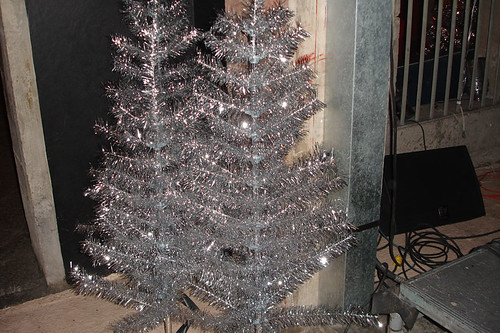
"
Describe your street. Describe another street. Compare."
That suggestion, originally made by Gorges Perec, is part of a longer quote sourced in a recent post at Pasta & Vinegar by blogger Nicholas Nova. Nova examines Perec's suggestion that we should "question [our] teaspoons," or look critically at things that we consider mundane or take for granted. "
Make an inventory of you pockets, of your bag," the quote continues. "
Ask yourself about the provenance, the use, what will become of each of the objects you take out."
Nova suggests: "Why is this important, maybe first to highlight how the mundane is intriguing. Beyond the descriptive level, it’s also curious wrt to innovation and design as it allows to ask question and possibly to nurture near future world." A
previous Where post speculated on how streetscapes and shopping centers might evolve in a hypothetical, post-retail future. The more pragmatic way to approach this admittedly fantastical scenario would be to question the teaspoons of current retail environments as they exist today and think about how shopping might be a different -- but still essential -- component of urbanism a few decades hence.
A recent post at the David Report describes a design studio and upcoming panel discussion on the Future of Shopping. From that blog, I'll snatch another repurposed quote fragment: "
Our culture is experiencing transition at so many different levels that we find ourselves at an unprecedented moment in history where we have begun to realistically re-imagine art, craft and design’s relationship to our culture, and its future...The future of luxury is an open question without obvious answers but it will be the young artists, craftspeople, and designers at Konstfack who will ultimately provide them. What will we be shopping for in the future? Bling Bling? The way things look now, it is more likely to be clean air and pure water."
The suggestion here assumes that the current transitionary period that humanity is experiencing will result in a fairly dire future. The commodification of clean air and pure water (which, to some extent, has already happened) will likely make shopping an even more important part of daily life. Imagine Wal-Mart selling de-particleized oxygen tanks in bulk, for the low low price of $259.99 a pack.
Purchasing essentials is, and will likely always be a tactile experience. It is quite common to buy a book without reading it first, or a CD without listening to it, but we are much more careful about buying things like food and shelter. In grocery stores, fresh produce is left out, unpackaged, to be groped and examined before purchase. Speaking of questioning tea spoons, think about your most recent trip to buy groceries. What was the ratio of things you'd tasted before to things you were trying for the first time when you rolled your cart up to the cashier's station? It's probably a safe bet that most of the food was familiar. And shopping for a new house or condo often takes months, with the buyer wanting to visit and experience firsthand the space that they might be purchasing to make sure that it meets all of their needs. What would the required commodification of air and water mean to urban retail environments?
Now swing the other way; let's end this post with some optimism. What will retail environments look (feel? taste? sound? smell?) like in the future if conditions generally improve for humanity? Retail is the essential element, the primary building block of the current globalized, megapolitan-level urbanism. Our infrastructure -- economic, transportation, and even social -- is largely built around shopping centers and commercial corridors. For better or worse, retail and commerce are often what give our society (and even our lives) meaning. With each successive generation, who you are and what you do are ever more tightly bound. So if our livelihoods and our identities continue to align more closely, it is very possible that urban commercial structures will become more diverse and complex. For retail, specifically, this could mean that shopping will become a much more immersive and meaningful experience, less about materialism for materialism's sake, and more about finding material goods that augment and/or enhance one's lifestyle in a productive way.
We see stores as boxes full of things that we can buy. But a retail environment has so much more potential than that. Rarely nowadays do store environments actually heighten the shopper's understanding of the products on display. If there is an effort to do so, it is almost never done at the middle class, mass market level. So how could retail environments change and adapt as consumers become, for example, increasingly environmentally aware, or as people become more interested in the related DIY movement?
The Reconfigurable House project sheds some light on this: "The project is a critique of ubiquitous computing 'smart homes', which are based on the idea that technology should be invisible to prevent DIY." The Reconfigurable House is an artistic experiment, an environment made up of easily manipulated experiential factors. Walking through the "house," a person can adjust everything from humidity to lighting to noise level. In a retail environment, this kind of technology could be used to expose and test products in an effort to build a consumer's trust. Shopping for a jacket becomes an entirely different experience when fitting rooms allow you to change the weather conditions to see how the garment holds up.
What would such developments mean for cities? It's hard to say. The visual impact of shopping corridors would likely remain the same. But the way that people interacted with stores, and the role that shopping played in daily life, would likely change. This has implied effects on everything from transportation planning to public space. What are some of the mundane aspects of contemporary retail districts that might provide some useful insight upon closer examination?
 (Photo from The Style Press. The original full-color version can be viewed by clicking the photo.)
Links:
Question your tea spoons (Pasta & Vinegar)The Future of Shopping (The David Report)Reconfigurable House (2007) by Usman Haque and Adam Somlai-Fischer (Rhizome Inclusive)