Showing posts with label destruction. Show all posts
Showing posts with label destruction. Show all posts
Sunday, May 4, 2008


Friday, May 2, 2008
WEEKEND READING: April 26-May 2, 2008
 It's back! Did you miss it? Hooray for Weekend Reading.
ITEM ONE: First things first -- Jane Jacobs' birthday is coming up this Sunday. In her honor several cities around the US and Canada are hosting "Jane's Walks," free guided neighborhood tours. Whether or not you are living in a Jane's Walks city, make sure to get out and stroll around your neighborhood at some point this weekend.
ITEM TWO: Attributos Urbanos presents an awesomely thorough glossary of contemporary urbanism terminology. (via atlas(t))
ITEM THREE: CEOS for Cities on how homogeneity hurts innovation.
ITEM FOUR: NASA releases spectacular high-res images of cities at night, seen from outer space. (via The Map Room)
ITEM FIVE: Straightforward title for a great Planetizen post: Neighborhoods Are Building Blocks of Civic Life.
ITEM SIX: Jetson Green takes a look at deconstruction (material salvaging) and the green benefits. Video included!
ITEM SEVEN: We'll wrap up with some more watchable goodness. 'But it's supposed to be reading,' you say? Rules are made to be broken. Check out Peter Zumthor discussing his absolutely brilliant thermal baths in Vals (pictured).

(Photo from Flickr user Bau TW. The original full-color version can be viewed by clicking the photo.)

Sunday, March 30, 2008
Urbanffffinds 024


Monday, December 31, 2007
Best of the Urblogosphere: 2007 Round-Up
 I went back through all of the Weekend Reading posts from the past year and pulled what I thought were the very best of the best. I've divided things up into two categories: General Urbanism and Place-Specific posts. Descriptions of the selections are followed by their date on which they originally appeared in WR.
GENERAL URBANISM
ITEM ONE: BLDGBLOG on "terrestrial reorganization" during WWII. (April 20)
ITEM TWO: Celsias on why designing cities around cars is such a terrible idea. (May 18)
ITEM THREE: Harvey Feldspar's city-hopping geoblog of the future, from Wired's examination of the future of our mobile society. (June 29)
ITEM FOUR: London architecture criticHugh Pearman on the Tate's megacities exhibit -- a stunning critique of contemporary starchitecture. (July 14)
ITEM FIVE: This Airoots post explores a fascinating artist's village in Mumbai. Organic urbanism at its best. (August 24)
ITEM SIX: NY Mag sets the record straight on Jane Jacobs' legacy. (September 28)
ITEM SEVEN: The Next American City features an article about how violent foreign policy creates more violence at home. (October 12)
ITEM EIGHT: City of Sound reexamines cities as destructive systems. (November 2)
ITEM NINE: Fabulous imagery of re-imagined slums via Subtopia. (December 7)
ITEM TEN: Spacing Wire features this beautiful and concise argument for humanism in the environmental movement. (December 14)
PLACE-SPECIFIC
ITEM ONE: A New York Times feature on the evolution of Curitiba into a poster child for good urbanism. (May 25)
ITEM TWO: Built Environment Blog takes a bike ride through ever-fascinating Brooklyn. (June 1)
ITEM THREE: The Economist goes back to Beijing. (August 24)
ITEM FOUR: Fabulous article from Frieze on the Brazilian megacity of São Paulo. (August 31)
ITEM FIVE: The Lincoln Institute explores post-apartheid Johannesburg. (October 5)
ITEM SIX: BLDGBLOG's rather infamous paean to the wonders of Los Angeles. (October 19)
ITEM SEVEN: More great stuff from Spacing: an Angelino's take on Toronto's messy urbanism. (October 19)
ITEM EIGHT: And finally, an Airoots post on the architectural wonderland of Tokyo's retail scene. (December 7)
If there are any of these that you missed the first time around, I urge you to take a look...they're great reading, start to finish. Have a wonderful, safe, and happy new year! See you in 2008.
(Photo from Non-Photography.com. The original full-color version can be viewed by clicking the photo.)
Friday, December 28, 2007
WEEKEND READING: December 21-28, 2007
 Check back on Monday for a round-up of the past year's most interesting Weekend Reading Items. But for now, check out the current crop:
ITEM ONE: WorldChanging on the importance of voluntary simplicity. The article is not directly about cities, but the ideas that it presents are certainly integral to the reimagining of cities as sustainable places.
ITEM TWO: AHI's blog examines a decidedly different vision for the city of the future.
ITEM THREE: Jay Walljasper's new blog, The Ecopolitan, kicks off at National Geographic's site.
ITEM FOUR: TNAC on The Independent's recent list that names London as the current World Capital.
ITEM FIVE: GPS message-in-a-bottle locative art. Pretty cool stuff.
ITEM SIX: The City Room on Hollywood's fascination with the destruction of New York, which Ed Koch cheekily refers to as "edifice envy."
ITEM SEVEN: Lots of dreamy, really wonderful images of the UK over at BLDGBLOG - like the one pictured above.
Have a wonderful weekend, everyone!
Friday, December 7, 2007
WEEKEND READING: December 1-7, 2007
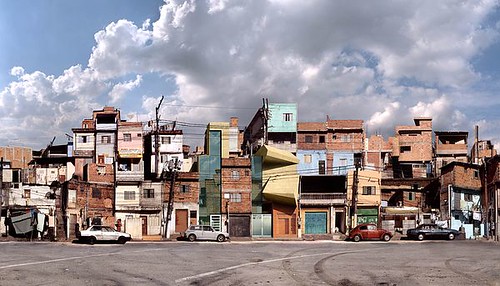 Back to business as usual this week for Weekend Reading. Thanks again to Colin for taking over during November, and thanks once more to all of the guest bloggers who helped to keep Where chugging along during NaNoWriMo!
ITEM ONE: It's BLYGAD 2.0! Tumble Like You Give a Damn, folks.
ITEM TWO: The Architectural League of New York has put out a call for entries to its Young Architects Forum competition for 2008.
ITEM THREE: In the past, little attention was paid to South America and its blossoming cultural scene. Not much has changed, there, but Line of Sight dug up a great article from a 1916 New York Times on the subject.
ITEM FOUR: Subtopia has a post called "Squatter Imaginaries" that contains some of the coolest images you'll ever see. (photo credit)
ITEM FIVE: Giant scale model of a partially destroyed downtown = kickass display for your living room.
ITEM SIX: The Future of Cities on what Jane Jacobs might have thought of Facebook.
ITEM SEVEN: Things Mag starts a recent post off with some interesting ruminations on destruction and redevelopment in the UK. Much link love follows.
'Till next week, happy surfing.
(Photo from Flickr user shadeofmelon. The original full-color version can be viewed by clicking the photo.)
Thursday, November 15, 2007
Drifting Through the City, Literally: Soldiers in the Living Room (Guest Post by Mirabai Auer)
 He said: 'this space that you look at, this room that you look at, is nothing but your interpretation of it. […] The question is how do you interpret the alley? […] We interpreted the alley as a place forbidden to walk through and the door as a place forbidden to pass through, and the window as a place forbidden to look through, because a weapon awaits us in the alley, and a booby trap awaits us behind the doors. This is because the enemy interprets space in a traditional, classical manner, and I do not want to obey this interpretation and fall into his traps. […] I want to surprise him! This is the essence of war. I need to win […] This is why that we opted for the methodology of moving through walls. . . . Like a worm that eats its way forward, emerging at points and then disappearing. […] I said to my troops, "Friends! […] If until now you were used to move along roads and sidewalks, forget it! From now on we all walk through walls!"
 –Commander Kokhavi of the Paratrooper Brigade, Israeli Defense Forces
A number of architectural and urbanist theories, dealing with geo-psychology and the conceptualization of city space, are being taught in an unlikely place -- military academies. Their strangely adapted applications serve as a reminder that ideas do not flow narrowly from the "conceiver" to "intended-user", but are rather commodities in the world marketplace, available for mass consumption and arguably, manipulation.
Eyal Wiezman details this phenomenon in his piece, "The Art of War", in which he outlines the emergence of a new guerilla strategy utilized by the Israeli Defense Forces, referred to as infestation. In an attack on the city of Nebulus in 2002, Israeli soldiers moved through the city, via a series of holes and tunnels. More simply, their game of war was not fought visibly on the street; the effort was conducted almost entirely indoors. The soldiers avoided alleys, streets, courtyards, and the like. Indeed, the soldiers were 'walking through walls,' fighting from within the urban fabric, climbing through homes, abandoned warehouses, and shops.
All of the aforementioned places have historically been considered, to varying degrees, private. After all, most homeowners don't envision their living rooms as fertile grounds for battle, nor do they anticipate soldiers 'worming their way inside (their homes)' emerging from freshly drilled holes in their drywall. Yet, increasingly, military education is proposing that the city is in fact a borderless place, in which the boundaries and intended uses of space (both public and private) are fluid and dynamic, i.e. the living room is both a strategic location and a place for television-watching and snacking. One woman recounts her personal experience in the attack: "Imagine it – you're sitting in your living-room, which you know so well; this is the room where the family watches television together after the evening meal, and suddenly that wall disappears with a deafening roar, the room fills with dust and debris, and through the wall pours one soldier after the other, screaming orders. You have no idea if they're after you, if they've come to take over your home, or if your house just lies on their route to somewhere else."
The shift in tactical thinking reflects the military's adoption of several key canons of architecture and philosophy, among them Situationism. In the 1960's, Situationists advocated for the creative and critical re-examination of the urban landscape through such practices as dérive and détournement, which involves the adaptation of obsolete spaces for new, unintended uses. These practices encourage the re-envisioning of how spaces are used and by whom.
For example, a dérive, or drifting walk, is propelled by emotion and spontaneity; typologically, it is rather different from the often mechanical and repetitive walk to work (or store, school, etc.) Situationists suggested that curiously and attentively traversing new pathways could be a catalytic exercise in the process imaging the built environment afresh, and set the stage for new social contexts. These practices grew out of an increasing dissatisfaction with landscape of the capitalist city, which Situationists believed was designed in an overly prescriptive and dogmatic fashion, and was ultimately an expression of class relationships. Arguably, if the capitalist city had strictly-defined rules of engagement, then the practices of dérive and détournement were intended to de-contextualize the overly-ordered city and enable citizens to think outside of the systematic box.
These concepts, through the traditional lenses of planning and urban studies, are oft presented as visionary, progressive, or artistic (after all, isn't the idea of détournement partially responsible for adaptive reuse of industrial space into lofts and studios?). In fact, yesterday's Where post, Traversing Newark Avenue, is a rather classic example of dérive in which the author documents the physical and social nuances of a Jersey City street in photos, text, and sound.
Ironically, the military's co-optation of the same ideas has been used to bolster already (arguably) bloated military power and to justify the rather undemocratic invasion of private space. Yet, after all, aren't they simply envisioning a new use for the home? And a new relationship between the dwellers and visitors (troops, in this case)? The author Eyal notes: "In no uncertain terms, education in the humanities – often believed to be the most powerful weapon against imperialism – is being appropriated as a powerful vehicle for imperialism."
The manipulation of philosophy and theory does in fact occur religiously. Yet, somehow in the academic world, ideas seem to grow in their own Petri dishes, undisturbed by realities. These little glass plates of ideas are assumed to be tended by the few and carefully trained. And yet, ideas like dérive exist in the muddied, multi-layered context of the city; "The Art of War" reinforces the common-sense notion that places are birthed from context and a multiplicity of vantage points and that urban theory is never purely applied -- it is always a working model.
Big thanks to Mirabai Auer, an urban planning Masters' candidate at the University of Illinois-Chicago who works part-time as a GIS map maker.
Thursday, November 8, 2007
World Urbanism Day
In honor of World Urbanism Day (aka Town Planning Day), I thought it would be interesting to take a look at what might become of some of the world's great cities if global warming's worst case scenario came to pass. Scientists estimate that, were all of the ice caps and snow pack on earth to melt, the sea level would be somewhere between 230-260 feet (70-80 m) higher than it is today.
While no one reading this post is likely to see this kind of damage, it's interesting to imagine what today's cities would look like in such a radically different world -- but the scale is so vast that it's hard to fathom. The following is a simple visualization of the landscapes of twelve major coastal cities around the world in three imagined futures: red overlays represent areas that will be submerged after a 50 foot (15.2 m) sea level rise; orange overlays represent areas submerged after a 150 foot (45.7 m) rise; and yellow overlays represent areas submerged after a full 250 foot (76.2 m) rise. The colors represent the fire-like spread of the ocean inland. Take these pictures for what you will; they are what they are.
While many of the cities represented were included for their global importance today, the visual impact of the colored overlays played a big part in determining what cities made the list. The numbers below each square image describe the approximate length of one side in miles/kilometers.
New York City, United States
 (74.5/120)
Montreal, Canada
 (54.7/88)
Rio De Janeiro, Brazil
 (26/42)
Abidjan, Côte d'Ivoire
 (28.6/46)
London, Great Britain
 (16.8/27)
Stockholm, Sweden
 (22.4/36)
Istanbul, Turkey
 (22.4/36)
Mumbai, India
 (53.4/86)
Sydney, Australia
 (22.4/36)
Hong Kong, China
 (18.6/30)
Pyongyang, North Korea
 (20.5/33)
Tokyo, Japan
 (83.9/135)
------------------------
The images above were created using Google Maps and a filter from Hey What's That dot com.
Links:
World Urbanism Day (Wikipedia)
Google Maps
HeyWhatsThat.com (EDIT: I found a direct link to the tool that I used.)
While no one reading this post is likely to see this kind of damage, it's interesting to imagine what today's cities would look like in such a radically different world -- but the scale is so vast that it's hard to fathom. The following is a simple visualization of the landscapes of twelve major coastal cities around the world in three imagined futures: red overlays represent areas that will be submerged after a 50 foot (15.2 m) sea level rise; orange overlays represent areas submerged after a 150 foot (45.7 m) rise; and yellow overlays represent areas submerged after a full 250 foot (76.2 m) rise. The colors represent the fire-like spread of the ocean inland. Take these pictures for what you will; they are what they are.
While many of the cities represented were included for their global importance today, the visual impact of the colored overlays played a big part in determining what cities made the list. The numbers below each square image describe the approximate length of one side in miles/kilometers.
 (74.5/120)
Montreal, Canada
 (54.7/88)
Rio De Janeiro, Brazil
 (26/42)
Abidjan, Côte d'Ivoire
 (28.6/46)
London, Great Britain
 (16.8/27)
Stockholm, Sweden
 (22.4/36)
Istanbul, Turkey
 (22.4/36)
Mumbai, India
 (53.4/86)
Sydney, Australia
 (22.4/36)
Hong Kong, China
 (18.6/30)
Pyongyang, North Korea
 (20.5/33)
Tokyo, Japan
 (83.9/135)
------------------------
The images above were created using Google Maps and a filter from Hey What's That dot com.
Links:
World Urbanism Day (Wikipedia)
Google Maps
HeyWhatsThat.com (EDIT: I found a direct link to the tool that I used.)
Friday, May 25, 2007
Don't Touch The Art

In case you haven't heard, tourists are ruining Machu Picchu. The famous Incan sanctuary left over from that civilization's headier days, is starting to show signs of wear and tear after a tenfold increase in tourist numbers since 1990. In case you're wondering, that adds up to almost a million visitors traipsing across the fragile site every year. Meanwhile, in San Antonio, 2.5 million visitors a year are beginning to cause problems for another famous ruin, the Alamo. Many wandering hands have grazed the walls, and the moisture and oil from this contact is beginning to wear the structure down.
I am utterly fascinated by the fact that so many of us find ruins so compelling that, in our desire to take part in them and their history, we willingly take part in their gradual destruction. I'll admit off the bat to being one of the dreaded "touchers" in art museums...I'll walk right up to a painting and brush my finger along a particularly juicy-looking brushstroke -- after scoping out the room to check for guards, of course. I know that this makes me a terrible, horrible, no-good very bad person, but I'm making the confession to say this: I don't have a thing for touching ruined buildings, but I get it.
Consciously, the desire to touch a building like the Alamo is most likely the result of something along the lines of "Maybe Davy Crockett touched this very wall." But subconsciously, I wonder if the need to touch a historic building, or a painting, or any kind of artwork, comes from that most famous aspect of human nature: the desire to leave our mark on the world. With signs around telling us not to touch or be careful near a crumbling building, our instincts kick in, and we perform an act of counter-creative graffiti in a tiny effort to take part in recreating the world for future generations. We are not fascinated with Davy Crockett's history as an isolated idea, but with being a part of the same history as this man.
Buildings are very solid, permanent things in our day-to-day experience of the world around us. It makes perfect sense, then, that on some level we look at ruins as artworks, once-lived-in sculptures. They provide us with an opportunity not just to connect with the past, but also take part in the imagined past of the future...if that makes any sense. Ruined buildings are not solid, permenant things, but continually-evolving pieces of collaborative art. They are living history. By touching a deteriorating wall, we become architects of destruction.
(Photo from Flickr user liquidhotmagma.)
Links:
Machu Picchu site at risk (LA Times)
Remember Not to Touch the Alamo (Architectural Record)
Subscribe to:
Posts (Atom)


