Showing posts with label urban planning. Show all posts

Friday, June 19, 2009

Don't Miss: My Space @ NAC


There's another Whereblogger-authored post up over at Next American City's Daily Report...I'm a little late getting this one up, as it went live over a week ago, but later is better than never, as they say. The post takes a look at three Chicago-based urban planning non-profit orgs' attempts at interactive websites, and their various levels of success at engaging users. Below, a teaser, and here, a link. If you're so inclined, do take a look!

In cities—especially densely-populated cities, where open skies are a precious commodity—getting people to use public spaces isn’t usually a challenge. But getting people to talk about public space is another issue altogether. These days, the Internet is allowing planners and architects to reach out to Average Joe citizens to generate discussions about the built environment in new and increasingly creative ways; in Chicago, a number of recent public space-related initiatives have used the web to get people talking about the city’s public realm—with varying degrees of success.

This past week the Metropolitan Planning Council launched a region-wide search for Chicago’s best public spaces. Placemaking Chicago challenges Chicagoland residents from southeastern Wisconsin all the way down the lakefront to northwestern Indiana to send in photos and videos hosted at Flickr, YouTube, and their ilk, in order to determine the metro’s most enjoyable and successful public spaces. MPC is offering users various prizes, and winners will be determined by several rounds of judging, including an MPC-selected panel and a final public vote...


Once more with that link.


(Photo from Flickr user John Zacherle. The original full-sized version can be viewed by clicking the photo.)

Friday, May 22, 2009

The New New South

When our grandparents re-imagined the urban environment, we wound up with Pruitt-Igoe and the Parisian banlieues. As a result, popular opinion leans somewhat sharply in the negative direction when it comes to large-scale urban renovations. Still, it is largely accepted, among the current generation of urbanists and architects, that the suburbs are in need of a serious, large-scale overhaul. It's always important, when taking on a major project, to learn from the lessons of the past. But what exactly do the tower blocks and windswept concrete plazas of the latter half of the twentieth century teach us? On the surface, it's that tower blocks and windswept concrete plazas make for dire cities. But beyond that, these stark interventions illustrate quite plainly that it is almost never a good idea to rip down everything and start from scratch.

It's too bad, really, because starting a city from scratch is a very romantic and exciting idea. But cities are places that are used by millions of people, in millions of different ways; the longer a place is inhabited, the more people develop routines in and around them. Aesthetics aside, familiarity sets in, and even ugly places can become comfortable and familiar. Modernist urban renewal projects didn't just fail because they were severe and lacked a sense of human scale; they failed, at least in part, because they ignored the patterns and rhythms of the places that they replaced.

It's encouraging, then, to see that some of the cities considered the greatest offenders by anti-sprawl camp are starting not only to attempt to densify, but that they are doing so in ways that adapt rather than replace their built environments. Take, for instance, Miami, where a former car dealership is being redeveloped as a highrise urban district, or Charlotte, North Carolina, which has taken several steps in the past few years to actually start acting like a city of its economic stature. A new light rail has been built, for instance, with plans for considerable expansion; density has been encouraged along the transit lines; in one suburb, all new commercial buildings are required to have at least two stories. For a city with a population density of only 2,515 people per square mile (slightly less than that of Bangladesh), these are very promising steps toward urbanization. Better yet, there's been no wholesale removal of the city's existing fabric; just modifications.

Other sprawling cities are starting to take notice. Atlanta, the undisputed Capital of the New South since its rapid revival back in the late 1980s, has recently taken note of Charlotte's urbanization, with the Atlanta Journal-Constitution calling the city "a feisty, undersized boxer [that punches above its weight]." No small words from the Rome of Suburban Postwar America. And as that same article notes (albeit in downplayed terms that any smart urbanist will snicker at), Atlanta is currently struggling under the weight of the obscene freeway system that grew as fast as the metro's population. The city is already saddled with several eight-lane freeways (that's eight in both directions, for a total of 16) and the Georgia State Assembly seems to be making transit decisions using a 1965-vintage playbook. With New Jerseyans now complaining about the gridlock in the Big Peach (which they actually do in the AJ-C article), Atlanta's mobility problems are looking like a very serious liability.

Charlotte, meanwhile, has half the population of Atlanta but less than half the congestion. It remains to be seen if Charlotte will ever catch up to Atlanta in terms of international economic stature, but even if it doesn't, Charlotte can lead the way as a slew of sprawling mid-sized Southern cities (the entire region is notorious for its sprawl, after all) seek to densify and re-work their urban fabric. By taking the lead on lifestyle issues, Charlotte could become the capital of the New New South.


(Photos from Flickr user wbwood1969 and The Daily Green.)

Friday, March 6, 2009

Introducing Urbanism: Top Books for Curious Novices


In January, I asked Where readers and contributors what books they’d recommend to introduce the basic concepts of urbanism to curious, non-expert friends. I asked for a short list of accessible, concise books.

Since the initial query more than 30 titles have been suggested. Because I was already familiar with only a handful of the books, I headed to the library to get better acquainted with at least some of the other suggestions.

Based on that library visit, on posted comments from readers, on behind-the-scenes advice from Where contributors and my interpretation—from my own very amateurish (and American) perspective—of what counts as “accessible” and “concise,” here are five books about the basics of urbanism that I’d now recommend to relatively clueless, but curious friends.

Almost all of the links in this post connect to Google Book Search.

The Top 5

1. The Death and Life of Great American Cities by Jane Jacobs (1961). At about 450 pages, “concise” is probably not the most apt description of this book. But, as this is the single best written, most accessible, most compelling book I’ve ever read about cities, I’m willing to forsake the concision criterion even in my first recommendation. If you want to know what can make cities pleasant, safe and interesting places to live, read this book. If you want to read one of the best non-fiction prose stylists of our time, read this book. It’s a classic, and deservedly so. As one Where reader put it: “It’s a great book for explaining why we care about all of this.”

2. The Option of Urbanism by Christopher Leinberger (2007). While not as fun to read as The Death and Life of Great American Cities or The Geography of Nowhere (see below), this slender volume briskly highlights difference between drivable sub-urban development and walkable urban development, and does a good job of explaining the benefits of walkable city neighborhoods. It’s good primer on the basics of density, zoning and the hidden subsidies fueling drivable sub-urban development.

3. The Geography of Nowhere by James Howard Kunstler (1993). This book is an exploration—and excoriation—of the rise of suburbia and sprawl. It also explains how the more traditional patterns and places of city life and country life are superior to the “geography of nowhere.” Accessible and ferocious.

4. Cities Back from the Edge by Roberta Gratz, with Norman Mintz (1998). According to a Where reader, this book is “in the spirit of Jacobs” and discusses “how existing cities can be improved with citizen participation in contrast to destructive master plans.” The book is filled with lots of specific ideas about how to improve downtown areas, all of them lavishly illustrated with real life examples from successful efforts in dozens of cities.

5. How Cities Work by Alex Marshall (2000). Squarely aimed at the lay person, this book seeks to discover what forces shape places and cities—and finds that one of the most powerful forces is political choices, particularly those having to do with transportation policy. A Where reader gave this recommendation: “It’s not comprehensive, of course, but it’s a good snack, possibly the kind that could interest a person in a larger meal.”

A Tall Stack of Other Suggestions

Many other titles were suggested. They’re all listed here in no particular order, with quoted comments—when available—from the Where readers and contributors who recommended them.

Cities of Tomorrow by Peter Hall is “a great history of urban planning, knowledge of which is essential for understanding modern cities.”

The Last Landscape by William Whyte “focuses on the benefits of relatively dense urban form.”

Good City Form by Kevin Lynch is a “very engaging overview of urban history and theory” with “compelling ideas for developing vibrant cities.”

The Granite Garden by Ann Whiston Spirn “introduces thoughtful ways of improving the relationships between cities and the ecosystems in which they’re built.”

Building Suburbia by Dolores Hayden covers the sociology and history of suburbia. “It's written in a way a layperson…can understand.”

Till We Have Built Jerusalem: Architecture, Urbanism, and the Sacred by Philip Bess “does a nice job” explaining “exactly why urban design matters.” It may not be a simple primer, but “a few of the chapters are perfect intros to the subject.”

The Old Neighborhood: What We Lost in the Great Suburban Migration, 1966-1999 by Ray Suarez is an “excellent introduction to the challenges experienced in aging, post-industrial cities, including Chicago, Cincinnati and Philadelphia.”

Building the Dream: A Social History of Housing in America by Gwendolyn Wright is “an essential resource for understanding the social movements and political processes that have shaped urban/suburban cultural landscapes.”

The Culture of Cities by Louis Mumford is a “great classic” by an “exceptional writer.” The book includes introductions to the ideas of Ebenezer Howard and Patrick Geddes, two influential early modern urban planners.

Crabgrass Frontier by Kenneth Jackson “does a great job of explaining how we ended up with the urban landscape we have,” and is “very accessible, too.”
http://books.google.com/books?id=On0iJsl0HY4C

The Power Broker by Robert Caro, while “not short at all, reads like a novel” and “illustrates the state of city administration and urban planning during the past century better than anything else I’ve ever read.”

Delirious New York by Rem Koolhaas and “On Liberty” by John Stuart Mill are good to read together because Koolhaas’s book “provides an essential perspective on why contemporary urbanism discussions are where they are today,” and Mill’s essay is a “classic for anyone who wants to learn about living with other people, things and places.”

Who's Afraid Of Niketown? by Friedrich von Borries “investigates the contemporary effect of global corporations on public space and urbanism.”

Books, essays, articles by J.B. Jackson because his “short, easily digestible” work “looks at cities and other environments in such a different way,” and “inspires people to think beyond the clichés.”

Psychogeography by Will Self is an “interesting anecdotal urbanist book.”

Nature's Metropolis: Chicago and the Great West by William Cronon is “longish,” but provides historical perspective on urbanism issues.

The Essential William H. Whyte as a substitute for the out of print City: Rediscovering the Center by William H. Whyte.

"Junkspace" an essay by Rem Koolhaas.

A Better Place to Live: Reshaping the American Suburb by Philip Langdon.

Poetics of Cities: Designing Neighborhoods that Work by Mike Greenberg.

The Living City: Thinking Big in a Small Way by Roberta Gratz.

To Scale: One Hundred Urban Plans by Eric Jenkins.

American Project: The Rise and Fall of a Modern Ghetto by Sudhir Venkatesh.

Off The Books: The Underground Economy of the Urban Poor by Sudhir Venkatesh.

(Photo from Flickr users danlorentz and docman. The original full-sized color version can be viewed by clicking the photo.)

Monday, February 9, 2009

Think Big. Freak Out.

Daniel Burnham's line "Make no little plans; they have no magic to stir men's blood" is probably one of the most famous quotes to come out of the field of urbanism. It's also one of the most thoroughly abused. Burnham's maxim about aiming high is used by proponents of megaprojects like Atlantic Yards (the poster child for megaprojects, you see) in defense of superblocks and devastatingly overbearing towers. In truth, Burnham did not stop where the quote does. The quote is almost always truncated, cutting off much of the great planner's intent. The full quote reads:

Make no little plans. They have no magic to stir men's blood and probably themselves will not be realized. Make big plans; aim high in hope and work, remembering that a noble, logical diagram once recorded will never die, but long after we are gone will be a living thing, asserting itself with ever-growing insistency. Remember that our sons and grandsons are going to do things that would stagger us. Let your watchword be order and your beacon beauty. Think big. (via)


The idea of a noble, logical plan becoming a living thing is about as far from the logic of the contemporary commercial megaproject as you can get. Giant developments that have become commonplace in cities like New York, London, and Chicago over the past two decades are designed to eliminate risk, to minimize mess. They are, in a word, sterile. Burnham was talking about creating plans that are dynamic, and that improve their surroundings, not wall themselves off from them.

So if it's not the four-tower 3,000-condo 250,000 square-feet-of-retail megacomplex, what does a grand plan look like? What can we do to stir mens' blood, to re-engage the many millions of people who have become disconnected from the urban environment, who have willfully or accidentally removed themselves from the discourse? In the face of increasingly grave problems, how can citizens be energized to turn their cities into the viridian green, environmentally-restorative engines that we have heard so many advocates call for them to be?

There are no small changes that need to be made. I refuse to parrot, any longer, the absurd myth that changing your lightbulbs or using a fabric bag to pick up groceries will save the world. The words "hogswaddle" and "poppycock" come to mind (apparently climate challenge turns me into a Dickensian lower-class Brit). It's true that these things add up, but public opinion on fighting climate challenge is waning; people are growing tired of the issue. The public is, of course, fickle, so this should come as no surprise. The bite-size formula is not going to work. The ante must be upped.

For planners, architects, and urbanists, this necessitates a call for big plans. We need so many more Burnhamian Big Ideas. It's time to re-think infrastructure, and architecture, and every tiny component of every city. All things can be re-imagined; we're starting to see these kinds of big ideas in playful fits and starts. Defunct airports can become magnificent tree-covered mountains; parks can be used as psychological and environmental rehabilitation centers; whole cities can become stand-in icebergs; we could build rivers in the sky, and fill them with floating classroom-ferries. Nothing about our cities is set in stone -- not even their geography. And as nature starts to change our cities in new ways, we need to re-think how our cities interact with nature.

Perhaps the greatest piece of infrastructure that cities have at their disposal, in terms of reimagining and regenerating the cityscape, is often also the last remembered. People -- the citizens that use the city, kick it, punch it, pull it down and lift it up a hundred million ways each day -- are brimming with ideas about how to make their cities better. The images in this post, for example, are from a collection of entries to a public call for the reinvention of Coney Island. This is the crazy shit that people come up with; it follows that what they want to start seeing more of, in addition to genuine, solid plans for making cities work better, is some freaky, crazy shit.

Here's a proposal; the seed of a big idea, perhaps: let loose. Think about the most unchangeable features of your city, and try to imagine them changed. Don't just daydream; come up with Big Ideas, grand plans for revolutionizing the way that your city works. Get crazy, and put down on paper the ideas you wouldn't dream of bringing up in a meeting at work. Then upload them and share them with everyone who has a computer and a set of working eyes. We need more sky rivers, more radical civic interventions, and more acid-trip theme parks. More than ever, we need very, very Big Ideas. And if we try hard enough, if we come up with enough crazy shit, maybe we'll be able to shock more people into caring about how their city works, and what it looks like. No one cares if you tell them the airport is being turned into condos and a dog park. Heads turn when you suggest that it be geo-engineered into an urban Matterhorn. It doesn't have to happen. It just has to get people to pay attention.

Burnham wisely noted that each generation's sons and grandsons would do things that would stagger their forebears. Make your grandparents proud; go freak out on your city.


(Photo from MASNYC's Flickr gallery.)

Monday, January 26, 2009

Brief Interviews with Hideous Cities

Urbanism, like any field, has its own dogmas, orthodoxies and raging controversies. It's both art and science, it affects almost everyone on a daily basis (whether they realize it or not), and it overlaps with a vast array of related disciplines.

In short, urbanism has a lot in common with language.

People have been calling attention to this similarity for ages--Christopher Alexander's pattern language is a prime example--but David Foster Wallace may have unknowingly revealed the most useful facet of the relationship in his essay "Authority and American Usage," by probing the conflict between linguistic Descriptivism and Prescriptivism. Prescriptivists are those who believe in objective, fixed rules to guide the usage of language; Descriptivists, on the other hand, seek to define a language by how people actually use it. DFW ultimately concludes that the English language depends upon the former group, although any would-be Prescriptivist must establish credibility before publicly defining what's right and wrong.

It turns out urbanism has its own versions of Prescriptivism and Descriptivism: Professional planners, architects, academics, media and city administrators tend to develop consensus about what makes cities work. Density, mixed-use development, and transit become components of an urbanist orthodoxy; a freeway through a vibrant neighborhood troubles the urban Prescriptivist in the same way an "ain't" irks the English teacher.

Meanwhile, every urban dweller is routinely playing the twin roles of critic and planner in many small ways. Cities are created by the sum of individual choices to live in certain neighborhoods, shop at certain stores or occupy public spaces, and everyone forms an opinion about what's good and bad in their own urban environments. Urban Descriptivism would hold that these millions of collective actions and opinions are right, whether experts agree or not--even if those actions produce strip malls, car culture and isolation.

Urban Descriptivism is probably more interesting, and it's certainly easier. Robert Venturi and Reyner Banham have glorified the neon signs, freeways and sprawl of LA and Las Vegas, choosing to find beauty in those environments because they’re already there anyway. Venturi may have coined the Descriptivists’ mantra when he wrote, “Main Street is almost all right.” Their approach teaches us to treasure someone else’s trash, enhancing the urban experience without necessarily building anything.

Clearly, each extreme has severe flaws: One leads to hubris and utopian fantasies; the other ignores social pathologies in favor of intellectual entertainment. Hence DFW’s conclusion. We can’t assume those planning our cities are credible just because they’re making the plans. But we need rules and guidance—an entirely hands-off approach will create interesting cities with multitudes of serious problems.

Maybe this is why urbanists keep returning to Jane Jacobs. She reconciles these approaches in The Death and Life of Great American Cities by merging a Descriptivist’s eye for the way cities actually are (not how they should be) with a Prescriptivist’s desire to make cities better—by nurturing what’s already good in those cities rather than trying to recreate them. David Foster Wallace writes that every language needs its authorities; Jane Jacobs tells us that stepping outside and thoughtfully considering one’s surroundings are the first steps toward becoming an authority on the language of urbanism.


(Photos from Flickr users jamessmke and Roadsidepictures. The original full-sized versions can be viewed by clicking the photos.)

Thursday, January 22, 2009

Posh to be Poor? Transportation

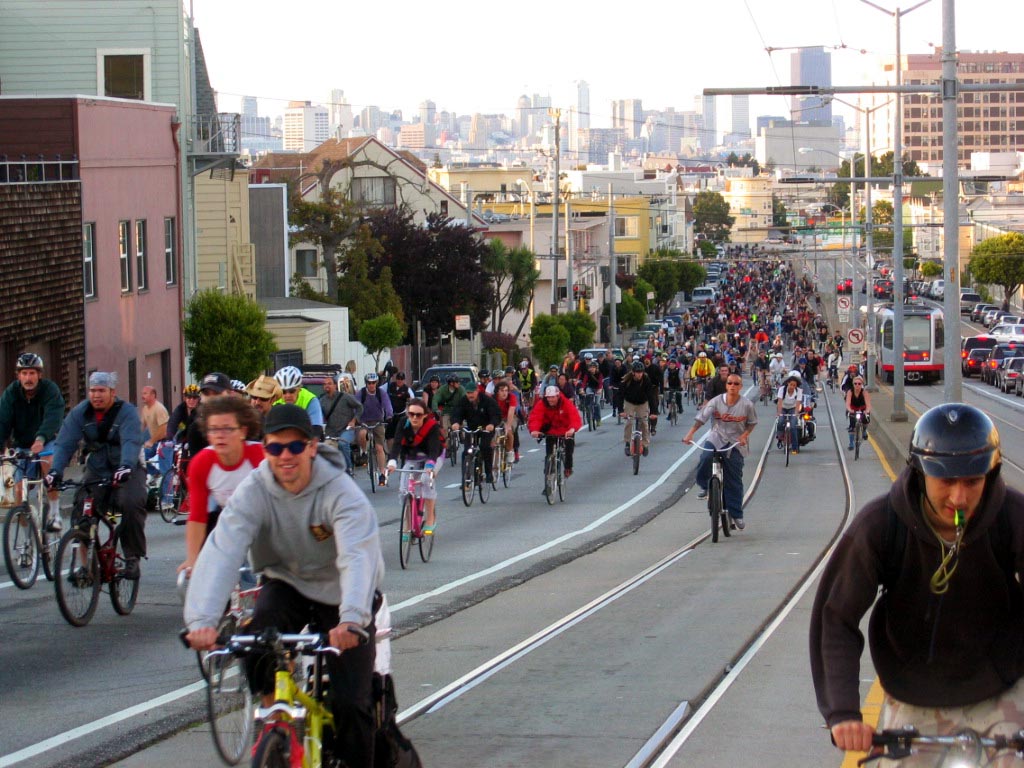
Over the last few years there has been a surge away from motorcar transportation towards public transportation and the bicycle. This can in part be attributed to the sustainable movement as well as the growth of our urban cores. In 2008, the number of people living in cities eclipsed rural dwellers for the first time. As cities become more dense, the efficiency of traffic becomes increasingly important and for residents, it becomes faster to take public transportation. Now, aside from public transportation, the bicycle is also seeing a boom in popularity as a primary mode of transportation for many city dwellers.


The bicycle is rapidly becoming the popular mode of transportation in large urban cores. It is cheap, you can find a decent used bike for 25 bucks that will get you around the city fairly well. Bikes are easy to maintain and aren't subject to expensive repairs as they age. No need to buy insurance either, or fill up on gas. These qualities make it a very attractive option for those who are strapped for cash. Also, it is environmentally friendly due to the lack of emissions and lower embodied energy than the automobile. So, this is an important turning point as people begin to look away from a more expensive, more convenient mode of transportation, to one that is significantly more affordable. In fact, New York city saw a 35% increase in people biking to work in 2008. Unlike public transportation though, biking has become a trend with thriving organizations such as Critical Mass advocating for increased ridership. It has become cool to ride a bike as demonstrated by the many celebs recently caught on 2 wheels. Lance Armstrong may have sparked a national movement toward road bikes, but the many bike messengers roaming our urban cores have sparked a fixed gear revolution. Once seen as tacky or radical, the bike messenger style has invaded western culture influencing clothing, style (messenger bag anyone??), and heck, transportation!


So why does this mean it's becoming posh to be poor? Well, because it's a move away from expensive transportation options, toward more affordable and accessible option. It's a move away from $30,000 SUV's toward $125 bikes (these are both averages of course.) Low income residence take public transit, they ride bikes, and they hop trains; 3 methods of transportation that will see a steep increase in 2009. As we enter into an age of frugality, where we find pleasure in the simple aspects of life, people will worry less about luxury and more about experience, an idea which has grown in prominence over the past few years.


Posh to be Poor? Introduction

(Photo from Treehugger The original full-sized color version can be viewed by clicking the photo.)
(Photo from SFGate The original full-sized color version can be viewed by clicking the photo.)
(Photo from Wikipedia The original full-sized color version can be viewed by clicking the photo.)

Saturday, December 6, 2008

Press Re:

Where's friends over at the Congress for New Urbanism passed along some info today for a fast-approaching deadline. If you are or know of an urbanist that's worth honoring , take a look and submit, submit, submit!

Charter Awards 2009 honor the urbanism the world needs now

CNU's Charter Awards recognize the best of New Urbanism and Smart Growth -- whether the work is architectural, landscape, and urban designs or the publications, policies, plans, and codes that structure them. Awards are selected by a jury of distinguished urbanists, led this year by Victor Dover, and judged on the extent to which they fulfill and advance the principles of the Charter of the New Urbanism. This year, submitters also have the opportunity to describe how projects advance the operating principles in the Canons of Sustainable Architecture and Urbanism.

In recognizing design and development that make communities more livable and promote greater harmony between the built and natural environments, the awards demonstrate how urbanism is a remedy our planet needs -- a vital way to green the American Dream. Please help spread the word, especially to those -- either professionals or students and professors --whose urbanism and Smart Growth you admire. Find information and entry forms at http://cnu.org/awards.

Submissions Due: January 20, 2009

Tuesday, July 8, 2008

Kotkin Kabob'd

On principle, Where does not link to any article containing Joel Kotkin's canned, willfully ignorant whinnying about how cities suck and suburbs are, like, totally awesome, bro. But Where does link to Bill Fulton's skillful and thorough skewerings of said whinnying. In fact, it does so with great aplomb.

And now I'll stop writing about this blog as if it's a sentient being.

Friday, April 4, 2008

WEEKEND READING: March 29-April 4, 2008

First things first: MONU has put out a Call for Submissions for their upcoming issue on "Exotic Urbanism." Sounds freaking brillaint. Now, on to this week's cream o' the crop.

ITEM ONE: New-ish blog Boredom Is Always Counter-Revolutionary with a cutting rant about advertisements, architecture, and envisioning the city of the future.

ITEM TWO: Lee Bey has his own cutting rant this week, this one zeroing in on race, crime, and public housing in Chicago. Spot-on.

ITEM THREE: Switching gears a bit, MNP's post on suburb-eating robots will blow your mind and tickle your funny bone. (Photo credit)

ITEM FOUR: Interchange blogger Scott Page on DIY Urbanism and the upcoming Wicker Park Bucktown workshops in Chicago.

ITEM FIVE: CS Monitor examines Hugo Chavez's plan to build a Venezuelan Brasilia of sorts. Welcome to Caribia, the 21st Century Socialist City.

ITEM SIX: Some eye candy from The Map Room -- a collection of late 19th and early 20th century maps of Latin American cities.

ITEM SEVEN: More humor to cap things off this week. The Onion features an hilarious exposé on the aristocrization of gentrified neighborhoods in American cities (via Super Colossal).

Adios, compadres. See you next week!

Tuesday, April 1, 2008

Blogedanken Public Poll

Here are my favorite entries from each of the six Blogedanken participants who submitted full responses. Take a quick read-through, pick the one you think is the most interesting, and vote in the public poll at the bottom of the post. One-two-three, and by April 10th we'll have a winner! That person will then recieve a copy of Hyperborder, courtesy of PA Press.

Patrixbanx
(Portland, Maine, USA)
It sure would be nice to have a suburban commuter rail network in southern Maine. It would be even nicer if the commuter rail stations weren’t sited in the middle of vast parking lots, especially closer to the urban core. So why not allow development to cluster around those stops, like say Morrill’s Corner? And by development, I mean dense development. We’ll need to reform our zoning to encourage such growth, of course – not just by creating incentives for density but by creating disincentives for sprawl as well. Oh, and remember – this is Maine, a land that get’s pretty damn cold over the course of our long winters, and global warming hasn’t turned us into South Carolina just yet. Yet I hear tell of other cities even further north that are colder and get more snow than us, yet still manage to have a vibrant street life even in depressing old February. We gots to have that. I don’t know how exactly but if we’re going to discourage driving so we can have more walkable and transit oriented neighborhoods, we might as well make the streets of Portland a pleasant place to be in the depths of winter – bike and pedestrian friendly snow clearance, warm transit shelters, fun festivals, whatever it takes.

Medea
(Medellin, Colombia)
24 hour public transportation makes shifts easier to stagger, so bus drivers are not competing with each other in hazardous maneuvers. Every bus and taxi driver will receive mandatory drivers ed and courses on politeness and good manners. If they are rude or customers complain, their punishment won´t be a fine, but they´ll have to do public service hours cleaning the riverbanks.

M.B.
(Mexico City, DF, Mexico)
As a way of improving safety and bridging the gap between the city core and the bulging periphery, the city has launched a Defense of Modern Ruins program, stringing together blighted sights that range from industrial sights to downtrodden art-déco buildings to bureaucratic baroque whales. The program includes low-rent housing schemes, urban wilderness tours and itinerant party circuits.

T H Rive
(Victoria, BC, Canada)
Wireless capable crosswalks.
Edit: *apologies for the absolute shortness of mine. explanation: The crosswalk I was requesting was the ones that go green on ALL sides so that diagonal crossing is validated. It's quicker. The wireless part was more outdoor, cafe oriented Etc green wireless spaces. The result of the mixup?>> Wireless Crosswalks. Still a good idea. (4/1/08 5:38 PM)

Dan Lorentz
(Lexington, Kentucky, USA)
Organize a strong city-wide neighborhood group to promote mixed-use planning that supports street-level vitality, and make the first priority of that group the reweaving of the city's street web to create more corners for mixed-use development.

Petersigrist
(Cambridge, England, UK)
Hovering leisure boats with transparent roofs and floors, which hover about twenty feet in the air and provide lifts around town above underwater gardens with glass walls at street level as well as terraces, balconies, shops, and restaurants that open onto the streets and river


Remember: vote or die! (Hah. Always wanted to use that in context).

Friday, March 28, 2008

WEEKEND READING: March 22-28, 2008

Sorry for the slow week. Regular posting should resume after this weekend. In the meantime, there's always plenty of weekend reading to go around!

ITEM ONE: First off, a bit of self-promotion. I have a new post up at Next American City projecting some possible outcomes of the rise of online virtual worlds and increased advertising in Western culture. The French Quarter as an export? Perhaps...

ITEM TWO: WorldChanging with a stirring piece on the powerful political act of optimisim.

ITEM THREE: Is your city a "Paris" or a "London"? Read this Economist piece comparing the two euro-glam-capitals and ponder that question for a bit. (Via Pittsblog)

ITEM FOUR: PlannersWeb takes an in-depth look at the role of urban planners in a Chavez-led Venezuela.

ITEM FIVE: Core77 reports on the book containing the radical designs generated by participants in eVolo's '06, '07, and '08 Skyscraper Competition. Flashy stuff. (Photo credit)

ITEM SIX: Speaking of radical architecture, Richard Florida posted news of a massive floating city-cum-cruise ship. This definitely falls under "You gotta see it to believe it."

ITEM SEVEN: Over at Interchange, Barbara Faga looks at the somewhat comical tug-of-war in public perception of which is worse: density or sprawl.

Hasta luego; enjoy your weekend.

Thursday, March 27, 2008

Having Fun with Community Planning

Wicker Park Bucktown (WPB) is a community group here in Chicago that deals with two trendy, gentrifying neighborhoods (Wicker Park and Bucktown, natch). As part of their master planning process, WPB is holding a series of open houses about which I have received several emails over the past couple of days. Looks like there will be some pretty creative activities going on at these open houses. So, seeing as I've still not had time to write a full post, here's a look at some innovative community planning ideas from WPB's press release. They certainly sound like fun, which is the first step to getting people involved...

>> A photo exhibit titled Inside is Outside, curated by WPB resident Jessica Cochran. The photo exhibit will include work by neighborhood photographers, including Ron Seymour and Carlos Flores.

>> A storytelling booth, run by BulletProof Film. In the storytelling booth, you will be asked a series of questions about the neighborhood, and then you can tell a personal story about the neighborhood. Your answers and story will be video and audio recorded as an archive of the neighborhood. We also hope to use the audio in the future to punctuate mp3 walking tours, adding some local flavor.

>> A mapping exercise, on a really really big map of the neighborhood. This is a pretty standard master plan element. You’ll be asked to indicate where you live, where you favorite place is in Wicker Park and Bucktown, and what area you think needs the most attention.

>> Postcards from the Future. Pretend it’s the year 2028, and you just visited Wicker Park and Bucktown. What did you do? What was the neighborhood like? This is your opportunity to describe how you see the neighborhood in 20 years.

>> Photo suggestion box. What’s your big idea for the neighborhood? In the other activities, we’ve asked you to answer questions and write about your vision for the future, but what are we missing? Write it down on our thought-bubble chalkboard, and we’ll take a picture of you with your big idea.

>> DIY (Do-It-Yourself) Budget. WPB has to submit a budget to the City of Chicago each year for approval. How would you spend the money? We’ll give you fake money to deposit into 8 different piggy banks, representing the 8 categories of WPB’s budget.

>> Panel discussions. At 1pm on each Saturday there will be a panel discussion. The first panel discussion, March 29, will feature three local business owners whose businesses have grown over the years. The panel will include: Noam Frankel, Greener Cleaner; Sue Daly, Renegade Craft Fair; and Bill Jacobs, Piece Brewery and Pizzeria. The panel will be moderated by Suzanne Keers, Co-founder of Local First Chicago. The details of the other two panel discussions will be posted soon, so check back for details.

For more information about the open houses, which will be held on Saturdays March 29, April 5, April 12 from 10am - 4pm at 1275 N. Milwaukee Avenue in Chicago, check out the link below.

(Photo from Flickr user -- and friend of Where -- Chris Brunn. The original full-color version can be viewed by clicking the photo.)


Links:
WPB Master Plan Open Houses

West North (Thanks to Payton for the heads up).

Friday, March 21, 2008

Happy Whereday!

Well la-de-da. Exactly one year ago today, Where's first post went up. The site looked a lot different...no logo, basic Blogger format, very...yellow (not sure what I was thinking, there). And here we are, 365 days later, with the 250th post. Plus, since four regular weeks = one full year in blog-years, that makes today Where's 13th anniversary! Hip hip hoo-ray, and all that jazz.

For a bit of self-indulgent celebration, I've put together a list of the Top Ten posts (and series) over the past year. Each header links to the original post. The date of publication follows a brief sample quote, and the posts are listed in chronological order. Without further ado...

Open Spaces, Non-Places
"People have idealized 'open' space when what they should really be focusing on is 'quality' space...[And when] the distinction between 'open' and 'quality' public space is ignored, it allows not only for the types of ridiculous arguments used by the 'concerned neighbors' mentioned above, but on a more subversive level it devalues public space in general." (4/10/07)

Community 2.0 and the Built Environment
"Just as each technological revolution has had to prove its mettle over time, so has the internet; at first, there was a great deal of fear surrounding the dot com revolution...Physical communities, we feared, would become a thing of the past. But now, it seems, we have reached the critical point at which people trust the web -- trust it enough to really take control of it." (5/13-18/07; weeklong series)

Speeding Succession
"Why not help along the process of ecological succession? As urban areas around the world begin to reimagine and reconfigure themselves as more localized, sustainable places, people stranded by a fuel crash or a series of eco-disasters could get work replacing suburban communities with trees. For every house torn down and mulched, ten trees could be planted." (5/29/07)

A True Alternative
"Of late, we have been plagued in our building and planning practices by an intense mediocrity, a society-wide indeciciveness. What we want, of course, is the best of both worlds: the convenience, community, and culture of the city, and the peace, privacy, and pastoral scenery of the small rural town. What we've wound up with is suburbia: the best of nothing." (6/21/07)

The Dawn of Digital Urbanism
"'Who will watch the watchers?' This, I think, will be the most fundamental challenge of Cyberspace: in a universally connected world, the unwatched watcher has more power than ever, as they will have unprecedented access to the masses." (6/28/07)
(Also: from the response post a few days later, Everyone is Watching You: "To paraphrase that famous line: when everyone is a watcher, who's watching the watchers? Everyone.")

Resident Experience Master Planning
"New advances in crowd simulation technology are making Resident Experience Master Planning more and more possible and, with the economic potential of such a development so high, indeed more probable...If urban planning could figure out exactly how to get people to do specific things or behave in specific ways, it would give new and rather intense meaning to the term 'master planning.'" (7/13/07)

Eat Your City
"Urban farms could become for the 21st Century what large, elaborate central parks were in the late 19th and early 20th. Frederick Law Olmsted famously described Central Park in Manhattan as the lungs of the city, but with new green technologies these farms could become more than lungs -- they could be the heart and brain of the city as well." (7/25/07)

The Possibilities of the Post-Retail City
"It's interesting to imagine a world in which shopping took a back seat to other social spaces as the dominant street presence...To get an idea of what might fill the void [left by retail], it might be interesting to see how social space is structured in places where gift economies (or at least barter systems) often already exist and retail strips are few and far between, at least in the traditional sense: slums." (8/13/07)

World Urbanism Day
"[Presented here] is a simple visualization of the landscapes of twelve major coastal cities around the world in three imagined futures: red overlays represent areas that will be submerged after a 50 foot (15.2 m) sea level rise; orange overlays represent areas submerged after a 150 foot (45.7 m) rise; and yellow overlays represent areas submerged after a full 250 foot (76.2 m) rise. The colors represent the fire-like spread of the ocean inland." (11/8/07)

Living in SimCity
"In an existing version of SimCity, a player could cover an empty triangular plot with parks and watch the land value of surrounding blocks rise. Imagine a SimCity that allowed users to completely re-design the Polish Triangle so that any player walking through the area could access this visionary public space and interact with it." (2/13/08)


Have a wonderful weekend. Thanks for a great first year!

Wednesday, March 19, 2008

Designing SkyCar City: A Post-Studio History (Guest Post by Ella Peinovich)

Many notable architects and designers throughout history have created transportation-centric city models that represent the future or an idealized present. Historically, architectural movements have used these models to demonstrate their design fundamentals in a pure state to a world that did not, at that time, have the capabilities to achieve such idealistic forms. Each designer, in turn, walked a fine line between reality and fiction.

A few models worth mentioning would be the Futurist Antonio Sant'Elia’s Citta Nuova, and then, within the Modernist movement, Le Corbusier’s plan for Algiers and Frank Lloyd Wright’s Broadacre City. Later, the traditional utopian city changed when the line was officially crossed from being about the study of technological advances to science fiction, with Archigram’s Walking and Plug-in Cities. More recently, the 3D city model has been featured in the work of Dutch firms OMA and MVRDV through designs like the Hyperbuilding and the Five-Minute City.

Taking all of this into account, one can understand how overwhelming -- not to mention exciting -- it might be for a group of young architecture students to be presented with the open-ended challenge of creating such a complex city model by Winy Maas of MVRDV, a veteran to the topic. That was the situation I (and eleven of my classmates) found myself in during the last studio of my education in architecture.

…create a city built for the use of a skycar, a city with 'streets' at any level, or perhaps empty of streets as we know them…
-- Winy Maas, first day of the semester describing our assignment.


My studiomates and I were presented with an experiment: see how far transportation can shape architecture, with one constant variable -- the flying car. Winy had introduced us to a whole new set of Lego pieces; ones that were gravity-defying. We were to design a city that had no specific location, no city boundary, and no technological limits. This is a similar formula to those that have been at the heart of most city models in the past, except for the fact that we (twelve near-strangers) had no pre-established theory to drive the experiment.

We, with the guidance of our studio's co-leader, Grace La, quickly developed a pragmatic methodology of how to approach our design and then applied it to our hypothetical scene, assuming that humans would always be subordinate, or at least married, to our means of travel (this was also in line with the prescribed “sky car”). Ironically, though we were all architects-in-training, little time was spent designing architecture in the traditional sense. During our process, research, and developments we wore many hats: Urban Planner, Product Designer, Civil Engineer, Research Analyst, Historian, Editor, and then Architect. This mash-up of information with the added flavor of democratic group decisions more or less drove our re-imagining of the city form.

During this experience I learned some valuable design lessons. In no particular order of importance:

1) It is our responsibility as designers to address real issues rather than represent feel-good utopias.
A city model that is designed in reaction to current outstanding issues of common society (e.g. waste disposal, greening, traffic relief etc…) will likely get a lot of attention and praise. On the contrary, our city model chose to explore and build up a topic which currently carries a negative stigma. We suggested that, as a society, we accept that every person wants the freedom of having their own car. We chose to assume this desire of every individual and suggest that public transportation has no future. We feel our model holds its clout because it is based on realistic projections of where society IS headed, rather than where it SHOULD be.

2) Design by committee vs. the individual
When an individual is allowed to carry out an idea, they are able to create one conclusive and seamless design in a similarly seamless process. As soon as you allow everyone a voice, all you get is noise -- at least at first. It took my studiomates and I a while just to figure out how we could work together, which inevitably took away valuable design time. Admittedly I, and likely others, caved to the majority vote at different times during the design process just to move forward, and I know that many “place-holders” never got re-”placed”. However, I can confidently say that our design would not have been what it was without any one person in our studio contributing their input.

3) Build from the Bottom-up
I have to believe that the Modernists and Futurists had an idea for the final form of their models before they designed the infrastructure to support it. In my experience, a top-down method can be inefficient, continually having to cover its tracks along the way. Please do not misunderstand me; once a design has been established I think it is necessary to go back and implement the design diagram to every last detail, but I am referring the process of getting to your building diagram. On the contrary, we were very honest in our studies; we did not hide the unpolished edges that are always a possibility of functionally-driven design. Our process was prescriptive and built from the bottom-up.

4) Get Published
The most responsible thing a designer can do is contribute to the Industry by publishing and distributing their work. Being able to show something as a product of thought can create a much larger ripple than just talk, especial in a visually-oriented community. Work should be shared, flaws and all, so that others may see and critique in order to create dissemination.

There may be a conflict of interest for some in the architectural profession that view their work as an artform. But when you think of what has been entrusted to us by the public (e.g. to create efficient systems, reduce environmental impact, ect…) we owe it to everyone to find the best technologies to do the job, regardless of who authored them.

Now, well after the publication of Skycar City: A Pre-Emptive History, the record of my and my classmates' semester of city-building, it is up to the readers to make their own conclusions about the success of our research and model and decide whether it is worth mentioning alongside the great city models of the past.

------------------


Big thanks to Ella Peinovich, a design associate at Skidmore, Owings, and Merrill's San Francisco Office. Ms. Peinovich participated in a mixed studio, led by guest professor and MVRDV founding partner Winy Maas, of twelve undergraduate and graduate students at the University of Wisconsin-Milwaukee's School of Architecture and Urban Planning in the spring of 2006. The participants recorded their process and city model in the book Skycar City: A Pre-Emptive History.

Skycar City Studio co-leaders: Grace La, Winy Maas

Skycar City Studio participants: Bryan Howard, Tony Janis, Nick Moen, Ryan O’Connor, Trevor Patt, Ella Peinovich, Nick Popoutsis, Tarah Raaum, Gloribed Rivera-Torres, Scott Schultz, Tuan Tran, Andy Walsh

Edited 4/12/08 to include full list of studio participants.


Blogger's Note: The original post planned for tonight and announced on Sunday was going to focus on urbanism programs for kids in Singapore and Chicago. This post has been temporarily postponed, and will run at a later date. Sorry for any confusion!


Links:
Skycar City (Powells)

MVRDV-UWM Studio (Warning: absurdly long load time).

Friday, March 14, 2008

WEEKEND READING: March 8-14, 2008

Lots of good stuff this week, but Item One is a must-read for everyone.

ITEM ONE: This week marked the (unfortunately early) end of South Central Tour, a fantastic, photo-rich blog documenting an epic trip through South and Central American cities with two infamous street artists, Above and Ripo. Take a look back through the group's stops in Rio, São Paulo, Buenos Aires, Santiago, and a bucketload of other cities. (Photo credit)

ITEM TWO: Speaking of South American cities, here's a great article on the idealism, overpopulation, and developing crime problems of Brasilia.

ITEM THREE: Kazys wins for title of the week -- "Take the bus to the internet." The post doesn't disappoint.

ITEM FOUR: Another literary excerpt from Archidose, this one examining the struggle between technology and nature in architecture and urbanism.

ITEM FIVE: Space & Culture provides some great links about "desire lines."

ITEM SIX: Another eloquent commentary on how cities can be used to combat global warming. (Via Civic Nature).

ITEM SEVEN: Karrie Jacobs goes searching for the soul of Times Square, with interesting (and, of course, beautifully-written) results.

Traffic has been abnormally high lately at Where; thanks for the great week. Now you have a great weekend.

Monday, March 10, 2008

Blogedanken: The Wishlist

Strange title, no? To explain: the term "blogedanken" is a portmanteau of "blog" and "gedanken," a German word that translates, roughly, to "thought experiment." Tonight, a blogedanken for your entertainment and mental exercise. After the first part, you'll need to highlight the text to see the next three. Resist the urge to look ahead -- go one at a time, or it won't be any fun.

1.) Spend ten minutes brainstorming every bit of urban designery that would be on your ultimate wishlist for your city. Does your city need a more efficient subway? Better street life? A giant sculpture of Chuck Norris? Go crazy. Get creative. This is the easy part. (Here's a great example featured in Weekend Reading two weeks ago, in case you need inspiration).

2.) Now go back over your list and decide which fifteen things would be your top priorities if you could put together your ideal plan for your city. Think carefully -- what would really make your city a better place to live?|||

3.) Next -- without changing the order of your fifteen priority items -- circle the first, sixth, and eleventh entries on your list. Now try to come up with a way that you could combine all three into one grand, symbiotic piece of urban design and/or policy. Repeat the process for the groupings of items 2-7-12, 3-8-13, 4-9-14, and 5-10-15. Again: Go crazy. Get creative.|||

4.) You should now have five innovative, wildly imaginative urban solutions unique to the challenges that face your city. Post your favorites in the comments section of this thread. Floating sustainable fast food culture villages? Tribal teen centers hung from the bottoms of elevated high-speed train tracks? Tax breaks for city workers who rent their homes and volunteer with local nonprofits? Show us what you've got.|||

Go get your gedanken on.

EDIT: This blogedanken is now officially a contest. You can enter as many or as few of your five results from the exercise as you'd like, but no more than five entries per person, please. Entries should be added as comments to this thread, and only participants who complete all four steps will be eligible to win. Entries will be accepted between now and March 31st, at which point I'll narrow the entries down to the most creative/funky/innovative/entertaining of the bunch (yeah, it's subjective, I know) and open things up to a public vote from April 1-10. The winner will be announced on Friday, April 11, and will promptly receive, via mail, a copy of PA Press' book, Hyperborder.

(Photo from Flickr user Dom Dada. The original full-color version can be viewed by clicking the photo.)

Sunday, March 9, 2008

Weekend Reading Addendum

While cleaning out the email inbox, I stumbled onto some links that I have been meaning to add to Weekend Reading for some time now, and keep forgetting precisely because they're in my email inbox and not saved in my reader. Oh, my poor addled brain, unable to keep track of all these internets. Without further ado...

The website of the Hand Drawn Map Association (Photo credit)

A new blog called Variable Interest

Another from PlannersWeb

The new Monu on "Border Urbanism"

Enjoy, compadres.

Monday, February 18, 2008

The Endless City Q&A

After a tiny bit of prodding, the folks at Phaidon sent over a review copy of the recently released book The Endless City, edited by Ricky Burdett and Deyan Sudjic, and containing essays by the likes of Saskia Sassen, Enrique Peñalosa, and the indefatigable Rem Koolhaas. Where will feature a review of the book soon, but first, another treat from Phaidon; the editors were asked a series of questions. The following is a selection of the highlights from the record of this Q&A.

What are the main issues that you think people should be concerned about when it comes to city growth?
The book has a section titled ‘Issues’ that we hope synthesizes the complexities of urban growth. In it, a number of the contributors outline key issues but approach them from a variety of viewpoints. For example, Richard Sennett argues that ‘over determination’ can kill the vitality and growth of urban centers. Cities need to be dynamic and its physical forms and functions need to be endowed with the capacity to respond to indeterminate, unpredictable forces. Frank Duffy applies a similar idea when explaining the urban office, so ‘adaptability’ is the central issue they both cover. Another issue the book clearly prioritizes is sustainable development. The contributions from Guy Battle and Nicky Gavron, along with the Knoflacher, Rode and Tiwari essay, all detail urban growth strategies that respond to the environment and the challenges of climate change. Another central issue summarized by the three essays by Gerald Frug, Enrique Penalosa and Geetam Tiwari is governance and civic participation – cities need to allow for a multiplicity of voices and actors as well as a variety of experiences but there needs to be an agent or authority that can intelligently negotiate this multiplicity and still get something done. Tiwari explains this with particular reference to the forces dominating the informal sector. Both Anne Power and Sophie Body-Gendrot elaborate on this as well as some of the other pressing sociological concerns that urban designers, policymakers and the general public confront in the act of city making. Of course it goes without saying that quality design is the ingredient that delivers a truly remarkable city and allows individual places to flourish. The essays by architects Rem Koolhaas, Alejandro Zaera-Polo, and Jacques Herzog and Pierre de Meuron all contribute various reflections about how to reconcile a variety of factors and perspectives enmeshed within the city’s physical reality. It should be noted that many of the essays in the Cities section resonate with the broader themes in the Issues section as well. The result is a cross-sectional analysis between the six cities [New York, London, Shanghai, Johannesburg, Mexico City, and Berlin] and the global world with issues finitely referenced to specific urban conditions.

What world cities do you expect to go through the greatest changes in the 21st century?
The fastest growing cities are in Africa and across Asia and its up to the next generation to make sure their development does not repeat the mistakes of cities in the developed world – this means Lagos and Kinshasa, Mumbai, Deli and Dhaka, as well as Shanghai and Jakarta. It is projected that by 2030, over 4 out of every 5 urban dwellers will be in the developing world so this will have huge implications for the global economy. At the same time, mature cities such as London and New York City, Berlin and Mexico City need to ensure that their future growth reconciles their layered history of planning mistakes and prioritizes sustainable transport and inclusive, contained growth.

The book talks about the importance of cities learning from each other. Can you explain that? For example, what can NYC learn from Shanghai? Can small cities learn from big cities?
There are countless examples of cities looking to other cities when deciding how to invest in their future growth and health. Congestion charging in NYC wouldn’t be a viable option had London not demonstrated how it could be done, and Mexico City’s Metrobús is a stunning success modeled on the Transmilenio in Bogota and of course Curitiba. Ideas must be partnered with implementation strategies and learning often is a matter of scale. So yes, small cities can learn from big, and vice versa. The essay by Knoflacher, Rode and Tiwari describes how small cities can serve as incubators for innovation precisely because of their scale. Understanding how cities implement large projects such as the Olympics in London, doing it with the right amount of investment in public space, has a lot to do with acknowledging how the city and individual neighborhoods have developed over time and how open space serves to socially integrate people from disparate backgrounds. The contributions of both Saskia Sassen and Enrique Peñalosa emphasizes this learning, especially in the latter how urban centers in developed countries are recovering from their love affair with the car, delimiting the access of automobiles in favor of public transport. Cities in developing countries could learn a lot from this. Most importantly, in order for ideas to transfer from one city to another, there needs to be a complementary understanding about how policies, decision making and funding align to facilitate implementation. Frug’s essay explains how the power structures of the six cities vary and what impact permutations to each city’s existing systems could have on local and regional planning mechanisms.

What are the key ideas that you want people to take away from reading this book?
The 34 contributors to the book – along with the hundreds of policymakers, politicians, academics, architects, planners, and urbanists involved with the Urban Age project which forms the basis for The Endless City – all believe that cities can offer a better social and economic life for its citizens. Now that half the world’s population live in cities, there is an urgent need to take stock of the new urban condition and find an approach to dealing with it. City sprawl should be contained and there are innovative strategies for creating high density, highly liveable environments. We want to help those charged with running and making cities understand the relationship between the socio-economic and spatial characteristics of cities – and we want the general public to understand how sustainable urban development can actually improve the physical form of their cities and the quality of their lives.

Are you hopeful for the future when it comes to our cities?
Enrique Peñalosa, the former mayor of Bogotá, offers an incredible explanation for why we should all be hopeful for the future of cities. Cities offer the potential for ‘quality of life equality’, i.e. access to green, open space and social and economic mobility as well as physical mobility. Across the world, people are moving into cities at an alarming rate – and not just mega-cities but smaller cities comprising an overall urbanized region. Most importantly, the twenty-first century will be increasingly focused on reducing both the overall sum and per capita production of carbon emissions, and as emitters of 75 per cent of the world’s pollution, cities are the battleground on which the future and health of our planet will be determined.

Is there any way for ordinary people to make change in their own cities? Do you have any recommendations for someone who wants to get involved?
Ordinary people make change in their city everyday. They do this by opting for public transport instead of a private car, by holding their government officials responsible for the quality of the built environment, and by advocating for equal access to green, open space. Ensuring that there is investment in sustainable forms of transport, and that access to healthcare, education and community services does not depend on how much money you make or the wealth of your locality. Most importantly, if you don’t know what your community is doing locally to advocate sustainable urban development, then join a forum and find out. Participate.

(Thanks, Faye!)

(Photo from Flickr users thequickbrownfoxjumpsoverthelazydog and howzey. The original full-color versions can be viewed by clicking the respective photos.)