Showing posts with label connectivity. Show all posts

Thursday, April 23, 2009

Review: Buckminster Fuller at the MCA


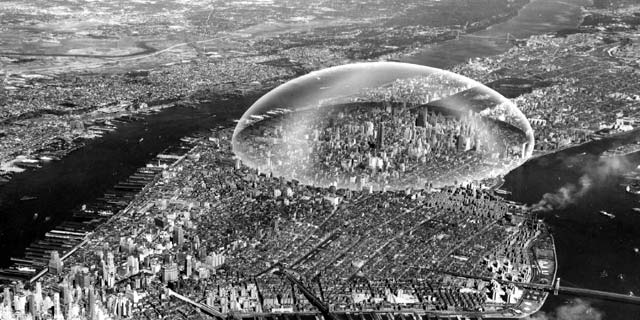
In a corner of the soaring lobby of Chicago's Museum of Contemporary Art sits an inconspicuous screen cycling though a series of quotes. "Don't fight forces," one suggests, "use them." A few seconds later: "Do more with less." And then: "Real wealth is ideas plus energy." These are the words of Buckminster Fuller, the great American thinker and designer famous for his geodesic domes and his pragmatic idealism. Fuller was a colorful man, and extraordinarily wealthy if measured by his own standard: his thoughts were abundant and bright, and his energy seemingly boundless. In the exhibit Buckminster Fuller: Starting With the Universe, the MCA has crafted an impressive overview of Fuller's life and work that brings into focus his prescient worldview and, more importantly, the thought process behind it.

It was after his failure as a businessman and the death of his daughter in 1927 that Fuller resolved to turn his life into an experiment to see how much one man could contribute to society in a lifetime, labeling himself "Guinea Pig B." The exhibit opens with several rooms filled with a diverse selection of objects that recount the beginning of this experiment. Models, drawings, maps, notebooks, and other objects show the evolution of Fuller's early work into his development of the World Game and the Dymaxion map during and after World War II.

Fuller prided himself on his comprehensive thinking; he approached each problem as part of a larger system of problems. Humanity's great challenges were all interlinked, and to consider solutions for one, it was necessary to consider the others simultaneously. Nowhere in the Starting With the Universe is Bucky's way of thinking on display more clearly than in the two rooms that detail the evolution of the Dymaxion Map into the development of the geodesic dome. It was his work on creating a map that eliminated the distortion of the planet's land masses that led to Fuller's fascination with polyhedrons. His engineer's brain latched onto the structural integrity of the icosahedron form that his map created when folded into a "globe," and by the 1950s he was working with his students at the legendary Black Mountain College in Asheville, NC, on developing the dome that would define the later part of his career.

Interestingly, it is a rather inconspicuously-placed video of Fuller at the mid-point of the exhibit that offers the clearest glimpse of how his industrious mind processed information about the world. His demonstration of how a flexible polyhedric structure shifts form is underlined by his emphasis on its uniform contraction and expansion. Throughout his life, Fuller worked on devising comprehensive solutions to myriad problems; his fascination with a flexible structure in which each part was equally responsive to all of the others is hardly inconsequential.

Beyond the geodesic dome, the maturation of which is explored in the second half of the MCA show, Bucky Fuller is arguably best remembered for his prescience. His ideas about environmentalism and the consequences of man's actions on the planet presage the contemporary Green movement by decades; he is also remembered for his early conceptualization of the internet and his musings on the growing importance of mass communications. Fuller understood everything as being part of a system, a network. In Buckminster Fuller: Starting With the Universe, the MCA has created an exhibit that presents Fuller's as a visionary worldview that remains relevant more than twenty years after the great thinker's death. Like any good museum exhibit, this one makes the visitor re-think they way that they look at the world. Bucky would be proud.

----
Buckminster Fuller: Starting With the Universe is on display at the Museum of Contemporary Art in Chicago until June 21st, 2009. For more information about the museum and its other exhibits, click here.


(Photos from ArchNewsNow, OSEarth, and PentaMil.)

Tuesday, April 29, 2008

The Next Street Art

Say there was a place that had some special meaning to you. It could be the alcove where you had your first kiss, the alley where you were mugged, the square where you participated in an important rally, or the location of an historic uprising. Good or bad, we all infuse places with our memories. This is what makes physical places so powerful, and why peoples' opinions and experiences of the same place can be vastly different. Places are what people make of them. Now, technology could be making it easier for tech-savvy street artists to etch their own experiences and opinions onto physical places, communicating the artists' own sense of a place to others who pass through it.

Barcodes are most commonly used in retail environments, but their size and informational storage capacities make them ripe for adaptation for more inventive uses. In Japan, barcodes are now being applied to gravestones to store and transmit information, when scanned, about the deceased. The idea here is that family members will, through videos, photos, and stories, be able to reconnect with the deceased in a less mournful, more celebratory way. Imagine "a sort of gravestone based, family fueled, wiki of the dead."

This technology could easily be used in public spaces to represent a political viewpoint or a historical event. Imagine walking down a street for the first time and noticing a bright green barcode sticker affixed to the facade of a building. Using a scanner-enabled mobile device, you could access a website loaded with the history of the building site, or a series of short stories about the surrounding blocks, or photos of a lifechanging event that a stranger experienced in the very spot where you are standing. Reading or viewing material like this would give the place a new gravitas, and would change your perception of what might otherwise be a mundane stretch of asphalt and brick.

RFID tags are another method of remote-storing information that, thanks to increased range, provide the opportunity for a bit more mischief. With the technological know-how, a clever street artist could program a chip to send a text message or photo to any wi-fi enabled mobile device passing by. Imagine again: you're walking down a street and you pass a hidden RFID tag; your phone rings. You answer. An audio recording plays, recounting a woman's personal account of a riot that took place across the street a decade earlier. Later, walking through a park, your text alert sounds. You open the message to find a set of coordinates and the time of an upcoming event, perhaps a flash mob or a constructive riot. Or, perhaps, a photo of the view from the very place that you are standing, hyperlinked to a database of stories and photos of places around the city (along the lines of Invincible Cities, linked below).

While they would only be accessible to those with the proper devices to read the information that they stored, RFID tags and barcodes have distinct advantages over more traditional forms of street art like posters, graffiti tags, and murals. For one thing, they are smaller, and less intrusive. While this could be seen as a weakness (especially for barcodes, which require direct interaction), it is also a strength in that RFID tags and barcodes are less likely to prompt their own removal than more readily noticeable artistic interventions. These tiny storage units can also provide more vivid, personalized accounts of events or viewpoints, and have the potential to be more impactful on their viewers.

RFID and barcode street art has the potential to turn the urban environment into a virtual minefield of information. While the potential for abuse by malicious hackers or marketing drones is there, the idea of being able to literally "tag" a place with multimedia information is an exciting one. Perhaps it's already being done. Anyone know of some examples?

(Photo from Flickr user cloverst. The original full-color version can be viewed by clicking the photo.)


Links:
Barcodes on tombs to connect with the dead (The Inquirer)

Invincible Cities (Thanks, Pete!)

Thursday, January 31, 2008

Coexisting and Coworking

Contrary to naysayers' and pessimists' early warnings, distance in the wired world is decidedly not dead. In fact, as has been pointed out a gazillion times already, the revitalization of many urban cores in the US and around the world has coincided with the miraculous rise of the internet and wireless technology. But why have people not retreated to mountaintops as was feared at the onset of the internet era? If you can have a creative and fulfilling career from anywhere, why not work from a rustic cabin overlooking a placid lake in a bucolic wood?

Blech. Boring.

A recent post on coworking (a trend that I am particularly enamored with) at Coroflot's Creative Seeds Blog inadvertently highlights why the internet has pushed people closer together rather than pulling them apart. Coroflot's lays out the options for those who don't have a formal office -- temporary cubicle, cobbled-together home office, isolating coffee shop -- and then explains that none of these environments has "the most important quality of the ideal creative workspace: other creative workers with whom to interact. It's well understood that good ideas and good creative work flow almost never flourish in a vacuum, and yet increasingly we are asked to make them do so."

Cities are more diverse, active places. They are larger and thus, by default, contain more possible answers to any question of location. Thus, for someone who is free to work anywhere, cities provide the most enticing environment. By living in a city, a creative worker has the opportunity to change up their daily workspace. There is always the option of moving out to The Sticks, but when The Sticks compete on a level playing field with the urban core, guess which one usually wins out?

There's another fact that's been repeated a gazillion times over the past few months that may provide a hint: for the first time in the history of civilization, half of the world's population now lives where?

(Photo from Flickr user MathieuCoste. The original full-color version can be viewed by clicking the photo.)


Links:
Your Dream Office is Just Over There: Co-Working and the Instant Creative Community (Coroflot's Creative Seeds Blog)

Friday, January 4, 2008

WEEKEND READING: December 29th, 2007-January 4th, 2008

It's been a crazy week for this blogger offline, but regular posting should resume next week. I have a ton of stuff backed up from the holiday season, so Where might get busy soon. As for Weekend Reading, we're starting off 2008 with some great material!

ITEM ONE: Sick of suburban sprawl? So are the people behind Project Outrage.

ITEM TWO: Der Spiegel profiles Albert Speer, Jr., son of the devil's architect.

ITEM THREE: Deputydog features a short but visually impressive post on one of my all-time favorite buildings (now, sadly, demolished), Diller + Scofidio's brilliant Blur pavillion. (photo credit)

ITEM FOUR: WorldChanging rounds up the top city-related stories from its 2007 archives.

ITEM FIVE: Social Practice points to this site, Encounters, which "[explores] informal education, lifelong learning, and social action."

ITEM SIX: Collapse author Jared Diamond's much-ballyhooed article on scales of consumption in the NY Times.

ITEM SEVEN: Do cities have color schemes? Brand Avenue takes a look.


Enjoy your weekend. It's 27 degrees in Chicago right now...feels like summer!!

Friday, December 21, 2007

WEEKEND READING: December 15-21, 2007


Welcome back to another Weekend Reading session, everybody! We have another good batch this week, but if you've only got a little time, make sure to check out Items One and Two.

ITEM ONE: A spectacular piece in The Walrus' Cities Special Issue on suburbia, commute times, and the economics of happiness. Don't miss this one!

ITEM TWO: Simmons Buntin, founder of Terrain, blogs at TNAC on the role of beer in creating the urban-rural society.

ITEM THREE: Some interesting musings on gentrification from a recent transplant to Brooklyn.

ITEM FOUR: Airoots on high-rise squatting in Mumbai.

ITEM FIVE: Megacities all over the world are starting their own climate change initiatives, including one Cuban city that's using horse-drawn carriages for mass transit!

ITEM SIX: The Economist on the Bali climate talks.

ITEM SEVEN: Planning a trip to Rotterdam this February? Make sure to check out The Mobile City conferrence on the 27-28th.

While I have your attention, I want to mention that I've just started blogging over at The Next American City's blog, The Street. I'll be covering all things related to leisure and public life in American cities. If you're interested, you can check out my first post here.

(Photo from Flickr user sarako. The original full-color version can be viewed by clicking the photo.)

Thursday, December 13, 2007

The Dream Remains the Same

A recent post over at TNAC's blog, The Street, suggests that it may be time to change the American Dream. But what is the American Dream, exactly? It's a well-worn turn of phrase (were it a turn in the road, the guardrail might be out from being hit so many times), and while people usually use "American Dream" as slang for "house in 'burbs, lawn, two cars, spouse, 2.5 kids, dog," I would argue very strongly against this interpretation. The American Dream is not about houses or property or ownership -- heck, it's not even about money; it's about "new hopes, new dreams, and a better way of life for the future."

That quote was taken from an animated short produced by the Walt Disney Company in the 1950s. The subject was, surprise surprise, the future of superhighways. The Disney folks imagined a tomorrowland where automobiles provided the ultimate in high-tech freedom and mobility, populations were dispersed over "vast metropolitan regions" and the family unit was supported and enhanced by the great amounts of leisure time left over from avoiding the hassles of urban existence. On top of that, a global system of superhighways was to connect all nations and peoples and increase cross-cultural communication and collaboration. Oh, how glorious it looks on that little YouTube screen.

The present, as we are well aware, looks slightly different. Private vehicles do provide freedom and mobility, in a way...even if much of that free time is spent in the car, staring at a bumper. As a result, we've given up on that whole "extra time with the family" thing; in fact, divorce rates have soared as our population has spread out, stretching marital relationships to their breaking points by removing the basic social frameworks that might allow spouses to have some much-needed time apart outside of the workday (since both work full-time to pay for the oversized McMansion and the two SUVs).

Then again, that scenario is as well-worn as the term "American Dream." Still, the Dream itself is in no need of an overhaul. We would do well, perhaps, to wrestle it out of the arms of marketing-types still using it to pitch the 1-Acre Lots For All, Ford Chevy Ram MegaCharger bullshit. But the American Dream is as honest and straightforward and bright today as it ever was. You can see it in the modern sustainability movement in the same way that you can see it in Disney's adorably retro vision of the superhighways of tomorrow: the American Dream is about change. More specifically, it's about things changing for the better, and about people having the freedom to enjoy and participate in the process of change. Society and culture are driven -- and have always been driven -- by the masses. The dream of a brighter future took the "American" moniker from the fact that the United States was the first modern nation to do away with the European monarchal system. Change will always happen since the people will demand it; the US was one of the earliest countries to make that its raison d'etre.

In the eternal quest for the elusive "brighter tomorrow," we will continue to make mistakes. We will have disasters and wars, and terrible things will happen. People will die, dictators will rise and fall, and the oceans might rise up to claim some of our cities. But we will continue to evolve with the world around us. So the American Dream is in no need of modification. It is always a good idea to stop along the path and shake off some cobwebs, but hope for something better is the essence of what makes us congregate, collaborate, and create.

Cities are based on this principle; at their core, they rely on change. Cities lose buildings and parks and whole districts; much like any living organism, old cells must be shed to make way for the new. While it is sometimes painful, change will always happen, and as the largest, most interactive manifestations of mankind's ambition, cities will have to change for the good and the bad, just like we do. In short, you can't curse the suburbs; you'll just run out of breath. Instead, try to imagine what the next batch could look like. Try to imagine a brighter tomorrow while accepting that the suburbs will be a part of it.

More on this soon, as a review of Paul Lukez's Suburban Transformations is forthcoming.

(Photo from Flickr user brassplayer. The original full-color version can be viewed by clicking the photo.)


Links:
Changing the American Dream (The Streets)

Magic Highway USA (Part IV)

Magic Highway USA Publicity Stills (Paleo-Future)

Friday, December 7, 2007

WEEKEND READING: December 1-7, 2007

Back to business as usual this week for Weekend Reading. Thanks again to Colin for taking over during November, and thanks once more to all of the guest bloggers who helped to keep Where chugging along during NaNoWriMo!

ITEM ONE: It's BLYGAD 2.0! Tumble Like You Give a Damn, folks.

ITEM TWO: The Architectural League of New York has put out a call for entries to its Young Architects Forum competition for 2008.

ITEM THREE: In the past, little attention was paid to South America and its blossoming cultural scene. Not much has changed, there, but Line of Sight dug up a great article from a 1916 New York Times on the subject.

ITEM FOUR: Subtopia has a post called "Squatter Imaginaries" that contains some of the coolest images you'll ever see. (photo credit)

ITEM FIVE: Giant scale model of a partially destroyed downtown = kickass display for your living room.

ITEM SIX: The Future of Cities on what Jane Jacobs might have thought of Facebook.

ITEM SEVEN: Things Mag starts a recent post off with some interesting ruminations on destruction and redevelopment in the UK. Much link love follows.


'Till next week, happy surfing.

(Photo from Flickr user shadeofmelon. The original full-color version can be viewed by clicking the photo.)

Thursday, November 8, 2007

WEEKEND READING: November 3-November 9, 2007 (Guest Post by Colin Kloecker)

Hi, I'm Colin and I usually write over at Blog Like You Give A Damn. But this month you'll find me here, curating Where's Weekly Reading segment. Brendan has graciously allowed me to break from his standard format for something a bit more casual. Let's call it a stream-of-thought meditation on a theme.

This week -- Near future urbanism: how an ubiquitous and multi-layered network might effect our urban environment. Photo: OiMax (via Flickr)

Moore's Law tells us that computing technology is advancing exponentially – essentially doubling every two years. With Rainbows End, mathematician, computer scientist, and science-fiction writer Vernor Vinge extrapolates on Moore's Law and envisions a near future where the physical world can be reinterpreted through "contact lenses that can overlay what the wearer sees with skins that redress the environment to your taste." [Check out this smallWORLD podcast to hear Vernor talk at length about the concepts and technologies behind Rainbows End] A similar concept is explored in William Gibson's recent novel Spook Country, in which locative artists create incredibly complex site specific geo/virtual mashups, tied to specific locations through GPS and wi-fi technologies [see gpsdrawing.com or this video for some real-world examples].

Both of these authors and their recent works are proposing a malleable virtual/ urban environment where user generated content meshes seamlessly with concrete and grass [see CSI:NY's recent foray into Second Life for a not-so-seamless example]. Essentially, if you don't like the looks of that new condo going up across the street - simply design a new facade, upload, and share with your social network of choice.

In a world where the net is everywhere and we are always online, geographic locations will be linked in as well. It won't be long before we are going about life tagging locations with keywords or personal stories like we would a page on the web (imagine geo.del.icio.us or MySpace taken literally). As technology advances and life-caching becomes more robust, you could feasibly go back to the location of your first kiss, bring up the appropriate file, and project that exact moment in real-time. Hackers and artists will upload pirate landscapes, momentarily hijacking reality for thousands of people at a time. Communities with similar belief systems might organize around a shared perception of reality or aesthetic sensibility - and then actually make that their reality.

So all of this speculation begs the question: in this media-rich user-generated landscape, what role is there for the architect and urban planner? Will cities be reduced to the skeletal equivalent of a wire frame 3D model, designed to be dressed up with an infinite and interchangeable architectural wardrobe? This is to say nothing about questions about privacy or invasive marketing strategies... phew!

As you can probably tell, I've been on something of a futurism kick. Check out futuretalks.com if you're digging it too. They recently started broadcasting an interesting series of conversations with futurists Gerd Leonhard and Glen Hiemstra. Until next week, Happy Friday!

Wednesday, October 3, 2007

(Re)Building Intellectual Infrastructure

Richard Florida, Dr. Creative Class himself, spent a good deal of time in a post today on his blog responding to some of the concerns raised in yesterday's Where post on questioning the logic of the CC. I'll admit that I haven't yet read Rise of the Creative Class (yesterday's post was about the phenomenon, not specificlly the book that started it), so reading his thoughts taught me a lot that I didn't know about his argument. As it turns out, I agree with him on more than I had originally thought. From Dr. Florida's post:

"My bottom line is that every human being is creative. And the creativity cannot be forced into the social categories we have imposed on ourselves...The real task is to build pathways to a creative society in which all can contribute and be rewarded [and] in which all engage their creativity at a much fuller level, thereby contributing to economic growth...The key to the future will be to extend the creative force into the service and manufacturing economies - across all segments of the population. The logic of the creative economy is such that the further development of the economy requires the further development of human creative capabilities. We need to shift from a creative economy and a creative class to much fuller and broader creative communities and a creative society."

This plays directly into the follow-up I had planned to last night's post. If cities hope to strengthen the creativity of their citizens in order to secure their economic futures, the officials holding the purse strings need to realize that coffee shops and bike paths aren't going to cut it -- they're the icing, not the cake. As illustrated in the Slate article referrenced yesterday, the creative class will seek out existing creative societies. Cities looking to invest in their creative infrastructure, then, should focus on building up the skills of those who already live there instead of looking to bring new folks in. To paraphrase City Comforts, brilliance innovates, genius follows.

Cities looking to build a creative populace can do so if they are willing to invest in what we'll call their intellectual infrastructure. Civic leaders' first step here would be to create the strongest school system possible -- a major responsibility that many cities illogically refuse to take seriously. That sadly overpoliticized issue aside, cities must find innovative ways to encourage their citizens to develop their own creative skills. It's time that politicians stop looking at citizens as "constituents" (read: votes) and start seeing them as what they are: the city's greatest assets.

In a recent post at atlas(t)'s Galleon Trade Edition, blogger Claire Light waxed nostalgic about the proverbial days of yore: "Once upon a time, before art was professionalized (insofar as people are willing to pay artists, that is to say) folks stayed at home a lot and made art themselves. Every middle class home had a piano, every working class one a fiddle, or a jew's harp. Young ladies drew each other for sport. Young men drooped from the forks of tree branches shouting, 'Beauty!' Jigs were danced, and danced well, on homemade wooden heels, family theatricals taught children the fine art of crying at will, [and] a blank wall was excuse enough for interpretive dance..."

As Dr. Florida (and several readers who commented on yesterday's post) pointed out, creativity is about a lot more than what we traditionally think of as the arts. Creativity and innovation, especially in terms of economics, must be valued in all fields and industries. What the atlas(t) post illustrates particularly well is the way that art used to be intregrated into society; these kinds of activities were much more accessible to the general public. Art-for-fun had no social stigma; it was just something that everyone did. In this way, artistic endeavors served as both social activities and intellectual stimulation. When you gathered around a piano and sang songs with your friends, you got some beneficial social juju and you gave your brain a workout. While you may not have been able to use your piano-playing skills or your ability to sing a high G at work the next day, your musical exploits sent you to the office or the factory with a fresh and slightly-stretched mind.

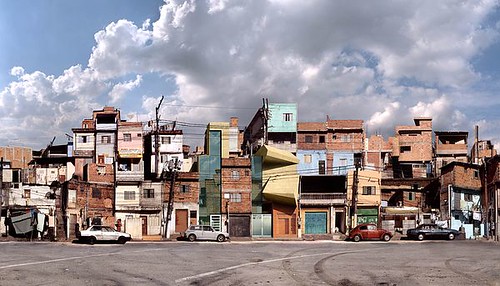
So what policies or public projects could a city undertake to try to rebuild this kind of intellectual infrastructure that makes creativity a common civic value? One idea comes from a recent airoots post (them again!) about a kind of dwelling in the Dharavi area -- best known as Asia's largest slum -- in Mumbai known as the "tool-house." When is a house a tool-house? "When every wall, nook and corner becomes an extension of the tools of the trade of its inhabitant. When the furnace and the cooking hearth exchange roles and when sleeping competes with warehouse space. A cluster of tool-houses makes for a thriving workshop-neighbourhood and its public spaces emerge as a dynamic by-product of such an auto-organized habitat."

To attempt the transformation of a contemporary Western (or Westernized) city into a tool-house city would be both disingenuous and impossible. What we can learn from these places is a social principle, not a building practice. Tool-house cities are innovative by necessity, but they illustrate "the relationship between production, livelihood and spaces." This relationship is vital to creative cities, where production -- not consumption -- is the primary economic mode of the citizen (think "prosumer").

Cities, then, should invest in projects and policies that reinforce the production-livelihood-space relationship and encourage citizens to apply the skills that they learn on the job to the world around them in new ways. Citizens should also be encouraged by civic leaders to build off-the-job skills as well, as these can also be applied to urban problems and will likely be more potent and flexible when combined with work-related knowledge.

But what, physically, might this kind of thing look like? Perhaps cities could organize and/or facilitate neighborhood skill-shares or tool-sharing programs, sponsor a job-shadow program for adults, or subsidize classes that could teach arts and trade-related job skills (how about a graffiti club that teaches teens masonry skills so that they can learn to build walls to paint on -- and how to clean them off) There are ten times as many solutions as there are problems. Any ideas?

(Photo from Flickr users pbo31 and Soumik.)


Links:
Creative Class Debates (Creative Class Group)

Manalo Juan (atlas(t) Galleon Trade Edition)

Urban Fictions: The Toolhouse (airoots)

Wednesday, April 18, 2007

The New Pittsburgh: Creating a Humane Urban Model

So a new idea hit the blogosphere a few weeks ago and, because I don't keep up with reading about my favorite city nearly as much as I should, I'm just now getting around to writing about it. It's the Manifesto for a New Pittsburgh, compsed by three Burgh bloggers (Mike @ Pittsblog, Jim @ Burgh Diaspora, and Jim Morris.) These guys have put together a pretty grandiose vision (the inspiring, Daniel Burnham kind of grandiose) for the Pittsburgh region but, as is noted in the introduction to the Manifesto, it's an idea that is not yet set in stone. Responses were requested.

One of the responses to this manifesto, which focuses largely on increasing connectons at the community, city, regional, and international level, asks how, exactly, Pittsburgh can reach out to the diaspora of Burgh natives across the planet. How, in essence, can former Pittsburghers living in Los Angeles or London or Tokyo be persuaded to invest money, time, or resources in their hometown when they live so far away?

Coincidentally, Pittsburgh played host to a Humane Metropolis Workshop just a week before the manifesto was posted. The conferrence is described thusly: "The objectives...include reviewing current urban improvement initiatives in Pittsburgh, promoting partnerships among local citizens and public officials, sharing relevant experiences from other cities, generating new ideas, and fostering awareness of Pittsburgh's emergence as a role model for other cities." There's all that "increased connectivity" talk again.

Greatness is what wins international attention--greatness in vision, leadership, innovation. Pittsburgh is a city that, thanks to its congenial attitude and ecologically rich setting, is particularly well-suited to becoming a global model of the "Humane Metropolis" discussed in the previous post. Most of the Pittsburghers I've met have had a real sense of pride in place; though they may not live there, they have strong feelings about their hometown. Thus, their own pride is, in part, tied to the fortunes of the city. Re-shaping Pittsburgh as the new model of greatness for healthy urban regions in the coming century could serve as an excellent means for inspiring members of the diaspora to contribute to the prosperity of their former home.

The Manifesto includes passages about "enfranchizing new and marginalized voices" and "reaching out to a 21st century global Pittsburgh of many colors, nationalities and ethnicities." It looks to me like there's quite a bit of connectivity between these two ideas already...


Links:
Manifesto for a New Pittsburgh

Pittsburgh: A More Humane Metropolis Workshop