Showing posts with label washington dc. Show all posts

Friday, March 27, 2009

Thinking Outside of the Box on the National Mall


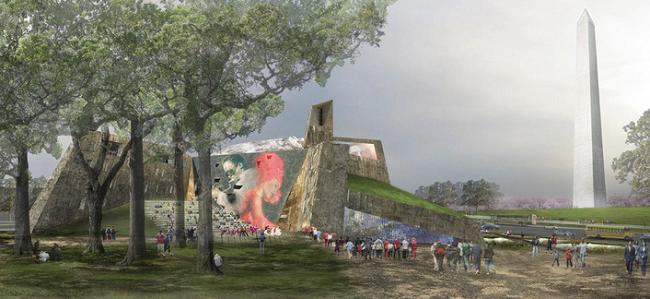
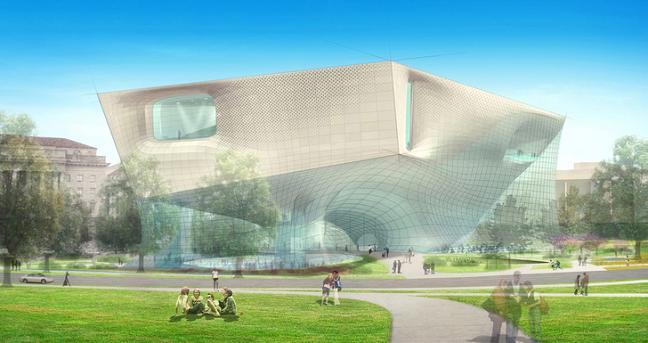
Submissions have just been unveiled this afternoon for six innovative entries in a competition to design the planned Smithsonian Museum of African American History and Culture, a $500 million project scheduled to open in 2015. The six competing teams are: Devrouax & Purnell with Pei Cobb Freed & Partners; Foster and Partners with URS; Diller Scofidio + Renfro with KlingStubbins; the Freelon Group, Adjaye Associates and David Brody Bond with SmithGroup; Moshe Safie and Associates with Sultan Campbell Britt & Associates, and Moody Nolan with Antoine Predock Architect.

Above is a rendering of Diller Scofidio + Renfro and KlingStubbins's avant garde submission; a rendering of Moody Nolan and Antoine Predock's proposal is below. Looks like the Smithsonian -- a fairly traditional institution, when it comes to architecture -- is planning to give the National Mall a bit of archi-juice. And we thought the National Museum of the American Indian's building was a departure!

It's always refreshing when, once in a blue moon, all of the entries in a competition are genuinely interesting, no?

(Photos from the Washington Post.)

Wednesday, February 27, 2008

The Staten Island of Tomorrow

The following comment was made in response to a post at the NY Times blog Dot Earth about the future of suburbia:

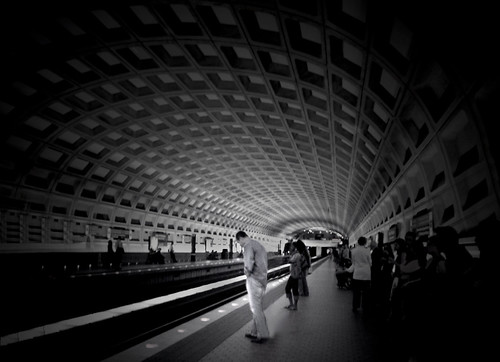
"The answer to can we uninvent Suburbia is Queens, which in my youth was essentially a suburb and is now a city. Before that in my father’s time it was Brooklyn, a borough of little villages, and more recently Staten Island. The best way of accomplishing this is through good urban transit. In the DC area where I now live, the biggest mall (Tyson’s corner) is in despair trying to attract a new Metro line. The most successful new malls (White Flint and Pentagon City) are on the Metro."
— Posted by Eli Rabett


Building on yesterday's post, how plausible might it be to link Staten Island to Brooklyn or Manhattan with an underwater tunnel neighborhood? Would it be possible to extend the 1 train from South Ferry to Tottenville? Could an entire transit corridor lined with high-density underwater apartment complexes and shopping centers finally provide a high-speed link between the forgotten fifth borough and "The City"? Lord, maybe they could bring back the 9 so that it could run express and actually serve a purpose.

But then, who would want to live in New York Harbor? Something tells me the view is less than pristine.

Still, it's an interesting concept; Staten Island as the new frontier in New York City...

(Photo from Flickr user dclarson. The original full-color version can be viewed by clicking the photo.)


Links:
Can We Uninvent Suburbia? (Dot Earth)

Friday, January 18, 2008

WEEKEND READING: January 12-18, 2008

Stellar, stellar week, folks. I can't overemphasize the awesomeness of the links below. Do yourself a favor and set aside an hour or two this weekend for some solid online reading.

ITEM ONE: Airoots weighs in on The "S-word" -- Slums -- and, in particular, the clearance thereof. (For more on the subject, check out this Globe and Mail article).

ITEM TWO: Mike Lydon writes a stirring post on Interchange about the importance of teaching urban planning in public schools.

ITEM THREE: In the future, buildings will talk to each other. (Image credit)

ITEM FOUR: Majora Carter is a sustainable urbanism ninja.

ITEM FIVE: New City Magazine tracks the migration of hipsters in Chicago (focusing heavily on Where's new center of operations, Wicker Park).

ITEM SIX: You've heard of designing a better mousetrap? How about designing a better White House?

ITEM SEVEN: Springwise takes a look at a potentially revolutionary new technology that could make entire neighborhoods self-sustaining.

And we'll leave it at that. Adios, compadres.

Friday, September 14, 2007

WEEKEND READING: September 8-14, 2007

I'd be lying if I tried to pass off a near-postless week by saying I'd been busy...I've been in hardcore daydream mode. Next week we'll return to our regularly scheduled programming...I think. :-) For now, there is weekend reading...

ITEM ONE: Pruned reports on the fascinating Seuthopolis project in Bulgaria, complete with some super imagery.

ITEM TWO: Speaking of imagery, Curious Expeditions has come up with an exhaustive photo collection of the world's most stunningly beautiful libraries (including Milan's Biblioteca Di Bella Arti, pictured above).

ITEM THREE: Planning a trip to a Developing World country? Stuff Your Rucksack.

ITEM FOUR: The Russians are apparently having baby making contests now. Hmmm...

ITEM FIVE: Norman Blogster over at Part IV introduces MIMOA with some superb sardonic wit.

ITEM SIX: New Monu! The topic: "Second-rate urbanism".

ITEM SEVEN: A great NY Times article on DC's promising new mayor, Adrian Fenty.

Enjoy your weekend!

Friday, June 29, 2007

WEEKEND READING: JUNE 23-29, 2007


It's that time again, folks. The weekend is here at last, and it looks like it might actually be a nice one in Chicago. If you're supposed to get crappy weekend weather, these links might actually be useful!

ITEM ONE: Mayor Daley wants Chicago to host the Olympics in 2016, but there are a few hurdles left to clear. Unfortunately for him, many of them happen to be the Windy City's citizens. (Via No Land Grab.)

ITEM TWO: The first Jane Jacobs awards are given to two urban innovators in New York.

ITEM THREE: The best book this year about San Francisco? SFGate thinks it's "The Suburbanization of New York".

ITEM FOUR: Wired features an article that serves as a great follow-up to yesterday's post on the Dawn of Digital Urbanism. (Via The Map Room.)

ITEM FIVE: This is even better -- an imagined glimpse of geo-blogging DC, Berlin, Dubai, Mumbai, and Torino in 2017. (Photo credit to Wired.)


Adios, compadres. Have a great weekend.

Friday, June 1, 2007

WEEKEND READING: May 26-June 1, 2007

This week, Where features Speedy Weekend Reading! It's also pretty much Solid States this week...sorry, Entire International Community.

ITEM ONE: Kazys Varnelis writes about the difference between the social structures of Los Angeles and New York and wonders which is more future-forward. (There is also a link to lots of great anti-Hipster stuff at Time Out NY.)

ITEM TWO: On Common Ground brings us this lovely pdf doc about the Pros and Cons of Gentrification.

ITEM THREE: Pruned gives a belated shout-out to the kickass UrbanLab proposal for Chicago that won the History Channel's City of the Future competitiopn a few months ago.

ITEM FOUR: Josh at Built Environment Blog put together a great e-tour of Brooklyn that really gives you a strong sense of the area. (I love this kind of writing.)

ITEM FIVE: Planners in Pittsburgh's South Side Flats neighborhood (which rocks, for the record) made the interesting and innovative decision to include fourth- and fifth-graders in the process of revising the neighborhood plan.

ITEM SIX: In a follow up to a previous Where post, Washington DC continues to struggle with the question of whether or not to re-examine its height limit.

That's all for me for this week. Happy Friday!

Wednesday, May 2, 2007

Capitals of Glamour


Berlin, it seems, is a city of paradox. The city has the image of an exciting, healthy metropolis set to ride globalization into the 21st Century. The reality is that, while vibrant, the German capital is a whopping $83 billion in debt, "[epitomizing] the costly, unfinished task of economically uniting east and west." (LA Times)

The much-buzzed-about city, which began rebuilding itself almost two decades ago, certainly looks good in photos. Splashy images of Renzo Piano and Helmut Jahn's towers at Potsdamer Platz and the then-edgy Sir Norman Foster's Reichstag rehab made the rounds in architectural circles, and tourist brochures promoted the city as a hedonistic party haven. The Glamo-magic worked, and international opinion of the city appears to have soared even while unemployment and debt mounted. Now, foreign investment is carving out a new Berlin where abandonment and low land values -- a rarity in a modern European capital -- are actually adding to the glamour of the place by practically promising high returns on investments. Berlin has become, in short, a testament to the power of reputation.

Stateside, Washington DC is apparently beginning to experience growing pains thanks to the American urban renaissance. As land becomes increasingly scarce in the mostly-gentrified areas surrounding downtown, the law that restricts building heights to 130 feet is being called into question. This idea is as ironic as it is controvertial, as a big part of the visual allure that adds so much to the city's Glam quotient (GQ?) can be attributed to the uniform building heights throughout the city, which have preserved historical character and internationally famous vistas.

Though crime is notoriously high, DC maintains a sizable measure of glamour; Los Angeles and New York are the nation's centers of culture, entertainment, commerce, and celebrity, but Washington has the special distinction of being the political center of the Western world. Long before globalization kicked into high-gear in the early 1990s, Washington was an international metropolis. Now, with every city from Taipei to Indianapolis claiming international importance, the District's monuments and the Americanized Parisian streetscapes that frame them so well in billions of tourists' photos have even more weight; these vistas put to shame many cities claims of relevance, serving as reminders of what a true Global City looks like.

Berlin, until recently, was another capital city with a low-slung skyline. Now, towers continue to push into the himmel (like my German skills?) and the city's popularity continues to grow. It's hard to imagine the Washington Monument and the Capitol Dome sharing the skyline with the types condo and office towers that appear on postcards of other American cities, but as land values in the central part of the city climb ever higher, some people are starting to ask whether its realistic not to. Their argument is not completely irrational.

Washington DC and Berlin are vastly different cities. Still, it's almost impossible to miss the parallels between the two in the tiny, tiny modern world. As DC struggles to calm its violent crime rate and re-imagine itself as a city that is accessible to people throughout the economic spectrum, it will be interesting to see whether the Glamourous City effect raises the city up like Berlin...or ruins it.


Links:
Investors betting on a Berlin boom (LA Times)

High-Level Debate On Future of D.C. (Washington Post)
Sunday, April 22, 2007

DisPlace Me


You might have figured out already that I consider place to be a pretty important thing. While it doesn't get the attention that it deserves, individual geography plays a huge role in how we understand our selves and how we fit into the global community. One social problem that I've always found particularly disturbing is the loss of place. Refugees around the world, forced from their homes by war, famine, natural disasters, or any number of causes, often find themselves in places that do not want them. Whether this means that they are not welcomed by the people or by harsh terrain, the outcome is the same. Refugee camps are communities that cannot be, because of the high transience and mortality rates. Nothing in a refugee's place in the world is permenant; they have nothing to hold onto.

Next weekend, in 15 cities across the United States, Invisible Children will be hosting DisPlace Me, a simulation/protest that is designed to help Americans understand what it is to lose their place in the world. From their website: "The Lord’s Resistance Army (LRA) has abducted thousands of children, subjected them to torture or sexual violence and forced them to fight in a violent guerilla army for 21 years—making it the longest running war in Africa. In hopes of providing protection from this rebel militia, the Ugandan government forcibly evicted its Northern citizens from their homes—giving them 48 hours to relocate into camps. Today, more than 1.5 million Northern Ugandans remain far from secure, suffering nearly 1,000 deaths per week due to inhumane living conditions in the camps.

"'Displace Me' is the nationwide event giving Americans the chance to respond.

"By traveling to one of our 15 camps and gathering together, the strength of our size will make a visible statement to our government and media that the citizens of the U.S. demand action in ending the war in Northern Uganda, in order to send the Acholi people suffering in the camps and the abducted children back home. The point is to travel; the point is to become displaced yourself."


Go get lost.


Links:
DisPlace Me

InvisibleChildren.com