Showing posts with label internet. Show all posts

Friday, July 24, 2009

The Attraction fo Free


Everyone likes to get free stuff, even when it's junk -- like brochures and keychains at a trade show, or a reusable bag from your local market. Retailers and businesses give out free things as a marketing ploy, to build rapport and disseminate information. Another form of free comes in the newspaper ads, with the buy one get one free coupon, or the holiday giveaways (think Black Friday.) These giveaways are designed to attract patrons to a certain retail location in hopes that they will spend more moeny, come back more often, and essentially support the business. It seems to work as my mailbox is inundated with these coupons nearly everyday.

So, with my tabletop covered in coupons and freebie offers, I began to think, how can Rustbelt cities and cities with declining populations use the idea of free to attract new residents. The goals seem similar, stores need people to come in and buy their assorted goods while cities need to attract people to come and start businesses, raise families, and pay city taxes. Perhaps these cities could create marketing campaigns targeting young creative entrepreneurs by offering buildings, land, space, tax breaks. After all, the Rustbelt is, if nothing else, is rich in land and space, just look at Flint.

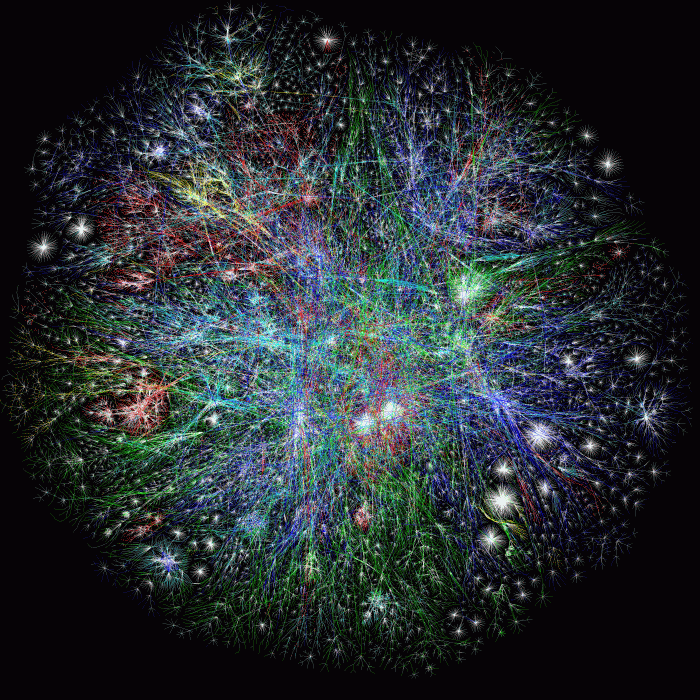
There exists a whole class of creatives out there who would love to start their own businesses but can't due to the burden of large overhead costs especially in business hubs like NYC or Chicago. Rustbelt cities in conjunction with the internet's world wide marketplace offer very low overhead costs. However, in order to make these individuals pack their bags and move to a new city that they know little about and attempt to form some type of business, they need incentive. Businesses take time to start, and by offering entrepreneurs free rent, you are granting them time to learn the city, be inspired by the city, and establish their own business' in the city.


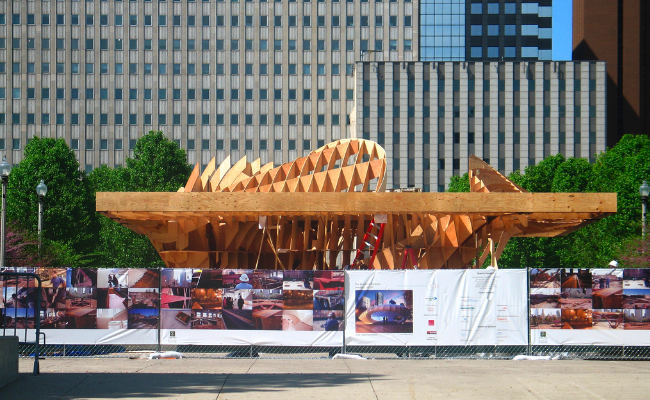
The real power of a program like this comes in the formation of a community. Once the idea catches on and creatives begin to take to he plunge into the Rustbelt, stronger and stronger creative communities will form attracting more and more people to the city. This can be seen in the reformation of the DUMBO neighborhood in NYC from a burnt out, unattractive block, into a vibrant community of artists and professionals. David Walentas, a NY developer bought up a huge portion of the Dumbo neighborhood in the late 90's then enticed an array of artists to take up residence by offering free rent for an extended period of time. The artists attracted the professionals and soon the neighborhood was bustling with a diverse group of New Yorkers. So the question is, can this work on a national if not global scale with the Rustbelt and other declining cities?


(Photo from icanhascheezburger, Corine Vermeulen-Smith, and NYT The original full-sized color version can be viewed by clicking the photo.)

Friday, June 19, 2009

Don't Miss: My Space @ NAC


There's another Whereblogger-authored post up over at Next American City's Daily Report...I'm a little late getting this one up, as it went live over a week ago, but later is better than never, as they say. The post takes a look at three Chicago-based urban planning non-profit orgs' attempts at interactive websites, and their various levels of success at engaging users. Below, a teaser, and here, a link. If you're so inclined, do take a look!

In cities—especially densely-populated cities, where open skies are a precious commodity—getting people to use public spaces isn’t usually a challenge. But getting people to talk about public space is another issue altogether. These days, the Internet is allowing planners and architects to reach out to Average Joe citizens to generate discussions about the built environment in new and increasingly creative ways; in Chicago, a number of recent public space-related initiatives have used the web to get people talking about the city’s public realm—with varying degrees of success.

This past week the Metropolitan Planning Council launched a region-wide search for Chicago’s best public spaces. Placemaking Chicago challenges Chicagoland residents from southeastern Wisconsin all the way down the lakefront to northwestern Indiana to send in photos and videos hosted at Flickr, YouTube, and their ilk, in order to determine the metro’s most enjoyable and successful public spaces. MPC is offering users various prizes, and winners will be determined by several rounds of judging, including an MPC-selected panel and a final public vote...


Once more with that link.


(Photo from Flickr user John Zacherle. The original full-sized version can be viewed by clicking the photo.)

Thursday, June 18, 2009

Networked Urban Politics


"Participation is war. Any form of participation is already a form of conflict", says architect and activist Markus Miessen, following Chantal Mouffe: "It is very important to envisage the task of democracy in terms of creating the institutions that will allow for conflicts between adversaries." Mouffe, a Belgian political theorist, has theorized on the notion of a "conflictual consensus", in which only a minimum common aim (democracy, equality, justice, etc.) needs to be settled and agreed upon within a society. The means for reaching this aim and even the meaning of the aim itself, on the other hand, can and should be disputable.

Miessen is more concerned with the spatial effects and possible materialization of these conflictual consensuses, particularly by way of everyday urbanisms: "When participation becomes conflict, conflict becomes space. Re-inserting friction and differences into both the scale of the institution and the city bears the potential of micro-political forces that render conflict as practice. In this context, participation becomes a form of non-physical, productive violence. Micro-political action can be as effective as traditional state political action."

- - -

Technologies that enable participation have become a staple of contemporary life, overcoming distance, economic limitations and even political constraints. Teens in Ciudad Neza are glued to their cell-phones just like their counterparts in Midtown Manhattan (though they might be planning a stickup instead of a cocktail soiree). ICTs have become so important to the functioning of societies that mobile phones are being handed out by governments along with food stamps and the One Laptop Per Child project seems demure compared to the aggressive downward pricing spirals of the netbook market. Today, 24/7 global connectivity is closer to practical reality than to some outlandish fiction.

- - -

From the nineteenth-century barricades to the revolts of 1968 to the social disruptions of the early 1990s, The Street was always an ideal escape valve for urban tensions and the preferred site of high profile (spectacular) political and social demonstrations. The Street was the perfect set for frictions. But if, as we’ve said before, The Street has systematically been loosing relevance, doesn't it make perfect sense that The Web take its place in this sense too?

- - -


The political perceptions and consequences of The Web and networked urbanisms differ intensely according to specific geographical contexts.

Here in Spain — not quite the First World, but still — there is a bubbly enthusiasm over new technologies and the promise of what they might deliver: salvation from impending economic fallout, a new dawn of proactive citizenship, gaining a steadier foothold in the Developed Nations club (after the brick-setter, real-estate-speculator and tour-guide triad has been widely acknowledged to be a flop as far as development schemes go), etc. Lethargic institutions, burned-out public universities, covetous town halls and ailing private companies are all eager to jump on the digital bandwagon here. The government is lending money for laptops, funding mediateques and data centers, talking Citizenship 2.0, etc. Hopes are high and the atmosphere is cheery, but approaches remain largely superficial or are limited to insiders, specialists and bureaucrats.

This is not the case in the Third World.

- - -

My browser is stuffed with Tehran bookmarks. Just like Cuban bloggers sneaking into Havana hotels to post their thoughts and opinions on the web or massive reactions to government corruption cases prompted by unofficial on-line reports in China, web activists and connected common-folk in Iran are opening channels for a new understanding of urban (networked) politics — proving at the same time that networked urban realities are far from being pretty or easy to grasp. The Street (Web) resistance that is shaking Iranian cities along with our reductive and jaundiced perception of Iran (Remember the days when thanks to George W. Bush — and to a lesser degree, Sally Field — Iran rarely evoked something other than a helplessly closed and traditional society?) is one of those events that change people’s gut perception of history in the making. But there is an additional element here. Like the Obama election or the global response to the Swine Flu affair, the unfolding of these fundamentally urban episodes and our reactions to them cannot be separated from the presence of digital technologies.


(Photos from Flickr user misterarasmus. The original full-sized color version can be viewed by clicking the photo.)

Tuesday, June 2, 2009

Change? What kind of Change?

Yesterday, General Motors filed for bankruptcy and the US Government now owns a 60% stake in the largest American car company. Whether it be for better or worse, one thing is clear: the auto industry will not remain the same, and change is coming. Perhaps now, in the beginning of one of the largest economic restructurings ever, it is an appropriate time to talk about change. 

There are 2 types of change: regulative change and massive change. One works to bring processes up to date and improve efficiency while the other creates a whole new logic, a whole way of doing things, thereby completely changing the way a system works. GM thought it could save itself by closing plants, streamlining processes, and attempting to create a leaner, more efficient manufacturing company. The problem is, the US automotive industry doesn't just need to be more efficient, it needs to be completely restructured. It is not just the processes that need to change; it's also the motivations, the way of thinking, and the image that drives the company. GM and Ford have resorted to making cartoon cars out of classics! Isn't that post-modernism in a bottle? Is that where we should be? Meanwhile, BMW is making concepts like the GINA which could inspire and rewrite the future of automotive technology. OK, end American Auto Rant.


America, and indeed the developed world, doesn't need regulative change, but massive change. Technology has vastly improved the way we communicate and connect with each other and yet we seem to take that at face value and fail to realize how these massive changes could rewrite the ways in which we operate as a society. The vast spread of information provided by the internet allows for and encourages experimentation. In a trying time like this, we should not hang tight to what we know, but venture out into the unknown to explore and grow, like the pilgrims, or like Lewis and Clark. Regulative change is like pioneering a new cassette tape when everyone has an iPod. In our cities, our landscapes, our businesses, and our buildings, we need to start seeing massive change that will bring us as a society up to the level of our technology.


The restructuring of GM is an opportunity to create massive change, to rewrite not only an industry but a country, and a mentality. If we want to be in a new age, we have to start acting like we are already there.  

(Photos from ideo.ro and wikimedia. The original full-sized versions can be viewed by clicking the photo.)

Thursday, April 2, 2009

Technology: Personal or Public?


“Any technology tends to create a new human environment... Technological environments are not merely passive containers of people but are active processes that reshape people and other technologies alike.”

Marshall McLuhan

* * *

It’s a worthwhile exercise to periodically consider why the much-maligned personal automobile is, in fact, maligned. The effort will likely yield such adjectives as expensive, dangerous, pollutant, isolating, frustrating and sprawl-inducing. Amazingly enough, however, the advantages of cars used to get all the attention. One hundred years ago, the car’s invention started a transportation revolution while becoming the symbol of American freedom, convenience and progress.

Today, most people have been around cars their whole lives. The magic has largely worn off and the auto industry currently epitomizes the deepest woes of the US economy. Computers and their accompanying innovations, on the other hand, have seized the mantle of progress that cars once proudly possessed. The benefits of computing, and especially the Internet, have produced a worldwide cultural shift that’s at least as enormous as the one cars created.

Computers and cars have plenty in common. Both have an isolating effect—one removes the traveler from the public realm while the other replaces (and simulates) many forms of face-to-face contact. Both cost plenty of money—a lump sum for the initial purchase and a limitless series of repairs, upgrades and modifications. And finally, both became, in different eras, a form of personal expression and a virtual extension of self for their owners.

Cities can’t avoid expressing the effects of widely-adopted technologies. The impact of cars on cities is obvious and well-documented; the impact of computers and global connectivity less so (interest in the latter is booming, though—see Kazys Varnelis and his Network Architecture Lab, for example). Despite their behind-the-scenes nature, one manifestation of computers in urban landscapes seems more visible than the rest—the internet café.

Internet cafés abound in European, Asian and Latin American cities, but are curiously scarce in the United States. They offer a bustling, communal (if not exactly social) alternative to a city full of people inside their homes, alone in front of their computers. It’s a bit of an exaggeration to say, but the internet café’s urban presence appears inversely related to individual car ownership and usage. In a society as affluent and individualistic as the United States, it makes sense that many would prefer owning something and fully controlling it instead of paying to use it in public. Like mass transit, internet cafés offer the benefits of use without demanding the steep costs of ownership or the hassle of maintenance, and in a public setting to boot. Reaping those rewards just requires that we relinquish total control of the item in use. In an age when a single hard drive, iPod or email account can store all the data most will ever amass on their computers, we’d do well to recognize that ability as the privilege that it is.


(Photo from Flickr user thw05.)

Thursday, January 22, 2009

Wherever you go, there you are.

It struck me the other day, while reading one of Springwise's increasingly frequent posts on the mass customization of travel, that the types of travel apps and sites being developed right now to personalize the urban travel experience could have a profound impact not just on how we visit cities, but on how cities themselves function, as well.

Urban travel has long been a two-sided coin, with time in a new city being divided (in different ratios, depending on the tourist) between the standard landmarks like the Empire State Building, or the Forbidden City, and the day-to-day urban world that exists on the edges of guidebooks; think of Brooklyn back in the 1990s, or Beijing's fast-evaporating hutongs today -- places to which people are drawn to observe the day-to-day lives of other people, to experience the spectacle of the extraordinary-ordinary.

The Postcard City and the Real City are inevitably pitted against each other in a battle for the urban tourist's limited time. But as cities grow bigger and bolder on our increasingly urban planet, it seems fair to assume that greater and greater numbers of tourists will make their way down the streets of cities that they do not call home; as such, the traditional landmarks and attractions become more and more crowded, making the prospect of tooling around a lesser-seen part of the metropolis an increasingly attractive option for visitors.

The aforementioned trendblog has spotted some real doozies lately; a site that allows you to navigate cities by mood (Could Yelp-like testimonials about certain blocks, streets, parks, or even whole neighborhoods define or even change the mood of a given place?); another that uses personal data to create personalized guidebooks (Would the diversity of interests force travel publishers to re-think the meaning of the term "attraction?" I.E. cyclists' internationally competitive quests to speed up the steepest slopes could reboot the way a whole subculture navigates hilly cities like San Francisco, Pittsburgh, Guilin, and Lisbon); and yet another that helps you track down a hot scene at the last minute with crowdsourced GPS data (Anybody up for an impromptu, flashmob-style block party?)

The customization of the urban tourism experience not only makes wandering off the beaten path more common, but more enticing as well, and has the potential to distribute visitors more evenly around the city than old-school printed-paper guides, with their hyper-selective map insets and restaurant listings.

But does this dispersal of small-time explorers legitimize or cheapen the Real City? It seems like an echo of the ongoing argument about gentrification; after all, while tourists themselves are a temporary presence in a given location, their combined influence can be very powerful over time. (You could make a strong case for the influence of tourism in speeding the process of gentrification, itself.) And, while the carving of initials into a famous landmark is a time-honored tradition (as old as the very idea of "landmarks"), the tourists of tomorrow could soon be able to carve their very presence into the city in the unpredictable paths that they cut through it, shifting not only the way that other visitors, but the very citizens of the city in question, navigate and experience a place.

(Photo from Flickr users LondonSLR and neiljs. The original full-sized versions can be viewed by clicking the photos.)

Wednesday, December 31, 2008

Considering Urban Retail: A Re-post at the Crossroads

As we head into 2009 with economists predicting the closing of as many as 73,000 retail locations across the United States due to dismal holiday sales, it seems like a good time to look back at one of Where's most popular posts from last year, "The Possibilities of the Post-Retail City," originally published in August of '07.


I just had my first exposure to Reverend Billy, the leader of the Church of Stop Shopping. After reading a Polis post about the Reverend's anti-consumerist group, I thought it was an actual church. To which I said: "Oh, excellent.

Of course, the CoSS is actually an act, with the "Reverend" being the stage persona of NYC performance artist Bill Talen. It's a send-up of streetcorner preachers and televangelists, and it sounds hilarious. Better yet, there's a point! Reverend Billy preaches against corporatist architecture and urbanism, advocating for sustainable, walkable communities with local economies. And while the site does pay lip service to independently owned local businesses, it is the Church of Stop Shopping, and one of their taglines is "Love is a Gift Economy!" Obviously, these people think that there are better ways for us to use all of that street-level retail space.

And that got me thinking: if there were no major retail chains and independents had to hold up the local economy, what would we do with all of that ground-floor space? Indeed -- and my upbringing in a capitalist society may shine through right here -- but where would we walk to? Certainly, there are plenty of places that we walk every day, but a large amount of pedestrian traffic is genereated by shoppers. And while it's not a requirement for these ground-level spaces that make up our streetscape be places of commerce, their presence is utterly vital to functioning neighborhoods. Often (these days) even moreso than upper-level residential windows, storefronts are the Jacobsian "eyes on the street" that act as a natural deterrant to crime.

Shopping is also a huge part of the social life in many (if not most) contemporary cities; in fact, that's just what Reverend Billy and his fake church take issue with. And whether or not you agree with the Church of Stop Shopping (or, as I'm sure many do, find it outright offensive), it's interesting to imagine a world in which shopping took a back seat to other social spaces as the dominant street presence. Imagining Paris without the Champs-Elysées or New York without Park Avenue sparks a giddy, no-holds-barred creative energy akin to imagining those cities in a work of science fiction or postapocalyptic literature.

To get an idea of what might fill the void, it might be interesting to see how social space is structured in places where gift economies (or at least barter systems) often already exist and retail strips are few and far between, at least in the traditional sense: slums.

An article from Forbes, mentioned briefly in a previous post at Where, described the socioeconomic situation of many older, established slums in Asia and South America thusly: "Many slum dwellers are in fact entrepreneurs, albeit writ very small. They recycle trash, sell vegetables, do laundry. Some even run tiny restaurants and bars for their neighbors." So while there are no Ginza Districts in the favelas of Rio, there is a social commerce to such places. Restaurants and bars remain important components of the neighborhood, which makes good sense; people have always come together over food and drink, and will continue to do so regardless of any freak evaporations of the retail sector.

Another thing that brings people together is knowledge -- or, more specifically, the exchange thereof. Another recent post covered McGill University's Edible Cities project in Kampala; the site for the students' project "includes a low-lying wetland area...where a youth cooperative practices brick-makings, providing work for otherwise unemployed youth...and a sloping dryland area where farming is [practiced]." While this is a very rural area being discussed (albeit in the context of a larger city), the Kampala site illustrates two more possible uses for a retail-less streetscapes: public workshops (which could cover a variety of topics in addition to brickmaking) and storefront hydroponic community gardens.

Heh.

If the second option seems somewhat far-fetched, the first is hardly at all; in fact, in the face of looming irrelevance in the digital age, libraries around the world are starting to take on a more social role in their respective cities, staging various events and programs to encourage public discourse and teach skills that cannot be learned with a mouse and keyboard. One of the most innovative library programs that I've heard of recently is in Medellín, the second city of Colombia.

Once the so-called Kidnappping Capital of the World, Medellín has made more news recently for building five spectacular modernist libraries (like the one in Santo Domingo Savio, pictured above) in its most impoverished barrios. One of the programs to utilize these new libraries -- which are equipped with computer labs full of brand spankin' new computers -- is HiperBarrio, which teaches teens in the barrios how to use blogging and other social media tools as a creative outlet for self-expression. Juliana Rincon, one of the founders of HiperBarrio, spoke of the program's inspirataion in a recent interview with Global Voices Online, saying, "It was amazing...telling these kids about blogs and finding out that they had no idea that there was something like a blog, that they existed. [Or even] that you could write online and have a virtual space to keep your writing, the videos you like, and pictures." Libraries, in this case, serve not just as containers for information, but as catalysts for the creation of new information and new ideas. Certainly, this kind of social space, the place of public learning, will play an increasingly important role in cities as we continue through the Information Age.

Whatever we come up with to fill storefronts and social spaces, shopping districts and neighborhood retail strips are unlikely to disappear within the lifetime of anyone reading this blog post. Still, imagining a world without retail can tell us a lot about how we use cities, why we do things the way that we do, and how we can improve urban places without courting Starbucks and Barnes & Noble for civic salvation. In fact, picturing your neighborhood without any shops selling anything other than necessities might be a great way to fall in love with the place all over again. That is, of course, assuming that you love your neighborhood -- and that you don't live off Rodeo Drive.

----------

That's all for now, folks. Best of luck to everyone in 2009. Let's hope it's not as bad as we're all worried it's going to be.

(Photo from Flickr user galitagreeneyes. The original full-sized color version can be viewed by clicking the photo.)

Monday, November 17, 2008

The Next, Next Street Art

Street With A View is a performance/digital art hybrid (I know! So rad!) coordinated by a small team of artists, residents of Pittsburgh's North Side, and Google. The artists thought up the idea to create vignettes in the city's streets that would be coordinated with when Google's Street View camera car would drive down those same streets. They tapped local residents to act out a series of scenes, coordinated with the Googleheads, and the rest is history.

SWAV's staged "interventions," as the team refers to them, point out an interesting possibility for street art. Referring to an earlier post on the subject, tech like RFID chips and barcodes will make digital graffiti a more ready possibility in the future. SWAV highlights one of the many ways that this type of art could be achieved: take a 360˚ photo (of which there are plenty freely available through Street View for an enterprising hacker), doctor it, and attach it to an RFID chip installed inconspicuously nearby. Set it up with an automatic trigger, and any passersby with an iPhone or a Blackberry will be treated to an alternate reality version of the place that they're walking through.

Aside from the potential for humor, there is political potential here as well. Think of preservationists looking to impress upon people the importance of preventing the destruction of historic structures; take the current, well-publicized battle over St. Vincent's in Manhattan, for example. A skilled digital artist with a penchant for quirky 1960s-vintage low-rises could create a digital, 360˚ recreation of the intersection of 7th Ave and 12th Street in which to-scale renderings of the 300 and 233 foot towers planned by the adjacent hospital replaced the distinctive O’Toole Medical Services Building. Passersby could get a better sense of the scale and blandness of the new development than they ever could from a wallet-sized picture in the Times.

Inverting the perspective, SWAV says some interesting things about Google's Street View feature as well. When examining the interventions on the Google Maps website, try to imagine what a normal user, unaware of the SWAV project, might think when encountering the digital parade. At the same time that it makes Google Street View more fantastical, SWAV also makes it, in a way, seem a bit more real. Certainly moreso in examples like the moving truck or the garage band practice. Add to that the impromptu "meta-interventions" staged by locals unaware of the project until it was happening, and the lines between reality and digital representation get delightfully blurry.

To ponder: If people become more aware of the Google Street View camera car and scenes like those staged by SWAV become more common (which seems very plausible, I think), what role does the Street View feature take on? Its parallel reality becomes heightened; humor and politics are woven into the scenery, and become as valid as the built environment that the feature was intended to represent. In addition, what does a more theatrical representation on the web mean for the real place being represented? If one were to walk down Sampsonia Way in Pittsburgh -- a charmingly "Pittsburgh" kind of street -- would it seem boring? Less authentic or interesting than its Street Views counterpart? Does the digital city draw from the real city, or add to it?


(Photo from Street With a View. The original full-sized color version can be viewed by clicking the photo.)

Monday, August 4, 2008

A bit of color...

Tonight's storm in Chicago:


And, oh god...Tokyo is on Google Street Views...


Thursday, July 10, 2008

Digital Density

CHICAGO, 2008


Dense concentrations of people = dense concentrations of information. Will the NIMBYs of the digital city complain about websites that ruin the character of neighborhood infoclouds? Or perhaps block new sites from launching because they displace smaller, scrappier sites with more interesting content? Will the artistic streetpunks and art insurgents of tomorrow be carefully and sneakily grafting their tag onto Flickr images?

Is the future of urban activism electronic?

Thursday, June 26, 2008

The New WalkScore

The popular Gmaps mashup, which made a big splash in urbanism circles last year when it debuted, has a fantastic new color-coded map of Seattle up on their site. Hopefully this is a sign of things to come. I'll be waiting anxiously for the Chicago map.

Tuesday, June 10, 2008

Information Overload

Hyperlinks, RSS feeds, Google News, Wikipedia, Technorati...

The amount of information that flows through a web savvy person's brain these days is staggering when you take a step back and observe. Eventually, one can get to a point -- a sort of "information overload," if you will. It gets to be too much to take in. There are too many interesting tidbits, too many convenient coincidences, too many inputs, period. Blogging, as a form of writing that takes that constant stream of information and tries to somehow decipher or make sense of it (albeit a tiny bit at a time, while, ironically, adding to the tsunami) can literally become overwhelming.

Scratch that. This is not a hypothetical. Blogging has become overwhelming. I hope you'll bear with me through this rather indulgent post; perhaps I'm just as narcissistic as the general populace seems to believe bloggers to be, but I feel a strange urge to explain why this blog has, despite several promises to the contrary, remained mostly dormant for the past two months.

In short, the constant flow of media got to be too much. At some point, sifting through hundreds of news items and blog posts and articles and videos every day stopped being enjoyable and started to feel like a heavy weight on the shoulders. Blogging, when not for profit, should at least be fun, and Where became more of a responsibility than an exciting project, for a while.

Excuses aside, I do intend to get things up and running again, but every time I try, the thought of putting together a long post with multiple sources gets a little...exhausting. No joke. Perhaps I started to take this all too seriously. That's always a surefire way to make yourself miserable, isn't it?

So I ask Where's little community of regular readers to bear with me over the next few weeks as I try to sort things out and get back on the blogging horse. I'm taking a cue from BLDGBLOG, Pruned, and Landscape Urbanism, and Where will be featuring more short, informal posts (though they will be titled and archived in the sidebar) while I work back up to 1000+ word entries.

Where's coming back. It's just taking longer than anticipated...

Monday, March 31, 2008

W(e are )here

The following post contains the introduction that this blogger wrote for the W(e are )here show, which opens today at the Intermedia Arts Gallery in Minneapolis. The show is being curated by the founders of Solutions Twin Cities, one of whom happens to be Mr. Colin Kloecker of BLYGAD fame. If you're going to be around the Cities at all between now and May 9th, 2008, do stop by and take a look. For more information, see the link at the bottom of the post.

------------------

During the Age of Discovery, great explorers crisscrossed the planet in search of uncharted territory. They left a visual legacy in the maps that recorded their journeys, and with each new discovery, mankind's knowledge of Earth grew. One can only imagine how thrilling it must have been to live in a world that was seemingly growing larger by the day. The very concept of "where" -- humanity's understanding of our relationship to the world around us -- was expanding.

Today, the internet revolution has democratized exploration in ways that Columbus and Magellan could never have imagined: everyone has become an explorer. New cartographers are adding their personal explorations to existing maps and creating new records of their own experiences. If that which is observed is inherently altered, it follows that a person's experience of a place directly changes the place itself; places are what people believe them to be. That means that today's maps are about much more than hills, valleys, rivers, and roads. Maps have become tools for examining the emotional, sociological, and philosophical aspects of the human experience.

The concept of "where" is changing once again, expanding to include increasingly minute and varied facets of our world. The ever-ephemeral sense of place is created by human interaction with the physical world. Maps have always charted changing systems, but in the internet age the more intense focus on the hyperlocal has sped up the rate at which cartographers work. Slower-moving features of the planet -- shifting continents, growing cities, and eroding shorelines -- have already been adequately mapped; places are now being recorded as they exist for short periods of time. New maps record what could be termed the "hypercurrent."

Within this gallery, you will find a sampling of how cartography is being redefined by this change in scale. Whether recording a tiny patch of previously unremarkable forest floor down to the tiniest twig and blade of grass, reorganizing the contents of the Bible to visualize cross-references and social relationships, or taking a fresh look at urban growth by examining the construction date of houses currently on the market, today's cartographers are rethinking how the world around us is recorded and represented to assert the fact that we are here. This new breed of explorer is taking the impersonal maps and graphs of yesterday and making them deeply personal.

Welcome to the New Age of Discovery.
Where is expanding. W(e are )here.


Links:
W(e are )here (Intermedia Arts)

Solutions Twin Cities

Blog Like You Give a Damn

Friday, March 21, 2008

Happy Whereday!

Well la-de-da. Exactly one year ago today, Where's first post went up. The site looked a lot different...no logo, basic Blogger format, very...yellow (not sure what I was thinking, there). And here we are, 365 days later, with the 250th post. Plus, since four regular weeks = one full year in blog-years, that makes today Where's 13th anniversary! Hip hip hoo-ray, and all that jazz.

For a bit of self-indulgent celebration, I've put together a list of the Top Ten posts (and series) over the past year. Each header links to the original post. The date of publication follows a brief sample quote, and the posts are listed in chronological order. Without further ado...

Open Spaces, Non-Places
"People have idealized 'open' space when what they should really be focusing on is 'quality' space...[And when] the distinction between 'open' and 'quality' public space is ignored, it allows not only for the types of ridiculous arguments used by the 'concerned neighbors' mentioned above, but on a more subversive level it devalues public space in general." (4/10/07)

Community 2.0 and the Built Environment
"Just as each technological revolution has had to prove its mettle over time, so has the internet; at first, there was a great deal of fear surrounding the dot com revolution...Physical communities, we feared, would become a thing of the past. But now, it seems, we have reached the critical point at which people trust the web -- trust it enough to really take control of it." (5/13-18/07; weeklong series)

Speeding Succession
"Why not help along the process of ecological succession? As urban areas around the world begin to reimagine and reconfigure themselves as more localized, sustainable places, people stranded by a fuel crash or a series of eco-disasters could get work replacing suburban communities with trees. For every house torn down and mulched, ten trees could be planted." (5/29/07)

A True Alternative
"Of late, we have been plagued in our building and planning practices by an intense mediocrity, a society-wide indeciciveness. What we want, of course, is the best of both worlds: the convenience, community, and culture of the city, and the peace, privacy, and pastoral scenery of the small rural town. What we've wound up with is suburbia: the best of nothing." (6/21/07)

The Dawn of Digital Urbanism
"'Who will watch the watchers?' This, I think, will be the most fundamental challenge of Cyberspace: in a universally connected world, the unwatched watcher has more power than ever, as they will have unprecedented access to the masses." (6/28/07)
(Also: from the response post a few days later, Everyone is Watching You: "To paraphrase that famous line: when everyone is a watcher, who's watching the watchers? Everyone.")

Resident Experience Master Planning
"New advances in crowd simulation technology are making Resident Experience Master Planning more and more possible and, with the economic potential of such a development so high, indeed more probable...If urban planning could figure out exactly how to get people to do specific things or behave in specific ways, it would give new and rather intense meaning to the term 'master planning.'" (7/13/07)

Eat Your City
"Urban farms could become for the 21st Century what large, elaborate central parks were in the late 19th and early 20th. Frederick Law Olmsted famously described Central Park in Manhattan as the lungs of the city, but with new green technologies these farms could become more than lungs -- they could be the heart and brain of the city as well." (7/25/07)

The Possibilities of the Post-Retail City
"It's interesting to imagine a world in which shopping took a back seat to other social spaces as the dominant street presence...To get an idea of what might fill the void [left by retail], it might be interesting to see how social space is structured in places where gift economies (or at least barter systems) often already exist and retail strips are few and far between, at least in the traditional sense: slums." (8/13/07)

World Urbanism Day
"[Presented here] is a simple visualization of the landscapes of twelve major coastal cities around the world in three imagined futures: red overlays represent areas that will be submerged after a 50 foot (15.2 m) sea level rise; orange overlays represent areas submerged after a 150 foot (45.7 m) rise; and yellow overlays represent areas submerged after a full 250 foot (76.2 m) rise. The colors represent the fire-like spread of the ocean inland." (11/8/07)

Living in SimCity
"In an existing version of SimCity, a player could cover an empty triangular plot with parks and watch the land value of surrounding blocks rise. Imagine a SimCity that allowed users to completely re-design the Polish Triangle so that any player walking through the area could access this visionary public space and interact with it." (2/13/08)


Have a wonderful weekend. Thanks for a great first year!

Friday, March 14, 2008

WEEKEND READING: March 8-14, 2008

Lots of good stuff this week, but Item One is a must-read for everyone.

ITEM ONE: This week marked the (unfortunately early) end of South Central Tour, a fantastic, photo-rich blog documenting an epic trip through South and Central American cities with two infamous street artists, Above and Ripo. Take a look back through the group's stops in Rio, São Paulo, Buenos Aires, Santiago, and a bucketload of other cities. (Photo credit)

ITEM TWO: Speaking of South American cities, here's a great article on the idealism, overpopulation, and developing crime problems of Brasilia.

ITEM THREE: Kazys wins for title of the week -- "Take the bus to the internet." The post doesn't disappoint.

ITEM FOUR: Another literary excerpt from Archidose, this one examining the struggle between technology and nature in architecture and urbanism.

ITEM FIVE: Space & Culture provides some great links about "desire lines."

ITEM SIX: Another eloquent commentary on how cities can be used to combat global warming. (Via Civic Nature).

ITEM SEVEN: Karrie Jacobs goes searching for the soul of Times Square, with interesting (and, of course, beautifully-written) results.

Traffic has been abnormally high lately at Where; thanks for the great week. Now you have a great weekend.

Sunday, March 9, 2008

Weekend Reading Addendum

While cleaning out the email inbox, I stumbled onto some links that I have been meaning to add to Weekend Reading for some time now, and keep forgetting precisely because they're in my email inbox and not saved in my reader. Oh, my poor addled brain, unable to keep track of all these internets. Without further ado...

The website of the Hand Drawn Map Association (Photo credit)

A new blog called Variable Interest

Another from PlannersWeb

The new Monu on "Border Urbanism"

Enjoy, compadres.

Monday, March 3, 2008

Where Joins Brazen Careerist

It's been in the works for the past few months, and today BrazenCareerist.com finally went live. Where is proud to have been invited to be one of the 50+ blogs included in the launch of this new site, a Gen Y-focused career advice aggregator from internet freelancer extraordinaire Penelope Trunk and Employee Evolution founders, Ryans Healy and Paugh.

Where might seem, at first, like an odd choice to be included in a career advice site...this was acknowledged by both the BC team and myself at the outset. However, this blog was selected as an example of a young professional (ahem) using blogging as a tool to begin building a career and a professional identity within a specific field. w00t!

Congrats to the Brazen Careerist team for today's launch. Show your support, friends and neighbors. Click the above image or the BC logo on the sidebar and check out the fancy new digs!

In related news, the end of this blogger's Americorps service year is fast approaching and my job search is officially on, so if anyone's looking to hire a good urbanist come mid-April, shoot me an email. ;-)


Links:
BrazenCareerist.com

Penelope Trunk's Brazen Careerist

Employee Evolution

RMB City Video


Found on Kosmograd.