Showing posts with label chicago. Show all posts

Wednesday, July 8, 2009

Coming Back to the City


The American city has taken quite the rollercoaster ride over the past 70 years. For the half century following World War II, anti-urban sentiment managed to keep pace with the United States’ unprecedented affluence, creating glistening suburban landscapes that surrounded increasingly troubled urban cores. Eight of the ten largest US cities in 1950 recorded their historical population peaks that year (only New York and Los Angeles continued to grow after that census).

This trend has reversed itself in the past couple of decades, of course, and most cities have benefited from the newly widespread appeal of urban living. As Mark Twain reminds us, though, history tends to rhyme rather than repeat itself, and the rebirth of cities is no exception.


A few months ago, Marc described a phenomenon he called Earbud Urbanism. Contemporary technology as epitomized by the iPod, he wrote, now allows us to replace our actual surroundings with personalized content, one sense at a time. Kazys Varnelis made a similar point last week, just before the 30th anniversary of the Sony Walkman. The Walkman, he wrote, symbolizes the recolonization of US cities just as boomboxes (perceived as “sonic assault devices”) symbolized the height of urban tension and decay.

Why, then, did cities become more appealing in the 1980s and 1990s? Perhaps Earbud Urbanism contributed by making it easy to ignore the unsavory elements of urban environments. In the 19th and early 20th centuries, cities teemed due to lack of choice: If you wanted to do certain things you needed to be in the city. Now, our choices have increased exponentially, and comparatively few people truly need to be located at any one place in order to do something. Everyone’s loved ones are just a virtual arm’s reach away, consumer products can be delivered to some of the most remote places on earth, and one can practically run a business without rolling out of bed. The physical locations of jobs seem to follow people to where they’ve decided to live, instead of the opposite.

Perhaps the suburban fortess mentality of the postwar era gave way to a subtler kind of fortress mentality. The affluent who have chosen to return to the city have come back on their own terms, not the city’s. Many inhabit condos that are sealed off from the surrounding urban environment, with plenty of parking infrastructure to facilitate driving everywhere else. The same high-end chain stores, also with ample parking, have even filled in the formerly industrial spaces of many cities (Chicago’s Clybourn Corridor, for example). And when we do have to venture outside of our comfort zones on foot, of course, we have our iPods to keep us company.


(Photo from Flickr user fensterbme.)

Friday, June 19, 2009

Don't Miss: My Space @ NAC


There's another Whereblogger-authored post up over at Next American City's Daily Report...I'm a little late getting this one up, as it went live over a week ago, but later is better than never, as they say. The post takes a look at three Chicago-based urban planning non-profit orgs' attempts at interactive websites, and their various levels of success at engaging users. Below, a teaser, and here, a link. If you're so inclined, do take a look!

In cities—especially densely-populated cities, where open skies are a precious commodity—getting people to use public spaces isn’t usually a challenge. But getting people to talk about public space is another issue altogether. These days, the Internet is allowing planners and architects to reach out to Average Joe citizens to generate discussions about the built environment in new and increasingly creative ways; in Chicago, a number of recent public space-related initiatives have used the web to get people talking about the city’s public realm—with varying degrees of success.

This past week the Metropolitan Planning Council launched a region-wide search for Chicago’s best public spaces. Placemaking Chicago challenges Chicagoland residents from southeastern Wisconsin all the way down the lakefront to northwestern Indiana to send in photos and videos hosted at Flickr, YouTube, and their ilk, in order to determine the metro’s most enjoyable and successful public spaces. MPC is offering users various prizes, and winners will be determined by several rounds of judging, including an MPC-selected panel and a final public vote...


Once more with that link.


(Photo from Flickr user John Zacherle. The original full-sized version can be viewed by clicking the photo.)

Monday, June 8, 2009

Making the Best of the Airport City


Whether Mother Earth can cough up the fossil fuels needed to keep the airline industry flying is a matter of debate (and one that we really should be debating). While airports are primarily significant in their relationships with each other, the ground-level impact that an airport can have on a city is massive. John Kasarda has even coined the term “aerotropolis” to describe the economic activity that develops around airports.

Unfortunately, urban transportation systems fail to accommodate the aerotropolis. The problem makes sense in light of the transportation challenges that an airport creates for a city. Airports must lie far from the urban core by necessity—a dense urban core actually increases the likelihood that an airport will have to be more remote.

Meanwhile, though, successful international airports have spurred the construction of large-scale office parks, hotels, malls and even casinos. In Chicago, the O’Hare area is second only to the Loop in job concentration.

Chicago provides a perfect example of the aerotropolis’ accessibility conundrum. An old city with a historically strong center, Chicago now strikes a delicate balance between the transit-oriented past and the automobile-dependent present. In the midst of its shift toward the latter, Chicago happened to build the largest airport in the world (more recently surpassed by Atlanta’s airport). Another half century since O’Hare’s construction, Chicago still has a largely radial transit and road network that both center on the Loop and link the airport to the rest of the city with just a few spokes.

Not that Chicago’s planners are to blame for the situation. After all, most of the metropolitan area’s transit infrastructure predates O’Hare, as does much of the city’s residential and commercial development. A hundred years of booming development can’t be reproduced overnight. Furthermore, an airport-generated commercial area still needs to have the actual airport at its center, and airports don’t offer accessible or vibrant public spaces like many downtowns can. An airport is likely to generate a sprawling and automobile-dependent aerotropolis, and to some extent that’s unavoidable.

How to integrate the aerotropolis into the metropolis, then? Considering Chicago’s example, a dual-centered metropolis offers an opportunity to create a vibrant and dense corridor between the two hubs. The rail transit network in Chicago, as mentioned above, focuses on the Loop but connects it to O’Hare via the Blue Line. The path between the two offers an easy commute to either employment center and features exciting, walkable neighborhoods and commercial areas that have thrived since before the airport even existed. Thus, the aerotropolis may affect cities negatively in certain ways, but that second central business district might also produce distinct advantages for parts of those cities.


(Photo from Flickr user Wouter Kiel.)

Thursday, May 21, 2009

From Projects to Pediments

Housing Projects have always been an interesting issue for urban planners, designers, and architects to discuss. The problem of poverty is a big one, and one that has yet to be solved. There have been many models, yet none of them have been hailed as wildly successful. So today, many older housing projects are being torn down, demolished, and replaced with mixed income housing and strip malls. Basically, the idea is to replace these vertical ghettos with low rise housing with a portion dedicated to low income housing.


For the past nine months or so, Chicago has been trying something a little different. The Chicago Housing Authority has taken their 16 building Dearborn Homes low income housing project on South State Street, and is attempting to "beautify" the structures with pediments and keystones. It isn't clear how the units will be doled out when finished, whether it will all remain low income housing, or if they will try to sell most of the units as luxury condos and leave a percentage for low-income housing.


The CHA website
, under the clever heading that reads "CHAnge," provides video documentation with classical music and animations on many of their housing project developments.  The Dearborn Homes link, however, simply goes to a brief information page that states:

"Dearborn Homes is currently operating as one of the CHA’s “relocation resources,” providing capacity for residents who have moved from other developments undergoing redevelopment or rehabilitation. Plans for the property’s future are currently under consideration. "

Whether these homes become luxary condos, or maintain thier public status, interesting discussion is sure to follow. Will people buy these units that were once considered slums? Will pediments and keystones solve the problems that exist in public housing? We shall see.

Thursday, May 14, 2009

Sense of the City Winner: Congrats ssales of San Francisco!

It all came down to a close race between ssales' San Francisco, sallycat's Buenos Aires, and DeborahMcCoy's Chicago tours, which between the three of them captured a full 50% of the 99 votes cast in Where's Sense of the City Challenge at NextStop.com. The winner when all was said and done late last night was ssales, a "hoop goddess and aspiring lawyer" from the City by the Bay whose tour of her town struck just the right balance between quirky sights, hotspots, and parks to grab 22 votes and earn her the top spot bragging rights and a $50 Visa gift card from NextStop.

All of us at Where would like to extend our hearty congratulations to the winner, and to thank everyone who entered and voted. It's been fun to get a sense of how you experience your cities these past couple of weeks -- and what a mix of cities it was! The Sense of the City Challenge drew 17 entries from San Francisco, Buenos Aires, Chicago, Prague, Sydney, Milwaukee, Vancouver, Gold Coast, the two Portlands (Oregon and Maine), Athens, Phoenix, Pittsburgh, Austin, and Bali.

Thanks, also, go to the folks at NextStop.com, particularly Isabel, who set this whole shindig up, and Kevin, the programmer who built the nifty widgets that have been up on the Where homepage during the contest. The widgets will stay for a few more days for anyone who wants to swing over to NextStop to check out the Sense of the City entries (though voting is now closed) and any of the other challenges that NextStop is currently running. Bon appetite!


(Photo from Allposters.co.uk, by way of NextStop.com.)

Thursday, April 23, 2009

Review: Buckminster Fuller at the MCA


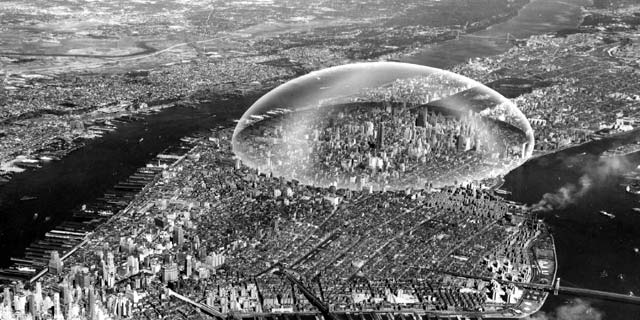
In a corner of the soaring lobby of Chicago's Museum of Contemporary Art sits an inconspicuous screen cycling though a series of quotes. "Don't fight forces," one suggests, "use them." A few seconds later: "Do more with less." And then: "Real wealth is ideas plus energy." These are the words of Buckminster Fuller, the great American thinker and designer famous for his geodesic domes and his pragmatic idealism. Fuller was a colorful man, and extraordinarily wealthy if measured by his own standard: his thoughts were abundant and bright, and his energy seemingly boundless. In the exhibit Buckminster Fuller: Starting With the Universe, the MCA has crafted an impressive overview of Fuller's life and work that brings into focus his prescient worldview and, more importantly, the thought process behind it.

It was after his failure as a businessman and the death of his daughter in 1927 that Fuller resolved to turn his life into an experiment to see how much one man could contribute to society in a lifetime, labeling himself "Guinea Pig B." The exhibit opens with several rooms filled with a diverse selection of objects that recount the beginning of this experiment. Models, drawings, maps, notebooks, and other objects show the evolution of Fuller's early work into his development of the World Game and the Dymaxion map during and after World War II.

Fuller prided himself on his comprehensive thinking; he approached each problem as part of a larger system of problems. Humanity's great challenges were all interlinked, and to consider solutions for one, it was necessary to consider the others simultaneously. Nowhere in the Starting With the Universe is Bucky's way of thinking on display more clearly than in the two rooms that detail the evolution of the Dymaxion Map into the development of the geodesic dome. It was his work on creating a map that eliminated the distortion of the planet's land masses that led to Fuller's fascination with polyhedrons. His engineer's brain latched onto the structural integrity of the icosahedron form that his map created when folded into a "globe," and by the 1950s he was working with his students at the legendary Black Mountain College in Asheville, NC, on developing the dome that would define the later part of his career.

Interestingly, it is a rather inconspicuously-placed video of Fuller at the mid-point of the exhibit that offers the clearest glimpse of how his industrious mind processed information about the world. His demonstration of how a flexible polyhedric structure shifts form is underlined by his emphasis on its uniform contraction and expansion. Throughout his life, Fuller worked on devising comprehensive solutions to myriad problems; his fascination with a flexible structure in which each part was equally responsive to all of the others is hardly inconsequential.

Beyond the geodesic dome, the maturation of which is explored in the second half of the MCA show, Bucky Fuller is arguably best remembered for his prescience. His ideas about environmentalism and the consequences of man's actions on the planet presage the contemporary Green movement by decades; he is also remembered for his early conceptualization of the internet and his musings on the growing importance of mass communications. Fuller understood everything as being part of a system, a network. In Buckminster Fuller: Starting With the Universe, the MCA has created an exhibit that presents Fuller's as a visionary worldview that remains relevant more than twenty years after the great thinker's death. Like any good museum exhibit, this one makes the visitor re-think they way that they look at the world. Bucky would be proud.

----
Buckminster Fuller: Starting With the Universe is on display at the Museum of Contemporary Art in Chicago until June 21st, 2009. For more information about the museum and its other exhibits, click here.


(Photos from ArchNewsNow, OSEarth, and PentaMil.)

Tuesday, March 24, 2009

Earbud Urbanism


I was walking down the in downtown Chicago recently wearing my white earbuds, loud tunes pumping out of my iPod into my head, and it got me thinking. When you have earbuds in, it's almost as if the music is inside your head. It overtakes your thoughts. Ok, maybe not completely, but it would be hard to deny the fact that what we listen to affects our mood and our perception of our surroundings.

On this walk, I started to become aware of how many people were walking around with one of their five senses -- hearing -- completely disconnected from their environment, and I thought to myself: how does this disconnection alter our perception of the urban condition as we experience it? I wonder how many urban designers take into consideration the fact that people are walking around detached from their environment, being highly influenced by a source that the designers themselves cannot control. Personal technology is taking over how we interpret our surroundings and changing the way we feel about places, and this should be considered as we move further and further into interactive technologies.

So, imagine: your music is playing in your ears, and you're walking down the street with a certain demeanor dictated by the recent events in your life, the weather, and of course your music; what's the last thing you notice? Advertisements. Ironically, the ads placed all around the city to get you to buy devices with white earbuds are suddenly ineffective, blending into the grey zone of focus deprivation caused by the mood enhancing device sending electrical waves to your brain. In the end, it is the corporation, the large companies that build and control our urban experiences. Storefronts are often completely detached from the context of the buildings they are plugged into, creating a street level experience dictated more by the corporate retailers than the architect or planner. So it is fair to say that these businesses have a significant stake in our urban experience, and will not keep pumping money into failing advertising mediums but will instead resort to new mediums, capitalizing on our newfound technological dependency.

I can imagine, in the near future, holding your electronic device up to a window display and downloading music from a record store. The technology is already here; its just a matter of how that tech is eventually used as a marketing tool that will change the way we experience the city and our daily life. Instead of billboards, there will be giant digital displays. Using the technology showcased in the Mini ad a while back, called "augmented reality,"  these displays will reflect you as you walk by, but will project a certain brand of clothing onto your image, detecting your body size and instantly altering the clothing image to fit you using a complex algorithm. These displays will show you in real-time with a Snickers and a Coke in your hand asking "Why Wait?"

So I wonder: how much of what we experience is predetermined by a planner, an architect, or a corporation, and how much of it is dependent on sources we create and introduce ourselves? My guess is that we will increasingly be adding our own sources and corporations will tap into this and use it to promote their agendas, thereby creating a new urban condition.  Earbud Urbanism, anyone?  


(Photos from Apple and Designboom. The original full-sized color version can be viewed by clicking the photo.)

Friday, March 6, 2009

The Living...The Built...The McDonald's Parking Lot


You may not agree with TS Eliot’s statement that every age gets the art it deserves, but it’s hard to argue that we don’t—to some extent—get the cities we deserve. In fact, a city may be human culture’s most perfect expression of collective will, a direct and tangible product of millions of individual decisions multiplied by thousands of days. Certain forces, people and institutions tend to exert disproportionate influence on the way cities evolve, but by and large the masses make the cities, and without all those people cities would not even be cities.

Human culture produces cities, and cities in turn influence those cultures. Eliot thought the same about art, and art’s cultural role is more limited than that of cities. Does this mean that subpar cities are created by subpar cultures, and can one expect crappy cities to foster even crappier human relations in their streets and buildings? Are planners, architects and other creators of the built environment to blame for the desolation of downtown Detroit or for me not knowing my neighbors?

Probably not. Architectural historian Spiro Kostof made this unexpected yet intuitive point in his 1987 commencement address to UC Berkeley’s College of Environmental Design:

“Cities are amalgams of the living and the built, always tidying up, never finished. Their agenda is colossally overburdened, its charge near impossible to rein in. There is no way in which design alone will breathe life into a dying enterprise, any more than a vibrant sense of community can be attributed in earnest to the act of design.”

Kostof’s speech—at least that part of it—amounts to a call for more piazzas. That is, more free spaces where human activity can run its course, whatever that turns out to be. The life and energy teeming within cities is bound to find its own way, perhaps guided and elevated by the Burnhams, the Olmsteds and the Koolhaases but never steered by them.

The most vibrant public space near where I live happens to be the neighborhood McDonald’s. Although there’s a beautiful, expansive park only two blocks away, a large group of elderly gentlemen are congregating in that McDonald’s from morning until evening on any given day of the week, usually having nothing more than a coffee. During the summer, they bring their own chairs and hang out in the parking lot. The place is full of people every time I pass by. I opt for the big park when I want to get out of the house, but for some variety of reasons many others find the Golden Arches to be a suitable piazza of sorts. I can tell you this much: They aren't there for the food.

Many view McDonald’s (and parking lots) as the worst American culture has to offer, and more than a few planners would raze every McDonald’s in sight given the opportunity. Builders and planners can only build and plan, though. They can’t actually add the people or dictate the uses of their creations. Ultimately, I think, we do get the cities we deserve because, to a great extent, we are those cities.


(Photo from Flickr user brtsergio.)

Thursday, January 29, 2009

LaHood: Not a Disastrous Pick, After All?

I don't know about you, but after Ray LaHood was tapped to serve as Obama's Secretary of Transportation, most of what I read around the urblogosphere was bad-news-bears. Urban policy wonk Ryan Avent questioned the decision over at Grist, as well as his own blog; over at WorldChanging, Alex Steffen wondered aloud wether Obama had used the position as a throwaway to appease Republicans; and transit blog The Overheard Wire took a padded swipe at the new Sec. Interested in getting the opinion of someone in the transit policy arena from LaHood's home state (which, luckily enough, happens to be my own), I checked in with a friend who's on the board of the Chicago-based Active Transportation Alliance, formerly the Chicagoland Bicycle Federation. He pointed me to an editorial piece in the org's latest newsletter, ModeShift, which paints a much sunnier picture of LaHood than I've become accustomed to reading. According to the ModeShift article, LaHood is a strong and vocal proponent of rails-to-trails programs, and has been twice-honored by the League of Illinois Bicyclists for his efforts on biking issues. So his mass transit record is still murky, but it sounds like LaHood's not all bad news. Just a bit of food for thought.

Edit: all that being said, I'm starting to wish that this Nadler fellow would have been given the nod.

Monday, January 26, 2009

Become a Whereblogger!


Where is looking to add some new international flavor to our blogging team. We're looking for bloggers based outside of North America who are interested in contributing posts about urbanism 3-5 times a month. If you're interested in becoming a Whereblogger, send a quick email with a bit of background info: who you are, where you're based, what you do, why you're interested in blogging for Where. But first, please read the following:

Two important qualifiers: to be considered, you must be able to write in reasonably clean English. Knowledge of Chicago Style or AP or what-have-you is not needed, but we like to keep language consistent around here, so unfortunately that rules out posts written in otros lengues. You must also actually live in a city. Small cities are ok (though as a general rule, bigger is better), and ultimately the quality of your writing is more important than your personal geography, but writing well about cities requires regular interaction with the urban environment. In other words, Farmer Brown-types need not apply.

Also, while there are several spots to fill (there's a max of 10 contributors, myself included, at any time; currently there are six of us) selectivity will be exercised. Building a strong team requires looking for quality over quantity, so there's no hurry to fill the roster for the sake of doing so. Ultimately, we're looking for people who can answer the question "Can you consistently produce well-written, thought-provoking blog posts?" with a confident "Yes." (And, of course, with whom we agree on that point.)

And while we're on the topic of contributors, I'm pleased to introduce you to another Chicagoan who will be joining the team today:

Drew Austin (Chicago) plans mass transit for a living and passes through his favorite Chicago building, the Merchandise Mart, five days a week. He grew up in Indianapolis but has since moved on to larger Midwestern cities. In addition to transportation, he's fascinated by public space, good architecture, bad architecture and urban morphology. He once wrote about those topics on a short-lived blog called The List of Dorms. His favorite grid-based city is, of course, Chicago, and his favorite grid-based game is Scrabble.

So, to wrap up, here's that email again if you are interested in joining the team Hopefully there will be a few more introductions to make over the next few weeks. Perhaps one of them will be yours.

Wednesday, November 5, 2008

Incredible

Just got back from Barack's massive victory rally in Grant Park, here in Chicago. America's first black prez certainly knows how to throw a party; but the really amazing thing wasn't actually the rally itself, which was fairly typical (if nonetheless inspiring) political fare. The mind-blowing aspect of this event was how it completely devoured the city core. As far as the eye could see, down every street in the Loop and well into River North along the Magnificent Mile, hundreds upon hundreds of thousands of supporters jammed the streets, sidewalks, and Mayor Daley's beloved planted medians. Every building with an LED or a floodlight mount was decked out in red, white, and blue. Buildings without such decorative schemes opted for window art, lighting interiors to form an American flag, "Vote 2008," and USA. Miles away from the event, the streets literally rung with the excitement of an entire city. The sense of pride, and of common purpose, was so intense you could taste it.

It seemed fitting that America's first urban president in quite a while should come from here, the most quintessentially American of cities. Obama is an American President, and a Son of Chicago. Tonight, we celebrated both.

Wednesday, October 15, 2008

Gender and Economic Access

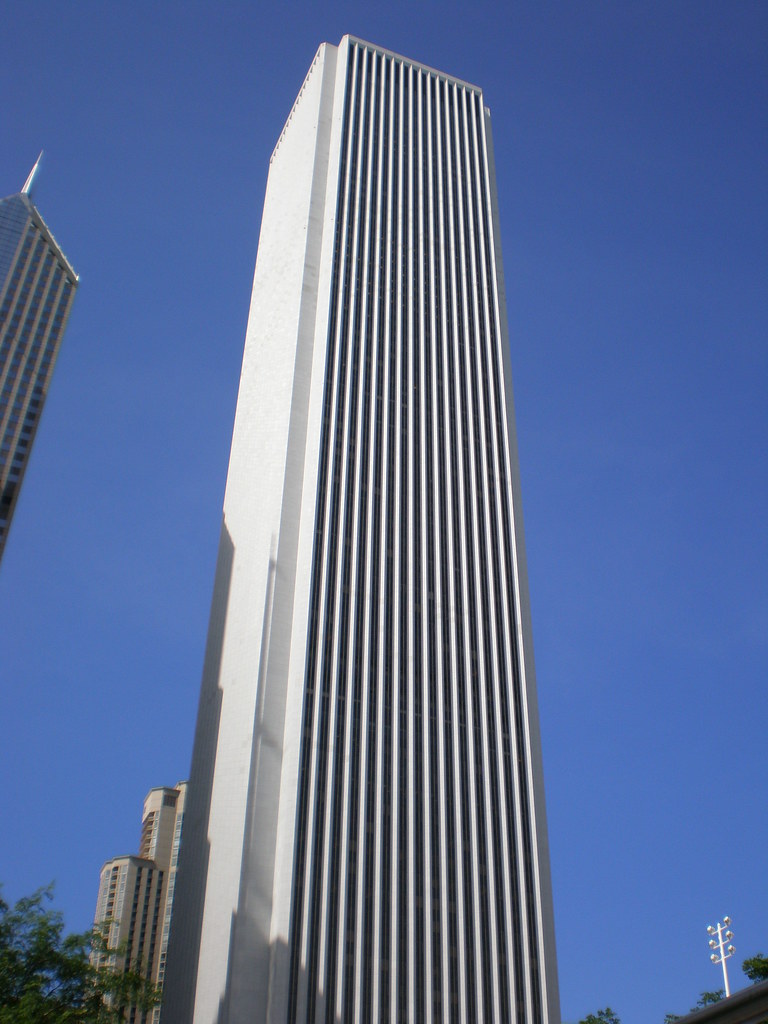
Walking through my Chicago Loop-based office building, I am often struck by the simultaneous layers of experience that exist in one geographical space. There are executives who have never stepped foot on public transit and service staff who commute hours to work each day on increasingly faulty Chicago buses. They eat different food, communicate with different technology and in my building, even use separate elevators. (Higher floors, which have their own elevators, house the more prestigious offices.) They occupy the same physical space, yet their experiences rarely overlap.

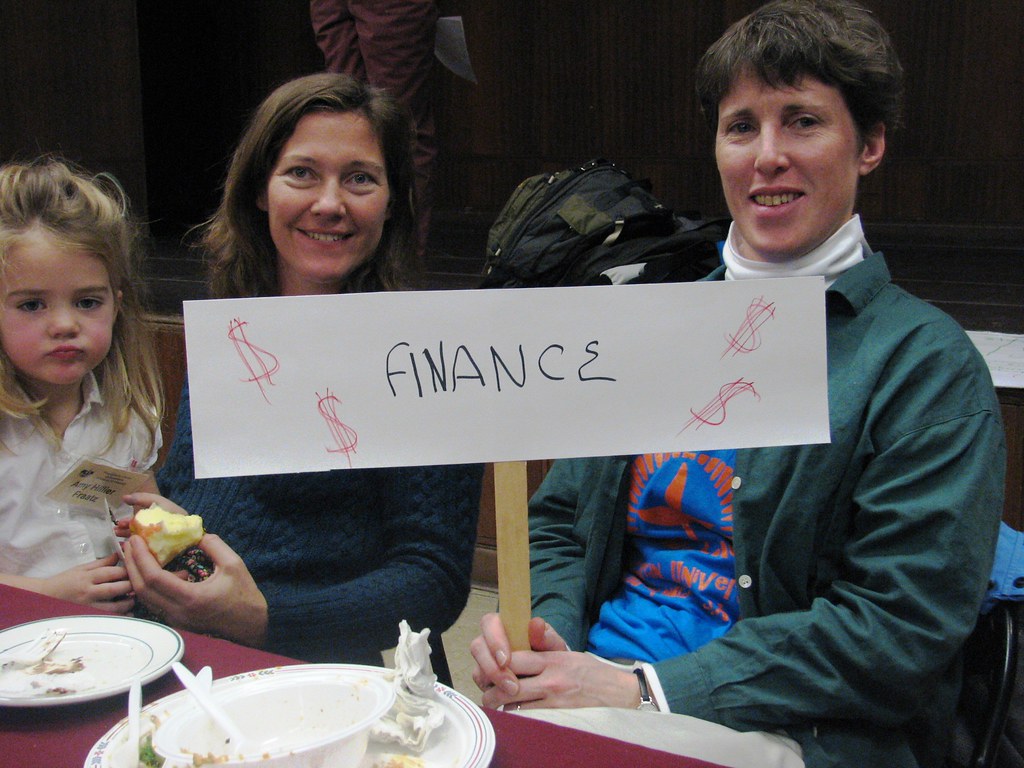
In a city with a history of entrenched inequality, this separation is often exacerbated by factors of race, education, etc., but it generally boils down to a matter of access granted by economic means. Money affords, among other things, certain clothes (which confer a sense of belonging in a workplace) and the ability to eat out (a center of socialization). Your geography of access is limited by your economic reality.

Gender plays a fundamental role in determining the geographies of economic access within Chicago. The phenomenon known as the "feminization of poverty" is not only an international issue (see the Millennium Development Goal #3), but also surfaces in Chicago. Americans already have a tendency to picture young mothers on welfare when they think about poverty, and in Chicago unfortunately that is an accurate picture, with women comprising almost 60% of all those under the poverty line.

Chicago Foundation of Women Executive Director Hannah Rosenthal notes in an NPR interview that a leading cause of women in poverty is the burden of single-parenthood: a third of all women-headed households in Chicago are in poverty. A quick look at the Boys and Girls Club membership demographics reveals that 48% of all members are from families living well below the poverty line, while an overwhelming 72% live with their mother's only.

While this equation (women in poverty=single parent families in poverty) may seem obvious, the solution is certainly not; financing families (often single-parent) in poverty is a much more complex problem requiring a much larger sum. There are additional access challenges- access to safe schools and affordable childcare options are two that readily come to mind. A favorite development blogger of mine, Niti Bahn, writes about how much harder it is to be poor in the US than in the developing world; without common developing world features, such as a large extended family for childcare, raising a family alone in the US is no exception.


In Chicago, the cause of financing availability is led by ShoreBank, an institution famous for its successful focus on community revitalization. Based on the Southside of Chicago, ShoreBank provides banking services to its surrounding community, despite a median family income of only $20,000. (They also, incidentally, provided Yunus and his fledgling Grameen Bank startup advice in the eighties for him to export back to his native Bangladesh. How's that for microfinance street cred? I could go on and on about this company- visit their website and read about them. Now! They are a triple bottom-line company, as well as being minority- and women- led. But I digress...)

Last year, Shore Bank launched a program to refinance subprime mortgages, saving many Chicago families (including many single-parent families) from foreclosure. Often, their community development loans go to small, female-owned businesses allowing them to escape from potential failure. Their community development credits often focus on lending to “credit-challenged” women who would be ignored by other commercial banks.

In the interview referenced above, Hannah Rosenthal laments that few studies of poverty use a gender lens in their analysis. This underscores the importance of smart institutions such as Shore Bank, who work to bring attention to gendered poverty and to alleviate the resulting limited access to resources.

Let’s hope in this unfavorable banking climate that Shore Bank is able to continue its work to transform Chicago’s economic landscape!


Note: I was deliberately focusing on gender in this post, though certainly many of the factors pointed out as problems of gender have racial roots as well.

(Photo from Flickr user hanneorla)
(Photo from Flickr user Edu-Tourist)

Thursday, September 18, 2008

The Bean


New updates to Chicago on Google Maps' satellite coverage finally show The Bean and a completed Millennium Park. In case you were wondering if every last square inch, including the very tip-top, is polished, here's your proof.

Wednesday, September 17, 2008

A F%@$ing Break: Give me one, Please

It seems like every couple of weeks there's another city ranking list, and the extremely flawed methodology of each one is ever more extremely flawed than that of the list before it. Add to the pile: Forbes' recently-vomited-up list of America's Most Stressful Cities.

Obviously, I'm being melodramatic. And obviously, this means that I have some emotional stake in the results. So let's be done with it: Chicago topped the list. Which...I'm sorry, I have to laugh at that. Hard. Just last week, I was talking to a close friend about my growing desire to head out East, because Chicago has such a relaxed atmosphere. It's very casual here, and thus harder to get things done. A bit of procrastination is built into the way of life. Thus, working on more than a couple of projects at once gets more difficult. You feel almost pressured, in a weird way, to do less.

The merits and problems associated with this way of life are fodder for another discussion, but help to frame my reaction to Forbes' list. How, I wondered upon reading the article this morning, could this possibly be? And then, there it was, in the list of reasons Chicago placed so highly: "rising unemployment rate, expensive gas, high population density and relatively poor air quality."

I'll give them the rising unemployment. I'll even toss in an E for Effort on the air quality, even though it's really not that terrible. Wind blows a lot of our air pollution up to my good ole' hometown to the north, Milwaukee, giving the metro of only 1.7 million some of the worst air quality for a city in its size range. Milwaukee, in turn, dumps sewage into Lake Michigan, which then floats down to Chicago and closes our beaches (though this has been happening a lot less in recent years thanks to the Deep Tunnel project...but again, I digress).

Rising gas prices I had to roll my eyes at, because crowding issues on the CTA and Metra have been evidence of the fact that people are taking advantage of alternate options here. If anything, transit ridership should have been taken into account for determining stress in Chicago. Though it appears that these are metro area rankings (something Forbes is continually foggy about with its lists), so whatever.

But density?? This is a negative factor in determining stress? For my official position on this criterion, please refer to the title of this post.

I will grant -- as any pro-density advocate worth their salt will -- that there is such a thing as an unhealthy level of density. Chicago, my friends, comes nowhere near that level. There are plenty of residential high rises springing up around town, but it's hardly anything that you can compare to, say, the high-rise blocks of Hong Kong. Chicago has wide streets, many of them lined with trees. There is plenty of parkland, much of it well-maintained and relatively safe. As a friend once noted when visiting from New York, "My God, you can actually see the sky here."

Forbes' list is blatantly skewed toward older, more densely-populated cities (more commonly referred to by those with sense as "real cities"). Chicago is followed by New York, Detroit, Los Angeles, and San Francisco, with San Diego, Cleveland, Salt Lake City, Providence (yes, seriously), and Philadelphia finishing things out. Only one of these cities, you'll note, is not located in the older, more highly-urbanized Northeastern and California Coast regions.

Density wasn't the only thing to play a part, but it had a noticeable effect on the outcome. At any rate, this seems to be a better indicator of stress levels. I'll take living in a high-rise over living on the freeway any day of the week. Now excuse me, I have to o relax.

Monday, September 15, 2008

A Letter to Barack

Dear Senator Obama;

Of America's four largest cities, Houston and Chicago are partially underwater, and New York's financial heart is having a coronary. Los Angeles seems to be in the best shape right now, and when you can say that, you know that we have a very, very serious situation on our hands.

Meanwhile, Senator McCain and his moose nugget continue to their banshee screeching about your lipstick on a pig comment in an effort to move the election further and further into their party's most familiar territory: the character assassination campaign.

For over a year and a half, you have promised us a different campaign. You have promised us that you would rise above the pettiness and catscratching that usually passes for political discourse in this country. You gave us your word that, this time, things were going to change. You practically trademarked the word.

Senator Obama, the idea that Americans don't want to hear about actual issues, that the last thing they want to hear is policy talk -- this is the most insidious lie that has been told. True, there are those in both camps that would follow their party out of a plane in flight without a parachute. They are of little concern.

You can run the same campaign that we have seen time and time again. You can continue to get caught up in the scuffle that the GOP is so desperate to get you caught up in. When they will launch an attack ad that oh-so-coyly (tee hee, tee hee) suggests that you just might be a pedophile, what line is left for them to cross?

There is no winning, here, sir. The deeper you get into their fight, the less energized your base will be. The more of us young, tech-savvy folks who launched you past Senator Clinton into the position where you now sit will feel duped, cheated, and used.

Our greatest cities are on their knees. What will you do, Senator, to rectify the situation on Wall Street? In the plainest of terms (because no one loves wonk but a wonkette), tell us what happened, and how you intend to address it if you are elected. What can be done for Houston and Chicago, and other waterfront cities, to protect them in the future? Yes, the current relief efforts are important, but what will you do, specifically, to address the problems that are creating these increasingly dangerous storm systems that travel further inland each year?

Senator Obama, you are at a crossroads, and the current polling information has little good to say about the way that you've responded to Senator McCain's attacks thus far. If you cannot live up to your promise of change on the campaign trail, you have little hope of winning this election, because it speaks very poorly of your ability to affect change once you are in office.

We are still holding our breath. Change the conversation.

Saturday, August 23, 2008

3000 Broadway

Sure, all major cities look big and dense at their cores. But how do they compare a bit further out? Where's got some (admittedly loose) comparative urbanism for ya's today: aerial images of the address 3000 Broadway in America's nine largest cities -- #10 San Jose has no like-named street. (For the record: Philly's is from 3000 Broad Street, and Dallas' is from 3000 Broadway in the suburb of Garland, since the address does not exist in The Big D proper).

New York City, NYLos Angeles, CAChicago, ILHouston, TXPhoenix, AZPhiladelphia, PASan Antonio, TXSan Diego, CADallas, TX

Thursday, August 14, 2008

Air Show

It's Air Show Weekend here in Chicago, which means the US Air Force's Blue Angels are "practicing" overhead for the next few days. "Practicing," of course, translating to "flying so ridiculously low and fast over one of the most densely populated areas in the country that the noise they make sets off car alarms and makes pictures tilt on their wall hangars."

Seriously, who thought this up?

Any thoughts on urban air shows? They're a blast to watch, but really...do they have to practice over the 'hoods for three days? Listening to the roar of the jets flying overhead, I feel a bit on edge...I have to wonder if an event like this has some sort of subtle psychological effect on people.

Wednesday, August 6, 2008

You Have to Earn It

(Cross-posted from the Neighbors Project blog)I'm moving out of my current apartment at the end of the month. When I go, the next people to live here will be paying literally almost twice as much as I currently pay in rent. My neighborhood -- on the border of Wicker Park and the Ukranian Village in Chicago -- is being gentrified. I feel weirdly responsible, even in my leaving of the place. Since I don't have any control over the management company, I'm not really doing anything, per se; but as it turns out, that's exactly the problem.

Moving to a new neighborhood does not guarantee that you will be welcomed into the existing community -- especially when the neighborhood in question is going through large-scale change. I was reminded of this fact this morning while researching today's Neighbor News post. I came across this story from Pittsburgh, where a team of young urban farmers has created a working farm in one of the poorer areas of the city, bordered by one of its most infamous ghettos, The Hill. One of these people articulated quite nicely the idea that first got me involved with Neighbors Project last fall: "We're aware we didn't grow up in the Hill," she said. "We have to earn a place here."

When anyone, young or old, moves to a new neighborhood, they become agents of change. There will be things that we make worse for some people, and things that we make better for others. Few people can claim to wield the power of a developer or city councilman; indeed, our impact on a new neighborhood, as individuals, is small, but it is still important. The choice that we are each presented with is: will I merely pass through this neighborhood, or will I earn a place here?

I'll let you in on an embarrassing little secret: I never really earned a place in the community that I'm moving away from. I had originally intended to stay longer than I'm going to wind up staying, so I'd just assumed I'd get more involved in the future. I heard about neighborhood meetings and saw people out on their stoops, but I was always in a hurry. Even working closely with a group like Neighbors Project, it was easy to feel too busy to engage with my own block.

And now I can't help but wonder if, had I gotten to know the people living around me, I might have been able to find a way to keep my apartment affordable. Maybe one of my neighbors has a relative or a friend moving to town, and I could have re-signed my lease and subletted the apartment. It's a pretty fruitless line of thinking, really, since the past is the past and the rent has already been hiked. Still, it's disturbing to see how much impact a lack of effort can have, and it's made me remember why it's important to slow down and engage with my surroundings.

When you move to a neighborhood, and are immersed in a new community, remember that doing nothing within that community is doing something.

-----------

I wrote this post recently for the blog of Neighbors Project, a nonprofit that I've become more and more involved with since I first reported on it a year ago. I've been working for NP over the summer and recently joined the National Board of Directors, and I figured that, since I can put a little of the blame on NP for the lack of posts on Where, I'd cross-post to share a bit of what I've been up to. As for Where, there are big changes on the horizon. More on that later. For now, get out and earn your place in your neighborhood.

Chicago Prints

Found some spectacular art prints of Chicago landmarks while poking around on Etsy today. If you see one you're interested in purchasing, click on the image and it will take you directly to the seller's page.