Showing posts with label urban agriculture. Show all posts

Saturday, July 4, 2009

Suburbs Survival

Cities have been getting a lot of attention lately with the majority of earth's population residing in dense urban cores for the first time in history. There seems to be a growing consensus that cities are the way forward and that suburbs should burn in hell for destroying out beautiful countrysides, our farmlands, and promoting unsustainable lifestyles. So how do we resurrect the suburb or make it better? Are we planning on disassembling them and using the material to build new urban dwellings or are they going to become abandoned and sit empty? Is there a way to think about the burbs differently that will lead to a new lifestyle or a renewed sustainable energy?


To survive long-term, the suburbs will likely have to become more community oriented and organized. This century thus far has proved to be about social and sustainable movements. Two movements the suburbs can embrace to improve their chances of retaining and attracting citizens are intense car sharing programs, and intense community farm programs.

Typically, neighborhoods center around some type of public space, whether that be a park, an elementary school, or another type of community-oriented structure. These centers could act as transport hubs, where car share programs are initiated. Programs like carpoolconnect.com can help people find rides and coordinate with neighbors to accomplish errands and daily tasks. Perhaps it seems extreme, but if the suburbs want to kick their negative wrap, they are going to have to show they can compete with cities on transportation and social interaction.


Suburban farming has become a big thing as well. Though urban farming has attracted much of the attention because of its extreme conditions, many suburbanites have been converting their yards into mini-farms and, in some cases, turning a profit. Many organizations have popped up to promote the transformation of turf lawns to lush homestead farms, most famously Fritz Haeg's Edible Estates. His organization has inspired a new breed of farm and a new brand of agriculture. Companies are beginning to form around the country with the intention to lease and cultivate neighborhood lawns. Weekly neighborhood farmers markets could be held at the community center with the majority of produce and added value products coming from within the neighborhood.

When it comes down to it, the suburbs need to bolster their sense of community interaction in all areas of their citizens daily life from transportation methods to food choices to live/work arrangements. The suburbs aren't going to just disappear, so hopefully in the next few years we as a society will develop some new suburban living models worth promoting.


(Photo from The Shift Home and the author. The original full-sized color version can be viewed by clicking the photo.)

Monday, April 20, 2009

The Maturation of Urban Agriculture

Urban Agriculture is maturing, and like any concerned parent, those of us with a vested interest are worried about the path she will take and the choices she will make in these crucial developmental years. She's not quite ready to leave home, but she certainly isn't interested in hanging with the 'rents all weekend. That corporate bloke has been coming around a lot more lately, whispering sweet nothings in her ear and chumming it up with Dad in the den. With all this attention, she's beginning to see that life exists outside of the small community in which she has grown up. The city offers so much opportunity, yet with it comes so much risk, and as for that corporate guy, word on the street is that he's been into some pretty shady business. Meanwhile, there is a young guy around the block that Urban Ag has become friends with; he's so sweet, and seems to be well-grounded. Sure, he's a bit dorky, but we all know he'll treat her better in the end than the corporate bloke looking for some arm candy and a quick buck.


Now that I've lived out my childhood fantasy of writing a mid-90's teen sitcom, I should clarify that comparison. Urban Agriculture is at a pivotal point in its life. It began as an agency for social change, turning abandoned inner city lots into fruitful gardens which accomplished great things within their communities. Not only did these gardens beautify otherwise decaying neighborhoods, they also began to educate underprivileged residents about proper diet, provided nutritious food where none was to be found, and in some cases initiated job training programs with the local residents to jump start agricultural opportunities. Growing Home in Chicago, and Red Hook Farms in Brooklyn are too shining examples of this idea. Indeed, the social gains far exceeded the monetary gains, but it was only a matter of time before the light was shed on the potential of Urban Agriculture.


Today, we are seeing the corporate world snake it's way into the game. A recent article in the Detroit Free Press shows a possible 70 + acre development in the middle of downtown Detroit proposed by 2 financiers. Corporations, operating on the intention of reaping profit, will by nature set in motion practices to eradicate the competition. In the case of Urban Agriculture, this would mean all the small non-profit organizations trying to grow food in community settings to help residents get on their feet. Corporate-run urban farms could dominate the local food market by creating huge quantities and lowering prices which will drive out the many smaller farms. Walmart drove out all of the little Mom and Pop shops; why wouldn't a corporate farm drive out all the Mom and Pop farms?

Meanwhile, behind the backdrop, there is a growing movement of young creatives turning back to the land. Hundreds if not thousands of college grads are learning farm practices, working on CSA farms, and gaining knowledge to begin building a new food network in America. With the average age of farmers nearing 60 years of age, there is a huge push to get youth engaged in agriculture. In this case, Urban Agriculture makes a lot of sense because not only will the food be local, but it will allow young people to work and create in a collaborate environment where they can go out at night and have a life...off the farm.


I can think of about 15 people I know personally who are graduating with design degrees and looking to start their own small farms to supplement their freelance work. Why? Because nobody is hiring, they see the need, and they understand the value that a farm can create within a community. This has been well illustrated by the New York Times over the past year with many features focused on growing young farmers. But these people are starting farms of l1-2 acres, not 70-100 acre lots, and they aren't taking over whole portions of the city, but rather fitting nicely into the existing urban fabric. In addition, this new generation understands the problems associated with industrial farming, and therefore has a new respect for the land as not only creating profit, but creating life. That poetry just doesn't seem to flow from corporate farms, no matter where you put them.

Times are changing for Urban Ag -- she's growing up. The difference between Urban Agriculture and a real person though is a brain. A person can make decisions, Urban Agriculture relies on an intense network of farms, advocates and patrons. Together, we must figure out what is best for Urban Agriculture and our communities, then we must act to insure their safety. Will the introduction of large corporate farms defile the great assets of Urban Agriculture?


(Photos from Chicago GSB, Detroit Free Press, NYT, The original full-sized color version can be viewed by clicking the photo.)

Tuesday, March 17, 2009

Rustbelt to Weedbelt

SO did anybody catch the article last week in the Economist about the legalization of marijuana in the states? If not, I'm amazed because it burned through the blogosphere like a wildfire in July after a severe drought. The article, or issue rather, was no doubt spurred on by severe drug wars going on in Mexico and South America right now, the Economist offers reasons why marijuana should be legalized and regulated in the States. Now I"m not going to offer my opinion on this because frankly I don't have one, I could really care less either way. However what really interests me, are the consequences of marijuana legalization on our urban fabric, particularly that of the Rustbelt city and other inner city locations.

We all know Urban Agriculture is the big thing these days, hailed to save our urban youth by offering values, safe havens, and job training. My question is, what will happen to these urban farms when we legalize marijuana. I don't know the answer, and I am not implying there is one answer, I just think it's an incredibly interesting question, and so I thought I would poss it to the community here at Where. I mean, the inner city has historically been plagued with drug crime and addiction but perhaps the legalization of marijuana could offer a way out? I mean, the urban farms, the knowledge of agriculture is already there, and certainly the abandoned lots are there, and the drug colonies are there. On the other hand, maybe it would be a terrible thing leading people to dependency and bigger addictions. Either way it's a compelling situation to ruminate on. Rustbelt - Weedbelt. Discuss.


(Collage created by author from online media. The original full-sized color version can be viewed by clicking the photo.)

Tuesday, February 3, 2009

Posh to be Poor? Food

Food is a hot topic these days and will continue to be in the next few decades as Earth's population grows to record numbers...every year. Food has taken the spotlight high atop the green podium due to the massive amounts of chemical pesticides used for agriculture as well as the enormous amount of transportation-elated energy that is required to provide us all with raspberries in January. Terms such as organic, locavore, CSA, and most importantly community gardening have become common language for many progressive westerners. Over the last decade there has been an increasing trend toward growing one's own food. This can be attributed to the rising costs of food as well as to light being shed on CAFOs and the massive amounts of media attention focused on the conditions in which our foods are grown and nurtured.

Overall, food prices are rising, which isn't exactly helpful to the middle class worker. This is leading to a movement toward homesteading: if you can't afford to buy food, grow it yourself. Shrinking cities are filled with abandoned lots waiting to be developed; however, seeing the state of economy, one can figure that won't be happening for a while. In the meantime, residents in these neighborhoods can capitalize on this open space by planting and harvesting a garden, thereby reducing their grocery costs. There is a significant movement to convince the Feds to plant a garden on the White House lawn. This symbolizes the American movement toward urban gardening and sustaining oneself with the land that one maintains. You don't even need a lot of land to hop on the garden train: some folks in New York have started a Chicken Coop Co-op in their tiny backyard. It's apparently become quite the hit as the local breakfast spot offers a specialty dish using only eggs from this co-op. According to UrbanChickens.org founder K.T. LaBadie,

Their [eggs] production cost is cheap: you can buy chickens for as little as a couple of dollars, and three hens will likely average about two eggs a day. You can also use their waste to help revitalize a garden...There've been recalls on everything from beef to spinach, and I think people want to have peace of mind knowing their food is coming from a very trusted source.


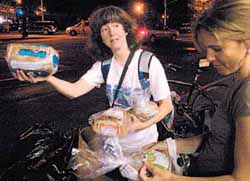
Another trend that has garnished a lot of attention in the last 10 years is the growth of the Freegan Movement. If you aren't familiar, the concept is to eat only what you can find for free. This usually includes scavenging through bakeries' and big box stores' dumpsters for bagged and canned goods. In New York, there was a Freegan group who would throw rooftop parties and everyone was required to bring some found food. I'm not saying it's a great idea, but people are doing it, and loving it. In the western world we tend to undervalue what goes into our bodies. Rarely is a plate scraped clean, and a massive amount of organic waste is created. Likewise, bakeries and grocers overstock, causing outdated items to be pitched. This group capitalizes on the waste of others. For some, dumpster diving has taken on a new image in the 21st century as a rouge sport as opposed to a last resort for the poor. Many of the people taking part in these events have jobs and don't need to dumpster dive. They do it for the experience.

Posh to be Poor? Introduction
Posh to be Poor? Transportation

(Photos from Eat the View, New York Times and Freegan.Info. The original full-sized versions can be viewed by clicking the photos.)

Wednesday, November 19, 2008

Eat local or eat smart


I love food. I'm a happy eater, and a less-than-happy yet genuinely enthusiastic cook. Only recently, though, have I started gaining a sort of food conscience. Food conscience growing up was more about knowing how to hold up my chopsticks properly, or being able to recognize a shallot, or learning to enjoy gross stuff like ants eggs (yes, we eat ants eggs in Mexico. We call them escamoles, and they're positively buttery and delicious). In any case, conscience was more of a snob thing than an actual curiosity or desire for knowledge about the stuff I was being fed.

Now that I'm older, though, not only do I care about what I cook or eat; I also try to worry about what goes onto my plate and how it gets there. I've tried to go organic, but in Spain it's still virtually impossible (organic food stores or markets rare here, and the prices are simply insane). I've tried to buy fresh produce in markets instead of supermarkets. Barcelona has wonderful food markets. But most of the tomatoes in the markets are also grown in those massive plastic-covered freak farms in Almería, and many of the fruits are imported from Brazil or India and the fish is sometimes frozen. I've begun to wonder how far a conscientious eater can really go, particularly in an urban setting.


Apparently pretty far. Take locavores, or local eaters. Yes, it's a proper word. But what does eating locally actually mean? Originally, it seems locavores should only eat food produced within a 100-mile radius of their home. Details and hidden agendas aside, a very good case has been made against this hardcore notion of eating local, in its own terms. It turns out that eating local can actually be less sustainable than eating food from the other side of the equator (click to read why).

Again, we're faced with one of the distortions of the localist rhetoric. It's one thing to support locally-oriented farmers markets or wanting to eat something that hasn't been radiated and tastes like plastic. I think initiatives like Fritz Haeg's Edible Estates or the various urban-farming movements taking over empty lots and fighting underemployement are great. But this sort of initiative can only cover a fraction of our needs, and can only work under very specific conditions. Why not make a call for eating consciously instead of only locally?

Wednesday, August 6, 2008

You Have to Earn It

(Cross-posted from the Neighbors Project blog)I'm moving out of my current apartment at the end of the month. When I go, the next people to live here will be paying literally almost twice as much as I currently pay in rent. My neighborhood -- on the border of Wicker Park and the Ukranian Village in Chicago -- is being gentrified. I feel weirdly responsible, even in my leaving of the place. Since I don't have any control over the management company, I'm not really doing anything, per se; but as it turns out, that's exactly the problem.

Moving to a new neighborhood does not guarantee that you will be welcomed into the existing community -- especially when the neighborhood in question is going through large-scale change. I was reminded of this fact this morning while researching today's Neighbor News post. I came across this story from Pittsburgh, where a team of young urban farmers has created a working farm in one of the poorer areas of the city, bordered by one of its most infamous ghettos, The Hill. One of these people articulated quite nicely the idea that first got me involved with Neighbors Project last fall: "We're aware we didn't grow up in the Hill," she said. "We have to earn a place here."

When anyone, young or old, moves to a new neighborhood, they become agents of change. There will be things that we make worse for some people, and things that we make better for others. Few people can claim to wield the power of a developer or city councilman; indeed, our impact on a new neighborhood, as individuals, is small, but it is still important. The choice that we are each presented with is: will I merely pass through this neighborhood, or will I earn a place here?

I'll let you in on an embarrassing little secret: I never really earned a place in the community that I'm moving away from. I had originally intended to stay longer than I'm going to wind up staying, so I'd just assumed I'd get more involved in the future. I heard about neighborhood meetings and saw people out on their stoops, but I was always in a hurry. Even working closely with a group like Neighbors Project, it was easy to feel too busy to engage with my own block.

And now I can't help but wonder if, had I gotten to know the people living around me, I might have been able to find a way to keep my apartment affordable. Maybe one of my neighbors has a relative or a friend moving to town, and I could have re-signed my lease and subletted the apartment. It's a pretty fruitless line of thinking, really, since the past is the past and the rent has already been hiked. Still, it's disturbing to see how much impact a lack of effort can have, and it's made me remember why it's important to slow down and engage with my surroundings.

When you move to a neighborhood, and are immersed in a new community, remember that doing nothing within that community is doing something.

-----------

I wrote this post recently for the blog of Neighbors Project, a nonprofit that I've become more and more involved with since I first reported on it a year ago. I've been working for NP over the summer and recently joined the National Board of Directors, and I figured that, since I can put a little of the blame on NP for the lack of posts on Where, I'd cross-post to share a bit of what I've been up to. As for Where, there are big changes on the horizon. More on that later. For now, get out and earn your place in your neighborhood.

Tuesday, March 11, 2008

Architectural Revision

The term "revision" means, literally, to "see again." And in a recent article for the Toronto Star, Christopher Hume inadvertently showed how revision is sorely missing from the urban design dialog today.

Early in the article, which discusses the gentrification of Toronto's Liberty Village neighborhood: "Speaking of parks, there is virtually no green space anywhere here; perhaps the city should finally grapple with the issue of Lamport Stadium, which is so rarely used it could easily be demolished to make way for a park." And then, shortly thereafter: "recycling...old structures ensures a level of integrity and sustainability vital in an age of global warming."

So what gives, Mr. Hume? Why no love for Lamport Stadium.? Surely, if Vienna can figure out how to turn gasometers into a dazzling residential complex, Toronto can pull off the conversion of a stadium into a park without wasting all of that energy by tearing down the existing structure, no? As the urban affairs critic of the largest newspaper in one of the world's few truly global metropoli, Hume is, by default, a major voice in the current discussion on how cities should evolve. It is telling that he would so quickly dismiss a stadium that would probably be relatively simple to convert to public green space.

Culturally, many of us still think of old buildings as things that should be demolished to make way for that which is new, shiny, and more immediately perceived to be "green." But while converting stolid brick warehouses into luxury condo complexes is all well and good, architectural revision is a field with no horizon. Every underused or unattractive building can be rethought and retrofitted to become something that better serves the needs of a surrounding community. It just takes some spitshine and imagination.

How could Lamport Stadium be revised, as a piece of architecture? While an actual Torontonian would probably have the best answer, let's give it a shot. First off, as can be see in the above image, there is very little physical structure to the stadium. The bulk of the site (the playing field) is at-grade, or at least near it. The elimination of any gates or perimeter walls and the conversion of the obscenely large surface parking lot on the southeastern end of the site would create a sizable, T-shaped open green area that could be made quite lovely by a good landscape architect. The wings of green space that currently flank the stadium could be converted to community playing fields with shaded seating areas under the bleacher structures.

The bleachers themsevles provide the best opportunity for out-of-the-box thinking. How could large, clunky concrete structures be revised to serve optimally as part of a public park? While there are many possibilities, the first that comes to mind is: terraced community gardens. With the removal of most or all of the seating and the addition of some permanent soil beds, the porous concrete structures would be the perfect support system for a vertical farm, to be tended by Liberty Village neighbors.

Check out the picture of Lamport Stadium to the right. Cover the steeply-sloped back sides of the bleachers with solar panels or photovoltaics, retrofit what are assumedly locker rooms in the podium under the arched structure, and you've got a zero-energy community center for cold or rainy days. Heck, once you get going, this is more fun than it is challenging.

Revising and rethinking our buildings is a critical step that needs to be taken for us to move closer toward a truly sustainable form of urbanism. What are some strange buildings that could be revised to better serve your city's needs?

(Photos from Google Maps and Flickr user antifuse. The original full-color versions can be viewed by clicking the photos.)


Links:
Liberty Village highlights poor planning (Toronto Star)

Creative Recyling: Gasometer City (Treehugger)

Monday, December 3, 2007

The Craig Hartman Interview - Part I

The following interview, in which SOM San Francisco design partner Craig W. Hartman, FAIA, discusses his firm's plan for the redevelopment of San Francisco's Treasure Island, was conducted in two parts. The first two questions asked by Where, as well as Mr. Hartman's first answer, have been copied directly from an email exchange. We then switched to a telephone conversation, which begins here with Mr. Hartman's second answer. The interview will be posted in two parts that do not correspond with the change in conversation methods, but rather split the text into two even halves.

----------------------------------


Where: As big-ticket and high-profile as SOM's proposal for the redevelopment Treasure Island (TI) is, it looks like it belongs on its site in the way that all great projects do; from what the renderings show, it's the kind of development that, when finished, could become a part of the city in a way that that makes one wonder what the place was like before the project was built. But what's most fascinating about TI is the fact that, even in a city with such incredibly rich architectural and cultural traditions, the site seems to have lacked traditional contextual cues. So what was the starting point for designing of this development?

Craig Hartman: The starting point wasn't a question of aesthetics – or even architecture. The question was what have we learned, collectively, about intelligent forms of human settlement that should be applied to this place? What are the possibilities when a community is developed as a singular idea as opposed to incremental growth? Can we conceive a holistic urban ecology that goes beyond sustainability – sustaining existing conditions - to be regenerative? Can we plant the seeds of an ecology that brings together stewardship of the natural environment, diversity (not only human but species diversity) along with social and cultural vitality and what kind of urban and architectural form would support these aims? In short, given the chance to start from tabla rasa, what might a 21st Century neighborhood representing the values of San Francisco look like?

The setting is an inversion of [what] might be typically thought of as urban context. The site itself is synthetic - a recycled manmade artifact in which the earth's topography is an artificial flat plane and the structures, for the most part, conceived as temporary shelter. The island was built contemporary with the Bay Bridge as a manmade extension of Yerba Buena Island. Some of Treasure Island's fill came from the tunnel cut through Yerba Buena. The island's first wave of architecture was the temporary fantasy created for the 1939 International Exposition and the second, also intended to have a short shelf life, consisted of the structures created to accommodate the Navy's occupation in World War II.

So the real "contextual" influence was the vast horizontal plane of the Bay, the City of San Francisco skyline to the south and the drama of the weather pattern sweeping through the throat of the Golden Gate and across the island on a daily basis. Wind, fog and sun are the determinants, along with the physical reality of the subsurface geology and the desire to create a place that is compact and walkable - highly accessible to mass transit, culture and urban amenities on one hand and a variety of open space on the other. To achieve this required an interweaving of low-rise and tall buildings, a variety of open space typology and a fine grain of streets and pedestrian pathways.


W: I know that "context" has become something of a dirty word...or at least a word that has sort of lost most of its meaning in architecture since no one can really seem to agree on what it means. This is lamentable, I think, since the concept itself has been forsaken for a semantic argument, and sometimes it feels like the whole idea of a buildings responding to the sites on which they're built gets waylaid in the process. At any rate, the strength of the TI plan is that it draws from its surroundings without trying to mimic them. One of the most interesting things about the plan is the way that the wind patterns were used to determine the organization of the buildings and the open space, and how the grid would be canted. (The architectural romantic in me loves the concept of a "city shaped by the wind"). I'm interested to know how the other intangible factors that you brought up -- sun, fog, geology, even the cultural values of San Francisco -- helped to define the physical environment in the project.

CH: I agree that context doesn't have a lot of currency in architectural discourse at the moment, and it's not really surprising because contextualism in the [1990s] got branded as a style, an architectural style, and it became a crutch, as these styles often do. Specifically in the case of contextualism, in my observation at least, it became a code word for a lukewarm architecture that tepidly reflected history rather than authentically addressing its place, and I think the outcome of that was that originality and innovation really took a backseat to timidity. So I agree with that point but I also would suggest that the work we're doing at Treasure Island is based upon context, but context that has a larger meaning and is more broadly considered. Context might be considered both as physical and cultural, and the physical landscape includes the natural as well as the built environment.

The other point that I would make before getting into the specifics of context for TI is that by now, at the beginning of the 21st Century, we've learned some lessons from the past about forms of building, the effects of consumption and the nature of human habitation. Buildings consume the majority of energy production and emit the majority of the carbon dioxide in the world - and the second [largest source of these things] is our cars and transportation. Add those two things together with sprawling, consumptive patterns of development and we get the environmental crisis that we have today. So clearly, if we address the questions of the way we settle and the way we move we can begin to address our major climate problems. All those things were part of the consideration of context for this island


W: You talked earlier about what you referred to as a "regenerative urbanism." How does TI take architecture that step from sustainability to actually being a regenerative urban place?

CH: Well that would be, perhaps, a hopeful term rather than an absolute metric. I think most environmentalists would say that it's very difficult to make an urban environment truly regenerative because "regenerative" would suggest that you're not sustaining merely current conditions but, through the work that is being produced, you've actually initiated a mending or healing of the environment. Treasure Island has been inhabited by the Navy since the early 1940’s. Their use of the island has been very pragmatic, based upon the most expedient and efficient operational pattern of the time. Militaries throughout history have not exactly been noted for their gentle use of the land. Like perhaps most of us, the Navy was not very mindful of consequences of certain material use, the way that rainwater runs off the island into the Bay and not really mindful of the energy that is consumed, because all of those resources were thought to be plentiful and... [Searches for the right word]

W: Self-replenishing.

CH: Exactly. And we now know that all of these things have a finite quality, or that they are part of a system that is recycled continuously. So what we tried to do here is to take this manmade island and bring it to a level that it had never achieved before. This includes naturally cleaning water that strikes the surface when it rains through bioswales in the earth, purifying it by a natural means. It also includes minimizing water that is consumed on the island, maximizing recycling of water that is used and being certain that all water that does make it back into the Bay is clean. [We are also] generating produce on the island with organic farms and in the process, making a place that supports a diversity of species that includes not only a healthy environment for humans but also supports the widest possible variety of others; birds, animals, reptiles and so forth. It's meant to be an incremental example of the way that we can coinhabit urban spaces with nature and with a wide and varied organic diversity – people, plants, animals. And this urbanistically, the goal is a vital human social and cultural diversity.


W: Im interested by the way that you talk about integrating the two halves of the [built environment] and the natural environment because there's a lot of public space on the island in your plan, and the density of the built areas is really high which allows -- I think -- more than half of the island to be left open, right?

CH: That's correct.

W: And I thought when I was reading about it initially that it was really interesting that nowadays [in] most developments the centerpiece will be a mall or a commercial district, and it's always retail, retail, retail, kind of like a drum beat. What I thought was really interesting about TI is that most of the public space is not really oriented toward commerce but more toward...natural settings. Was that something that was [done consciously]?

CH: That was absolutely a guiding principal when we got into this. We had the opportunity of coming into this project relatively late in the process in terms of the design. There had been a previous design for the island that was based upon a lower density [with] housing spread out across the island and a kind of greensward that wound through the middle. It wasn't meant to be suburban but I think that was the outcome. My colleagues and I at SOM were asked to join the team when an additional development entity was added to the team and after the project had gone through a lengthy public review process in which many issues had been raised. We joined an existing team that included SMWM, architects and planners and CMG, landscape architects along with an array of high level engineers including civil and Arup who focused on sustainable engineering and transportation strategies. Also added at that time were BCV architects who focus on retail and Hornberger Worstell who focus on hotels.

There are many stakeholders and interested parties whose opinions a perspectives must be considered in any San Francisco project, and especially one of this scale, prominence and importance. There are official agencies specifically set up to govern and critique the development, beginning with the Treasure Island Development Authority and the TI Citizen’s Advisory Board along with City Agencies such as the Planning Department and the Department of the Environment and various California State jurisdictional bodies. There are also advocacy groups and concerned citizens. A consistent concern shared by all was that the future of this island needed to be based upon sustainable urban principles. So pretty late in the process, only about a year ago, when we got involved with this we benefitted, really, from what had been a lot of critique -- very constructive critique, I think -- by the community, and that really helped. It gave us the ability to have some leverage in the process. The development team was very much aligned with these principles and wanted to make it happen.

Perhaps the most important concept we brought to this is the making of a very compact urban space focused on mass transit and aquatic mass transit -- the ferry. We repositioned...the ferry key on the west side [of the island], as close as possible to San Francisco’s Ferry Terminal as opposed to the back side, where it had been proposed. Then [we worked] to really densify or compact the housing through the selective use of tall buildings placed to focus density for social purposes or for ease of access to transit. This concept allowed us to have the great park.

The park is different from the parks of the 19th and 20th century, to a certain extent, in the sense that it has multiple uses and characteristics, from natural and wild to cultivated and urban and is not only recreational but also has pedagogical and productive elements. There is a structured recreational area, but structured recreation requires a lot of irrigation, so that is also compact and designed in a way that it can be multi-use. We also worked on making parts of the island productive – a 20 acre organic farm that visitors can actually walk through and experience as a “farm to table” pedagogic tool. Then vast amounts of [the green spaces] are simply wild lands that are shaped to allow natural systems to operate, like tidal pools that support a diversity of species types. So that was a guiding goal here: to minimize, as much as we possibly could, our ecological footprint, and maximize the environmental potential.


W: I thought it was really interesting that, in addition to there being a lot of it, it doesn't seem like the [green space is] just tacked on. It's worked all throughout the project and sort of integrated throughout the entire island, and I thought one of the most interesting ways that manifested itself is in the rotated grid and how the landscape is used as a buffer for the wind. That struck me as really interesting and I was wondering if you might talk more about that.

CH: That's a very good observation. This island is a beautiful setting -- an unbelievable setting -- so the views from the island are extraordinary. But it also suffers the brunt of all the major weather coming in from the Pacific, right through the Golden Gate passage. There are very powerful photos of the fog coming through that passage and sweeping across the Bay but you have to spend a lot of time on the island to really understand the effects of constant wind. It's a very uncomfortable feeling so at the very beginning the idea was to make this place habitable in a comfortable way and to look to nature and traditional agrarian techniques for ways creating calm and sheltering occupied spaces.

The first thought was to simply create the quality of sand dunes on the westerly side that would reflect the wind upward. We found that that does have an effect, but it's a fairly micro impact. And we are doing that - creating a shaped topography on the west side that creates localized calm areas. I think its very interesting, especially the way Kevin Congerland of CMG developed the idea as a clearly manmade geometry that operates as dunes and swales do in wild landscapes.
But in the urban areas, the neighborhoods, the technique we found most effective was to place the buildings themselves so that they sheltered the public spaces on the leeward side. Through work with RWDI, the wind consultants, we found that there is roughly a 15:1 relationship between the height of an object and the distance from that object that one could expect relative calm on the leeward side.

The first and most obvious fact is that the wind is coming from the west and the island is tilted upward to the north by approximately 32 degrees off of due north. So that creates this angle that you see as the main organizing structure in the island's grid plan. We have turned all of the major streets in that direction and have placed the buildings so that they are creating buffers along that edge. Borrowing from agrarian traditions in which wind rows – trees - are used to create sheltered areas to protect croplands which you see in our own country and also in Europe. We've simply taken this idea and extended it through the urban space to the open space as a wind buffer. So, on one hand, its nature and on the other, architecture, that does the work the work of creating calmed and sheltered public space. To further this concept, we staggered the streets in the other direction so that we're not creating wind channels.

This shifted, or bent grid, orients the principal public spaces and streets to the south, bringing the maximum amount of sunlight directly onto these spaces for the maximum hours of the day. That's a very important thing, to have sun in these spaces, because the wind and fog is so prevalent, resulting in cool temperatures most of the time. The fortuitous thing is that the 32 degree angle, directly to the south, also opens view corridors directly onto the city of San Francisco. It creates a really powerful connection between the island’s public spaces and San Francisco’s skyline.


W: So the view down those streets looks straight at the city, then. The view down the street would kind of frame San Francisco.

CH: That's correct. The angle frames the city, and brings high south sun on the island streets. Perhaps the other point worth mentioning is your comment about how the green space is woven through the urban, the wild and the organic, agrarian parts of the island. That was a very conscious idea, to create a purposeful set of varied and interwoven public spaces including an art park, urban spaces, organic farm and wild lands, all linked to the windrows. One of the most important for the social life of the island is a series of small urban parks we have cut into the neighborhoods. These are small -- approximately a half-block -- in size. With their scale and the placement, the intention is to create a social nucleus or focus for smaller-grained neighborhoods throughout the larger community. So the neighborhoods and the island’s social life become an integral part of the island’s environmental and ecological agenda.


----------------------------------


Tomorrow Where will feature Part II of this interview, in which we delve into the social and community aspects of the TI design, as well as the architecture. Don't miss it!

Links:
Bending the Grid (SOM) (photo credits)

Friday, July 27, 2007

WEEKEND READING: July 21-27, 2007


Good stuff good stuff good stuff this week. If you're from or going to be visiting Chicago this weekend and don't have time to read them all, skip straight to item seven.

ITEM ONE: All About Cities poses the question "What makes cities great to visit?"

ITEM TWO: Building on the urban agriculture theme from earlier this week: Pittsburgh's Pop City -- the kind of pragmatically upbeaet media outlet that every city should have at least one of -- covers urban farming in that city.

ITEM THREE: Sheer awesomeness from the construction of Amsterdam's new subway: "7,000 mirrors hung in clusters of three on buildings along the 2.4 miles of the route that's underground. Measuring devices shine infrared beams onto each mirror once an hour, measure the reflection, and feed data into a central computer. After triangulating, the computer raises the alarm if any building shifts more than 0.5 millimeters in any direction. A millimeter is the thickness of a paper clip."

ITEM FOUR: Life Without Buildings describes every architecture student's vision of Hell.

ITEM FIVE: Those crazy Londoners have come up with a unique way to direct tourist traffic in their city: Vibrating rings.

ITEM SIX: Paris is not car-friendly. Raise your hand if you're surprised. (Anyone? Anyone? Bueller? Bueller?)

ITEM SEVEN: Last but not least, Chicagoans looking for something to do this Saturday afternoon should head over the DIY Neighborhood event in Logan Square. It's the first event for a promising new urban community-focused nonprofit called Neighbors Project, which will soon be starting chapters in Brooklyn and San Francisco (or so I'm told).

Have a freakin' awesome weekend, folks.

(Photo from Flickr user shadeofmelon.)

Wednesday, July 25, 2007

Eat Your City


Grist has a fun new city list out this week, and they really rolled the dice on a few of their choices. The eco-zine has compiled a list of fifteen "green" cities -- which the writers readily admit is a figure of speech. Few would argue, after all, that London (#7) is literally a green place, though its environmental efforts are notable. Half of the spots on the list are occupied by exactly who you'd expect to see: Portland, Curitiba, Vancouver, San Francisco, Sydney. Mixed in with these are a number of major players with new green initiatives and enviably walkable cores (Copenhagen, Barcelona). And, certainly, examples of all of these cities' resourcefulness and creativity are given to support their election to the list (which appears to be entirely objective). But the most exciting entries are the dark horses.

The Gristies start things off with an oddball: Reykjavik, Iceland. The chilly city of the north Atlantic has apprently begun powering its public transit system (busses) with hydrogen. Even more interesting, all of its energy comes from renewable sources. Rising star Bogotá makes an appearance, with former Mayor Enrique Peñalosa's traffic-busting garnering heavy coverage.

Easily the most fascinating city on the list, however, is Kampala, Uganda. Kampala is (along with Addis Abeba, I would argue) becoming a city to watch, and its eco-efforts are only helping to build the buzz. In its explanation, Grist highlights the city's agricultural initiatives: "Faced with the 'problem' of residents farming within city limits, the city passed a set of bylaws supporting urban agriculture that revolutionized not only the local food system, but also the national one, inspiring the Ugandan government to adopt an urban-ag policy of its own."

Forgive me if the "city to watch" lable seems a bit crass...it is true that Kampala faces serious economic challenges (around 40% of residents live in absolute poverty), but that's exactly why the city's urban ag efforts are so intriguing. As it turns out, for a long time urban farms were seen as an unsanitary public nuissance. According to an article by the International Development Research Center of Canada, Kampala city administrators had to sell the perceived problem of urban farming as a solution to many citizens. The city even participated in the McGill University-led Making the Edible Landscape project, which aims to turn cities -- traditionally large-scale food consumers -- into centers of food production.

Urban agriculture is a well-documented option for increasing the sustainability of a neighborhood or individual lot. But city-wide campaigns are, I think, almost unheard of in industrialized nations. But recent talk of skyscraping urban farms in Manhattan have juiced the public imagination a bit, it seems, and one Columbia University professor -- err, Doctor -- Dickson Despommier, believes that urban farmscrapers will likely be a reality within the next 10-15 years.

But the possibilities don't stop there. Urban farms could become for the 21st Century what large, elaborate central parks were in the late 19th and early 20th. Frederick Law Olmsted famously described Central Park in Manhattan as the lungs of the city, but with new green technologies these farms could become more than lungs -- they could be the heart and brain of the city as well, collecting and treating runoff and waste water for public use and even pumping clean energy back into the city grid. If Kampala can take its rambling landscape and designate farmland zones, and New York can build towering farms, who's to say where the innovation stops. Indeed, Central Park itself set off a firestorm of park design and construction around the US and the world; what if London took that Trafalgar Square grass stunt from earlier this summer and ran with it, converting large public spaces across the city to farmland? Or if Tokyo retrofitted the upper floors of of all of its buildings to transform the city's roofscape into a massive urban garden? Imagine Los Angeles tearing down its freeways to develop sprawling agricorridors to knit long-torn neighborhoods back together, or Toronto employing a massive network of barges to form a second coastline of floating farmland along Lake Erie, or a stablized Kabul turning rubble piles from American bombings into terraced hydroponic inter-city field networks. The possibilities, as they say, are endless.

At any rate, if Grist is still around in fifteen years, it will be interesting to see whether they still use the term "green city" as merely a figure of speech.

(Photo from Flickr user namayanjaj.)


Links:
15 Green Cities (Grist)

Building an Edible Landscape (IRDC)

Kampala Project Information (McGill School of Architecture)

Press/Media for Making the Edible Landscape

Skyfarming (New York Magazine)