Showing posts with label creativity. Show all posts

Monday, July 21, 2008

The Outquisition and Urbanism Camp

Prolific greenblogger Alex Steffan wrote a post last weekend about an idea spawned during a late-night coffeetalk with the equally prolific and fantastic Cory Doctorow (which sounds like maybe the most thoroughly awesome way to spend a weeknight, ever) that Doctorow dubbed "The Outquisition." The idea is grand and audacious in just the right way, and the comments that follow the initial post are well worth a read. But this post is about an offshoot inspired by a footnote in Steffan's post.

The dynamic e-duo's Outquisition involves sustainability-minded urbanites trekking out to failing suburbs and shrinking cities around the world, bringing with them innovative, site-specific solutions to the slew of new problems being brought on by the collapse of the oil-based economy. In his litany of suggestions, Mr. Worldchanging mentions "running holistic programs for kids" as a possible method of green evangelism. This re-ignited an idea I'd been going over a few months back: urbanism camp.

There are all kinds of camps for kids. There are outdoor adventure camps, sports camps, art camps, and plain old-fashioned away-from-home summer camps, with their crafts and campfires and capture the flag tournaments. Kids learn a lot at camp; not only do they build social skills, they are able to hone their interests and be exposed to new activities and ideas. With families increasingly looking at cities as a solid alternative to suburban picket fences, it seems like camp would be the perfect way to teach kids how to appreciate the urban environment.

Indeed, life in the city is very different from life in the suburbs for a youngster. A city-focused camp could feature games that took advantage of urban neighborhoods, sneaking in lessons about street safety amidst the fun. Trips to different neighborhoods, museums, community centers, parks, and public spaces could not only expose kids to a variety of subjects, but also introduce them to the many different creative outlets provided by a dense urban core.

This poses all sorts of interesting questions; architecture, public space, sustainability, diversity, mass transit -- can these things be entertaining to an eleven-year-old? It's kind of fun to ponder. Maybe someday, somebody will actually come up with an affirmative answer.

Thursday, July 10, 2008

Digital Density

CHICAGO, 2008


Dense concentrations of people = dense concentrations of information. Will the NIMBYs of the digital city complain about websites that ruin the character of neighborhood infoclouds? Or perhaps block new sites from launching because they displace smaller, scrappier sites with more interesting content? Will the artistic streetpunks and art insurgents of tomorrow be carefully and sneakily grafting their tag onto Flickr images?

Is the future of urban activism electronic?

Tuesday, June 10, 2008

Chicago: Creative Capital?

Fast Company's Fast Cities 2008 list (which is about a thousand times more coherent than last year's) came with a delightful cherry on top for this blogger, as it named Chicago the "Creative Capital of the Universe." Being from Milwaukee (Chicago's little brother to the north) and currently residing in the Windy City, I found this exciting news; Chicago has long suffered from what you might call Second City Syndrome, always trying to get out from under New York's shadow. (For the record: we don't really think of Los Angeles as a real place, so we're still #2).

All About Cities' Wendy Waters wrote a post tonight questioning whether or not the title was quite accurate; indeed, her assessment of the title's pithy, attention-grabbing nature is right on: it would be boring to read another article about New York or San Francisco being the most creative. But there's more merit to the title than you might think if yer not from 'round these parts.

I'll turn to Paul Graham's recent essay, "Cities and Ambition," for my defense. In his highly enjoyable piece, Graham asserts that cities that act as hubs of ambition have a way of communicating with people; New York says to its residents, "You should make more money;" Silicon Valley says "You should be more powerful;" Cambridge says "You should read all of those books you've been meaning to read." Chicago is most certainly an ambitions place -- it's the Emerald City of the Midwest, the Mount Olympus of Flyover Country. All (rail)roads lead here, so to speak. But after reading Graham's essay, I had trouble picking out exactly what Chicago was saying through its citizens' ambition.

"Creative Capital of the Universe" hit me like a brick in the face. Of course! Chicago says to its citizens, "You should be more interesting." The city is a domestic melting pot, pooling people from a region that is typically overlooked and underappreciated. We of the rust belt and great plains cities flock to Chicago to prove ourselves. Chicago's Second City Syndrome is a great asset; a city that is constantly trying to prove itself, after all, demands that its citizens do the same. And because of the slight sense of inferiority, Chicago is less pretentious than other global hubs like New York, London, or San Francisco. That lack of pretention has the power to erode fear of the unknown; Chicago has always understood that, to make big headlines, you need to take big risks.

In a world as spiky and competitive as the one that we live in today, it's pretty much impossible to claim that one city can claim to be the creative capital. But in terms of big headlines, Chicago seems to have inspired exactly what it was hoping: controversy. Screw being rational. Be more interesting.

(Photo from Flickr user kellyhafermann. The original full-color version can be viewed by clicking the photo.)


Links:
US City of the Year: Chicago (Fast Company)

Chicago: Creative Capital of the Universe? (All About Cities)

Cities and Ambition

Monday, March 31, 2008

W(e are )here

The following post contains the introduction that this blogger wrote for the W(e are )here show, which opens today at the Intermedia Arts Gallery in Minneapolis. The show is being curated by the founders of Solutions Twin Cities, one of whom happens to be Mr. Colin Kloecker of BLYGAD fame. If you're going to be around the Cities at all between now and May 9th, 2008, do stop by and take a look. For more information, see the link at the bottom of the post.

------------------

During the Age of Discovery, great explorers crisscrossed the planet in search of uncharted territory. They left a visual legacy in the maps that recorded their journeys, and with each new discovery, mankind's knowledge of Earth grew. One can only imagine how thrilling it must have been to live in a world that was seemingly growing larger by the day. The very concept of "where" -- humanity's understanding of our relationship to the world around us -- was expanding.

Today, the internet revolution has democratized exploration in ways that Columbus and Magellan could never have imagined: everyone has become an explorer. New cartographers are adding their personal explorations to existing maps and creating new records of their own experiences. If that which is observed is inherently altered, it follows that a person's experience of a place directly changes the place itself; places are what people believe them to be. That means that today's maps are about much more than hills, valleys, rivers, and roads. Maps have become tools for examining the emotional, sociological, and philosophical aspects of the human experience.

The concept of "where" is changing once again, expanding to include increasingly minute and varied facets of our world. The ever-ephemeral sense of place is created by human interaction with the physical world. Maps have always charted changing systems, but in the internet age the more intense focus on the hyperlocal has sped up the rate at which cartographers work. Slower-moving features of the planet -- shifting continents, growing cities, and eroding shorelines -- have already been adequately mapped; places are now being recorded as they exist for short periods of time. New maps record what could be termed the "hypercurrent."

Within this gallery, you will find a sampling of how cartography is being redefined by this change in scale. Whether recording a tiny patch of previously unremarkable forest floor down to the tiniest twig and blade of grass, reorganizing the contents of the Bible to visualize cross-references and social relationships, or taking a fresh look at urban growth by examining the construction date of houses currently on the market, today's cartographers are rethinking how the world around us is recorded and represented to assert the fact that we are here. This new breed of explorer is taking the impersonal maps and graphs of yesterday and making them deeply personal.

Welcome to the New Age of Discovery.
Where is expanding. W(e are )here.


Links:
W(e are )here (Intermedia Arts)

Solutions Twin Cities

Blog Like You Give a Damn

Wednesday, March 19, 2008

Designing SkyCar City: A Post-Studio History (Guest Post by Ella Peinovich)

Many notable architects and designers throughout history have created transportation-centric city models that represent the future or an idealized present. Historically, architectural movements have used these models to demonstrate their design fundamentals in a pure state to a world that did not, at that time, have the capabilities to achieve such idealistic forms. Each designer, in turn, walked a fine line between reality and fiction.

A few models worth mentioning would be the Futurist Antonio Sant'Elia’s Citta Nuova, and then, within the Modernist movement, Le Corbusier’s plan for Algiers and Frank Lloyd Wright’s Broadacre City. Later, the traditional utopian city changed when the line was officially crossed from being about the study of technological advances to science fiction, with Archigram’s Walking and Plug-in Cities. More recently, the 3D city model has been featured in the work of Dutch firms OMA and MVRDV through designs like the Hyperbuilding and the Five-Minute City.

Taking all of this into account, one can understand how overwhelming -- not to mention exciting -- it might be for a group of young architecture students to be presented with the open-ended challenge of creating such a complex city model by Winy Maas of MVRDV, a veteran to the topic. That was the situation I (and eleven of my classmates) found myself in during the last studio of my education in architecture.

…create a city built for the use of a skycar, a city with 'streets' at any level, or perhaps empty of streets as we know them…
-- Winy Maas, first day of the semester describing our assignment.


My studiomates and I were presented with an experiment: see how far transportation can shape architecture, with one constant variable -- the flying car. Winy had introduced us to a whole new set of Lego pieces; ones that were gravity-defying. We were to design a city that had no specific location, no city boundary, and no technological limits. This is a similar formula to those that have been at the heart of most city models in the past, except for the fact that we (twelve near-strangers) had no pre-established theory to drive the experiment.

We, with the guidance of our studio's co-leader, Grace La, quickly developed a pragmatic methodology of how to approach our design and then applied it to our hypothetical scene, assuming that humans would always be subordinate, or at least married, to our means of travel (this was also in line with the prescribed “sky car”). Ironically, though we were all architects-in-training, little time was spent designing architecture in the traditional sense. During our process, research, and developments we wore many hats: Urban Planner, Product Designer, Civil Engineer, Research Analyst, Historian, Editor, and then Architect. This mash-up of information with the added flavor of democratic group decisions more or less drove our re-imagining of the city form.

During this experience I learned some valuable design lessons. In no particular order of importance:

1) It is our responsibility as designers to address real issues rather than represent feel-good utopias.
A city model that is designed in reaction to current outstanding issues of common society (e.g. waste disposal, greening, traffic relief etc…) will likely get a lot of attention and praise. On the contrary, our city model chose to explore and build up a topic which currently carries a negative stigma. We suggested that, as a society, we accept that every person wants the freedom of having their own car. We chose to assume this desire of every individual and suggest that public transportation has no future. We feel our model holds its clout because it is based on realistic projections of where society IS headed, rather than where it SHOULD be.

2) Design by committee vs. the individual
When an individual is allowed to carry out an idea, they are able to create one conclusive and seamless design in a similarly seamless process. As soon as you allow everyone a voice, all you get is noise -- at least at first. It took my studiomates and I a while just to figure out how we could work together, which inevitably took away valuable design time. Admittedly I, and likely others, caved to the majority vote at different times during the design process just to move forward, and I know that many “place-holders” never got re-”placed”. However, I can confidently say that our design would not have been what it was without any one person in our studio contributing their input.

3) Build from the Bottom-up
I have to believe that the Modernists and Futurists had an idea for the final form of their models before they designed the infrastructure to support it. In my experience, a top-down method can be inefficient, continually having to cover its tracks along the way. Please do not misunderstand me; once a design has been established I think it is necessary to go back and implement the design diagram to every last detail, but I am referring the process of getting to your building diagram. On the contrary, we were very honest in our studies; we did not hide the unpolished edges that are always a possibility of functionally-driven design. Our process was prescriptive and built from the bottom-up.

4) Get Published
The most responsible thing a designer can do is contribute to the Industry by publishing and distributing their work. Being able to show something as a product of thought can create a much larger ripple than just talk, especial in a visually-oriented community. Work should be shared, flaws and all, so that others may see and critique in order to create dissemination.

There may be a conflict of interest for some in the architectural profession that view their work as an artform. But when you think of what has been entrusted to us by the public (e.g. to create efficient systems, reduce environmental impact, ect…) we owe it to everyone to find the best technologies to do the job, regardless of who authored them.

Now, well after the publication of Skycar City: A Pre-Emptive History, the record of my and my classmates' semester of city-building, it is up to the readers to make their own conclusions about the success of our research and model and decide whether it is worth mentioning alongside the great city models of the past.

------------------


Big thanks to Ella Peinovich, a design associate at Skidmore, Owings, and Merrill's San Francisco Office. Ms. Peinovich participated in a mixed studio, led by guest professor and MVRDV founding partner Winy Maas, of twelve undergraduate and graduate students at the University of Wisconsin-Milwaukee's School of Architecture and Urban Planning in the spring of 2006. The participants recorded their process and city model in the book Skycar City: A Pre-Emptive History.

Skycar City Studio co-leaders: Grace La, Winy Maas

Skycar City Studio participants: Bryan Howard, Tony Janis, Nick Moen, Ryan O’Connor, Trevor Patt, Ella Peinovich, Nick Popoutsis, Tarah Raaum, Gloribed Rivera-Torres, Scott Schultz, Tuan Tran, Andy Walsh

Edited 4/12/08 to include full list of studio participants.


Blogger's Note: The original post planned for tonight and announced on Sunday was going to focus on urbanism programs for kids in Singapore and Chicago. This post has been temporarily postponed, and will run at a later date. Sorry for any confusion!


Links:
Skycar City (Powells)

MVRDV-UWM Studio (Warning: absurdly long load time).

Wednesday, March 12, 2008

Do the Gedanken, Win a Copy of Hyperborder

Everybody loves a contest, right?

In an effort to generate some reader participation and get the creative juices flowing around here, Where is turning Monday's Blogedanken into a contest. Entries should be added as comments to the original post.You can enter as many or as few of your five results from the exercise as you'd like, but no more than five entries per person, please.

The contest will run between now and March 22nd, at which point I'll narrow the entries down to the most creative/funky/innovative/entertaining of the bunch (yeah, it's subjective, I know) and open things up to a public vote from March 23-30. The winner will be announced on Monday, March 31, and will promptly receive, via mail, a copy of PA Press' book, Hyperborder.

We're on the honor system here, folks, so play fair. Best of luck!

Thursday, March 6, 2008

Next Generation Diversity

Our cities are changing, and the discussion of diversity must now change to keep pace with their evolution. Civic and community leaders must begin teaching citizens how to communicate and understand each other across neighborhood boundaries, shifting the focus from physical diversity to philosophical.

After his controversial study last October revealed that ethnic diversity significantly lowers the level of trust in a given community, Bowling Alone author Robert Putnam, was quick to point out that his report was not meant to be read as a warning that different people shouldn't live near each other. "What we shouldn’t do," Putnam told the Financial Times, "is to say that they [immigrants] should be more like us. We should construct a new us." But uniting people from different communities and walks of life has proven a very difficult challenge thus far (see: gentrification). Ethnic and racial diversity are stated goals in many revitalization efforts. The fact that these efforts often fall short of expectations not only undermines the efforts of anyone trying to change their community for the better, it undermines the case for diverse cities, period.

Another study of diversity, this one from the University of Michigan's Scott Page, offers some insight into how this "new us" might be constructed. Diversity, Page asserts, greatly improves productivity in organizations "because diverse groups of people bring to organizations more and different ways of seeing a problem and, thus, faster/better ways of solving it...If we’re in an organization where everyone thinks in the same way, everyone will get stuck in the same place."

For cities, this idea is a more academic expression of the Jane Jacobs quote that Richard Florida so often cites: "When a place gets boring, even the rich people leave." When there are too many people who all think in similar ways living in the same area, "sense of place" tends to suffer. Meanwhile, enclave-type neighborhoods often draw their distinct character from their demographic solidarity; think of Harlem in New York, Calle Ocho in Miami, Boystown in Chicago, or Chinatown...just about anywhere. These are strong, proud communities that are relatively happy with where they live and who they live near -- namely, people who look and act similarly.

That doesn't have to be a negative thing. When considering diversity and vibrancy, remember that Manhattan has always been rather famously segregated, but the different ethnic neighborhoods gained strength from compactness and proximity. Unfortunately, white flight turned this into a negative, and gentrification is the same process moving in the opposite direction. But as young people start to move back to cities, they are understanding those cities in a way that the previous generation did not: they are recognizing that cities aren't contained within municipal boundary lines. When considering urban problems, the next generation will have to look at entire metropolitan areas for solutions. The "new us" is regional.

(Photo from Flickr user Donna *deestea*. The original full-color version can be viewed by clicking the photo.)

Links:
Study paints bleak picture of ethnic diversity (Financial Times)

In Professor’s Model, Diversity = Productivity (NY Times)

Friday, February 29, 2008

WEEKEND READING: February 23-29, 2008


Happy Leap Year everyone! The crappiest month gets a whole day longer...Seriously, y'all, I hate February. Hooray for Weekend Reading, right?

ITEM ONE: TNAC becomes NAC, and kicks off a contest to come up with a tagline. The response so far has been El Lame-o, so go make some noise.

ITEM TWO: A massive wishlist for Hong Kong, Asia's Global City.

ITEM THREE: Pop City talks to Urban Design Associates honcho Don Carter about the eight things Pittsburgh needs to become a 21st Century City. It's about the Steel City, but many of Carter's points can be applied universally.

ITEM FOUR: Richard Florida frames urban development with an article about the Sex Pistols, and some interesting conversation follows.

ITEM FIVE: The Ground Floor explores the relationship between density and safety in urban areas.

ITEM SIX: Planetizen takes a look at Rotterdam's new "Blue Building" (seen in last week's Urbanffffinds).

ITEM SEVEN: A detailed written account of the soundscape of the boomtime Chinese city.

Have a fantabulous weekend, everyone! This blogger's headed home to Milwaukee for the weekend.

(Photo from Flickr user cblee. The original full-color version can be viewed by clicking the photo.)

Monday, January 7, 2008

Vital Risk

The Ansari X Prize offered $10 million to whoever could pull off the first non-NASA manned space flight in the US. It worked, and Virgin (of Megastore fame) will soon be offering commercial space flights as a result. The X Prize's founder, Peter Diamandis, had this to say about his inspirational award in a recent post in GOOD Magazine's Big Ideas series: "The Ansari X Prize experiment worked, just like when Charles Lindbergh won the Orteig Prize for his transatlantic flight 80 years ago. We are genetically programmed to compete, and we do our best work, and take the highest risks when we go head-to-head for fame, fortune, or honor...X Prizes are one way to combat the risk-averse society that has developed over the last 40 years. As an American, I think risk-averse behavior is destroying our nation."

Diamandis, here, puts concisely into words what it seems like a lot of Americans are feeling lately: we have gone soft. The United States, one of the most dynamic and innovative nations in the history of human civilization, is falling behind other countries in many areas. Our telecommunications, internet, financial, and transportation industries -- among others -- are struggling to keep up with those in countries less tied down by byzantine policy and disturbingly well-established corporate hierarchies. The US is still a global economic leader, no doubt. Still, with China and India (not to mention little South Korea with its hyperfast 'net) nipping fervently at our heels, this country's position is not as assured as it once was. Our risk-averse behavior, which has manifested itself most blatantly in the nauseating wave of paranoia that has gripped Americans for the past seven years, is hampering our competitiveness in the global marketplace. At a time like this, visionaries like Diamandis are sorely needed.

That makes you wonder what the X Prize could do for American cities. As has been generally accepted as fact by now, the fortunes of contemporary nations are tied directly to those of those nation's major urban areas. In the United States, logic suggests that our lack of effective and innovative urban policy over the past half century (or more) has had more than a little bit to do with the US' threatened position at the top of the global economic heap. And with Scientific American recently having named the X Prize Foundation as the Policy Leader of the Year, it stands to reason that Mr. Diamandis might be able to do a lot of good by wielding some of his foundation's influence in urbanism-related fields.

As it turns out, he's one step ahead. The X Prize Foundation is currently sponsoring a competition to develop the world's most efficient vehicle -- with a minimum rating of 100 miles per gallon. Thanks to the auto and oil industries' ferocious lobbies, this kind of competition would have been unheard of just a couple of years ago. Now, the 43 entries are being prepared for the Detroit and New York auto shows. A 100mpg car -- designed and (hopefully) made in America -- is literally just over the horizon.

So take a minute, now, to imagine what the X Prize could do for the myriad of long-abused and misunderstood policy issues facing American cities. Private transportation is important in today's sprawling megaregions, but what might the X Prize be able to do to improve affordable housing, crime, or mass transit? The last of these was addressed in a recent op-ed piece in the LA Times (written, shockingly, by a policy analyst from the transit-loathing "Reason" Foundation), which asked: "The X Prize was just a $10-million purse, yet it helped induce the birth of private spaceflight as well as a host of technological innovations. Is it really so fanciful to think that it could conquer gridlock?" Here's the op-ed pitch for Los Angeles:

"The Metropolitan Transportation Authority carves out some of the $115 billion in transportation funding that's headed to the region over the next couple of decades to stage a contest....[and] creates two teams. Team A tries to lure as many motorists out of their cars as possible by building rail. (Note to referee: Ex-bus riders don't count as ex-motorists.) Team B must lure motorists to telecommuting. The team with the most ex-motorists after a set period of time wins the prize."

Game on!

(Photo from Flickr user phamthanhk45. The original full-color version can be viewed by clicking the photo.)


Links:
X Prize (GOOD)

X Prize Foundation

Detroit 2008: Automotive X-Prize entries coming to Cobo (AutoBlog)

Create some healthy competition (LA Times)

Thursday, December 13, 2007

The Dream Remains the Same

A recent post over at TNAC's blog, The Street, suggests that it may be time to change the American Dream. But what is the American Dream, exactly? It's a well-worn turn of phrase (were it a turn in the road, the guardrail might be out from being hit so many times), and while people usually use "American Dream" as slang for "house in 'burbs, lawn, two cars, spouse, 2.5 kids, dog," I would argue very strongly against this interpretation. The American Dream is not about houses or property or ownership -- heck, it's not even about money; it's about "new hopes, new dreams, and a better way of life for the future."

That quote was taken from an animated short produced by the Walt Disney Company in the 1950s. The subject was, surprise surprise, the future of superhighways. The Disney folks imagined a tomorrowland where automobiles provided the ultimate in high-tech freedom and mobility, populations were dispersed over "vast metropolitan regions" and the family unit was supported and enhanced by the great amounts of leisure time left over from avoiding the hassles of urban existence. On top of that, a global system of superhighways was to connect all nations and peoples and increase cross-cultural communication and collaboration. Oh, how glorious it looks on that little YouTube screen.

The present, as we are well aware, looks slightly different. Private vehicles do provide freedom and mobility, in a way...even if much of that free time is spent in the car, staring at a bumper. As a result, we've given up on that whole "extra time with the family" thing; in fact, divorce rates have soared as our population has spread out, stretching marital relationships to their breaking points by removing the basic social frameworks that might allow spouses to have some much-needed time apart outside of the workday (since both work full-time to pay for the oversized McMansion and the two SUVs).

Then again, that scenario is as well-worn as the term "American Dream." Still, the Dream itself is in no need of an overhaul. We would do well, perhaps, to wrestle it out of the arms of marketing-types still using it to pitch the 1-Acre Lots For All, Ford Chevy Ram MegaCharger bullshit. But the American Dream is as honest and straightforward and bright today as it ever was. You can see it in the modern sustainability movement in the same way that you can see it in Disney's adorably retro vision of the superhighways of tomorrow: the American Dream is about change. More specifically, it's about things changing for the better, and about people having the freedom to enjoy and participate in the process of change. Society and culture are driven -- and have always been driven -- by the masses. The dream of a brighter future took the "American" moniker from the fact that the United States was the first modern nation to do away with the European monarchal system. Change will always happen since the people will demand it; the US was one of the earliest countries to make that its raison d'etre.

In the eternal quest for the elusive "brighter tomorrow," we will continue to make mistakes. We will have disasters and wars, and terrible things will happen. People will die, dictators will rise and fall, and the oceans might rise up to claim some of our cities. But we will continue to evolve with the world around us. So the American Dream is in no need of modification. It is always a good idea to stop along the path and shake off some cobwebs, but hope for something better is the essence of what makes us congregate, collaborate, and create.

Cities are based on this principle; at their core, they rely on change. Cities lose buildings and parks and whole districts; much like any living organism, old cells must be shed to make way for the new. While it is sometimes painful, change will always happen, and as the largest, most interactive manifestations of mankind's ambition, cities will have to change for the good and the bad, just like we do. In short, you can't curse the suburbs; you'll just run out of breath. Instead, try to imagine what the next batch could look like. Try to imagine a brighter tomorrow while accepting that the suburbs will be a part of it.

More on this soon, as a review of Paul Lukez's Suburban Transformations is forthcoming.

(Photo from Flickr user brassplayer. The original full-color version can be viewed by clicking the photo.)


Links:
Changing the American Dream (The Streets)

Magic Highway USA (Part IV)

Magic Highway USA Publicity Stills (Paleo-Future)

Thursday, November 8, 2007

WEEKEND READING: November 3-November 9, 2007 (Guest Post by Colin Kloecker)

Hi, I'm Colin and I usually write over at Blog Like You Give A Damn. But this month you'll find me here, curating Where's Weekly Reading segment. Brendan has graciously allowed me to break from his standard format for something a bit more casual. Let's call it a stream-of-thought meditation on a theme.

This week -- Near future urbanism: how an ubiquitous and multi-layered network might effect our urban environment. Photo: OiMax (via Flickr)

Moore's Law tells us that computing technology is advancing exponentially – essentially doubling every two years. With Rainbows End, mathematician, computer scientist, and science-fiction writer Vernor Vinge extrapolates on Moore's Law and envisions a near future where the physical world can be reinterpreted through "contact lenses that can overlay what the wearer sees with skins that redress the environment to your taste." [Check out this smallWORLD podcast to hear Vernor talk at length about the concepts and technologies behind Rainbows End] A similar concept is explored in William Gibson's recent novel Spook Country, in which locative artists create incredibly complex site specific geo/virtual mashups, tied to specific locations through GPS and wi-fi technologies [see gpsdrawing.com or this video for some real-world examples].

Both of these authors and their recent works are proposing a malleable virtual/ urban environment where user generated content meshes seamlessly with concrete and grass [see CSI:NY's recent foray into Second Life for a not-so-seamless example]. Essentially, if you don't like the looks of that new condo going up across the street - simply design a new facade, upload, and share with your social network of choice.

In a world where the net is everywhere and we are always online, geographic locations will be linked in as well. It won't be long before we are going about life tagging locations with keywords or personal stories like we would a page on the web (imagine geo.del.icio.us or MySpace taken literally). As technology advances and life-caching becomes more robust, you could feasibly go back to the location of your first kiss, bring up the appropriate file, and project that exact moment in real-time. Hackers and artists will upload pirate landscapes, momentarily hijacking reality for thousands of people at a time. Communities with similar belief systems might organize around a shared perception of reality or aesthetic sensibility - and then actually make that their reality.

So all of this speculation begs the question: in this media-rich user-generated landscape, what role is there for the architect and urban planner? Will cities be reduced to the skeletal equivalent of a wire frame 3D model, designed to be dressed up with an infinite and interchangeable architectural wardrobe? This is to say nothing about questions about privacy or invasive marketing strategies... phew!

As you can probably tell, I've been on something of a futurism kick. Check out futuretalks.com if you're digging it too. They recently started broadcasting an interesting series of conversations with futurists Gerd Leonhard and Glen Hiemstra. Until next week, Happy Friday!

Wednesday, October 31, 2007

Five Innovation Myths Applied to Urbanism

A recent CEOs for Cities post pointed out a great article by Dev Patnaik that outlined five common mistakes made by businesses looking to be innovators. All of them, in one way or another, dealt with the myth of the silver bullet, and the article made a clear and concise argument for the importance of institutional context and diversified methodology. The myths that Patnaik does away with are all important for urbanists to consider as cities work to position themselves as both innovative places and as incubators of economic and technological innovation. On top of that, responding to context (cities each have very different conditions, physically and economically) and diversification (urban problems are both numerous and intrinsically interconnected, and there is no one solution to anything) are particularly applicable. The following is a breakdown, in urbanism terminology, of Patnaik's ideas.

• Over-reliance on high-profile, "sexy" projects

The Guggenheim Bilbao made just as big a splash in the fields of urban planning and policy as it did in architecture. Now, it's a commonly-held belief that cities can build megaprojects that will catapult them into the international spotlight and trigger a surge of prosperity. In reality, even when such projects are independently successful they are never the silver bullet that was imagined. Chicago's Millennium Park, for example, is by all accounts a huge success as a public space and tourist attraction. Still, it was a financial fiasco, and the glamour and goodwill afforded the city by the park is now being squandered by the miserable failure of the city's transit system -- a battle in which the City of Chicago is too strapped to play any meaningful role. Big projects can be important to cities, but it's even more important to pay close attention to what trade-offs will need to be made in terms of basic services (transit ain't the only thing hurtin' in Chicago) in order to pull off a good piece of stunt urbanism. Millennium Park is an innovative piece of landscape architecture, but as an urban regenerator it's as archaic as they come.

• Unhealthy fascination with unique, charismatic civic leaders

Michael Bloomberg, Gavin Newsome, and Ken Livingstone all command a considerable amount of media attention for their efforts to improve their cities. This innovation red herring is especially potent in urbanism: everyone loves a superstar mayor. And while these mayors can teach us a lot, it is important to remember that the best and most innovative mayors from the past (Jaime Lerner is a prime example) were willing to take risks; that is to say that great mayors have often made names for themselves by bucking trends and trying new ideas that were responsive to their specific cities rather than following standard procedures being replicated, cut-and-paste style, in other cities.

• Misapplication of other cities' approaches

Building on the previous point, it is often assumed that because Idea X worked in City Y, it will be equally successful in City Z. This is absurd. Take, for instance, the public transportation system in Medellín. The city's 3.2 million inhabitants live in a long, narrow valley. While the central part of the city, located in the lowest and flattest part of the valley, is served by a standard subway system, the densely populated neighborhoods that climb up the western hillsides are served by the Metrocable, a cable-car line that has become very successful both as a transit line and -- to the delight of city officials -- a tourist attraction that has helped (along with other projects) to lower crime and improve the economic outlook for the neighborhood's poorer residents. The lesson to be learned here for other cities is that unconventional transit options can be worth the risk if they are properly tailored to the needs of the community. The misapplication of this lesson would be for a flat city to assume that building a cable car would be a good idea since it worked in Medellín. This is a relatively simple illustration, but you get the idea.

• Descent into a cycle of self-recrimination

Pittsburgh, the oddball city so dear to my own heart, is the poster child for this kind of thinking. Many Pittsburghers labor under the assumption that their city is suffering because it is unable to hold onto the talented young people who graduate from major universities in the area like the University of Pittsburgh and Carnegie-Mellon University. (In fact, Pittsburgh has an unusually high rate of retention of its young natives). Pittsburghers see Creative Class capitals like San Francisco and Austin attracting large numbers of young creative types and makes the assumption that it is not cool enough to compete. Untold energy is put into trying to make the city cooler and more attractive to young people. Meanwhile, the draconian tax system that discourages start-ups (the number that exist regardless of this fact is a testament to the city's unrealized potential) go unchanged because Pittsburgh fails to realize that music festivals and extensive bike paths aren't going to save the city. The Burgh was a global hub of commercial and technological innovation at the turn of the 19th century. To be successful today, all cities (Pittsburgh included) would do well to look back at their strongest points and learn how to replicate that kind of success.

• Resignation to superficial changes

Patnaik uses the example "Let's just paint the walls purple" to mock companies' shallow understanding of the funky interiors of creative business HQs -- most famously, the Googleplex. Cities have a long and storied history of believing in the power of cosmetic changes only to be let down by the results. A phenomenon that you might call Trinket Urbanism had a death grip on North American cities until relatively recently as every city rushed to have their version of one-off amenities built in other cities. Baltimore's Festival Harbor spawned a gazillion of those so-called "Festival Marketplaces." Arenas were all the rage throughout much of the 1990s. Making a city more attractive is certainly not a bad idea, but there is a dangerous perceived correlation between beautification and prosperity. Flowering medians do not a center of innovation make.

(Photo from Flickr user emsef. The original full-color version can be viewed by clicking the photo.)


Links:
Innovation Mistakes (CEOs for Cities)

Five Common Mistakes in Innovation (Business Week)

Wednesday, October 3, 2007

(Re)Building Intellectual Infrastructure

Richard Florida, Dr. Creative Class himself, spent a good deal of time in a post today on his blog responding to some of the concerns raised in yesterday's Where post on questioning the logic of the CC. I'll admit that I haven't yet read Rise of the Creative Class (yesterday's post was about the phenomenon, not specificlly the book that started it), so reading his thoughts taught me a lot that I didn't know about his argument. As it turns out, I agree with him on more than I had originally thought. From Dr. Florida's post:

"My bottom line is that every human being is creative. And the creativity cannot be forced into the social categories we have imposed on ourselves...The real task is to build pathways to a creative society in which all can contribute and be rewarded [and] in which all engage their creativity at a much fuller level, thereby contributing to economic growth...The key to the future will be to extend the creative force into the service and manufacturing economies - across all segments of the population. The logic of the creative economy is such that the further development of the economy requires the further development of human creative capabilities. We need to shift from a creative economy and a creative class to much fuller and broader creative communities and a creative society."

This plays directly into the follow-up I had planned to last night's post. If cities hope to strengthen the creativity of their citizens in order to secure their economic futures, the officials holding the purse strings need to realize that coffee shops and bike paths aren't going to cut it -- they're the icing, not the cake. As illustrated in the Slate article referrenced yesterday, the creative class will seek out existing creative societies. Cities looking to invest in their creative infrastructure, then, should focus on building up the skills of those who already live there instead of looking to bring new folks in. To paraphrase City Comforts, brilliance innovates, genius follows.

Cities looking to build a creative populace can do so if they are willing to invest in what we'll call their intellectual infrastructure. Civic leaders' first step here would be to create the strongest school system possible -- a major responsibility that many cities illogically refuse to take seriously. That sadly overpoliticized issue aside, cities must find innovative ways to encourage their citizens to develop their own creative skills. It's time that politicians stop looking at citizens as "constituents" (read: votes) and start seeing them as what they are: the city's greatest assets.

In a recent post at atlas(t)'s Galleon Trade Edition, blogger Claire Light waxed nostalgic about the proverbial days of yore: "Once upon a time, before art was professionalized (insofar as people are willing to pay artists, that is to say) folks stayed at home a lot and made art themselves. Every middle class home had a piano, every working class one a fiddle, or a jew's harp. Young ladies drew each other for sport. Young men drooped from the forks of tree branches shouting, 'Beauty!' Jigs were danced, and danced well, on homemade wooden heels, family theatricals taught children the fine art of crying at will, [and] a blank wall was excuse enough for interpretive dance..."

As Dr. Florida (and several readers who commented on yesterday's post) pointed out, creativity is about a lot more than what we traditionally think of as the arts. Creativity and innovation, especially in terms of economics, must be valued in all fields and industries. What the atlas(t) post illustrates particularly well is the way that art used to be intregrated into society; these kinds of activities were much more accessible to the general public. Art-for-fun had no social stigma; it was just something that everyone did. In this way, artistic endeavors served as both social activities and intellectual stimulation. When you gathered around a piano and sang songs with your friends, you got some beneficial social juju and you gave your brain a workout. While you may not have been able to use your piano-playing skills or your ability to sing a high G at work the next day, your musical exploits sent you to the office or the factory with a fresh and slightly-stretched mind.

So what policies or public projects could a city undertake to try to rebuild this kind of intellectual infrastructure that makes creativity a common civic value? One idea comes from a recent airoots post (them again!) about a kind of dwelling in the Dharavi area -- best known as Asia's largest slum -- in Mumbai known as the "tool-house." When is a house a tool-house? "When every wall, nook and corner becomes an extension of the tools of the trade of its inhabitant. When the furnace and the cooking hearth exchange roles and when sleeping competes with warehouse space. A cluster of tool-houses makes for a thriving workshop-neighbourhood and its public spaces emerge as a dynamic by-product of such an auto-organized habitat."

To attempt the transformation of a contemporary Western (or Westernized) city into a tool-house city would be both disingenuous and impossible. What we can learn from these places is a social principle, not a building practice. Tool-house cities are innovative by necessity, but they illustrate "the relationship between production, livelihood and spaces." This relationship is vital to creative cities, where production -- not consumption -- is the primary economic mode of the citizen (think "prosumer").

Cities, then, should invest in projects and policies that reinforce the production-livelihood-space relationship and encourage citizens to apply the skills that they learn on the job to the world around them in new ways. Citizens should also be encouraged by civic leaders to build off-the-job skills as well, as these can also be applied to urban problems and will likely be more potent and flexible when combined with work-related knowledge.

But what, physically, might this kind of thing look like? Perhaps cities could organize and/or facilitate neighborhood skill-shares or tool-sharing programs, sponsor a job-shadow program for adults, or subsidize classes that could teach arts and trade-related job skills (how about a graffiti club that teaches teens masonry skills so that they can learn to build walls to paint on -- and how to clean them off) There are ten times as many solutions as there are problems. Any ideas?

(Photo from Flickr users pbo31 and Soumik.)


Links:
Creative Class Debates (Creative Class Group)

Manalo Juan (atlas(t) Galleon Trade Edition)

Urban Fictions: The Toolhouse (airoots)

Tuesday, October 2, 2007

Questioning the Creative Class Logic

Sometimes I can't help but wonder if maybe the whole Creative Class phenomenon is doing more to harm cities than it does to help them. Not in all cases, of course...certainly many cities are benfitting from the investment in their artistic and recreational infrastructure. But the primary purpose of a city is to provide high-quality services to all of its citizens, and at times it seems like this responsibility falls by the wayside as civic governments try to focus on building Creative Class-friendly amenities.

Gentrification happens because neighborhoods throughout a given city are unequally supported. And while this isn't the fault of the Creative Classmates, they appear to be exacerbating the problem by attracting a disproportionate amount of attention -- and funding -- from mayors who think of their presence as a silver bullet. With rich creative people comes an increased tax base, and with an increased tax base, more problems can be solved in less privileged areas, right?

Portland, Oregon, is seen as one of the capitals of the Creative Class. The city's arts and cultural scenes are thriving, with artists flocking to the once-granola metropolis to be a part of the scene. As a recent article in Slate pointed out, "it's rare to meet a young, creative Portlander who's from Portland." Its success in drawing talent from other cities is, in fact, one of the reasons that Portland is held up as model of the Creative Class metropolis. The CC is all about migration, after all; it could not exist without the internet, which allows for artists to live in cheaper cities while still participating in the larger artistic fields in which they are interested and/or employed.

Jump to the other side of both the country and the spectrum, to New York City. Manhattan and Brooklyn (and, to some extent, Queens) have become inordinately expensive. The city -- or The City, with caps, as it's known Stateside -- has become what airoots recently described as "a networking platform and marketplace for established creative people from all around the world, [but not] much of a place for emerging artistic production within the city." NYC is a popular city with the Creative Class as well; in fact, it is the sun to their universe, around which all things (in some way) orbit. In effect, New York has become the City of Art, while the artists have fled to the hinterland.

But what has made Portland -- or Boston, or Boise for that matter -- a hub of activity for those who have fled New York's rising rents? One of the things that a large chunk of the Creative Class' centers of production share is a strong public services network that pre-dates the city's popularity. They are cities with well-maintained parks, strong transit systems, and clean and affordable utilities (water, electricity, etc.) Cheap space must be available -- again from airoots, the new creative cities "are open and messy enough to provide artists with interstitial spaces they can takeover and make their own."

Walkability, density, urban character -- all of these things are supposedly important to the Creative Class. Yet there are cities much closer to New York (aka the Center) than Portland that offer all of these things in larger helpings yet have failed to tap into the Creative Class boom as effectively as the Rose City. To name a few: Philly (which is starting to benefit from NY's overflow but is still limping considerably), Washington DC, Pittsburgh, Cleveland, Cincinnati, Milwaukee, Richmond. It seems to me that the advantage that Portland had over these places was strong, well-maintained infrastructure. After all, if you don't want to live in New York but you can live pretty much anywhere else, you're going to choose a city that can provide you with the most comfortable life with the lowest amount of stress.

Milwaukee is a perfect illustration of the benefits of maintaining strong basic urban infrastructure -- and what happens when that maintenance falls by the wayside. The city managed, against all odds, to remain in the black into the 1930s while other cities across the US struggled with the Great Depression. This was largely due to the civic integrity of the city government (socialists, for the record) and the fact that they had not been extravagant in their spending during the Roaring Twenties. Milwaukee eventually suffered from the depression like the rest of the country, but anyone who has followed the history of the Midwest can tell you that the Brew City never suffered the kinds of blows sustained (or not) by Saint Louis, Detroit, and Cleveland. After the depression passed, the industrial city roared, and its services remained strong and well-maintained until the 1980s. Slowly over the past twenty-five years, the city and county have been chipping away at Milwaukee's utilities, infrastructure, and once-legendary bus and parks systems. Even with the Creative Class leading a renaissance in parts of the city, crime is at an all-time high and the racial segregation is some of the worst in the nation.

The importance of creativity in the modern economy is nothing to sneeze at. While basic services are something that cities need to focus more heavily on, it is important that they bolster the creativity of their populace. But it seems to me that spending city funds on cultural amenities, building artist housing, and hosting snazzy (and pricey) festivals might not be the best way to go about incubating a culture of innovation and artistic aspiration. If anything, they seem likely to create a dangerous "us and them" tension between the Creative Class and their fellow city-dwellers. In a way, this could even be seen as the institutionalization of the overprofessionalization of art.

So how can cities create a dynamic, creative culture without overreaching? I have some ideas, but this post is starting to get long, so I'll save them for tomorrow.

(Photos from Flickr users gonebiking and Digital Trav.)


Links:
The Indie City (Slate) (via Brand Avenue)

New York Rollercoaster City (airoots)

Urban Fictions: The Toolhouse (airoots)

Monday, October 1, 2007

Opening Planning

"[A] problem I think we have in the arts is the over-professionalization of art. What I mean by that is, it is the ethos of the professional artist to present the final piece, with no warts, no rough edges. This is the art. We do not allow you backstage to see the process. I think Americans, and people in every culture, want to see the creative process. And I think professional artists have alientated their publics by not allowing them in...You don't have to change the art form, but the audience should know how hard it is to perform a new piece of orchestral music, and they should see the first violins struggling, having to do it over and over again. There has to be a way to allow our artists to be more vulnerable and to open up the creative process and invite people in." -- Steven Tepper on Smart City Radio

Hearing this quote from the September 13th edition of SCR (I'm a bit backed up on my podcasts this month) made me recall an art project I'd read about in dezeen a while back. The project, called If Gio Only Knew..., was a design/build-reuse-performance-art thingy (if you will) in which the artist (Martino Gamper) took classic pieces of Gio Ponti-designed furniture and took them apart to refashion them into new pieces of furniture. The results were uneven and sometimes downright ugly, but the project stayed in the back of my mind.

It was hearing Tepper opine about the overprofessionalization of art that made me realize what I had really liked about Gamper's little adaptive reuse experiment: he let his audience backstage. Even if you weren't at Design Miami/Basel, where the Pontis were refashioned into Gampers, you can watch a video of the re-design process. Even while the results of each reconstruction may not have been aesthetically pleasing, someone who is interested in furniture design can watch the video and learn about Gamper's creative process, and try to come to some better understanding of how and why he rebuilt the pieces as he did.

Of course, my brain started to try to translate this Aha! moment into urban design, which is one of the most underappreciated artistic fields. How cities could benefit from a more open planning process was obvious; people who understand why something in their neighborhood is changing are more likely to approve of it and, if they don't, are able to offer more focused critique of why the change is inappropriate. But how could such understanding be achieved? Even with public hearings and meetings and partnerships, there still seems to be a very negative attitude toward planners, at least in the US.

It's a public relations problem, when you boil it down. Not the evil kind of PR that tells lots of happy little lies to obscure a big ugly truth, but plain old-fashioned direct communication. It has been well-lamented that civic engagement is lacking in the twenty- and thirtysomething crowd that carries the bulk of the weight of gentrification on their shoulders. Whole groups have been formed to address this very problem (see Neighbors Project in the sidebar for a good example). The PR issue is twofold, then: older urbanites know too much about old-school planning from the 1950s and 60s to trust contemporary planners, and younger urbanites (often suburban imports with little to no understanding of how cities are shaped) who know too little about planning to care.

Planetizen's Interchange blog had a great post last week from Scott Page, a planner himself, that discussed the urban planning field's apparent identity crisis of late. In it, he laments what is essentially the overprofessionalization of the planning field. "In this process of defining who we are, are we not" he asks, "leaving out people that are, in fact, planners but not trained as such?...Let’s champion planning as an art that merges vision with pragmatic thinking. And let’s find a better way to define our community which, ironically, is precisely what we are trained to do."

The need for a more inclusive and open planning community -- in which there is plenty of room for professional planners -- is apparent as cities begin to acknowledge that, in the face of increasingly complex problems, solutions must come from all corners. But what can break down this overprofessionalization? How does the audience (the citizenry of a given metropolis) understand how planning works, and how small changes (and even inconvenient ones) can contribute to a larger solution? How do planners "open up the creative process and invite people in?"

(Photo from Flickr user seanfrom.)


Links:
Urban Innovations (Smart City Radio)

If Gio Only Knew... (dezeen)

Our collective identity crisis (Interchange)

Wednesday, September 26, 2007

Framing Urbanism

Anyone who lives in a city is a student of urbanism. We have the choice of whether or not to pay attention to the lessons we are being taught, but they are taught either way. Every day of living in a city is a chance to learn about how the place works. So it helps to have a way of organizing the observation process.

That being said, I came across an organizational tatic of which I am particularly fond recently on re:ACT, a blog run by a dozen architecture students in Singapore. Ronald Lim, one of the re:ACT bloggers, put up a post entitled "My Wishlist for Architecture in Singapore." It's short (five items), practical, and the objective is very clear even without being directly stated. That objective is to make Singapore into a more architecturally conscious city, to improve the quality of the buildings being designed there by improving public awareness of architecture and design. Lim calls for an architecture and design department at the Singapore Art Museum, an annual competition similar to PS1 or the Serpentine Gallery, and an interesting set of tax incentives (among other things).

The benefit of having such a list, as an individual observer of a specific city, is that a person can identify what it is they are looking for in terms of an area's strengths and weaknesses. It's a framing technique, really. But a wishlist is especially helpful, I think, because it gives a person something to look for when visiting other cities. Even more than framing how one sees one's own city or even one's neighborhood, it frames how one approaches the urban form in general. This is beneficial because it allows the observer to absorb information from one place and take it home with them, using it to enrich their own city.

I've always thought it'd be really interesting to see a neighborhood group do this kind of thing, collectively. The common perception of the Neighborhood Association or Block Group is that of a stodgy, reactionary coalition of anti-growth crumudgeons with pickett signs and way too much time on their hands. Rather than hearing moaning and groaning about the death of a neighborhood's precious, precious character every time someone so much as proposes to trim their hedges, it'd be fascinating to see how a group might impact their community by identifying what defined the character that they were trying to preserve and coming up with a wishlist of ways in which that character could be strengthened and enhanced, and maybe even improved. Imagine a neighborhood group that actually courted developers to help achieve their goals of enhancing the architectural character of a neighborhood, welcoming and even helping to speed a long the process of approval for a new building in exchange for architectural sensitivity and some streetscaping improvements.

I wouldn't be surprised, actually, to hear that this has been or is being done. In fact it would be great to hear stories of this kind of thing; a neighborhood threatened by the dreaded gentrification beast working with developers instead of against them. I wonder how that works out...are the neighbors better off in the end, or do they wind up getting screwed over time? I'd be willing to bet on the former, but I'm open to arguments for the latter...

***

By the way -- while we're on the topic of taking observing what other cities are doing right when traveling, if you haven't heard of Civic Tourism yet, check out the link below. It's a great concept, and it seems like the kind of thing that could really give some extra oomph to your next urban vacation.

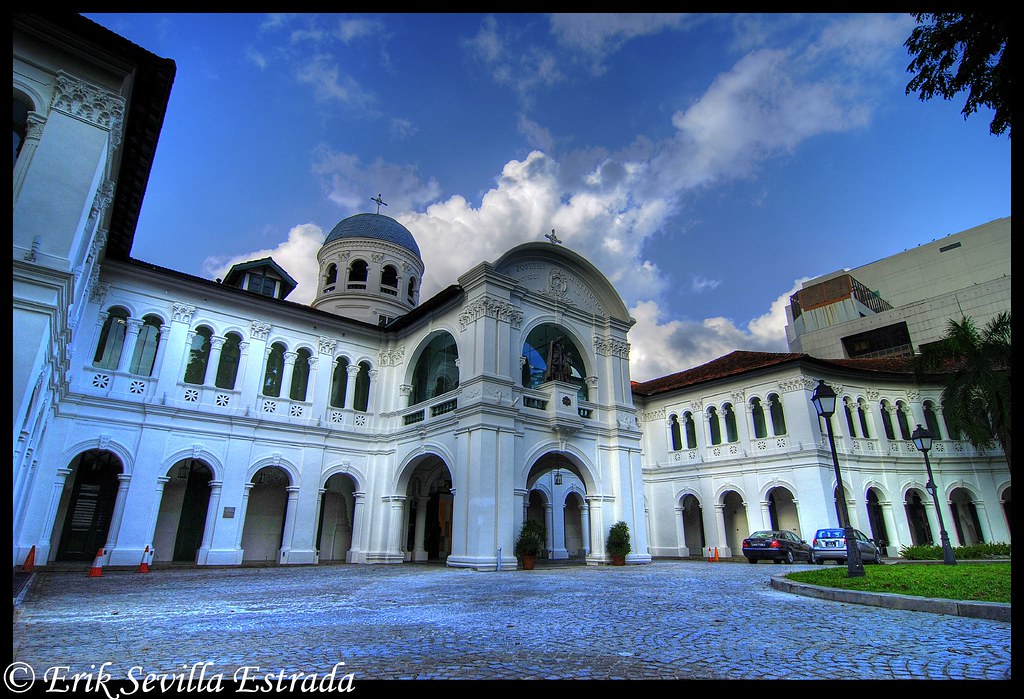
(Photo from Flickr user Erik Sevilla Estrada.)


Links:
My Wishlist for Architecture in Singapore (re:ACT)

Civic Tourism

Friday, May 25, 2007

Don't Touch The Art


In case you haven't heard, tourists are ruining Machu Picchu. The famous Incan sanctuary left over from that civilization's headier days, is starting to show signs of wear and tear after a tenfold increase in tourist numbers since 1990. In case you're wondering, that adds up to almost a million visitors traipsing across the fragile site every year. Meanwhile, in San Antonio, 2.5 million visitors a year are beginning to cause problems for another famous ruin, the Alamo. Many wandering hands have grazed the walls, and the moisture and oil from this contact is beginning to wear the structure down.

I am utterly fascinated by the fact that so many of us find ruins so compelling that, in our desire to take part in them and their history, we willingly take part in their gradual destruction. I'll admit off the bat to being one of the dreaded "touchers" in art museums...I'll walk right up to a painting and brush my finger along a particularly juicy-looking brushstroke -- after scoping out the room to check for guards, of course. I know that this makes me a terrible, horrible, no-good very bad person, but I'm making the confession to say this: I don't have a thing for touching ruined buildings, but I get it.

Consciously, the desire to touch a building like the Alamo is most likely the result of something along the lines of "Maybe Davy Crockett touched this very wall." But subconsciously, I wonder if the need to touch a historic building, or a painting, or any kind of artwork, comes from that most famous aspect of human nature: the desire to leave our mark on the world. With signs around telling us not to touch or be careful near a crumbling building, our instincts kick in, and we perform an act of counter-creative graffiti in a tiny effort to take part in recreating the world for future generations. We are not fascinated with Davy Crockett's history as an isolated idea, but with being a part of the same history as this man.

Buildings are very solid, permanent things in our day-to-day experience of the world around us. It makes perfect sense, then, that on some level we look at ruins as artworks, once-lived-in sculptures. They provide us with an opportunity not just to connect with the past, but also take part in the imagined past of the future...if that makes any sense. Ruined buildings are not solid, permenant things, but continually-evolving pieces of collaborative art. They are living history. By touching a deteriorating wall, we become architects of destruction.

(Photo from Flickr user liquidhotmagma.)


Links:
Machu Picchu site at risk (LA Times)

Remember Not to Touch the Alamo (Architectural Record)