Showing posts with label traffic. Show all posts

Wednesday, September 17, 2008

A F%@$ing Break: Give me one, Please

It seems like every couple of weeks there's another city ranking list, and the extremely flawed methodology of each one is ever more extremely flawed than that of the list before it. Add to the pile: Forbes' recently-vomited-up list of America's Most Stressful Cities.

Obviously, I'm being melodramatic. And obviously, this means that I have some emotional stake in the results. So let's be done with it: Chicago topped the list. Which...I'm sorry, I have to laugh at that. Hard. Just last week, I was talking to a close friend about my growing desire to head out East, because Chicago has such a relaxed atmosphere. It's very casual here, and thus harder to get things done. A bit of procrastination is built into the way of life. Thus, working on more than a couple of projects at once gets more difficult. You feel almost pressured, in a weird way, to do less.

The merits and problems associated with this way of life are fodder for another discussion, but help to frame my reaction to Forbes' list. How, I wondered upon reading the article this morning, could this possibly be? And then, there it was, in the list of reasons Chicago placed so highly: "rising unemployment rate, expensive gas, high population density and relatively poor air quality."

I'll give them the rising unemployment. I'll even toss in an E for Effort on the air quality, even though it's really not that terrible. Wind blows a lot of our air pollution up to my good ole' hometown to the north, Milwaukee, giving the metro of only 1.7 million some of the worst air quality for a city in its size range. Milwaukee, in turn, dumps sewage into Lake Michigan, which then floats down to Chicago and closes our beaches (though this has been happening a lot less in recent years thanks to the Deep Tunnel project...but again, I digress).

Rising gas prices I had to roll my eyes at, because crowding issues on the CTA and Metra have been evidence of the fact that people are taking advantage of alternate options here. If anything, transit ridership should have been taken into account for determining stress in Chicago. Though it appears that these are metro area rankings (something Forbes is continually foggy about with its lists), so whatever.

But density?? This is a negative factor in determining stress? For my official position on this criterion, please refer to the title of this post.

I will grant -- as any pro-density advocate worth their salt will -- that there is such a thing as an unhealthy level of density. Chicago, my friends, comes nowhere near that level. There are plenty of residential high rises springing up around town, but it's hardly anything that you can compare to, say, the high-rise blocks of Hong Kong. Chicago has wide streets, many of them lined with trees. There is plenty of parkland, much of it well-maintained and relatively safe. As a friend once noted when visiting from New York, "My God, you can actually see the sky here."

Forbes' list is blatantly skewed toward older, more densely-populated cities (more commonly referred to by those with sense as "real cities"). Chicago is followed by New York, Detroit, Los Angeles, and San Francisco, with San Diego, Cleveland, Salt Lake City, Providence (yes, seriously), and Philadelphia finishing things out. Only one of these cities, you'll note, is not located in the older, more highly-urbanized Northeastern and California Coast regions.

Density wasn't the only thing to play a part, but it had a noticeable effect on the outcome. At any rate, this seems to be a better indicator of stress levels. I'll take living in a high-rise over living on the freeway any day of the week. Now excuse me, I have to o relax.

Thursday, September 6, 2007

Why "Smart Growth" Isn't

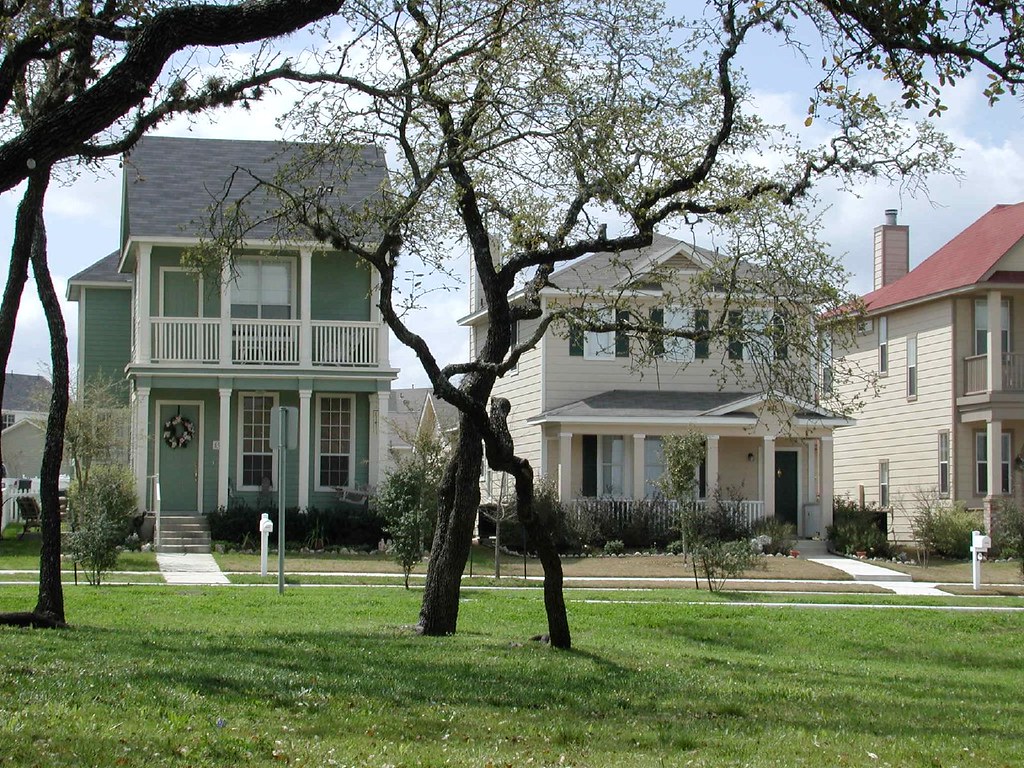
"Smart Growth" (henceforth "SG") is a grossly misused term these days. Almost exclusively used to describe slightly modified suburban development -- moderately smaller lots, more narrow streets, excessive subsidies, "walkable" "communities", and those detestable Towne Centres all come to mind -- the term is a bit of old fashioned semantic smoke and mirrors. The promise is that we can continue to build much as we have for the past fifty years if we consume a couple less farms, or if we move things just a little closer together. Of course, the fact is that these minor changes are producing minor results.

The danger here is twofold: on the one hand, "SG" advocates and the people who choose to (and can afford to) live in "SG" developments pat themselves on the back and insist that they are doing their part to save the world from global warming, when in fact they have made very little difference (and are probably likely to make it up through other small indulgences with which they congratulate themselves for being such good citizens); even more foreboding is the fact that the failure of these not-so-smart "SG" projects provides the pro-sprawl, anti-transit crowd with ample ammo in their arguments against not only "SG", but cities and urbanism in general.

Case in point: a recent article by Wendell Cox of Demographia for the Toronto Star highlights the inability of "SG" initiatives, with their emphasis on (barely) higher density and driving less (sometimes), to curb greenhouse gasses. This is no surprise for reasons discussed above. But the article also cites a University of Sydney study that makes the deceptive argument that dense, transit-linked city neighborhoods produce higher levels of greenhouse gasses per capita than sprawling suburbs.

If this seems counterintuitive, that's probably because the findings are slanted. It is true that Inner Sydney has the highest per capita outpot of GHG, but there is no mention of the fact that a huge chunk of this area is taken up by office towers, which consume massive amounts of energy for heating and cooling, thousands of acres of fluorescent lighting, and other energy-consuming systems that often continue running long after employees have left for the night. Being the central business district, Inner Sydney is also the destination of much of the auto traffic that originates in the surrounding sprawl. Outside the CBD, other neighborhoods include other offices and large tracts of industrial land (and factories are often very large producers of GHGs) that are much less likely to take up space in more far-flung areas.

Of course, 43.3% of the eco-footprint for the average New South Wales resident is created by the hugely disproportionate costs for importing food. This gets at the true heart of the problem facing cities and suburbs around the globe: the need to live locally. Of course, neither the pro-"SG" crowd nor its detractors talk much about that.

More on all of this "SG" business next week...

(Photo from Flickr user pfrench99.)


Links:
Planners denying reality (The Toronto Star)

Australian Conservation Foundation's Consumption Atlas

Tuesday, August 28, 2007

Honku

Aaron Naparstek is one of the people behind the popular NYC transit media site called Streetsblog. He's also the author of a book called Honku that updates that ancient Japanese poetry form, the haiku, by using the very contemporary theme of automobiles; or, more specifically, how f*@#$ing irritating they are.

From the publicity site for the book: "Honku is a road rage anger management technique. The next time some jerk cuts you off or steals your parking spot, rather than succumbing to the rage, take a step back. Separate yourself from the moment and try to observe it with clarity and perspective. Then boil it all down into crisp and pithy 5-7-5 gem. That's a honku."

So simple, and so brilliant. On a personal note, I took a few poetry classes in college. As a result, I now find reading poetry as enjoyable as rubbing sandpaper over my corneas. Still, a quick, pithy haiku always puts me in good spirits. There are a few "favorite" honkus published directly on Naparstek's site, so I decided to pull a few of my own favorites -- the best of the best of the best, if you will -- and re-post them here for your enjoyment. Take a read through, and if you like what you see check out the site for more.

Gruesome hit and run
fatalities up ahead
how awful - I'm late.

Drove six hours to
the Mall of America
got some McNuggets.

Atlanta traffic
easy to see why Sherman
burned this city down.

There's a great little story on the Honku site about the inspiration for the book. As it turns out, these literary zingers started off as a a community art project. Enraged by inconsiderate, horn-honking drivers disturbing the peace in his Brooklyn neighborhood, Naparstek started writing the honkus and taping them to lightposts in the area. Soon, honkus written by other residents started popping up. The city council rep took notice, as did the police, and the local media. Of course, in New York, the "local media" is the New Yorker and the New York Times. That was probably somewhat helpful in getting this project to really take off. Heh. At any rate, all of the attention fixed the problem: the cops started ticketing honkers and the noise dropped dramatically.

So the next time you're confronted by a problem in your neighborhood, remember that the annoyances we assume to be unavoidable can be remedied through unconventional solutions. You can't fix everything with a haiku, but if someone had told you this story before it had actually happened, you'd probably have laughed at them. We big city folk have a tendancy to mistake cynicism for common sense. We need to stop that.

One more for the road, from yours truly:

Leaning out windows
drivers scream for green. A train
rumbles overhead.


Links:
Honku.org (Photo Credit)

Streetsblog

Friday, July 20, 2007

WEEKEND READING: July 14-20, 2007


There was a glut of interesting stuff to sift through this week, so I can put a guaranteed stamp of "Awesome" on all of these links.

ITEM ONE: Josh Stephens has penned yet another great post for Planetizen's Interchange blog. The topic: Europerfection and the untapped potential of American surface lots.

ITEM TWO: My employer, the Corporation for National and Community Service, has a new report out that suggests that commute times affect volunteerism rates in American metros.

ITEM THREE: WorldChanging features a Q&A with Clare Lockhart and Ashraf Ghani on Afghanistan's National Solidarity Program and the future of the country.

ITEM FOUR: BLDGBLOG is taking the extra room fantasies of Manhattanites and turning them into a radio program.

ITEM FIVE: Mapping walkability = coolest mashup ever.

ITEM SIX: The witty Part IV posts a letter entitled "Dear Architects: I am sick of your shit." Hilarity ensues.

ITEM SEVEN: A book about carfree living that doesn't come across as preachy? A review on MSN claims the impossible.

Adios, compadres. See you next week.

(Photo from Flickr user shadeofmelon.)