Showing posts with label Bogotá. Show all posts

Monday, February 18, 2008

The Endless City Q&A

After a tiny bit of prodding, the folks at Phaidon sent over a review copy of the recently released book The Endless City, edited by Ricky Burdett and Deyan Sudjic, and containing essays by the likes of Saskia Sassen, Enrique Peñalosa, and the indefatigable Rem Koolhaas. Where will feature a review of the book soon, but first, another treat from Phaidon; the editors were asked a series of questions. The following is a selection of the highlights from the record of this Q&A.

What are the main issues that you think people should be concerned about when it comes to city growth?
The book has a section titled ‘Issues’ that we hope synthesizes the complexities of urban growth. In it, a number of the contributors outline key issues but approach them from a variety of viewpoints. For example, Richard Sennett argues that ‘over determination’ can kill the vitality and growth of urban centers. Cities need to be dynamic and its physical forms and functions need to be endowed with the capacity to respond to indeterminate, unpredictable forces. Frank Duffy applies a similar idea when explaining the urban office, so ‘adaptability’ is the central issue they both cover. Another issue the book clearly prioritizes is sustainable development. The contributions from Guy Battle and Nicky Gavron, along with the Knoflacher, Rode and Tiwari essay, all detail urban growth strategies that respond to the environment and the challenges of climate change. Another central issue summarized by the three essays by Gerald Frug, Enrique Penalosa and Geetam Tiwari is governance and civic participation – cities need to allow for a multiplicity of voices and actors as well as a variety of experiences but there needs to be an agent or authority that can intelligently negotiate this multiplicity and still get something done. Tiwari explains this with particular reference to the forces dominating the informal sector. Both Anne Power and Sophie Body-Gendrot elaborate on this as well as some of the other pressing sociological concerns that urban designers, policymakers and the general public confront in the act of city making. Of course it goes without saying that quality design is the ingredient that delivers a truly remarkable city and allows individual places to flourish. The essays by architects Rem Koolhaas, Alejandro Zaera-Polo, and Jacques Herzog and Pierre de Meuron all contribute various reflections about how to reconcile a variety of factors and perspectives enmeshed within the city’s physical reality. It should be noted that many of the essays in the Cities section resonate with the broader themes in the Issues section as well. The result is a cross-sectional analysis between the six cities [New York, London, Shanghai, Johannesburg, Mexico City, and Berlin] and the global world with issues finitely referenced to specific urban conditions.

What world cities do you expect to go through the greatest changes in the 21st century?
The fastest growing cities are in Africa and across Asia and its up to the next generation to make sure their development does not repeat the mistakes of cities in the developed world – this means Lagos and Kinshasa, Mumbai, Deli and Dhaka, as well as Shanghai and Jakarta. It is projected that by 2030, over 4 out of every 5 urban dwellers will be in the developing world so this will have huge implications for the global economy. At the same time, mature cities such as London and New York City, Berlin and Mexico City need to ensure that their future growth reconciles their layered history of planning mistakes and prioritizes sustainable transport and inclusive, contained growth.

The book talks about the importance of cities learning from each other. Can you explain that? For example, what can NYC learn from Shanghai? Can small cities learn from big cities?
There are countless examples of cities looking to other cities when deciding how to invest in their future growth and health. Congestion charging in NYC wouldn’t be a viable option had London not demonstrated how it could be done, and Mexico City’s Metrobús is a stunning success modeled on the Transmilenio in Bogota and of course Curitiba. Ideas must be partnered with implementation strategies and learning often is a matter of scale. So yes, small cities can learn from big, and vice versa. The essay by Knoflacher, Rode and Tiwari describes how small cities can serve as incubators for innovation precisely because of their scale. Understanding how cities implement large projects such as the Olympics in London, doing it with the right amount of investment in public space, has a lot to do with acknowledging how the city and individual neighborhoods have developed over time and how open space serves to socially integrate people from disparate backgrounds. The contributions of both Saskia Sassen and Enrique Peñalosa emphasizes this learning, especially in the latter how urban centers in developed countries are recovering from their love affair with the car, delimiting the access of automobiles in favor of public transport. Cities in developing countries could learn a lot from this. Most importantly, in order for ideas to transfer from one city to another, there needs to be a complementary understanding about how policies, decision making and funding align to facilitate implementation. Frug’s essay explains how the power structures of the six cities vary and what impact permutations to each city’s existing systems could have on local and regional planning mechanisms.

What are the key ideas that you want people to take away from reading this book?
The 34 contributors to the book – along with the hundreds of policymakers, politicians, academics, architects, planners, and urbanists involved with the Urban Age project which forms the basis for The Endless City – all believe that cities can offer a better social and economic life for its citizens. Now that half the world’s population live in cities, there is an urgent need to take stock of the new urban condition and find an approach to dealing with it. City sprawl should be contained and there are innovative strategies for creating high density, highly liveable environments. We want to help those charged with running and making cities understand the relationship between the socio-economic and spatial characteristics of cities – and we want the general public to understand how sustainable urban development can actually improve the physical form of their cities and the quality of their lives.

Are you hopeful for the future when it comes to our cities?
Enrique Peñalosa, the former mayor of Bogotá, offers an incredible explanation for why we should all be hopeful for the future of cities. Cities offer the potential for ‘quality of life equality’, i.e. access to green, open space and social and economic mobility as well as physical mobility. Across the world, people are moving into cities at an alarming rate – and not just mega-cities but smaller cities comprising an overall urbanized region. Most importantly, the twenty-first century will be increasingly focused on reducing both the overall sum and per capita production of carbon emissions, and as emitters of 75 per cent of the world’s pollution, cities are the battleground on which the future and health of our planet will be determined.

Is there any way for ordinary people to make change in their own cities? Do you have any recommendations for someone who wants to get involved?
Ordinary people make change in their city everyday. They do this by opting for public transport instead of a private car, by holding their government officials responsible for the quality of the built environment, and by advocating for equal access to green, open space. Ensuring that there is investment in sustainable forms of transport, and that access to healthcare, education and community services does not depend on how much money you make or the wealth of your locality. Most importantly, if you don’t know what your community is doing locally to advocate sustainable urban development, then join a forum and find out. Participate.

(Thanks, Faye!)

(Photo from Flickr users thequickbrownfoxjumpsoverthelazydog and howzey. The original full-color versions can be viewed by clicking the respective photos.)

Friday, February 8, 2008

WEEKEND READING: February 2-8, 2008

Did you know that it can actually rain slush? Like, the rain is semi-frozen, so as it hits the ground it collects and forms massive fraeking rivers of slush in the middle of streets. It's true. It happened in Chicago this week. It was the worst winter weather I've ever seen, and I'm from Wisconsin. By the way, here's your Weekend Reading. :-)

ITEM ONE: Great article on the recent trend in happiness-focused urban policies.

ITEM TWO: Interchange post by Greg Smithsimon about sustainability and the importance of having plans for change "lying around."

ITEM THREE: Strange Maps covers "America: The Mall" with an enlightening essay.

ITEM FOUR: Just discovered a fanastic new blog called Making Maps. Take a gander at this post on the principles of map design.

ITEM FIVE: Pruned covers some fabulously futuristic designs for a park in Venice. (Photo credit)

ITEM SIX: WebUrbanist's "5 Innovative Industrial Designs for Ecological Living" will have you rethinking the way you interact with everyday objects.

ITEM SEVEN: In the realm of Crazy-But-True, there is apparently a group trying to raise $10 billion to build a dome over Chicago to ward off nasty winter weather. After this week, I almost want to contribute. Best part: they've already raised $233,085.

No more slush rain this weekend, but it's supposed to get down to ten degrees Fahrenheit. Winter here sucks, y'all. Hope your weekend is warmer than mine!

Thursday, August 16, 2007

WEEKEND READING: August 11-17, 2007

This edition of Weekend Reading is all sorts of random. It's like urbanism salad!

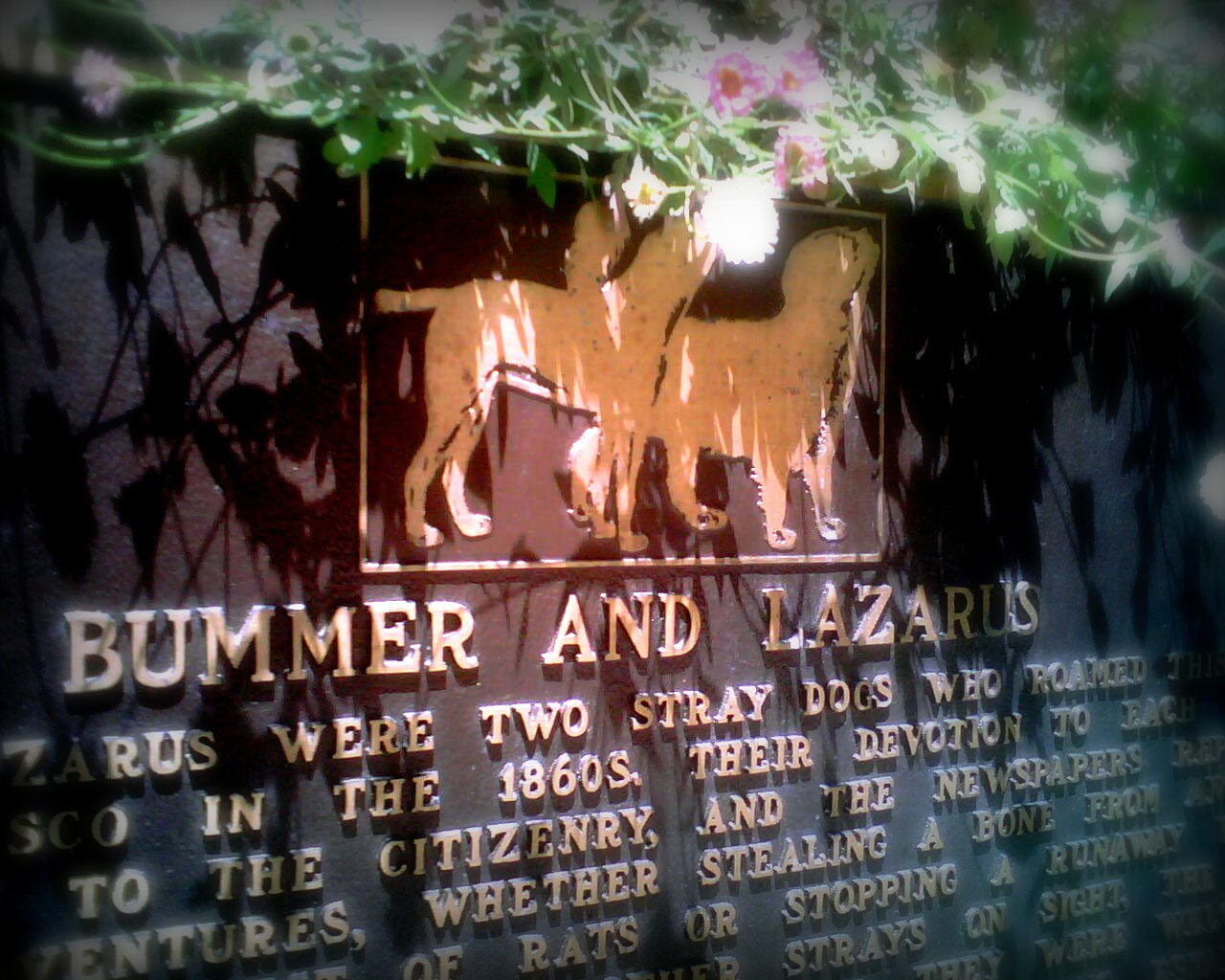
ITEM ONE: The story of Bummer and Lazarus, San Francisco's most famous pooches.

ITEM TWO: The "informal settlement"-watching blog Squatter City, written by the author of Shadow Cities.

ITEM THREE: Mexico City's mayor tries to push vendors off of the streets, but meets opposition from "a 63-year-old ex-con and great-grandmother."

ITEM FOUR: More radio hijinx from BLDGBLOG and DJ/rupture.

ITEM FIVE: The Washington Post asks "can globalization for for the world's slums?"

ITEM SIX: Will South America's first eco-city be built in rising-star Bogotá? Chances are good.

ITEM SEVEN: More from Colombia, where the previously mentioned HiperBarrio project continues to improve the city. For more on that resurgent city, click here.

See? Urbanism salad. Just like I promised. Check back over the weekend, as more of the Neighbor's Manifesto will be posted.

(Photo from Flickr user Dunstan Orchard.)

Wednesday, July 25, 2007

Eat Your City


Grist has a fun new city list out this week, and they really rolled the dice on a few of their choices. The eco-zine has compiled a list of fifteen "green" cities -- which the writers readily admit is a figure of speech. Few would argue, after all, that London (#7) is literally a green place, though its environmental efforts are notable. Half of the spots on the list are occupied by exactly who you'd expect to see: Portland, Curitiba, Vancouver, San Francisco, Sydney. Mixed in with these are a number of major players with new green initiatives and enviably walkable cores (Copenhagen, Barcelona). And, certainly, examples of all of these cities' resourcefulness and creativity are given to support their election to the list (which appears to be entirely objective). But the most exciting entries are the dark horses.

The Gristies start things off with an oddball: Reykjavik, Iceland. The chilly city of the north Atlantic has apprently begun powering its public transit system (busses) with hydrogen. Even more interesting, all of its energy comes from renewable sources. Rising star Bogotá makes an appearance, with former Mayor Enrique Peñalosa's traffic-busting garnering heavy coverage.

Easily the most fascinating city on the list, however, is Kampala, Uganda. Kampala is (along with Addis Abeba, I would argue) becoming a city to watch, and its eco-efforts are only helping to build the buzz. In its explanation, Grist highlights the city's agricultural initiatives: "Faced with the 'problem' of residents farming within city limits, the city passed a set of bylaws supporting urban agriculture that revolutionized not only the local food system, but also the national one, inspiring the Ugandan government to adopt an urban-ag policy of its own."

Forgive me if the "city to watch" lable seems a bit crass...it is true that Kampala faces serious economic challenges (around 40% of residents live in absolute poverty), but that's exactly why the city's urban ag efforts are so intriguing. As it turns out, for a long time urban farms were seen as an unsanitary public nuissance. According to an article by the International Development Research Center of Canada, Kampala city administrators had to sell the perceived problem of urban farming as a solution to many citizens. The city even participated in the McGill University-led Making the Edible Landscape project, which aims to turn cities -- traditionally large-scale food consumers -- into centers of food production.

Urban agriculture is a well-documented option for increasing the sustainability of a neighborhood or individual lot. But city-wide campaigns are, I think, almost unheard of in industrialized nations. But recent talk of skyscraping urban farms in Manhattan have juiced the public imagination a bit, it seems, and one Columbia University professor -- err, Doctor -- Dickson Despommier, believes that urban farmscrapers will likely be a reality within the next 10-15 years.

But the possibilities don't stop there. Urban farms could become for the 21st Century what large, elaborate central parks were in the late 19th and early 20th. Frederick Law Olmsted famously described Central Park in Manhattan as the lungs of the city, but with new green technologies these farms could become more than lungs -- they could be the heart and brain of the city as well, collecting and treating runoff and waste water for public use and even pumping clean energy back into the city grid. If Kampala can take its rambling landscape and designate farmland zones, and New York can build towering farms, who's to say where the innovation stops. Indeed, Central Park itself set off a firestorm of park design and construction around the US and the world; what if London took that Trafalgar Square grass stunt from earlier this summer and ran with it, converting large public spaces across the city to farmland? Or if Tokyo retrofitted the upper floors of of all of its buildings to transform the city's roofscape into a massive urban garden? Imagine Los Angeles tearing down its freeways to develop sprawling agricorridors to knit long-torn neighborhoods back together, or Toronto employing a massive network of barges to form a second coastline of floating farmland along Lake Erie, or a stablized Kabul turning rubble piles from American bombings into terraced hydroponic inter-city field networks. The possibilities, as they say, are endless.

At any rate, if Grist is still around in fifteen years, it will be interesting to see whether they still use the term "green city" as merely a figure of speech.

(Photo from Flickr user namayanjaj.)


Links:
15 Green Cities (Grist)

Building an Edible Landscape (IRDC)

Kampala Project Information (McGill School of Architecture)

Press/Media for Making the Edible Landscape

Skyfarming (New York Magazine)

Friday, May 18, 2007

WEEKEND READING: May 12-18, 2007


This week's roundup will be relatively short. All this Community 2.0 talk has (ironically?) made me want to spend more time outside. Actually, that could just be the slowly-but-surely improving weather here in Chicago...

First: I know that it's a bit silly for a little start-up blog to "promote" the most popular architecture blog in the 'osphere, but just in case you missed it Geoff over at BLDGBLOG had a really stellar week.

Second: We head over to Planetizen where one of my favorite Interchange bloggers, Josh Stephens, has a great post on working urbanism and planning into the high school curriculum in the US. (This is actually from last week, but I missed it. Better late than never...)

Third: This article by Jane Powell in SFGate has been making the rounds through the urbanism news aggregators. With good reason, too: it's
informative, hilarious, and debunks some surprising myths about the "green" building craze that's taking over our cites. It also has one of the best factoids I've heard in weeks: "Demolishing 10,000 square feet of old buildings wipes out the environmental benefit of recycling 2,688,000 aluminum cans." (!)

Fourth: I happened upon a great blog called Celcias this past week thanks to this wonderfully straightforward and informative post about building cities for people instead of cars. Who knew Bogotá was such a forward-thinking city? Probably a lot of people, right? Again, better late than never...

Fifth: My friend Jacob's blog, The Urban Louisvillian, has an interesting piece about Humane Metropolis-esque projects going on in Kentucky's largest city, like the City of Parks initiative pictured at the top of this post. I like both Jacob and the Humane Metropolis concept; thus, you are reading this plug.

That's all for this week. Make sure to check back later this evening, as "Community 2.0 and the Built Environment" will be concluding with an interview with MetroProper founder/developer Phil Tadros. And Windy City residents, don't forget about Great Chicago Places and Spaces. I'll see you there!