
Why is it that so many of the people out there studying/analyzing/writing about new urban trends, new technologies, new social configurations, etc. are either well past or fast approaching midlife?
xxx
Watching academics (or worse: bureaucrats and business gurus) try to keep up with the frenetic pace of our present-day spatial, cultural, social, etc. milieus can be a sad sight. Pro Thinkers struggle like parents or marketeers or morning TV hosts to stay current and swank and therefore (allegedly) relevant.
They are quick to embrace buzz working concepts, and just as quick to dump them.
xxx
To make matters worse, even regular people like you or me have a hard time upholding concepts, just like we do keeping relationships, tastes, personal aims, political allegiances and attention spans. We consume our concepts like we consume our everydayness.
xxx
The problem is that a number of these concepts could actually be useful and significant. They are unfairly — even irresponsibly – deemed tired, passé, fizzle; superficially exhausted and then dumped.
xxx
One of the poor bastards in this bunch is the notion of "informality". After a brief, guilt-driven stint of Western academic and media focus on the subject, at the moment informality sounds as old and worn as French Theory. Something to roll your eyes over.
xxx
I don't want to redeem anything or anyone here. I just don't think ideas should be treated as disposable objects. Ideas always linger and creep back up when you least expect it.
It's only fair that we're tired of hearing the same stuff from the same people, over and over again. OK. But that doesn't mean that everything that needs to be said has been said.
xxx
Right now, more than anything else, I have some basic, intuitive, poorly-shaped questions. I guess they're mostly questions for myself (given my comment track record on this blog):
- Can anyone actually pin-point "informality"? Or is the notion simply elusive and any attempt at this futile?
- Is the concept itself inadequate? Particularly considering there isn't an actual divide between formal and informal, that they are both the same thing: reductive categories that try to organize and make sense of functional and active by-products of our (Modern, global) development schemes and efforts.
- Do we really have to keep opposing the "informal" to the Western-developed-organized-etc.-etc. or can we maybe start understanding it as a mirror modernization, as the crooked limb of Modernity or its bad twin?
- Instead of considering it an absence of logic, can we accept informality as a logic in itself, with controls and hierarchies and orders and struggles and changes and growths?
- If we want to emphasize the historical breach and inequality of modernizing processes, why not simply try to analyze and describe how unequal types of development are crashing up against each other and invading each other as a result of globalization, instead of making it an Us vs. Them thing? There is no Us vs. Them. We've all been smeared.
- Beyond aesthetics, isn't informality ugly (scary even) because it reveals too much about our dirty, insecure, two-faced Modern selves?
- How about picturing an enhanced version of the informal? One that isn't primitive or picturesque or exotic, or at least not in its entirety. One that is inextricably related to whatever happens elsewhere: interconnected, active (sometimes aggressive), efficient and significant in its own right. One that we need not pity or fix, but understand.
Would anyone like to take a shot? 
(Photo by Pablo León de la Barra. José Rojas at House of Gaga in Mexico City. From the Centre for the Aesthetic Revoluction).
Showing posts with label globalization. Show all posts
Showing posts with label globalization. Show all posts
Friday, July 3, 2009
Informality, Enhanced

Thursday, May 28, 2009
Boredom in a Globalized World
 At the center of the city of Kashgar, on the far western edge of China, is a city of twisting streets lined by mud and brick buildings dating back centuries, to when Kashgar was a trading post along the Silk Road. The Chinese filled in a moat to create a ring road back in the 1980s, and built a highway through the middle of the historic center a few years later, but this historic urban core remained largely intact until recently. Today, Party officials in Beijing have issued a death sentence to historic Kashgar, citing earthquake-preparedness as an excuse for removing the largely Muslim population and leveling the neighborhood house by house as the residents leave.
I've never been to Kashgar; and yet, I find this news deeply disturbing. Reading a recent New York Times article about the Kashgar "redevelopment" on the heels of Katia's post about the planned clearance and "redevelopment" of Dharavi yesterday got me thinking about the effects that clearance projects have on the sociocultural fabric of our cities, and wondering what local changes might signal in the broader context of globalization.
China and India are the undisputed leaders of the pack in the developing world; anyone looking to learn about how globalization will affect cities in our rapidly globalizing world should look no further than the massive metropolises of these rising giants. Slum clearance is the name of the game in cities of all sizes in both of these countries; in places like Kashgar, such projects break up ethnic and cultural enclaves, spreading their tightly-knit populations across the sprawling, newer areas on the edge of the city. Drew's post on Monday pointed out the danger in not making room for smaller, less commercially-viable artistic and cultural scenes: when the grassroots scene dries up, the entire city's cultural cachet declines. Or, as Richard Florida likes to quote Jane Jacobs as saying, "When a place gets boring, even the rich people leave."
 What happens to a globalized city when it becomes boring? Could the decline of cultural diversity eventually undermine growing economic centers? Looking beyond the effect of cultural shifts on cities, what happens to a country in a globalized world when that country becomes boring?
 As they become more economically established, India and China are edging in on the cultural and economic dominance of the United States and the EU; what happens to the West once these two juggernauts are operating at full tilt? It's possible that everything will go smoothly. It's also highly unlikely. And with plenty of countries lining up for their chance at some record-growth years (think: Brazil, Turkey, Iran, Vietnam, Malaysia), it's the West that's getting increasingly "boring," to extend the metaphor.
Perhaps that's why the destruction of a place that I've never seen is so disturbing to me: in a globalized world where cities are the new neighborhoods and countries the new cities, the cycle of cultural turnover could eventually make entire regions irrelevant at a pace we've never seen before. It's important to remember that, while many cities are benefitting greatly from the effects of globalization, there is something to be said for keeping some aspects of culture local.
(Photos from Flickr users nakamamin and sake.vanderwall. The original full-sized versions can be viewed by clicking the photo.)
Thursday, February 12, 2009
Slums‘R’Us

Go figure, but the “feel-good movie of the year” is apparently Danny Boyle’s Slumdog Millionaire. Things must really be down when the filmic fairytale of choice has a sprawling slum built on a dump as a backdrop, when its protagonists are two poor little buggers turned orphans after their mom is clubbed to death in the middle of religious rioting, and when its highlights include mobsters blinding a kid with acid to earn bigger beggar bucks, caste prejudice, underage prostitution and a full-body dive into a brimming latrine. Sweet!
So where’s the feel-good? I guess part of the movie’s success at the box office has something to do with a lingering taste for the exotic. People seem to love Slumdog’s blasts of color, frantic pace and raw spurts of life; they agree that “slums never looked this cool”. Yes, the Third World keeps filling the promise of a relentless lust for life, an irrational drive that keeps the poor folks south of the equator going, even when faced with dire conditions and painful obstacles. What “westerners” don’t realize is that all this seemingly exuberant vitalism has little to do with joie de vivre and is actually a crude survival strategy.
Slumdog is a watered-down version of the slumsploitation genre that grew popular in the late 1990s and early 2000s, revealing the violent drag of Parisian banlieus, digging into the favelas of Rio and hovering over vecindades in the outskirts of Mexico City. Aside from the continental displacement (the sizzling streets of Mumbai and the swollen alleys of its informal appendix, Dharavi) the most notable shift is from the dominant dark undertone of the previous films to a cut-up, fast-track mode where darkness is reduced to “spice” and sideline for a puerile plot the masses can relate to: good guy vs. bad guys, rags to riches and love (and money, let’s not forget) conquers all.
As for the urban milieu, which even in slumsploitation flicks has a relentless and sobering presence, Slumdog reduces it to scenery, a collection of common places and fundamentally passive container. Even when the dogs turn to kings standing on the thirthy-somethingeth floor of soaring skyscrapers built on the margins of their rundown birthplace, viewers have no idea of how this massive urban change came about, what it means or how it relates to the squalor. And no one (outside of India) cares, really. It just seems to be part of the slums and the exotic “catching up” to the West. Part of the charm of the “escape” is that in the end we are confirmed that we know best and that our ways still hold their power and value (even at times like these, when the developed world’s own sense of power and value is failing). It’s actually funny, because in reality the First World appears to be falling closer to the Third, as global dynamics dissolve boundaries and hierarchies and everyday life gets messier, and connections with the “faraway” and “underdeveloped” reveal themselves closer to our own doorsteps that we ever thought, and the divide between city and suburb and exurb and slum is disappearing in both North and South.
 The only feel-good I got from Slumdog was M.I.A.’s “Paper Planes” playing in the background. The song succeeds were the movie fails: in dressing up the contradictions and the piercing realities of the “underdeveloped” in a way that hits “developed” sensibilities without them even knowing it. Despite the fact that M.I.A.’s song immediately makes you want to smile and dance and enjoy the bustling creativity and rhythm this beautiful big-eyed brown-skinned girl from some faraway corner of the world has to offer, the minute you start the music leaves you with this weird aftertaste, this nagging realization that there’s something you’re missing, something you don’t quite understand, something that’s not completely right. The track, with its infectiously charming yet chilling kids-gunshot-cashregister chorus, is the type of “friendly dirt” that actually makes you think.
 (Photo from Flickr user marcusfornell. The original full-sized color version can be viewed by clicking the photo. M.I.A. portrait by Napoleon Habeica, from babybabybaby magazine)
Wednesday, December 31, 2008
Considering Urban Retail: A Re-post at the Crossroads
As we head into 2009 with economists predicting the closing of as many as 73,000 retail locations across the United States due to dismal holiday sales, it seems like a good time to look back at one of Where's most popular posts from last year, "The Possibilities of the Post-Retail City," originally published in August of '07.

I just had my first exposure to Reverend Billy, the leader of the Church of Stop Shopping. After reading a Polis post about the Reverend's anti-consumerist group, I thought it was an actual church. To which I said: "Oh, excellent.
Of course, the CoSS is actually an act, with the "Reverend" being the stage persona of NYC performance artist Bill Talen. It's a send-up of streetcorner preachers and televangelists, and it sounds hilarious. Better yet, there's a point! Reverend Billy preaches against corporatist architecture and urbanism, advocating for sustainable, walkable communities with local economies. And while the site does pay lip service to independently owned local businesses, it is the Church of Stop Shopping, and one of their taglines is "Love is a Gift Economy!" Obviously, these people think that there are better ways for us to use all of that street-level retail space.
And that got me thinking: if there were no major retail chains and independents had to hold up the local economy, what would we do with all of that ground-floor space? Indeed -- and my upbringing in a capitalist society may shine through right here -- but where would we walk to? Certainly, there are plenty of places that we walk every day, but a large amount of pedestrian traffic is genereated by shoppers. And while it's not a requirement for these ground-level spaces that make up our streetscape be places of commerce, their presence is utterly vital to functioning neighborhoods. Often (these days) even moreso than upper-level residential windows, storefronts are the Jacobsian "eyes on the street" that act as a natural deterrant to crime.
Shopping is also a huge part of the social life in many (if not most) contemporary cities; in fact, that's just what Reverend Billy and his fake church take issue with. And whether or not you agree with the Church of Stop Shopping (or, as I'm sure many do, find it outright offensive), it's interesting to imagine a world in which shopping took a back seat to other social spaces as the dominant street presence. Imagining Paris without the Champs-Elysées or New York without Park Avenue sparks a giddy, no-holds-barred creative energy akin to imagining those cities in a work of science fiction or postapocalyptic literature.
To get an idea of what might fill the void, it might be interesting to see how social space is structured in places where gift economies (or at least barter systems) often already exist and retail strips are few and far between, at least in the traditional sense: slums.
An article from Forbes, mentioned briefly in a previous post at Where, described the socioeconomic situation of many older, established slums in Asia and South America thusly: "Many slum dwellers are in fact entrepreneurs, albeit writ very small. They recycle trash, sell vegetables, do laundry. Some even run tiny restaurants and bars for their neighbors." So while there are no Ginza Districts in the favelas of Rio, there is a social commerce to such places. Restaurants and bars remain important components of the neighborhood, which makes good sense; people have always come together over food and drink, and will continue to do so regardless of any freak evaporations of the retail sector.
Another thing that brings people together is knowledge -- or, more specifically, the exchange thereof. Another recent post covered McGill University's Edible Cities project in Kampala; the site for the students' project "includes a low-lying wetland area...where a youth cooperative practices brick-makings, providing work for otherwise unemployed youth...and a sloping dryland area where farming is [practiced]." While this is a very rural area being discussed (albeit in the context of a larger city), the Kampala site illustrates two more possible uses for a retail-less streetscapes: public workshops (which could cover a variety of topics in addition to brickmaking) and storefront hydroponic community gardens.
Heh.
If the second option seems somewhat far-fetched, the first is hardly at all; in fact, in the face of looming irrelevance in the digital age, libraries around the world are starting to take on a more social role in their respective cities, staging various events and programs to encourage public discourse and teach skills that cannot be learned with a mouse and keyboard. One of the most innovative library programs that I've heard of recently is in Medellín, the second city of Colombia.
Once the so-called Kidnappping Capital of the World, Medellín has made more news recently for building five spectacular modernist libraries (like the one in Santo Domingo Savio, pictured above) in its most impoverished barrios. One of the programs to utilize these new libraries -- which are equipped with computer labs full of brand spankin' new computers -- is HiperBarrio, which teaches teens in the barrios how to use blogging and other social media tools as a creative outlet for self-expression. Juliana Rincon, one of the founders of HiperBarrio, spoke of the program's inspirataion in a recent interview with Global Voices Online, saying, "It was amazing...telling these kids about blogs and finding out that they had no idea that there was something like a blog, that they existed. [Or even] that you could write online and have a virtual space to keep your writing, the videos you like, and pictures." Libraries, in this case, serve not just as containers for information, but as catalysts for the creation of new information and new ideas. Certainly, this kind of social space, the place of public learning, will play an increasingly important role in cities as we continue through the Information Age.
Whatever we come up with to fill storefronts and social spaces, shopping districts and neighborhood retail strips are unlikely to disappear within the lifetime of anyone reading this blog post. Still, imagining a world without retail can tell us a lot about how we use cities, why we do things the way that we do, and how we can improve urban places without courting Starbucks and Barnes & Noble for civic salvation. In fact, picturing your neighborhood without any shops selling anything other than necessities might be a great way to fall in love with the place all over again. That is, of course, assuming that you love your neighborhood -- and that you don't live off Rodeo Drive.
----------
That's all for now, folks. Best of luck to everyone in 2009. Let's hope it's not as bad as we're all worried it's going to be.
(Photo from Flickr user galitagreeneyes. The original full-sized color version can be viewed by clicking the photo.)
I just had my first exposure to Reverend Billy, the leader of the Church of Stop Shopping. After reading a Polis post about the Reverend's anti-consumerist group, I thought it was an actual church. To which I said: "Oh, excellent.
Of course, the CoSS is actually an act, with the "Reverend" being the stage persona of NYC performance artist Bill Talen. It's a send-up of streetcorner preachers and televangelists, and it sounds hilarious. Better yet, there's a point! Reverend Billy preaches against corporatist architecture and urbanism, advocating for sustainable, walkable communities with local economies. And while the site does pay lip service to independently owned local businesses, it is the Church of Stop Shopping, and one of their taglines is "Love is a Gift Economy!" Obviously, these people think that there are better ways for us to use all of that street-level retail space.
And that got me thinking: if there were no major retail chains and independents had to hold up the local economy, what would we do with all of that ground-floor space? Indeed -- and my upbringing in a capitalist society may shine through right here -- but where would we walk to? Certainly, there are plenty of places that we walk every day, but a large amount of pedestrian traffic is genereated by shoppers. And while it's not a requirement for these ground-level spaces that make up our streetscape be places of commerce, their presence is utterly vital to functioning neighborhoods. Often (these days) even moreso than upper-level residential windows, storefronts are the Jacobsian "eyes on the street" that act as a natural deterrant to crime.
Shopping is also a huge part of the social life in many (if not most) contemporary cities; in fact, that's just what Reverend Billy and his fake church take issue with. And whether or not you agree with the Church of Stop Shopping (or, as I'm sure many do, find it outright offensive), it's interesting to imagine a world in which shopping took a back seat to other social spaces as the dominant street presence. Imagining Paris without the Champs-Elysées or New York without Park Avenue sparks a giddy, no-holds-barred creative energy akin to imagining those cities in a work of science fiction or postapocalyptic literature.
To get an idea of what might fill the void, it might be interesting to see how social space is structured in places where gift economies (or at least barter systems) often already exist and retail strips are few and far between, at least in the traditional sense: slums.
An article from Forbes, mentioned briefly in a previous post at Where, described the socioeconomic situation of many older, established slums in Asia and South America thusly: "Many slum dwellers are in fact entrepreneurs, albeit writ very small. They recycle trash, sell vegetables, do laundry. Some even run tiny restaurants and bars for their neighbors." So while there are no Ginza Districts in the favelas of Rio, there is a social commerce to such places. Restaurants and bars remain important components of the neighborhood, which makes good sense; people have always come together over food and drink, and will continue to do so regardless of any freak evaporations of the retail sector.
Another thing that brings people together is knowledge -- or, more specifically, the exchange thereof. Another recent post covered McGill University's Edible Cities project in Kampala; the site for the students' project "includes a low-lying wetland area...where a youth cooperative practices brick-makings, providing work for otherwise unemployed youth...and a sloping dryland area where farming is [practiced]." While this is a very rural area being discussed (albeit in the context of a larger city), the Kampala site illustrates two more possible uses for a retail-less streetscapes: public workshops (which could cover a variety of topics in addition to brickmaking) and storefront hydroponic community gardens.
Heh.
If the second option seems somewhat far-fetched, the first is hardly at all; in fact, in the face of looming irrelevance in the digital age, libraries around the world are starting to take on a more social role in their respective cities, staging various events and programs to encourage public discourse and teach skills that cannot be learned with a mouse and keyboard. One of the most innovative library programs that I've heard of recently is in Medellín, the second city of Colombia.
Once the so-called Kidnappping Capital of the World, Medellín has made more news recently for building five spectacular modernist libraries (like the one in Santo Domingo Savio, pictured above) in its most impoverished barrios. One of the programs to utilize these new libraries -- which are equipped with computer labs full of brand spankin' new computers -- is HiperBarrio, which teaches teens in the barrios how to use blogging and other social media tools as a creative outlet for self-expression. Juliana Rincon, one of the founders of HiperBarrio, spoke of the program's inspirataion in a recent interview with Global Voices Online, saying, "It was amazing...telling these kids about blogs and finding out that they had no idea that there was something like a blog, that they existed. [Or even] that you could write online and have a virtual space to keep your writing, the videos you like, and pictures." Libraries, in this case, serve not just as containers for information, but as catalysts for the creation of new information and new ideas. Certainly, this kind of social space, the place of public learning, will play an increasingly important role in cities as we continue through the Information Age.
Whatever we come up with to fill storefronts and social spaces, shopping districts and neighborhood retail strips are unlikely to disappear within the lifetime of anyone reading this blog post. Still, imagining a world without retail can tell us a lot about how we use cities, why we do things the way that we do, and how we can improve urban places without courting Starbucks and Barnes & Noble for civic salvation. In fact, picturing your neighborhood without any shops selling anything other than necessities might be a great way to fall in love with the place all over again. That is, of course, assuming that you love your neighborhood -- and that you don't live off Rodeo Drive.
----------
That's all for now, folks. Best of luck to everyone in 2009. Let's hope it's not as bad as we're all worried it's going to be.
(Photo from Flickr user galitagreeneyes. The original full-sized color version can be viewed by clicking the photo.)
Tuesday, May 6, 2008
New York, Paris, London...Vegas?
 Fast-forward a bit. Let's say that it's 2050, since that seems to be a popular year for speculation these days. You're living in a stylish downtown penthouse a few blocks from a gleaming transit station servicing three different high-speed lines. You work in an office building as a Chief Innovation Officer -- not a light title to carry, by any means -- for a major technology firm. One day after work, you take a train a few miles west of the bustling commercial hub where you work to a rapidly-gentrifying neighborhood to meet a friend at a sunny sidewalk cafe on a dense street filled with shops and new condos. You are living the American Dream, with a beautiful home and a fantastic job in the heart of a dynamic urban center with its finger pressed firmly against the pulse of globalized culture. You are a proud resident of one of the world's Great Cities, capital letters required.
Now, imagine that that city is Las Vegas.
It sounds like science-fiction, no? But, in a recent post written from the American Planners Association convention in Sin City, California Planning & Development Report contributor Bill Fulton argues that Vegas is on the track to claiming a spot on the shortlist of the most exciting urban places on our already highly-urbanized planet. While your initial reaction may be something along the lines of "Say whaaaaat?" (mine certainly was), there is something very refreshing -- even inspiring -- about this idea.
Fulton's argument, in a nutshell: "Vegas is a not-too-subtle reminder to planners about how great cities are really created: You stuff vast amounts of money into a tiny space for decade after decade until the mixture of wealth, commerce, entertainment, and culture becomes so combustible that it finally explodes. Paris, London, Tokyo, San Francisco, Chicago, New York – all were built on this model."
There are so many ways to poke holes in this idea, which is oversimplified almost to a fault, and in fact this post was intended to do just that. But soon after the writing began, I realized that Fulton's speculated future for Las Vegas was far more interesting (not to mention uplifting) than much of urbanism discussion today. Contrast the idea of Vegas, one of the least sustainable cities in the country, as changing its tune and reinventing itself with the Die-or-Be-Drowned harping of James Howard Kunstler, a pundit whose bullheaded pessimism and truly shocking lack of imagination have just about made him a caricature of himself. Mr. Kunstler's tireless drumbeat: "Our gigantic metroplex cities will prove to be inconsistent with the energy diet of our future. I think our smaller cities and towns will be reactivated. We are going to be a far less affluent society."
Perhaps what's missing from the debate over how cities will deal with climate change is something as simple and extraordinarily difficult as optimism. After all, the combination of wealth, commerce, entertainment, and culture is, when you boil it down, mostly what accounts for the rises of cities like New York, Paris, London, and Tokyo. But there was more to it than just a healthy skeleton; there was meat on them bones, so to speak. These Great Cities were places that generated potential as much as they generated wealth. Many millions of people moved to these cities not on the promise of a better future, but on the hope thereof.
The city of Indianapolis is easily one of the least-interesting large cities in America, if not the world. But there is a pride of place there nonetheless, and on several occasions I have read or heard discussions about how to make Indiana's capital a "world-class city." What if talking the talk is an effective way to learn how to walk the walk? The verdict is still out on Indy, but look a little to the west for an idea of what could be. After all, a good deal of Chicago's greatness came from early residents, who were famous for their ability to bluster and boast, claiming greatness long before it was actually achieved (which, incidentally, earned Chicago its most famous nickname: The Windy City). These boosters and bright thinkers pushed and shoved their city into greatness, and without them Chicago would likely be a very different place today.
So who says that Vegas can't become, as Fulton suggests "the next New York?" While it would seem like a miracle to most of us living today, stranger things have certainly happened, and in less time. Thomas Friedman wrote in a recent column for the NY Times that "[Americans] want to do nation-building. They really do. But they want to do nation-building in America...They want our country to matter again. They want it to be about building wealth and dignity — big profits and big purposes. When we just do one, we are less than the sum of our parts. When we do both...no one can touch us."
There is a palpable desire in this country for very real and serious change (notably reflected in the presidential candidates' impassioned adoption of that very term in the current election season). Who are we to look to to shape how we think about the future? People like Fulton...or people like Kunstler?
(Photo from Flickr user Christopher Chan. The original full-color version can be viewed by clicking the photo.)
Links:
APA Conference: Love It Or Hate It, Vegas Is A Great City In The Making (CDPR)
Suburbia's End? (Richard Florida)
Who Will Tell the People? (NY Times)
Sunday, April 6, 2008
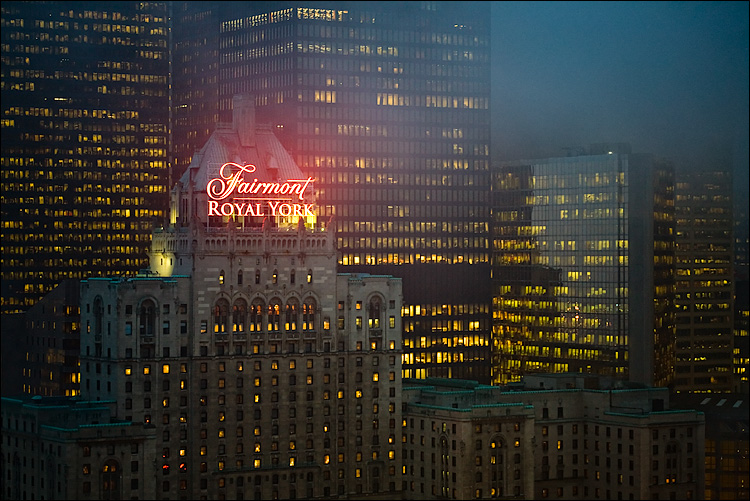

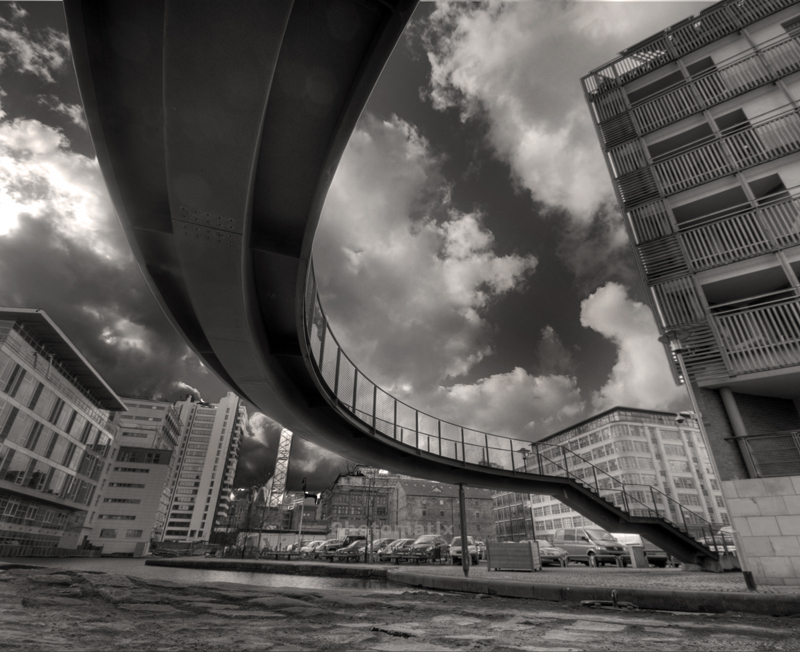


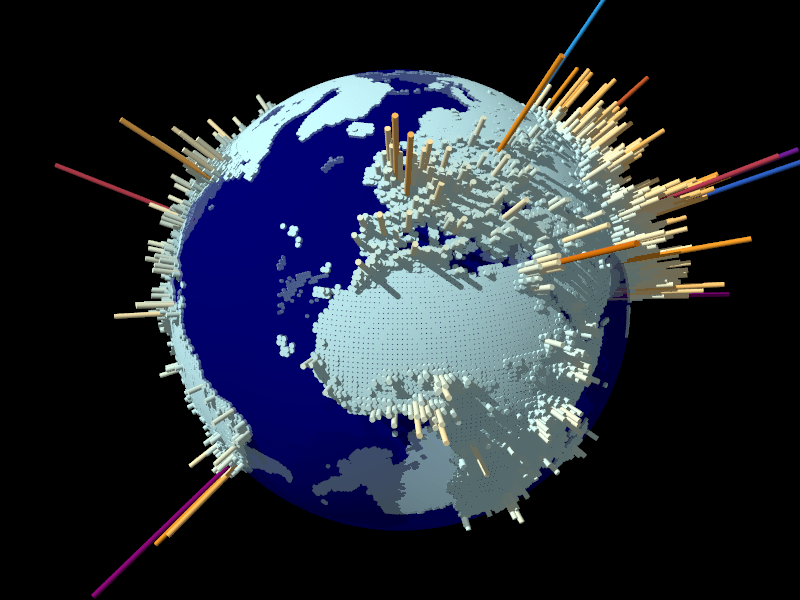


Sunday, March 16, 2008
Joie de Vivre Urbaine
 "...And joie de vivre [joy of living] may be seen as a joy of everything, a comprehensive joy, a philosophy of life..."
Long ago, writers disparaged cities like London, New York, and Paris, labeling them as hives of disease and destitution. But over time, industrialization and economic growth powered by these urban centers lifted hundreds of millions of people out of poverty, creating a prosperous and secure middle class like the world had never seen. Over the past few decades, we have seen this happen again in China and India. With the rise of ideas like common wealth and the urban planet, it seems less naive each day to believe that this trend could continue moving upward, creating a globalized standard of living (not to be confused with a singular global culture, which would be intensely boring).
But the current model of urban living, with its sprawl, auto-dependancy, and tokenization of nature, is unsustainable at best. If economic development in developing world-cities is to diminish poverty at any notable rate, everyone -- in worlds both "first" and "third" -- must work to bring about the evolution of their cities into healthy, green, globally-minded places. The City As Solution to Climate Change and Globalization Pains has been a popular topic of conversation of late. But how can people in developed countries be persuaded to agree?
As we step into this new Urban Age, those of us arguing for the City As Solution must focus on the joie de vivre urbaine. For cities to reach their full potential as engines for change, the urban chorus will need to grow louder and brighter. The masses should be reminded of the joys and conveniences of living in vibrant, eqitable urban neighborhoods, not guilt-tripped out of their McMansions and driven into gentrifying neighborhoods to exacerbate socioeconomic inequality. Only when a person believes that they will enjoy something -- and that they deserve to -- will they make a real effort to change their way of life.
This week, as Where wraps up its first year in the urblogosphere, each day will feature a post that celebrates the excitement, promise, and possibility of the urban environment. It's Urbanism For Fun (but no profit). A preview:
Monday: EXPLORE
We'll start off by looking at how Google Earth and online mapping sites are making urban places more exciting by helping urbanites develop a better understanding of their cities, and how this type of technology could affect urban culture and society in the future.
Tuesday: PLAY
Taking another look at mixed-reality gaming, Where will consider this emerging form of entertainment as a possible catalyst for economic development in the near future.
Wednesday: IMAGINE
If you could rethink how cities are built, how would you do it? It's a question many of history's most famous architects have taken on with relish. In a guest post by SOM design associate Ella Peinovich, who participated in an architecture studio that took on this very daunting challenge, we'll learn more about what it's like to go through the process of radically reimagining the urban form.
(This has been edited to reflect a change in content).
Thursday: LEARN
Thursday will feature Where's full review of the buzz-heavy book The Endless City, compliments of Phaidon.
Friday: CREATE
March 21st marks the 365th day since Where's first post. To celebrate this blog's "birthday," a special edition of Weekend Reading will look back on the top ten posts of the past year.
--
DON'T FORGET
The Blogedanken game will be open to entries through 11:59pm CST, this Saturday, March 22nd. Go play and submit your favorite results for your chance to win a copy of PA Press' Hyperborder.
(Photo from Flickr user Shimrit&Yaar. The original full-color version can be viewed by clicking the photo.)
Links:
Joie de vivre (Wikipedia)
Hyperborder (Princeton Architectural Press)
Monday, March 3, 2008
Monday, February 18, 2008
The Endless City Q&A
After a tiny bit of prodding, the folks at Phaidon sent over a review copy of the recently released book The Endless City, edited by Ricky Burdett and Deyan Sudjic, and containing essays by the likes of Saskia Sassen, Enrique Peñalosa, and the indefatigable Rem Koolhaas. Where will feature a review of the book soon, but first, another treat from Phaidon; the editors were asked a series of questions. The following is a selection of the highlights from the record of this Q&A.
 What are the main issues that you think people should be concerned about when it comes to city growth?
The book has a section titled ‘Issues’ that we hope synthesizes the complexities of urban growth. In it, a number of the contributors outline key issues but approach them from a variety of viewpoints. For example, Richard Sennett argues that ‘over determination’ can kill the vitality and growth of urban centers. Cities need to be dynamic and its physical forms and functions need to be endowed with the capacity to respond to indeterminate, unpredictable forces. Frank Duffy applies a similar idea when explaining the urban office, so ‘adaptability’ is the central issue they both cover. Another issue the book clearly prioritizes is sustainable development. The contributions from Guy Battle and Nicky Gavron, along with the Knoflacher, Rode and Tiwari essay, all detail urban growth strategies that respond to the environment and the challenges of climate change. Another central issue summarized by the three essays by Gerald Frug, Enrique Penalosa and Geetam Tiwari is governance and civic participation – cities need to allow for a multiplicity of voices and actors as well as a variety of experiences but there needs to be an agent or authority that can intelligently negotiate this multiplicity and still get something done. Tiwari explains this with particular reference to the forces dominating the informal sector. Both Anne Power and Sophie Body-Gendrot elaborate on this as well as some of the other pressing sociological concerns that urban designers, policymakers and the general public confront in the act of city making. Of course it goes without saying that quality design is the ingredient that delivers a truly remarkable city and allows individual places to flourish. The essays by architects Rem Koolhaas, Alejandro Zaera-Polo, and Jacques Herzog and Pierre de Meuron all contribute various reflections about how to reconcile a variety of factors and perspectives enmeshed within the city’s physical reality. It should be noted that many of the essays in the Cities section resonate with the broader themes in the Issues section as well. The result is a cross-sectional analysis between the six cities [New York, London, Shanghai, Johannesburg, Mexico City, and Berlin] and the global world with issues finitely referenced to specific urban conditions.
What world cities do you expect to go through the greatest changes in the 21st century?
The fastest growing cities are in Africa and across Asia and its up to the next generation to make sure their development does not repeat the mistakes of cities in the developed world – this means Lagos and Kinshasa, Mumbai, Deli and Dhaka, as well as Shanghai and Jakarta. It is projected that by 2030, over 4 out of every 5 urban dwellers will be in the developing world so this will have huge implications for the global economy. At the same time, mature cities such as London and New York City, Berlin and Mexico City need to ensure that their future growth reconciles their layered history of planning mistakes and prioritizes sustainable transport and inclusive, contained growth.
The book talks about the importance of cities learning from each other. Can you explain that? For example, what can NYC learn from Shanghai? Can small cities learn from big cities?
There are countless examples of cities looking to other cities when deciding how to invest in their future growth and health. Congestion charging in NYC wouldn’t be a viable option had London not demonstrated how it could be done, and Mexico City’s Metrobús is a stunning success modeled on the Transmilenio in Bogota and of course Curitiba. Ideas must be partnered with implementation strategies and learning often is a matter of scale. So yes, small cities can learn from big, and vice versa. The essay by Knoflacher, Rode and Tiwari describes how small cities can serve as incubators for innovation precisely because of their scale. Understanding how cities implement large projects such as the Olympics in London, doing it with the right amount of investment in public space, has a lot to do with acknowledging how the city and individual neighborhoods have developed over time and how open space serves to socially integrate people from disparate backgrounds. The contributions of both Saskia Sassen and Enrique Peñalosa emphasizes this learning, especially in the latter how urban centers in developed countries are recovering from their love affair with the car, delimiting the access of automobiles in favor of public transport. Cities in developing countries could learn a lot from this. Most importantly, in order for ideas to transfer from one city to another, there needs to be a complementary understanding about how policies, decision making and funding align to facilitate implementation. Frug’s essay explains how the power structures of the six cities vary and what impact permutations to each city’s existing systems could have on local and regional planning mechanisms.
 What are the key ideas that you want people to take away from reading this book?
The 34 contributors to the book – along with the hundreds of policymakers, politicians, academics, architects, planners, and urbanists involved with the Urban Age project which forms the basis for The Endless City – all believe that cities can offer a better social and economic life for its citizens. Now that half the world’s population live in cities, there is an urgent need to take stock of the new urban condition and find an approach to dealing with it. City sprawl should be contained and there are innovative strategies for creating high density, highly liveable environments. We want to help those charged with running and making cities understand the relationship between the socio-economic and spatial characteristics of cities – and we want the general public to understand how sustainable urban development can actually improve the physical form of their cities and the quality of their lives.
Are you hopeful for the future when it comes to our cities?
Enrique Peñalosa, the former mayor of Bogotá, offers an incredible explanation for why we should all be hopeful for the future of cities. Cities offer the potential for ‘quality of life equality’, i.e. access to green, open space and social and economic mobility as well as physical mobility. Across the world, people are moving into cities at an alarming rate – and not just mega-cities but smaller cities comprising an overall urbanized region. Most importantly, the twenty-first century will be increasingly focused on reducing both the overall sum and per capita production of carbon emissions, and as emitters of 75 per cent of the world’s pollution, cities are the battleground on which the future and health of our planet will be determined.
Is there any way for ordinary people to make change in their own cities? Do you have any recommendations for someone who wants to get involved?
Ordinary people make change in their city everyday. They do this by opting for public transport instead of a private car, by holding their government officials responsible for the quality of the built environment, and by advocating for equal access to green, open space. Ensuring that there is investment in sustainable forms of transport, and that access to healthcare, education and community services does not depend on how much money you make or the wealth of your locality. Most importantly, if you don’t know what your community is doing locally to advocate sustainable urban development, then join a forum and find out. Participate.
(Thanks, Faye!)
(Photo from Flickr users thequickbrownfoxjumpsoverthelazydog and howzey. The original full-color versions can be viewed by clicking the respective photos.)
What are the main issues that you think people should be concerned about when it comes to city growth?The book has a section titled ‘Issues’ that we hope synthesizes the complexities of urban growth. In it, a number of the contributors outline key issues but approach them from a variety of viewpoints. For example, Richard Sennett argues that ‘over determination’ can kill the vitality and growth of urban centers. Cities need to be dynamic and its physical forms and functions need to be endowed with the capacity to respond to indeterminate, unpredictable forces. Frank Duffy applies a similar idea when explaining the urban office, so ‘adaptability’ is the central issue they both cover. Another issue the book clearly prioritizes is sustainable development. The contributions from Guy Battle and Nicky Gavron, along with the Knoflacher, Rode and Tiwari essay, all detail urban growth strategies that respond to the environment and the challenges of climate change. Another central issue summarized by the three essays by Gerald Frug, Enrique Penalosa and Geetam Tiwari is governance and civic participation – cities need to allow for a multiplicity of voices and actors as well as a variety of experiences but there needs to be an agent or authority that can intelligently negotiate this multiplicity and still get something done. Tiwari explains this with particular reference to the forces dominating the informal sector. Both Anne Power and Sophie Body-Gendrot elaborate on this as well as some of the other pressing sociological concerns that urban designers, policymakers and the general public confront in the act of city making. Of course it goes without saying that quality design is the ingredient that delivers a truly remarkable city and allows individual places to flourish. The essays by architects Rem Koolhaas, Alejandro Zaera-Polo, and Jacques Herzog and Pierre de Meuron all contribute various reflections about how to reconcile a variety of factors and perspectives enmeshed within the city’s physical reality. It should be noted that many of the essays in the Cities section resonate with the broader themes in the Issues section as well. The result is a cross-sectional analysis between the six cities [New York, London, Shanghai, Johannesburg, Mexico City, and Berlin] and the global world with issues finitely referenced to specific urban conditions.
What world cities do you expect to go through the greatest changes in the 21st century?
The fastest growing cities are in Africa and across Asia and its up to the next generation to make sure their development does not repeat the mistakes of cities in the developed world – this means Lagos and Kinshasa, Mumbai, Deli and Dhaka, as well as Shanghai and Jakarta. It is projected that by 2030, over 4 out of every 5 urban dwellers will be in the developing world so this will have huge implications for the global economy. At the same time, mature cities such as London and New York City, Berlin and Mexico City need to ensure that their future growth reconciles their layered history of planning mistakes and prioritizes sustainable transport and inclusive, contained growth.
The book talks about the importance of cities learning from each other. Can you explain that? For example, what can NYC learn from Shanghai? Can small cities learn from big cities?
There are countless examples of cities looking to other cities when deciding how to invest in their future growth and health. Congestion charging in NYC wouldn’t be a viable option had London not demonstrated how it could be done, and Mexico City’s Metrobús is a stunning success modeled on the Transmilenio in Bogota and of course Curitiba. Ideas must be partnered with implementation strategies and learning often is a matter of scale. So yes, small cities can learn from big, and vice versa. The essay by Knoflacher, Rode and Tiwari describes how small cities can serve as incubators for innovation precisely because of their scale. Understanding how cities implement large projects such as the Olympics in London, doing it with the right amount of investment in public space, has a lot to do with acknowledging how the city and individual neighborhoods have developed over time and how open space serves to socially integrate people from disparate backgrounds. The contributions of both Saskia Sassen and Enrique Peñalosa emphasizes this learning, especially in the latter how urban centers in developed countries are recovering from their love affair with the car, delimiting the access of automobiles in favor of public transport. Cities in developing countries could learn a lot from this. Most importantly, in order for ideas to transfer from one city to another, there needs to be a complementary understanding about how policies, decision making and funding align to facilitate implementation. Frug’s essay explains how the power structures of the six cities vary and what impact permutations to each city’s existing systems could have on local and regional planning mechanisms.
What are the key ideas that you want people to take away from reading this book?The 34 contributors to the book – along with the hundreds of policymakers, politicians, academics, architects, planners, and urbanists involved with the Urban Age project which forms the basis for The Endless City – all believe that cities can offer a better social and economic life for its citizens. Now that half the world’s population live in cities, there is an urgent need to take stock of the new urban condition and find an approach to dealing with it. City sprawl should be contained and there are innovative strategies for creating high density, highly liveable environments. We want to help those charged with running and making cities understand the relationship between the socio-economic and spatial characteristics of cities – and we want the general public to understand how sustainable urban development can actually improve the physical form of their cities and the quality of their lives.
Are you hopeful for the future when it comes to our cities?
Enrique Peñalosa, the former mayor of Bogotá, offers an incredible explanation for why we should all be hopeful for the future of cities. Cities offer the potential for ‘quality of life equality’, i.e. access to green, open space and social and economic mobility as well as physical mobility. Across the world, people are moving into cities at an alarming rate – and not just mega-cities but smaller cities comprising an overall urbanized region. Most importantly, the twenty-first century will be increasingly focused on reducing both the overall sum and per capita production of carbon emissions, and as emitters of 75 per cent of the world’s pollution, cities are the battleground on which the future and health of our planet will be determined.
Is there any way for ordinary people to make change in their own cities? Do you have any recommendations for someone who wants to get involved?
Ordinary people make change in their city everyday. They do this by opting for public transport instead of a private car, by holding their government officials responsible for the quality of the built environment, and by advocating for equal access to green, open space. Ensuring that there is investment in sustainable forms of transport, and that access to healthcare, education and community services does not depend on how much money you make or the wealth of your locality. Most importantly, if you don’t know what your community is doing locally to advocate sustainable urban development, then join a forum and find out. Participate.
(Thanks, Faye!)
(Photo from Flickr users thequickbrownfoxjumpsoverthelazydog and howzey. The original full-color versions can be viewed by clicking the respective photos.)
Monday, January 7, 2008
Vital Risk
 The Ansari X Prize offered $10 million to whoever could pull off the first non-NASA manned space flight in the US. It worked, and Virgin (of Megastore fame) will soon be offering commercial space flights as a result. The X Prize's founder, Peter Diamandis, had this to say about his inspirational award in a recent post in GOOD Magazine's Big Ideas series: "The Ansari X Prize experiment worked, just like when Charles Lindbergh won the Orteig Prize for his transatlantic flight 80 years ago. We are genetically programmed to compete, and we do our best work, and take the highest risks when we go head-to-head for fame, fortune, or honor...X Prizes are one way to combat the risk-averse society that has developed over the last 40 years. As an American, I think risk-averse behavior is destroying our nation."
Diamandis, here, puts concisely into words what it seems like a lot of Americans are feeling lately: we have gone soft. The United States, one of the most dynamic and innovative nations in the history of human civilization, is falling behind other countries in many areas. Our telecommunications, internet, financial, and transportation industries -- among others -- are struggling to keep up with those in countries less tied down by byzantine policy and disturbingly well-established corporate hierarchies. The US is still a global economic leader, no doubt. Still, with China and India (not to mention little South Korea with its hyperfast 'net) nipping fervently at our heels, this country's position is not as assured as it once was. Our risk-averse behavior, which has manifested itself most blatantly in the nauseating wave of paranoia that has gripped Americans for the past seven years, is hampering our competitiveness in the global marketplace. At a time like this, visionaries like Diamandis are sorely needed.
That makes you wonder what the X Prize could do for American cities. As has been generally accepted as fact by now, the fortunes of contemporary nations are tied directly to those of those nation's major urban areas. In the United States, logic suggests that our lack of effective and innovative urban policy over the past half century (or more) has had more than a little bit to do with the US' threatened position at the top of the global economic heap. And with Scientific American recently having named the X Prize Foundation as the Policy Leader of the Year, it stands to reason that Mr. Diamandis might be able to do a lot of good by wielding some of his foundation's influence in urbanism-related fields.
As it turns out, he's one step ahead. The X Prize Foundation is currently sponsoring a competition to develop the world's most efficient vehicle -- with a minimum rating of 100 miles per gallon. Thanks to the auto and oil industries' ferocious lobbies, this kind of competition would have been unheard of just a couple of years ago. Now, the 43 entries are being prepared for the Detroit and New York auto shows. A 100mpg car -- designed and (hopefully) made in America -- is literally just over the horizon.
So take a minute, now, to imagine what the X Prize could do for the myriad of long-abused and misunderstood policy issues facing American cities. Private transportation is important in today's sprawling megaregions, but what might the X Prize be able to do to improve affordable housing, crime, or mass transit? The last of these was addressed in a recent op-ed piece in the LA Times (written, shockingly, by a policy analyst from the transit-loathing "Reason" Foundation), which asked: "The X Prize was just a $10-million purse, yet it helped induce the birth of private spaceflight as well as a host of technological innovations. Is it really so fanciful to think that it could conquer gridlock?" Here's the op-ed pitch for Los Angeles:
"The Metropolitan Transportation Authority carves out some of the $115 billion in transportation funding that's headed to the region over the next couple of decades to stage a contest....[and] creates two teams. Team A tries to lure as many motorists out of their cars as possible by building rail. (Note to referee: Ex-bus riders don't count as ex-motorists.) Team B must lure motorists to telecommuting. The team with the most ex-motorists after a set period of time wins the prize."
Game on!
(Photo from Flickr user phamthanhk45. The original full-color version can be viewed by clicking the photo.)
Links:
X Prize (GOOD)
X Prize Foundation
Detroit 2008: Automotive X-Prize entries coming to Cobo (AutoBlog)
Create some healthy competition (LA Times)
Wednesday, December 19, 2007
Chicago vs. Pittsburgh: Conclusion
 Tonight's post is the last of three in a blogging debate, in which Jim Russell of The Burgh Diaspora, who guest posted at Where last month, and I will discuss the relationship between Pittsburgh and Chicago, and which city relies more heavily on the other.
After Monday and Tuesday's conversation between Where and The Burgh Diaspora, Richard Florida became an impromptu (but welcome) third party to the debate; responding to my conjecture from yesterday and Dr. Florida's musings on Chicago's inherent geographical disadvantages in the globalized marketplace, Jim Russell came up with the following nugget of vocabularial wonder:
"Pittsburgh's bet on Chicago might be a bad one. The network economy springing from the migration of human capital could result in a cul-de-sac for global connectivity...both cities should seek to diversify their connectivity portfolios. No city is a standalone cash cow. Chicago is not a world onto Pittsburgh, nor should it be." (Emphasis added)
Tonight, we wrap up the "blog duel" with some conclusions; what have we learned from this exchange?
The concept of the "cul-de-sac for global connectivity" strikes me as a key takeaway here. The world has always, to some extent, operated regionally. The size of the regions that we are expected to follow and respond to has changed dramatically over the course of human history; where mankind's regional interests were once tied directly to the changing seasons and animal migration patterns, we now take in news at all times from across the globe. We belong to multiple tribes that move in different directions, at different speeds. We follow our neighborhood, our state or territory, our country, and our specialized circles of interest around the world.
But as cities become more closely woven through globalization, it is regionalism that becomes a threat to places like Chicago. I found Dr. Florida's suggestion that Chicago maintains no global geographic advantage particularly interesting because that very point highlights the exact problem posed by the rise of the global city: it has become very easy, in contemporary culture, to assume the inevitability of places like Chicago, which have in fact gained their prominence for very regional reasons. The loss of importance of physical regions and the diminished need for literal proximity represent a very basic but worldview-altering paradigm shift; Chicago is important in terms of American and especially Midwestern economics -- it rose as the transportation and distribution hub of the country -- but without increased efforts toward economic and connectivity diversity, it might just wind up as the Pittsburgh of the global megacity hierarchy.
Thanks again to Jim Russell for proposing this week's debate. Make sure to check out The Burgh Diaspora -- a must not just for Pittsburghers, but for anyone interested in learning more about diasporic networks in the global urban age.
(Photo found on FFFFOUND!. The original full-color version can be viewed by clicking the photo.)
Links:
Chi-Pitts Globalization (The Burgh Diaspora)
Chi-Pitts, or Vice-versa (Richard Florida and the Creative Class Exchange)
Diasporas, In and Out (Richard Florida and the Creative Class Exchange)
Tuesday, December 18, 2007
Chicago vs. Pittsburgh: Round 2
 Tonight's post is the second of three in a blogging debate, in which Jim Russell of The Burgh Diaspora, who guest posted at Where last month, and I will discuss the relationship between Pittsburgh and Chicago, and which city relies more heavily on the other.
Yesterday and today, in arguing Pittsburgh's heavier reliance on Chicago, The Burgh Diaspora made the following points:
(1) "Pittsburghers are using their extended network and doing all the heavy lifting concerning the connectivity between the two cities. On the other hand, I suspect that a Chicago located firm looking for opportunity discovers Pittsburgh through Pittsburghers, not via transplants to the City of Bridges."
(2) "Chicago needs the talent developed in Pittsburgh...However, Chicago is also an impressive producer of human capital. If Chicago retained all of its local graduates, then would the city need Pittsburgh at all? Like Pittsburgh, Chicago's research universities are world class. Furthermore, Chicago attracts global human capital in ways Pittsburgh has not...Chicago does not actively seek Pittsburgh talent, but Pittsburghers still move there as a result of established migration patterns[.]"
But these two passages, when read together, play off each other in a way that suggests that Chicago's reliance on Pittsburgh and other domestic second-tier cities plays a very major role in Chicago's establishing itself as a global city in the first place.
Let's start by looking at the second statement. Assuming that it were able to retain the talent developed at universities like U of Chicago, Northwestern, Loyola, and UIC, Chicago would indeed be sitting pretty. So would Pittsburgh, if it were able to retail all of the graduates of Pitt, CMU, and Duquense. This is, especially in a fluid global economy, impossible. As sociologists have recently documented, a new phase is being added to the life cycle for young people in developed countries: the odyssey. Young people have a tendency, once they have their diploma in hand, to strike out into the world, seeking their proverbial fortunes.
This creates a diasporic network of people across the country and the world with strong roots in a community other than they one in which they are living. As its title suggests, this is exactly what The Burgh Diaspora covers in depth: Pittsburgh's diasporic population, often considered to be one of the most extensive such networks. This is where cities like Pittsburgh, Cleveland, and Milwaukee, traditionally viewed as demographic "losers," gain a foothold. As the process of globalization continues to make centralization less of a necessity and more of a luxury, second-tier cities not only provide the cheaper business climate than their megacity counterparts (though, ironically, Pittsburgh is currently burdened by byzantine economic policies), they also become the default choice for smaller start-ups, making second-tier cities even more important incubators for the kind of talent needed to keep a megacity economy chugging along.
Back to the first of Burgh Diaspora's points: Pittsburgh's network, now, provides it with a unique opportunity to lift smaller businesses looking for a less overwhelming (read: risky) market in which to develop their product. Pittsburgh is able, through its extended diasporic network in Chicago, to earn free word-of-mouth advertising from its expatriate sons and daughters that could potentially drive these smaller companies east to the Appalachians. In the end, the Pittsburgh market is not as important to Chicago companies as the Chicago market is to Pittsburgh companies; I'll concede this. But in a global marketplace, Chicago's larger companies do need Pittsburgh's smaller ones to stay ahead of the international competition.
(Photo from Flickr user scoobyfoo. The original full-color version can be viewed by clicking the photo.)
Links:
IntoPittsburgh: Chicago (The Burgh Diaspora)
IntoPittsburgh: Chicago II (The Burgh Diaspora)
Monday, December 17, 2007
Chicago vs. Pittsburgh: Round 1
 Tonight's post is the first of three in a blogging debate, in which Jim Russell of The Burgh Diaspora, who guest posted at Where last month, and I will discuss the relationship between Pittsburgh and Chicago, and which city relies more heavily on the other.
Nowadays, anyone following urbanism, economics, public policy, or related fields will have certainly heard of the theory that we are entering into an age of global urbanism where cities all over the world will be competing directly with each other for talent. Talent, we are told, will be more and more valuable as society becomes more technologically advanced, shifting even more heavily toward an international information economy. What you know, essentially, will become what you're worth. In this economic environment, megacities like Chicago will no longer merely be competing with New York, Washington DC, and San Francisco for talent; soon (already, many would say) Chicago will have to go head to head with London, Paris, Buenos Aires, Cape Town, Mumbai, Tokyo, Shanghai, Sydney, and on and on.
This is a fairly logical progression of events. The major city has always acted as a magnet throughout its history in human civilization. People come to the city to get a job, to prove themselves, to make their fortune. The individual reasons are myriad, but the inspiration is the same: people come to the city to improve their quality of life. It doesn't always work out that way, but that's the basic impetus. Chicago, then, has long needed Pittsburgh -- and other cities like it -- to sustain itself. The larger the city, the more daunting it is to dream-chasers and immigrants. Medium-sized cities, then, are a prime source of population for larger cities.
Without Pittsburgh, in the literal sense, Chicago would not crumble and blow away; to think so would be naive. But Pittsburgh is a part of a group of cities that, together, have allowed Chicago to experience its recent -- and rather stunning -- revival over the past two decades. As post-industrial Western megacities like Chicago, New York, or London began to try to pick themselves up after losing manufacturing jobs in the 1970s and 80s, they began to rely on what you could call innovation-intensive fields like biomedicine, design, information technology, and (of course) the arts. These are highly specialized fields, and ones that many traditional middle class workers were not trained or educated to particpate in. Megacities, then, needed to draw in new talent from surrounding smaller cities.
Here's where Pittsburgh gets the upper hand over Chicago. As a mid-sized city, Pittsburgh is large enough to provide a genuinely urban lifestyle while not overwhelming the newcomer. As a bonus, the city also happens to be an important center of higher education, with two of the nation's best colleges (U of Pitt and Carnegie-Mellon) located in the Oakland neighborhood of the city. Generationally speaking, this works in the city's favor because it becomes an excellent place for people to move from a smaller city to start a family, where the parents can take advantage of the lower cost of living and provide for their kids, who can then more easily take advantage of nearby educational resources. Pittsburgh is, for all intents and purposes, a creative class factory.
This happens around the country. Pittsburgh, Cleveland, Cincinnati, Milwaukee, Minneapolis, Saint Louis -- all of these mid-sized cities have traditionally fed job-seekers into Chicago. Today, the competition is national, and Chicago draws more than ever from Seattle, Portland, San Antonio, Birmingham, San Diego, Denver, et. al. As the stakes are raised in coming decades, Bordeaux, Liverpool, Fortaleza, Adelaide, Fukuoka, Busan, Medellin, and Alexandria will all enter the mix. And not in the sense of traditional immigration, which creates ethnic communities, but in the sense of global creative class migration, which could create massive gentrified (or at least economically stable), internationally diverse areas in cities around the world.
Western society already operates as a sort of imperfect meritocracy. As this becomes more true, Chicago will need places like Pittsburgh more and more as it works to maintain and build its competitive creative core. Pittsburghers have the option to stay put; Chicago needs to convince them not to. It has to prove, however possible, that it can provide a better life. The burden lies with larger city.
(Photo from Flickr user -Nicole-. The original full-color version can be viewed by clicking the photo.)
Links:
The Burgh Diaspora
Tuesday, October 16, 2007
New City, Old Urbanism
 Cities in the New World followed a relatively simple logic that involved gridded streets and a central public space. In both North and South America, the evidence of this development pattern is most readily apparent in smaller towns and cities, where grids remain regular and humanly scaled, and town squares and plazas mayores are alive and well. Urban development has largely erased or obscured the original layouts of larger cities on both continents, but the real difference between the impact that the form had can best be seen in how they build cities today.
 In North America, for instance, the meandering suburban road, splintered with cul-de-sacs, has become the favored layout, while South American suburbs often maintain the urban grid, often extending the original further and further into the hinterland. Even more than the grid, though, the plaza mayor is encoded in the DNA of Latin American cities. Since the conquests of the Portuguese and the Spanish began reshaping the continent through colonization and subsequent urbanization, every settlement -- from the smallest of towns to enormous cities like Buenos Aires and São Paulo -- has been centered around one of these compact public spaces. So while contemporary North American towns and neighborhoods are usually built around retail clusters, when it is time to build a new city down South, the plaza mayor remains the central feature.
The image at the top of this post is an aerial photograph of the central area of Palmas, Brazil. Founded in 1989 after Brazil created the new state of Tocantins by separating the northern and southern territories of Goias, everything about this city is new. Still, as the aerial shows, the central feature of this rigidly-plotted micropolis (pop. 187,000) maintains the traditional form of the South American city, with an unrelenting grid and a visibly dominant central plaza that plays host to several important government offices.

It is, by all photographic accounts, a very green and spacious place. By all written accounts, it's also one of the most economically robust cities in the country at the moment. But cashflows and palm fronds aside, what earns Palmas its reputation as a modern-day Brasilia are its public buildings. Hubris is immediately visible in Palmas' architecture. The government house and administrative buildings spaced evenly across the massive plaza mayor are a delightful and at times shocking mix of modernist elegance and Las Vegas kitch. In short, the Brazilians have done it again: they've built a capital from scratch.
 As an outside observer, it seems to me that Palmas might be the most Brazilian of Brazilian cities as this southern juggernaut enters the 21st century struggling to gain more than just a regional foothold in the global economic/power structure. After all, Palmas is a city that remains true to tradition while making it seem distinctly modern. The eccelctic plaza and broad, tree-lined avenues look fresh and exciting, even though they are variations on a theme started in the 1500s (or earlier, depending on how you look at it). The architecture and the sheer expansiveness of the place are daring and ambitious in and of themselves. Palmas is a city with something to prove, and a plan on how to do it.
Really...just look at it.

(Photos from Panoramio users jpncerrado, GILMAR QUEIROZ, Rodrigo Goncalves Luz, and Ronaldo Mitt. Don't forget -- clicking on the images takes you to the full-color originals.)
Links:
Palmas.org
Boom time in Brazil (BBC News)
Thursday, August 16, 2007
WEEKEND READING: August 11-17, 2007
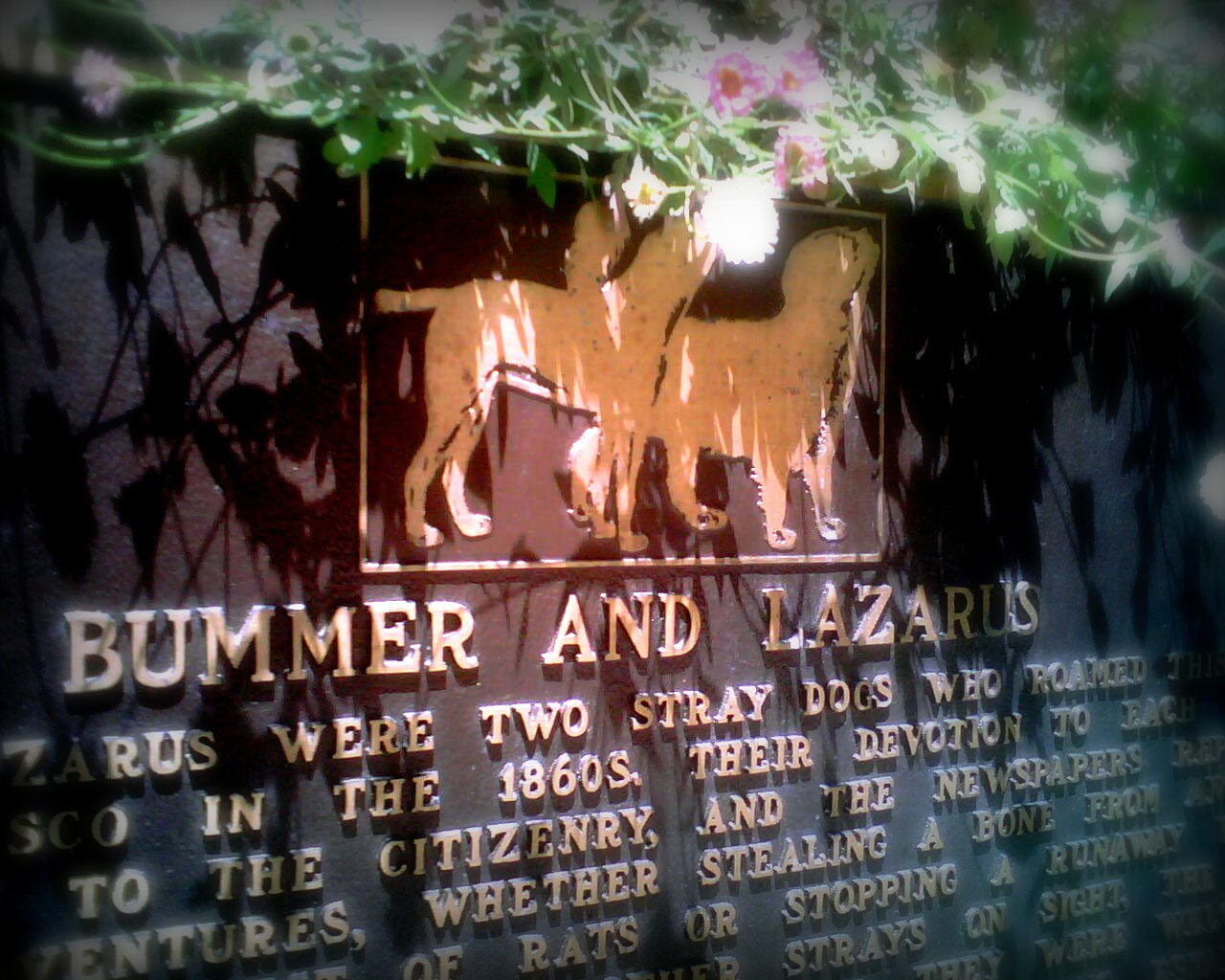 This edition of Weekend Reading is all sorts of random. It's like urbanism salad!
ITEM ONE: The story of Bummer and Lazarus, San Francisco's most famous pooches.
ITEM TWO: The "informal settlement"-watching blog Squatter City, written by the author of Shadow Cities.
ITEM THREE: Mexico City's mayor tries to push vendors off of the streets, but meets opposition from "a 63-year-old ex-con and great-grandmother."
ITEM FOUR: More radio hijinx from BLDGBLOG and DJ/rupture.
ITEM FIVE: The Washington Post asks "can globalization for for the world's slums?"
ITEM SIX: Will South America's first eco-city be built in rising-star Bogotá? Chances are good.
ITEM SEVEN: More from Colombia, where the previously mentioned HiperBarrio project continues to improve the city. For more on that resurgent city, click here.
See? Urbanism salad. Just like I promised. Check back over the weekend, as more of the Neighbor's Manifesto will be posted.
(Photo from Flickr user Dunstan Orchard.)
Monday, August 13, 2007
The Possibilities of the Post-Retail City

I just had my first exposure to Reverend Billy, the leader of the Church of Stop Shopping. After reading a post (over at Polis) about the Reverend's anti-consumerist group, I thought it was an actual church. To which I said: "Oh, excellent.
Of course, the CoSS is actually an act, with the "Reverend" being the stage persona of NYC performance artist Bill Talen. It's a send-up of streetcorner preachers and televangelists, and it sounds hilarious. Better yet, there's a point! Reverend Billy preaches against corporatist architecture and urbanism, advocating for sustainable, walkable communities with local economies. And while the site does pay lip service to independently owned local businesses, it is the Church of Stop Shopping, and one of their taglines is "Love is a Gift Economy!" Obviously, these people think that there are better ways for us to use all of that street-level retail space.
And that got me thinking: if there were no major retail chains and independents had to hold up the local economy, what would we do with all of that ground-floor space? Indeed -- and my upbringing in a capitalist society may shine through right here -- but where would we walk to? Certainly, there are plenty of places that we walk every day, but a large amount of pedestrian traffic is genereated by shoppers. And while it's not a requirement for these ground-level spaces that make up our streetscape be places of commerce, their presence is utterly vital to functioning neighborhoods. Often (these days) even moreso than upper-level residential windows, storefronts are the Jacobsian "eyes on the street" that act as a natural deterrant to crime.
Shopping is also a huge part of the social life in many (if not most) contemporary cities; in fact, that's just what Reverend Billy and his fake church take issue with. And whether or not you agree with the Church of Stop Shopping (or, as I'm sure many do, find it outright offensive), it's interesting to imagine a world in which shopping took a back seat to other social spaces as the dominant street presence. Imagining Paris without the Champs-Elysées or New York without Park Avenue sparks a giddy, no-holds-barred creative energy akin to imagining those cities in a work of science fiction or postapocalyptic literature.
To get an idea of what might fill the void, it might be interesting to see how social space is structured in places where gift economies (or at least barter systems) often already exist and retail strips are few and far between, at least in the traditional sense: slums.
An article from Forbes, mentioned briefly in a previous post at Where, described the socioeconomic situation of many older, established slums in Asia and South America thusly: "Many slum dwellers are in fact entrepreneurs, albeit writ very small. They recycle trash, sell vegetables, do laundry. Some even run tiny restaurants and bars for their neighbors." So while there are no Ginza Districts in the favelas of Rio, there is a social commerce to such places. Restaurants and bars remain important components of the neighborhood, which makes good sense; people have always come together over food and drink, and will continue to do so regardless of any freak evaporations of the retail sector.
Another thing that brings people together is knowledge -- or, more specifically, the exchange thereof. Another recent post covered McGill University's Edible Cities project in Kampala; the site for the students' project "includes a low-lying wetland area...where a youth cooperative practices brick-makings, providing work for otherwise unemployed youth...and a sloping dryland area where farming is [practiced]." While this is a very rural area being discussed (albeit in the context of a larger city), the Kampala site illustrates two more possible uses for a retail-less streetscapes: public workshops (which could cover a variety of topics in addition to brickmaking) and storefront hydroponic community gardens.
Heh.
If the second option seems somewhat far-fetched, the first is hardly at all; in fact, in the face of looming irrelevance in the digital age, libraries around the world are starting to take on a more social role in their respective cities, staging various events and programs to encourage public discourse and teach skills that cannot be learned with a mouse and keyboard. One of the most innovative library programs that I've heard of recently is in Medellín, the second city of Colombia.
Once the so-called Kidnappping Capital of the World, Medellín has made more news recently for building five spectacular modernist libraries (like the one in Santo Domingo Savio, pictured above) in its most impoverished barrios. One of the programs to utilize these new libraries -- which are equipped with computer labs full of brand spankin' new computers -- is HiperBarrio, which teaches teens in the barrios how to use blogging and other social media tools as a creative outlet for self-expression. Juliana Rincon, one of the founders of HiperBarrio, spoke of the program's inspirataion in a recent interview with Global Voices Online, saying, "It was amazing...telling these kids about blogs and finding out that they had no idea that there was something like a blog, that they existed. [Or even] that you could write online and have a virtual space to keep your writing, the videos you like, and pictures." Libraries, in this case, serve not just as containers for information, but as catalysts for the creation of new information and new ideas. Certainly, this kind of social space, the place of public learning, will play an increasingly important role in cities as we continue through the Information Age.
Whatever we come up with to fill storefronts and social spaces, shopping districts and neighborhood retail strips are unlikely to disappear within the lifetime of anyone reading this blog post. Still, imagining a world without retail can tell us a lot about how we use cities, why we do things the way that we do, and how we can improve urban places without courting Starbucks and Barnes & Noble for civic salvation. In fact, picturing your neighborhood without any shops selling anything other than necessities might be a great way to fall in love with the place all over again. That is, of course, assuming that you love your neighborhood -- and that you don't live off Rodeo Drive.
(Photo from Flickr user galitagreeneyes.)
Links:
Rev. Billy Ready for Close-up (Polis)
The Church of Stop Shopping
Two Billion Slum Dwellers (Forbes)
Kampala Project Information (McGill School of Architecture)
Red de Bibliotecas (en español)
HiperBarrio: Local Stories, Global Audience (Global Voices Online)
Thursday, June 28, 2007
The Dawn of Digital Urbanism

Blog Like You Give a Damn put up a great post last month on recent advances in online urban cartography (like Google's über-controvertial Street Views) and how these new digital reinterpretations of the world are moving us toward William Gibson's vision of cyberspace as a physically inhabitable place. From BLYGAD:
"Unlike the cyberspace that Gibson describes in [his book] Neuromancer:
'...a graphic representation of data abstracted from banks of every computer in the human system. Unthinkable complexity. Lines of light ranged in the nonspace of the mind, clusters and constellations of data. Like city lights, receding...' (69)
this new cyberspace will be much more familiar to us. It will look and behave in ways we understand - dangerous because the line between real and virtual will be that much more hazed. As the possibilities for exploration, learning, and knowledge building expand - so too will the potential for surveillance, misuse, and abuse."
Cyberspace is Shangri-la for the internet generation: a mythic miracle of a place that we are sure exists just over the horizon, within a whisper's length of our grasp. Each person has their own idea of this place painted in their mind, but I think the truth about an inhabitable Cyberspace is that it will be very much like Gibson's fantastical vision. It will also be very familiar to us, as BLYGAD predicts. In fact, our physical reality is already merging with its virtual counterpart. For, as the hyperconnectivity brought on by the rise of the internet becomes integrated into the urban fabric, understanding of one's physical environment is becoming more inextricably tied to one's understanding of the web itself. The melding of the physical and virtual (cyber) worlds is already taking place on both ends, with each side moving quickly toward the other. Eventually, of course, they'll meet somewhere in the middle.
We can see this trend online as the "clusters and constellations of data" described by Gibson are being harnessed to create a sort of digital urbanism, recreating various aspects of the physical world for Cyberspace. Akamai recently launched a tool -- Visualizing the Internet -- that has been described as a weather report for the web. Meanwhile, an online art project called We Feel Fine (profiled in the June issue of Metropolis) mimics the richly frenetic atmosphere of a busy public space without actually replicating any of the recognizable features of physical places. If the aforementioned Google Street Views is representational digital urbanism, We Feel Fine is the presentational version, capturing the essence of public space in a wholly new way, reorganizing the traditional tokens of public spaces (trading visual diversity for emotional diversity) into a "place" that could only exist online.
Good old-fashioned bricks and mortar urbanism, meanwhile, is getting a digital overhaul as handheld, web-enabled devices and wireless internet for laptop users takes the edge off of some this system's perennial problems. I'll take any chance I can get to highlight Urbanspoon, a site that catalogs every restaurant in several major US cities (DC was recently added), aggregates reviews from major websites, allows for user ratings and reviews, and provides neighborhood breakdowns via kickass "nighttime" maps that show the locations of all of the cities' eateries. Finding a great restaurant has never been so easy. Another genius web service, recently covered on Springwise, is MizPee, a San Francisco-based service that allows users to access a list of nearby public restrooms, eliminating one of the chief drawbacks of pedestrianism.
As cities become more digitally enabled, they are also starting to bleed together. Geographic constraints have been removed from art and culture in the same way that they were from commerce. Even street fashion has crossed over into the digital realm. As the David Report...well...reports, cities across the globe will be represented in "Street Clash," a blog where the tragically hip artkids from dozens of cities will go head-to-head in an effort to determine which city has the ultimate street style. The irony of this is that, while individuals can rep their hometowns in a token sense, they are still independent human beings free to change their geography at any time. That is to say that what is happening here is the formation of an international street style, as a handful of people cannot be representative of an entire urban population. Hipster fashion has been globalized. Whether this is good, bad, or just hilarious is still a question mark.
As BLYGAD's post points out, the transition of the physical world into the Cyberspace of the future could open a Pandora's Box of new social, ethical, and safety concerns. Pittsblog reported yesterday on a proposal from the city of Pittsburgh for a massive urban surveillance system. Mike Madison, who writes the blog, had this to say: "Hopefully the public will respond...to the proposal's Benthamite implications...It's one thing (though it's not necessarily a good thing) to be watched when you know that you're being watched. It's something else entirely -- and rarely a good thing -- to be watched all the time, when you don't necessarily know it" (emphasis his). Madison then asks the age-old question, "who will watch the watchers?" This, I think, will be the most fundamental challenge of Cyberspace: in a universally connected world, the unwatched watcher has more power than ever, as they will have unprecedented access to the masses.
As the internet becomes increasingly ubiquitous and reality moves toward the virtual, the emergent Cyberspace will almost certainly take on an urban form -- though it remains to be seen whether it will lean more heavily on the physical or virtual world. Either way, geography will become less and less binding as cities learn to connect in ever more complex ways, and we will likely come to understand urbanism as something very different from what it is now. Shangri-la is upon us.
(Photo from Flickr user 3views.)
Links:
New Urban Cartography (Blog Like You Give a Damn)
Visualizing the Internet (Akamai)
We Feel Fine
Urbanspoon
Mobile Loo Locator (Springwise)
Street Clash (David Report)
The Pittsburgh Panopticon (Pittsblog)
Monday, June 11, 2007
(Still) Made Here: Support

The last of the three subtrends of (Still) Made Here has a much more straightforward connection to urbanism. Support is about "the importance of community...[and] supporting one’s neighborhood, one’s city, one’s region, to regain a sense of place and belonging and to safeguard future access to the special and original, vs. the bland, the global and the commoditized." What the Trendwatching.com folks are talking about here is brand loyalty, with geography as the brand.
A big part of creating an attractive public identity for a neighborhood involves canceling out worries about the perceived hassles and drawbacks of urban life. One of the main complaints about urban life (and suburban life as well) is that traffic and congestion will make life more difficult. While city governments can encourage walking and transit usage all they want, this is not enough. Creative solutions must be found to make life at least seem simpler.
Pop to the Shops, which is covered more thoroughly in the TW report, is one of these such solutions. This online service allows residents of select cities in South Wales to shop at small local businesses for fresh food and other products and have them delivered straight to their door. On top of chipping away at perceived congestion problems by eliminating a shopper's time spent traveling to and from the grocery store while simultaneously raising the quality of the food they are eating, this service rather brilliantly taps into the story component from the previous subtrend. Even after the novelty wears off, living in a neighborhood where fresh produce and milk are delivered to your doorstep every few days still earns bragging rights. In other words, it's something that people will tell their friends about, and something that their friends will then look for themselves.
Support for independent, locally-owned businesses has always been a part of urban life. In The Death and Life of Great American Cities, Jane Jacobs described patronizing the shops that were owned and operated by her neighbors. Neighborhoods are only as strong as the communities that are formed within them. Communities, then, are joint ventures between groups of people who live within close proximity to each other to make something beautiful out of their surroundings. Again, I'm getting overly clinical, but if you consider all of the people in a community to be partners within a joint venture, it becomes easier to see why stengthening ties between the residential and commercial interest-holders is a vital part of creating the kind of place where people want to be.
People take to local stores. Coffee shops, restaurants, convenience stores -- all of these things become very important (if taken-for-granted) pieces of their neighborhoods' urban fabric. This happens because no one is going to brag about their neighborhood Starbucks or McDonald's. Well, I suppose there are probably exceptions to that rule, but I'd be willing to bet that the number of exceptions is by no means large enough to create buzz around a city neighborhood. So to promote local businesses in any way -- especially by helping them to compete with global conglomorates by connecting them to their customers through the internet -- is to improve the health of the neighborhood overall.
======================
To sum up this little exploration of the (Still) Made Here trend, I've paraphrased the questions posed by TW's editing team to entrepreneurs to make them more applicable to the marketing/public perception problems facing many urban neighborhoods. These are questions that, I hope, can be used by neighborhood groups to examine what people like about their neighborhood, how to tell its story in a captivating and compelling way, and how to get that story out there, into the proverbial ether. "Asset-based" planning has been a part of the planning vocabulary for a while now. The next step is to realize the potential of the intangible -- the cultural story of a place -- to neighborhood revitalization. And so:
Who might enjoy knowing more about our neighborhood, and would be interested in accessing our neighborhood's history, from an eco or ethics angle? How could we embed our cultural story to the public's perception of our neighborhood?
Is there an opportunity in creating a bold statement piece (manifesto, etc.) or turning an aspect of our neighborhood's current reputation into a distinctly local play, including a compelling local story? Who can we partner with to help us highlight this part of our neighborhood's story?
Can we promote unique and obscure local businesses, helping our neighbors to tell our cultural story to others in a more compelling way? Should we create new and/or innovative services that do this, if many local businesses are similar to those found in other, nearby neighborhoods?
Links:
(Still) Made Here (Trendwatching.com)
Pop to the Shops
Part I: Eco and Ethics
Part II: Story and Status
Subscribe to:
Posts (Atom)


