Showing posts with label parks. Show all posts

Friday, July 17, 2009

The New High Line

Photo of the High Line pathway

The High Line is an elevated park that runs along a portion of Manhattan's west side. It was once a railway, in use from 1934 until 1980. As vegetation took over, it became an informal and (not completely) inaccessible greenway above the streets. Neighborhood residents Joshua David and Robert Hammond started Friends of the High Line in 1999, hoping to save the structure from demolition and build support for the park idea. The city approved funding in 2004, and the lower section (from Gansevoort to 20th Street) opened in June.
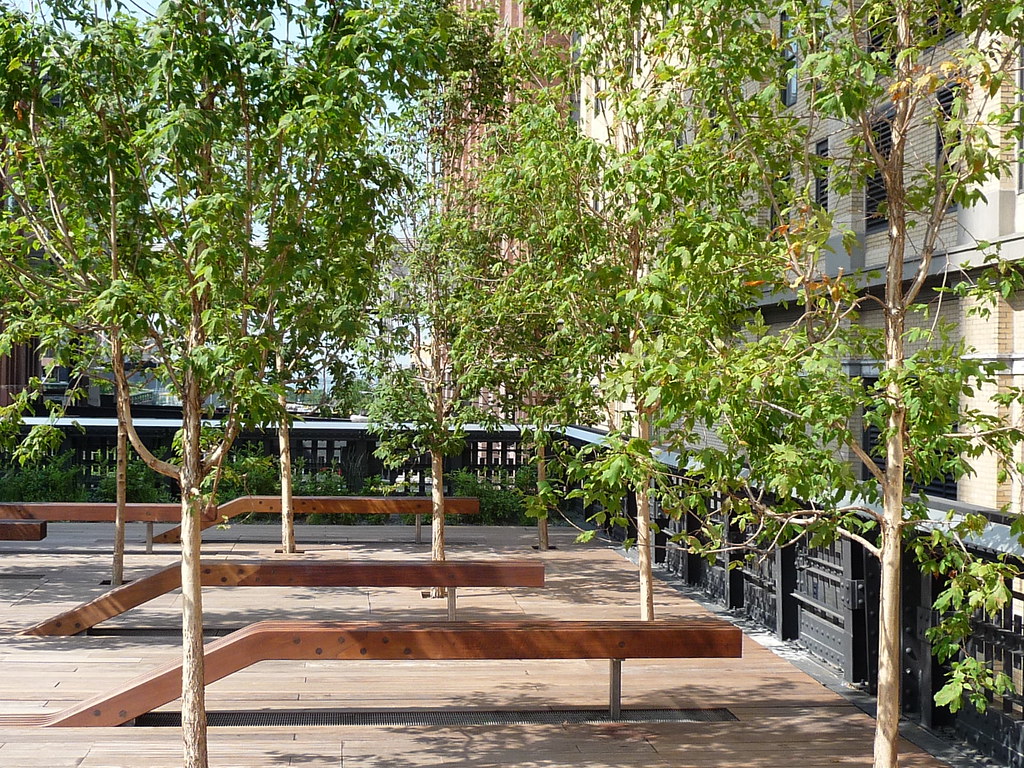
Photo of trees and benches along the High Line

The park was designed by James Corner Field Operations, Piet Oudolf, and Diller Scofidio + Renfro. It is made up of pathways that weave through the original train tracks, as well as diverse plants inspired by those that grew in the absence of maintenance. The city plans to continue the park along the Hudson Yards to the Javits Convention Center. According to Mayor Bloomberg, the first section has sparked considerable neighborhood development, with more than 30 new plans now in the works. The Whitney Museum is building an extension by Renzo Piano at the Gansevoort entrance.
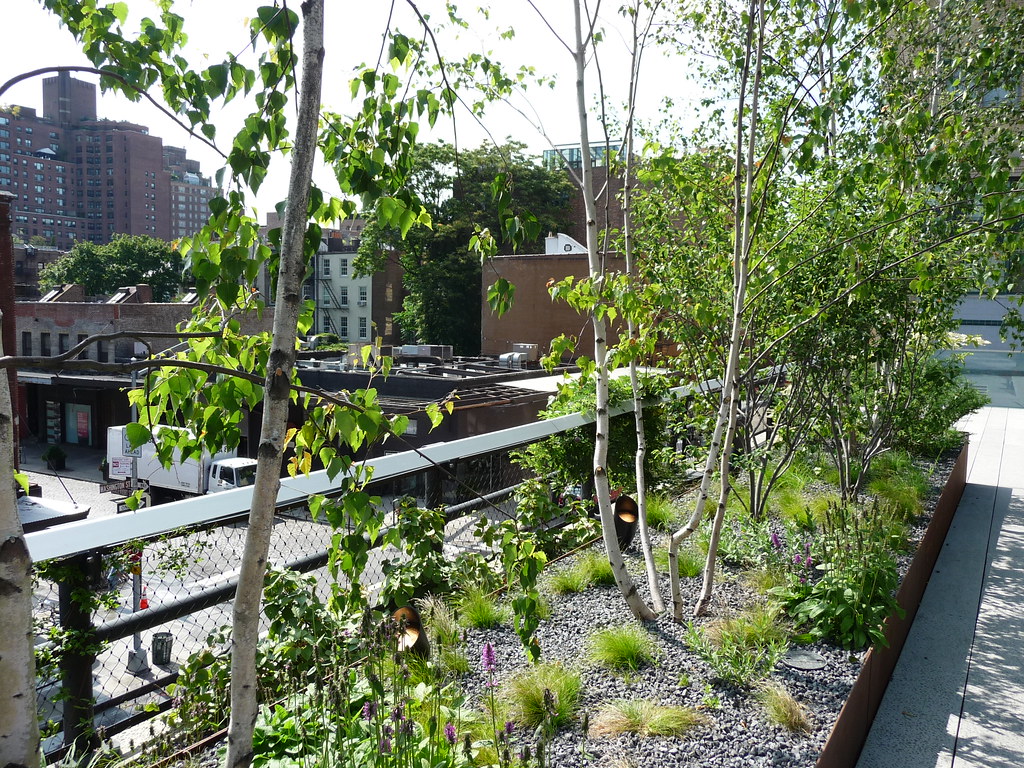
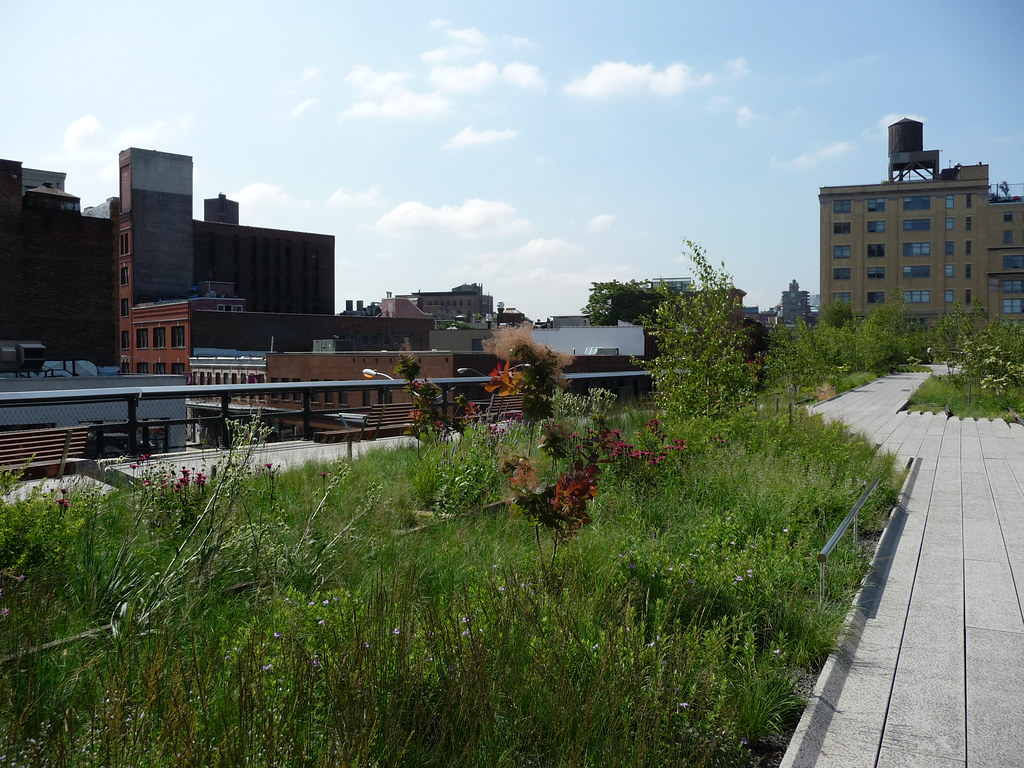
Photo of plantings along the High Line

On a recent visit, I was impressed by the High Line's varied landscape and playful atmosphere. It offers a different perspective on the city, where things come into view that are usually hidden from street level. The path moves along and through buildings, creating excitement in the discovery of new environments.
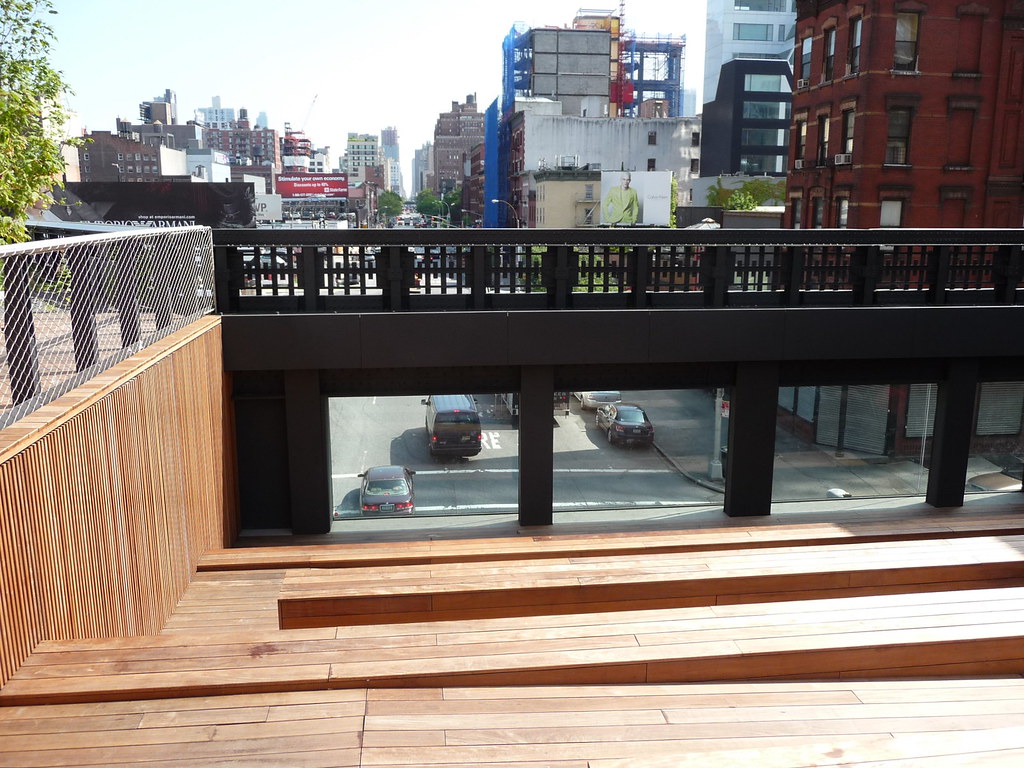
Photo of the theater onto the street at the High Line

The architecture is kind of slick, but it also has a relaxed, inventive feel that plays well against the seasoned ruggedness of its surroundings. I really like the idea of including the original train tracks. This might be even better if their continuity could somehow be maintained. They currently seem like set pieces rather than historically integrated parts of the neighborhood. I loved the rolling chairs on tracks, and the vegetation is tough and beautiful. The spectator windows onto the street (or into the park) are an interesting concept, framing everyday life as entertainment. However, I'm not sure the frames and stepped seating add much to the view, and they seem to draw energy away from the path. These opinions, however, are especially inconsequential in light of the overall greatness of the park.

Photo of rolling chairs on tracks at the High Line

The High Line is a wonderful part of the city's changing ecology, one that builds upon the old in shaping the new. I recommend starting with the exhibition Mannahatta/Manhattan: A Natural History of New York City at the Museum of the City of New York. It includes detailed reconstructions of the island before modern development, giving a sense of how our current moment fits within the area's unfolding story.

(Photos by Peter Sigrist)

Thursday, June 25, 2009

Public and Private Space

Photo of the Four Horses Fountain in MoscowHaving just returned from Russia, I’ve been thinking a lot about public and private space. The country has been experiencing rapid privatization since the early 1990s. Many aspects of urban life, from transportation to housing to recreation, are becoming less public.

This isn’t necessarily a bad thing. Private space can encourage responsibility for quality maintenance. We’re usually more likely to repair and improve upon places we own than places we share with everyone.

According to the logic of privatization, public maintenance is best contracted to independent businesses. In a way this makes sense. It provides incentive for efficient work, and as long as high quality is a requirement, we should get intended results at lower costs.

So why do market efficiencies often result in low-quality public space? Strip malls, for example, or dilapidated waterfronts. I guess it has to do with our priorities, and how much we’re willing or able to pay. If public space isn’t valued, there will be little incentive for businesses to compete over insufficient funds allocated toward its maintenance.

We expect to pay more for higher quality cars and houses. But what about bridges, water, roads, and other public entities? Not that we should pay more than we get in return, but it seems that quality services indicate a well-functioning society. While I found the parks, trains, and streets of Moscow nicely maintained, I heard that some neighborhoods are filled with uncollected garbage, and that the metro system was built at the rest of the country's expense. It's important that the benefits of public investment are distributed fairly.

Supporters of privatization might argue that services should be purchased directly by those who benefit from them, so as to reduce the misapplication of public funds. In its most extreme form, this might involve gated communities providing their own infrastructure, tollbooths at every bridge and roadway, and people hiring private companies for protection from crime. This could be considered fair in the sense that services would be more closely related to the amount we pay. However, it is less fair that children from wealthy families should start out with such major advantages over other children in education, health care, and basic safety. While salaries in lower paying fields like teaching and the military might rise with private demand, their services would be controlled by those who could afford them.

Photo of Tsaritsino ParkIn looking for ways of maintaining public space, Russia’s experience with socialism could offer useful lessons. While there are many aspects of Soviet rule that didn’t work, there are others that continue to benefit city residents. These include accessible transportation, parks, and cultural resources. It will be interesting to see if Russia can draw selectively from capitalism without losing the advantages of its socialist legacy. At the very least, we can study these advantages and see if they might work in other cities.

Is responsible maintenance of public space possible? Working on this would be a sound investment in our quality of life. Of course, the money for public investment has to come from somewhere. This is a question for economists, but it also has to do with where we place our values. If we care enough to improve upon the quality of our surroundings, we can make this happen. It will be important to figure out what improvement would mean and how to go about it. If we make this a priority, things could get better sooner than we think.

(Photo of the Four Horses Fountain by Miroslava De Abreu Coelho. Photo of Tsaritsino Park from Flickr user initsownway1701.)

Friday, June 5, 2009

Forest and the Fast Lane

Photo of a metro station in MoscowWhen it comes to transition, it seems there is a lot to learn in Moscow. I'm currently writing from there, after a day of walking around and taking a few pictures. The things that really stand out are the lasting marks left on the city from very different governing ideas: ornate metro stations, trees everywhere, aging apartment blocks, modernist masterworks, cars racing down streets that take an incredibly long time to cross. Everything Stalinist is gigantic.

Many public works have aged remarkably well. The metro stations are efficient and well maintained. The ones in the center of town have all kinds of architectural touches usually reserved for mansions, theaters, monuments, city halls, and museums. There is a basic sturdiness that prevents them from seeming too extravagant. Public green space lines the streets and fills the insides of apartment blocks. It’s very refreshing on summer days. Parks are full of young couples, new families, and elders reading or just watching people pass by. The ones I’ve seen so far have been clean but not highly manicured, which gives them a kind of wilderness atmosphere.

Photo of a park near Moscow State UniversityThe trains and parks seem like lasting gifts from the past, although they’re surely changing with today’s frenetic market experimentation. The giant streets are much less successful from a pedestrian’s point of view -- like highways running through city neighborhoods. If they were narrowed and filled in with plantings, spacious sidewalks, and small businesses, the improvement for walkers would be significant. I can’t quite see this happening, as the young and wealthy seem to really love these roadways. They're good for drag races at night and 360 skids in the middle of the day. It all makes Moscow an interesting mix of values and ideas, like any city, but multiplied by something extreme.

(Photos by Peter Sigrist)

Friday, November 28, 2008

Dump


The recent New York magazine article on the former Fresh Kills landfill in Staten Island, delineating the plans and hopes for the site’s transformation into an immense park, kicks off with a false ending:

“Let’s start at the end of one story, the story of the dump, with the view from way up on top of it…”

Fresh Kills might not function as or look like a dump anymore, but that doesn’t mean the dump is gone, or that the 53 year-old, 3000 acre-wide “mistake” is finally on its way to being “corrected” (same thing with this month’s Metropolis Mag profile of the alleged future park).

At the risk of this sounding like shameless self-promotion, I want to point to a very different perspective on the whole reclamation affair presented by architect/geographer John May in a book I recently worked on. As others have already highlighted, May’s controversial take on Fresh Kills describes the trash heap as a materialization of a collective morality, a set of basic, unquestioned beliefs that sustain and make operative our everyday reality without us even noticing. May sees in Fresh Kills a frightful memento of an era based on the assumption that “freedom and accumulation are complimentary goals; the recognition that images are commodities; and an unquestioned embrace of a set of hopeful and reactive technological responses, designed to prevent massive accidents that have already happened.” He recognizes that Fresh Kills is tied to a particular development scheme, both in economic and cultural terms.


What counts for the dump, counts for the remediation and redesign of the site. May goes straight to the throat of the Fields Operation proposal for reclamation, despite all its good intentions and wishful 4-step "livingscape" program. All the capping and veiling and the sealing tight are carried out not only to elude dealing with material run-off of the waste, but also to distract from what that waste means and implies and reflects (the architects and the city want to avoid any leaks, physical or moral).

In the urbanism of Fresh Kills, before and after closure, a series of enormous corrective measures and technological “fixes” (along with minor changes in the official rhetoric) are supposed to heal and cleanse and erase the ugly from the site, leaving a landscape that can be consumed without guilt as the “wholly fantastical Photoshop collages of upper-middle clash recreational enjoyment” of the proposal demonstrate. One has a nagging sense of this whole idea of a place set back on the right track, and healing itself back to normal is something of a hoax, “a remarkably compelling lie, beautifully rendered, but a lie nonetheless.” Like people who promise to cure cancer with meditation or massages.

What is to be done then? How can we respond to these overwhelming objects we’ve spun into being and then lost grip on? Do we need to make things better, or do we need to learn from them, even if the learning process is ugly and painful? Is there any way we can do both? The same questions apply to all the vast environmental challenges we’re currently faced with, our cities included.

Thursday, October 23, 2008

The Ads Are In the Air

In case you were wondering, the answer is no; nothing is sacred anymore. At least not to advertisers. A Dutch company called Geotronics recently launched a re-branding campaign by staging a full-blown musical number in the busy concourse of a train station in Utrecht. While there are plenty of ways to read this (the least entertaining of which is not that we'll finally have an answer for people who say musicals are unrealistic because "no one bursts into song and dance routines in real life"), it seems to set a troubling precedent. Long since unsatisfied by innumerable billboards and neon signs, advertisers have been aggressively acquiring pieces of the cityscape (ceilings, stairs, escalators, trees, sidewalks, benches, busses, etc.) over the past few decades. With this latest move, it seems, even the physical space -- the very air around us -- is fair game for splashy advertisements.


Observe above: an image of Charing Cross Station in London. Below, the same image with green filters highlighting existing advertisements:


Here, as in most contemporary public and quasi-public spaces, people are bombarded with ads for food, real estate, toiletries, and events. The advertising has become so ubiquitous, that it seems abnormal to pass through an urban space without ads on every flat surface (think back to the media bonanza in late 2006 when São Paulo banned all outdoor ads). And now, we can't even count on the people we're sitting next to, or the janitor sweeping up litter a few yards away, not to be a part of some grandiose sales pitch just waiting to erupt. The advertisement space in public spaces starts to look a bit more like this:


There's a fundamental problem with being told by your environment that you are merely a consumer. Yes, we are consumers living in a capitalist society, and I don't intend to argue the merit or value of that. But there is something to be said for maintaining the dignity of public space, and keeping some places free of advertisements. If we merely see each other as fellow consumers we are, in an odd way, pitted against each other. I have to buy what you can't buy if I want to feel successful. Ads do nothing to reinforce the fundamental building blocks of any harmonious human settlement: community, interdependence, and civic engagement. Those are the values that public spaces should strive to promote.

But what's the big deal with the Geotronics musical performance ad, you may be asking? If we are already bombarded by ads everywhere we go, what's the difference adding the occasional flash-mob-esque song and dance routine hawking toothpaste or the newest Barbie doll? It might even be fun -- certainly moreso than any billboard. But advertising has a way of growing, cancer-like, taking over new nooks and crannies without us noticing. In some cities, storefronts are now more profitable with windows boarded up to shoulder more posters and billboards.

Jump ahead a decade or two, to when these performance ads have become more commonplace. What happens when civic officials see more value in a park as a place for elaborate performance ads? Just imagine your city's parks, transit stations, and civic plazas as dozens or even hundreds of little Disneylands. And what would a child who grows up riding the Citibank Train to Coca Cola Park instead of just 'the local playground' think of the city once they were grown? The only value a place has once it's been bought is what the company that bought it was willing to pay for it.

(Original photo from Flickr user annabelb. The original full-sized color version can be viewed by clicking the photo.)

Thursday, September 18, 2008

The Bean


New updates to Chicago on Google Maps' satellite coverage finally show The Bean and a completed Millennium Park. In case you were wondering if every last square inch, including the very tip-top, is polished, here's your proof.

Thursday, July 3, 2008

Parks, Public Space, Political Theater, and a Picnic

The Village Voice reports today about a recent event led by one of Where's favorite American provocateurs, Reverend Billy. The Rev led a lively picnic-cum-protest in New York's Union Square, one of my all-time favorite urban public spaces, which is apparently under the threat of having its lovely Neoclassical pavillion turned into a private restaurant. While I'm not at all opposed to public-private partnerships as an option for reviving parks and public spaces in need of the funding and attention, the idea that one of the most popular and attractive parks in the country's largest city (which also happens to be one of its richest) needs privatization is absurd. Which leads to the conclusion that privatizing any part of it would only be done out of greed or incompetence. Let's hope this idea dies on the vine, eh?

(Photo from Flickr user safety dawn!. The original full-sized color version can be viewed by clicking the photo.)

Thursday, June 19, 2008

Three Short Urban Navigation Blogedankens

No prizes this time, but I do encourage you to leave comments if these exercises lead to any interesting answers...or more interesting questions. Click the links to see the inspiration for each thought experiment.


Blogedanken #1: Imagine that your city were like Venice; where would the Grand Canal be located? What streets would remain streets, and what ones would be sunken to form the city's canal network? Create a corresponding map. Does this map tell you anything about transportation and infrastructure networks in your city? How could such a map be used to plan transit lines, or a park system?


Blogedanken #2: If someone asked you to write a guide to your city for visitors that didn't want the tourist experience, where would you send them? Determine 5-10 places and/or experiences that you consider essential for the un-tourist in your city. Now create a walking-tour route that connects these spots in a way that creates a meaningful way -- a way that can direct the visitor's interpretation of your city. Compare your route to a map in a typical tourist guide. How do the two differ? What does this tell you about the way that you have experienced the city, yourself? What has your city taught you?


Blogedanken #3: Cities are very much about paths. Numerous networks of people, information, and physical infrastructure create a massive web often referred to as the urban fabric. Almost every city has one or two once-crucial cords in this web that have faded from prominence, or even disappeared completely. Imagine that you are creating a virtual guide, using GPS and voice recordings, to one of these defunct lines in your city. How have the areas around this forgotten path adapted since its decline? If they have not adapted particularly well, speculate as to why that might be. Based on what need the path and its surrounding infrastructure originally served, what currently vibrant paths through your city could become deserted or forgotten in the future? How might this be averted?

(Photo from Flickr user Damiel. The original full-color version can be viewed by clicking the photo.)

Tuesday, April 1, 2008

Blogedanken Public Poll

Here are my favorite entries from each of the six Blogedanken participants who submitted full responses. Take a quick read-through, pick the one you think is the most interesting, and vote in the public poll at the bottom of the post. One-two-three, and by April 10th we'll have a winner! That person will then recieve a copy of Hyperborder, courtesy of PA Press.

Patrixbanx
(Portland, Maine, USA)
It sure would be nice to have a suburban commuter rail network in southern Maine. It would be even nicer if the commuter rail stations weren’t sited in the middle of vast parking lots, especially closer to the urban core. So why not allow development to cluster around those stops, like say Morrill’s Corner? And by development, I mean dense development. We’ll need to reform our zoning to encourage such growth, of course – not just by creating incentives for density but by creating disincentives for sprawl as well. Oh, and remember – this is Maine, a land that get’s pretty damn cold over the course of our long winters, and global warming hasn’t turned us into South Carolina just yet. Yet I hear tell of other cities even further north that are colder and get more snow than us, yet still manage to have a vibrant street life even in depressing old February. We gots to have that. I don’t know how exactly but if we’re going to discourage driving so we can have more walkable and transit oriented neighborhoods, we might as well make the streets of Portland a pleasant place to be in the depths of winter – bike and pedestrian friendly snow clearance, warm transit shelters, fun festivals, whatever it takes.

Medea
(Medellin, Colombia)
24 hour public transportation makes shifts easier to stagger, so bus drivers are not competing with each other in hazardous maneuvers. Every bus and taxi driver will receive mandatory drivers ed and courses on politeness and good manners. If they are rude or customers complain, their punishment won´t be a fine, but they´ll have to do public service hours cleaning the riverbanks.

M.B.
(Mexico City, DF, Mexico)
As a way of improving safety and bridging the gap between the city core and the bulging periphery, the city has launched a Defense of Modern Ruins program, stringing together blighted sights that range from industrial sights to downtrodden art-déco buildings to bureaucratic baroque whales. The program includes low-rent housing schemes, urban wilderness tours and itinerant party circuits.

T H Rive
(Victoria, BC, Canada)
Wireless capable crosswalks.
Edit: *apologies for the absolute shortness of mine. explanation: The crosswalk I was requesting was the ones that go green on ALL sides so that diagonal crossing is validated. It's quicker. The wireless part was more outdoor, cafe oriented Etc green wireless spaces. The result of the mixup?>> Wireless Crosswalks. Still a good idea. (4/1/08 5:38 PM)

Dan Lorentz
(Lexington, Kentucky, USA)
Organize a strong city-wide neighborhood group to promote mixed-use planning that supports street-level vitality, and make the first priority of that group the reweaving of the city's street web to create more corners for mixed-use development.

Petersigrist
(Cambridge, England, UK)
Hovering leisure boats with transparent roofs and floors, which hover about twenty feet in the air and provide lifts around town above underwater gardens with glass walls at street level as well as terraces, balconies, shops, and restaurants that open onto the streets and river


Remember: vote or die! (Hah. Always wanted to use that in context).

Friday, March 21, 2008

Happy Whereday!

Well la-de-da. Exactly one year ago today, Where's first post went up. The site looked a lot different...no logo, basic Blogger format, very...yellow (not sure what I was thinking, there). And here we are, 365 days later, with the 250th post. Plus, since four regular weeks = one full year in blog-years, that makes today Where's 13th anniversary! Hip hip hoo-ray, and all that jazz.

For a bit of self-indulgent celebration, I've put together a list of the Top Ten posts (and series) over the past year. Each header links to the original post. The date of publication follows a brief sample quote, and the posts are listed in chronological order. Without further ado...

Open Spaces, Non-Places
"People have idealized 'open' space when what they should really be focusing on is 'quality' space...[And when] the distinction between 'open' and 'quality' public space is ignored, it allows not only for the types of ridiculous arguments used by the 'concerned neighbors' mentioned above, but on a more subversive level it devalues public space in general." (4/10/07)

Community 2.0 and the Built Environment
"Just as each technological revolution has had to prove its mettle over time, so has the internet; at first, there was a great deal of fear surrounding the dot com revolution...Physical communities, we feared, would become a thing of the past. But now, it seems, we have reached the critical point at which people trust the web -- trust it enough to really take control of it." (5/13-18/07; weeklong series)

Speeding Succession
"Why not help along the process of ecological succession? As urban areas around the world begin to reimagine and reconfigure themselves as more localized, sustainable places, people stranded by a fuel crash or a series of eco-disasters could get work replacing suburban communities with trees. For every house torn down and mulched, ten trees could be planted." (5/29/07)

A True Alternative
"Of late, we have been plagued in our building and planning practices by an intense mediocrity, a society-wide indeciciveness. What we want, of course, is the best of both worlds: the convenience, community, and culture of the city, and the peace, privacy, and pastoral scenery of the small rural town. What we've wound up with is suburbia: the best of nothing." (6/21/07)

The Dawn of Digital Urbanism
"'Who will watch the watchers?' This, I think, will be the most fundamental challenge of Cyberspace: in a universally connected world, the unwatched watcher has more power than ever, as they will have unprecedented access to the masses." (6/28/07)
(Also: from the response post a few days later, Everyone is Watching You: "To paraphrase that famous line: when everyone is a watcher, who's watching the watchers? Everyone.")

Resident Experience Master Planning
"New advances in crowd simulation technology are making Resident Experience Master Planning more and more possible and, with the economic potential of such a development so high, indeed more probable...If urban planning could figure out exactly how to get people to do specific things or behave in specific ways, it would give new and rather intense meaning to the term 'master planning.'" (7/13/07)

Eat Your City
"Urban farms could become for the 21st Century what large, elaborate central parks were in the late 19th and early 20th. Frederick Law Olmsted famously described Central Park in Manhattan as the lungs of the city, but with new green technologies these farms could become more than lungs -- they could be the heart and brain of the city as well." (7/25/07)

The Possibilities of the Post-Retail City
"It's interesting to imagine a world in which shopping took a back seat to other social spaces as the dominant street presence...To get an idea of what might fill the void [left by retail], it might be interesting to see how social space is structured in places where gift economies (or at least barter systems) often already exist and retail strips are few and far between, at least in the traditional sense: slums." (8/13/07)

World Urbanism Day
"[Presented here] is a simple visualization of the landscapes of twelve major coastal cities around the world in three imagined futures: red overlays represent areas that will be submerged after a 50 foot (15.2 m) sea level rise; orange overlays represent areas submerged after a 150 foot (45.7 m) rise; and yellow overlays represent areas submerged after a full 250 foot (76.2 m) rise. The colors represent the fire-like spread of the ocean inland." (11/8/07)

Living in SimCity
"In an existing version of SimCity, a player could cover an empty triangular plot with parks and watch the land value of surrounding blocks rise. Imagine a SimCity that allowed users to completely re-design the Polish Triangle so that any player walking through the area could access this visionary public space and interact with it." (2/13/08)


Have a wonderful weekend. Thanks for a great first year!

Tuesday, March 11, 2008

Architectural Revision

The term "revision" means, literally, to "see again." And in a recent article for the Toronto Star, Christopher Hume inadvertently showed how revision is sorely missing from the urban design dialog today.

Early in the article, which discusses the gentrification of Toronto's Liberty Village neighborhood: "Speaking of parks, there is virtually no green space anywhere here; perhaps the city should finally grapple with the issue of Lamport Stadium, which is so rarely used it could easily be demolished to make way for a park." And then, shortly thereafter: "recycling...old structures ensures a level of integrity and sustainability vital in an age of global warming."

So what gives, Mr. Hume? Why no love for Lamport Stadium.? Surely, if Vienna can figure out how to turn gasometers into a dazzling residential complex, Toronto can pull off the conversion of a stadium into a park without wasting all of that energy by tearing down the existing structure, no? As the urban affairs critic of the largest newspaper in one of the world's few truly global metropoli, Hume is, by default, a major voice in the current discussion on how cities should evolve. It is telling that he would so quickly dismiss a stadium that would probably be relatively simple to convert to public green space.

Culturally, many of us still think of old buildings as things that should be demolished to make way for that which is new, shiny, and more immediately perceived to be "green." But while converting stolid brick warehouses into luxury condo complexes is all well and good, architectural revision is a field with no horizon. Every underused or unattractive building can be rethought and retrofitted to become something that better serves the needs of a surrounding community. It just takes some spitshine and imagination.

How could Lamport Stadium be revised, as a piece of architecture? While an actual Torontonian would probably have the best answer, let's give it a shot. First off, as can be see in the above image, there is very little physical structure to the stadium. The bulk of the site (the playing field) is at-grade, or at least near it. The elimination of any gates or perimeter walls and the conversion of the obscenely large surface parking lot on the southeastern end of the site would create a sizable, T-shaped open green area that could be made quite lovely by a good landscape architect. The wings of green space that currently flank the stadium could be converted to community playing fields with shaded seating areas under the bleacher structures.

The bleachers themsevles provide the best opportunity for out-of-the-box thinking. How could large, clunky concrete structures be revised to serve optimally as part of a public park? While there are many possibilities, the first that comes to mind is: terraced community gardens. With the removal of most or all of the seating and the addition of some permanent soil beds, the porous concrete structures would be the perfect support system for a vertical farm, to be tended by Liberty Village neighbors.

Check out the picture of Lamport Stadium to the right. Cover the steeply-sloped back sides of the bleachers with solar panels or photovoltaics, retrofit what are assumedly locker rooms in the podium under the arched structure, and you've got a zero-energy community center for cold or rainy days. Heck, once you get going, this is more fun than it is challenging.

Revising and rethinking our buildings is a critical step that needs to be taken for us to move closer toward a truly sustainable form of urbanism. What are some strange buildings that could be revised to better serve your city's needs?

(Photos from Google Maps and Flickr user antifuse. The original full-color versions can be viewed by clicking the photos.)


Links:
Liberty Village highlights poor planning (Toronto Star)

Creative Recyling: Gasometer City (Treehugger)

Tuesday, February 26, 2008

Mixed-Use Infrastructure

Cities are extremely complex organisms made up of hundreds of independent and interdependent systems. The most basic and oft-overlooked of these systems are some of the most vital. Sewers, which remove waste and excess water, keep our streets clean and dry. They do this out of sight. Canals, rivers, bridges, and roadways allow for the transportation of goods and people within densely populated urban centers. We take them for granted. We have many large facilities for cleaning our water, recycling our trash, and producing our energy, and we hate it when we have to look at them. We so often forget to appreciate the importance of having a strong network of well-maintained public and green spaces. We get so involved in our own social systems that we forget that the larger framework of the city is there, making it all possible. We forget that cities themselves are living things, and that, ours are just tiny parts of a huge, interconnected process -- of creation, of destruction, of life.

What if more of the overlooked nerves and veins could be brought out into the open, or highlighted in some way? What if we had to interact with filtration systems and electric grids in a more direct way? What if we had to live on and in our bridges and tunnels instead of just passing over and through them. What might our cities look like if none of the processes that supported its existence went overlooked? How could we create an urban environment that helped citizens to better understand how their city works, and how they work within that system?

Bridges like the Ponte Vecchio in Florence, Italy, and the Chateau de Chenonceaux in France are evidence of the fact that bridges can be made into livable, functioning parts of the city. But what of the tunnels? In a twist of radical genius, a firm in Amsterdam recently proposed that the Dutch capital drain its canals and build an entire subcity of public, commercial, and parking (which, hopefully, could later be converted to other uses) under the canal system before re-filling the canals with water. No traffic topside would need to be disturbed, and a huge amount of space would be created, seemingly from scratch. There could be subterranean cafes dappled in light dancing through a glass ceiling open to the canal water overhead, movie theaters buried beneath bustling public plazas, perhaps even underground extensions of the city's many wonderful museums. No need for Renzo or Zaha; just dig down.

If these tunnels were to be dug, and another physical layer added to the fabric of Amsterdam, it would change the way that the canals were experienced by the public. Topside, they would remain serene, almost pastoral. But there would be the new knowledge that, once again, these canals were serving as a major thoroughfare, moving thousands of people through the city. Perhaps a public elevator system could be designed to access the tunnels using canal water in a hydraulic system, even more tightly tying the tunnels, the people, and the waterways together.

Speaking of water, Pruned recently took a detailed look at the work of Kevin Robert Perry, whose project on NE Siskiyou Street in Portland, Oregon, uses a system of landscaped "cells" reclaimed from parking space alongside the road. Water flows downhill into the landscaped areas, which use a series of checkdams to distribute water to the cells and prevent overflow, retaining and cleaning stormwater runoff on-site. While Perry's award-winning system only serves a small corner of the city, imagine the possibilities presented by a city-wide system. Much as Frederick Law Olmsted connected his parks with broad greenways, all of a city's streets could be lined with water retention gardens, with a hierarchical system designed to send all overflow, eventually, to parks specifically re-configured to collect and clean runoff. Think of Urbanlab's winning City of the Future entry, taken even further.

And what of our parks? While we take them for granted as part of the city's infrastructure, we certainly don't forget that parks exist like we sometimes forget about water treatment facilities. But couldn't parks be more than just gathering places? Couldn't -- and shouldn't -- they also be used as teaching tools? These public spaces provide a unique opportunity for showing urbanites how they impact their surroundings, and how their city works. In addition to cleaning wastewater and runoff, what other roles could re-imagined parks serve?

A contest was announced on February 15th by the Design Trust for Public Space and the Grand Army Plaza Coalition to generate ideas as to how Brooklyn's severely underused Grand Army Plaza, at the northern entrance to Prospect Park (which many, this blogger included, consider to be Olmsted's greatest park) could be redesigned as a more lively, energetic public space. The plaza, which sits atop a subway station, provides an excellent platform for any designer interested in creating a space that more clearly and fluidly emphasizes and integrates the transit system with the public space at street level. How do the public (park) and semi-public (subway station) interact, and how can design make this not only more enjoyable, but more informative?

Infrastructure could be an intriguing new frontier for the mixed-use movement. While inhabitable bridges seem long-overdue, there must be a thousand different ways of re-thinking infrastructure. Any ideas?

(Photo from Flickr user Rita Crane. The original full-color version can be viewed by clicking the photo.)


Links:
Gallery of Bridges in ArchitectureWeek (Civic Nature)

Amsterdam Subcity (BLDGBLOG)

Hyperlocalizing Hydrology in the Post-Industrial Urban Landscape (Pruned)

Growing Water (Urbanlab)

Reinventing Grand Army Plaza (Design Trust for Public Space)

Wednesday, February 13, 2008

Living in SimCity

SimCity, one of the most popular electronic games of all time, played an undeniable role in the return to the popular consciousness over the past few decades of urban planning. While the original game succeeded by breaking cities down into their most basic elements (residential, commercial, industrial, institutional, infrastructural, recreational), subsequent versions have become more complex, and more nuanced. And with the most recent version of the game, SimCity Societies (the first version not developed by creator Will Wright and his team at Maxis), came and went with barely a whimper, the franchise is ideally poised for a thorough revamp.

I recently read two posts at Very Spatial that got me thinking about SimCity and its potential for revival. The first of these posts was about mixed reality gaming, and it discussed a Nintendo DS game that allows players to visit a real island north of Tokyo and participate in a treasure hunt, with the handheld gaming system acting as an interface between the real island and the electronic version of the same place. This technology literally breaks down the walls between the player and the game, blending reality and fantasy. The second Very Spatial post focused on using online mapping technology to record personal histories or memories. The rise of mapping as a customizable, highly social tool should not be ignored by anyone interested in developing a city simulation game. Collaboration and customization are powerful selling points when trying to grab the interest of today's young people.

Mix quasi-reality and personalized cartography together and what have you got? Enormous potential. Consider the possibilities: a game could be created that allows people to create an alternate reality version of their neighborhood or their whole city and then upload that alternate reality onto a central server. Using a handheld device, they could then venture out into the city to interact with alternate realities created by other users. Games could cross paths and interact, teams could be built, and stories could intertwine. Social media and a wiki format could allow users to modify games created by other users, and whole alternate mythologies could be built, each one intrinsically tied to the place where it was developed. Gamers could travel to other cities to take part in other games. It's virtual reality without the stupid headgear.

The truly ingenious part of SimCity is that the game is disguised as a simple simulator that allows one to play God by building (and/or destroying) a city. Entire regions become customizable, and whole worlds and cultures imagined. Meanwhile, the game is also teaching players valuable lessons about how and why cities work: houses and factories don't do well next to each other; large buildings create more traffic, but well-planned transit alleviates that pressure; parks and recreational facilities are vital to morale (or "aura" as it was called in SimCity 3000) and public health. These lessons are still important today, but with advanced technology this type of simulator has the ability to teach an entirely new set of lessons.

In truth, the most basic building block of urban civilization -- more basic than residential, commercial, or industrial -- is social interaction. And by looking at cities at this most basic (and, at the same time, complex) level, we see an entirely new set of problems. Gentrification, segregation, resource distribution, community -- all of these issues could be explored through a SimCity game that mixed reality and personal fantasy.

An example: there is a triangular plaza in my neighborhood in Chicago. While it has a fountain and some trees, this scrappy public space has long been a source of frustration for some of my neighbors, who wish that the "Polish Triangle" would be better cared for, and that it could serve as a beautiful public gathering place. In an existing version of SimCity, a player could cover an empty triangular plot with parks and watch the land value of surrounding blocks rise. Imagine a SimCity that allowed users to completely re-design the Polish Triangle so that any player walking through the area could access this visionary public space and interact with it. The lessons learned would not only be more resonant -- they would be more personal, more real, and might actually affect public sentiment and, eventually, political will.

Another recent phenomenon suggests that this kind of gaming technology could be extremely successful if implemented: the Japanese cellphone novel. These novels, written by teens and young adults on their mobiles, have become a major literary movement in Japan, with half of the Top Ten bestseller list from the last year being made up of cellphone novels that were turned into actual print novels. A striking fact about the genre: most cellphone novels eschew details about the setting of the story. “If you limit it to a certain place," an author explained in a recent NY Times article on the subject, "readers won’t be able to feel a sense of familiarity.” Thus, while a core group is creating personalized content -- for free, unless and until their novels are printed -- massive demand is coming from outside of that core. It is a community that anyone can be involved in, and one where you can very easily make the switch between producer and consumer at your leisure.

The same could be done with a hyperlocal, mixed reality version of SimCity. You could import buildings to your neighborhood from around the world. Stick the Eiffel Tower in the middle of Central Park. Walk through Shibuya in the suburbs of Buenos Aires. Ultimately, the most compelling and useful alternate realities would rise to the top, whatever the reason for their popularity. In the future, you might be able to walk up and down your block several times and see it in a completely different way on each lap.

And, if you didn't like any of what you saw, you could change it in an afternoon.

(Photo from the Centre for Education in the Built Environment. The original full-color version can be viewed by clicking the photo.)


Links:
Mixed Reality Gaming In Japan (Very Spatial)

Creating Memories Using Maps (Very Spatial)

Wicker Park's Dirty Doorstep (Chicago Reader)

Thumbs Race as Japan’s Best Sellers Go Cellular (NY Times) (via Smart Mobs)

Friday, February 8, 2008

WEEKEND READING: February 2-8, 2008

Did you know that it can actually rain slush? Like, the rain is semi-frozen, so as it hits the ground it collects and forms massive fraeking rivers of slush in the middle of streets. It's true. It happened in Chicago this week. It was the worst winter weather I've ever seen, and I'm from Wisconsin. By the way, here's your Weekend Reading. :-)

ITEM ONE: Great article on the recent trend in happiness-focused urban policies.

ITEM TWO: Interchange post by Greg Smithsimon about sustainability and the importance of having plans for change "lying around."

ITEM THREE: Strange Maps covers "America: The Mall" with an enlightening essay.

ITEM FOUR: Just discovered a fanastic new blog called Making Maps. Take a gander at this post on the principles of map design.

ITEM FIVE: Pruned covers some fabulously futuristic designs for a park in Venice. (Photo credit)

ITEM SIX: WebUrbanist's "5 Innovative Industrial Designs for Ecological Living" will have you rethinking the way you interact with everyday objects.

ITEM SEVEN: In the realm of Crazy-But-True, there is apparently a group trying to raise $10 billion to build a dome over Chicago to ward off nasty winter weather. After this week, I almost want to contribute. Best part: they've already raised $233,085.

No more slush rain this weekend, but it's supposed to get down to ten degrees Fahrenheit. Winter here sucks, y'all. Hope your weekend is warmer than mine!

Wednesday, January 30, 2008

Sustainability and the Unimaginable City

A recent post at WorldChanging offered up for discussion a fantastic Bruce Sterling quote about sustainability: "The ruins of the unsustainable are the 21st century's frontier."

That's a pretty profound statement. To think that the world around us, the things that we consider familiar and take for granted, will be to our great grandchildren what the Roman Aqueducts -- or even British colonial forts -- are to us: relics. Of course, much of our built environment (especially the unsustainable portions) are considerably less visually appealing than crumbling arches and turrets. It's fun to imagine that, somewhere outside Cincinnati in 2108, there will be a tour bus that rolls past long-abandoned McDonald's huts and IHOP psuedo-ski lodges, describing to wide-eyed tourists how these strange buildings used to be used as restaurants back when people were willing to drive twenty minutes for food that had been flown across an ocean. But the likelihood of that scenario is slim.

Most likely, metropolitan regions will adapt to changing conditions, with cities and suburbs both densifying and growing and connecting in new ways. But what will become of the buildings and structures that are left in the sustainability craze's proverbial dust? As people become more educated on and concerned with sustainable buildings and neighborhoods, it seems logical to assume that demolitions will become less frequent than they are now as architects and planners seek to preserve structures with bones worth saving, and to reclaim materials when demolition is required. Politicians will mandate it; high tear-down rates will spell doom at the voting booths.

Even moreso than buildings, large chunks of our infrastructure could very well become obsolete, and will need to be repurposed. A post today at Loud Paper described a recent live design and model-building competition with a very novel premise: the two teams of architects were asked to design futuristic outpost buildings in the Alaskan wilderness, and their primary material was repurposed oil pipeline. Take that general concept to the city; what pieces of our current urban infrastructure -- even, or especially, the invisible pieces -- might we be trying to reuse as a construction materials once the large-scale shift to renewable energy sources has taken place?

And now, another Sterling gem to throw into the mix: "To me, 'sustainability' means a situation in which your descendants are able to confront their own problems, rather than the ones you exported to them. If people a hundred years from now are soberly engaged with phenomena we have no nouns and verbs for, I think that's a victory condition."

Whoa. Kind of re-frames the whole "repurposing" thing, hey?

It is easy (and, I think, quite common) to assume the perpetuation of current conditions. Humans like to think about the future, but we are stuck living only in the present. This means that our experience of the present has a very, very heavy influence on how we envision things ten, fifty, or a thousand years down the line. We live in fairly hectic period, so it can sometimes be difficult to imagine a world where the problems are completely different from those we face today, much less that we don't even have words to describe! My question is (inevitably, if you've ever read this blog before), how will this affect cities?

It's a silly question, really. After all, the very idea being discussed here is that the problems to be faced by a post-sustainability humanity aren't even conceivable to us now, so how the heck do we go about coming up with what those problems might entail? Of course, the answer is: we don't. We can't know what these problems or their solutions will be, but we can use the scenario to appreciate the massive opportunities presented by the challenges of creating a sustainable global society. All we need is a framing device.

Enter: the Air Tree. Madrid's recent announcement that they will be building three of these miraculous little structures (which were originally the result of a design competition in 2004) marks a very important moment in architecture and urban planning that is easy to overlook: the birth of an entirely new building type. The Air Tree is a temporary structure that marks what will hopefully be a permanent change in how cities will be built in the future, since its existence signals the arrival of the building with the sole purpose of acting as a unit of production for Quality of Life. These three futuristic pavilions will create for madrileños gathering places that use natural processes to filter and cool the air. The space beneath the Air Tree is not just social; it's cleansing and renewing.

Many common features of contemporary urban areas -- not in the least the Air Tree -- would have been unimaginable to people living a century ago. Stop and think about that for a second. Now try to imagine the unimaginable city of the future. Pretty thrilling, isn't it?


Links:
The Ruins of the Unsustainable (WorldChanging)

Architecture Gone Wild (Loud Paper)

What we get if we win... (WorldChanging)

The 'Air Tree' (Architecture.MNP) (Photo credit)

Sunday, January 6, 2008

Urbanffffinds 012

This was a very tough week. Lots of great urban imagery over on FFFFOUND!, but Where has pared it down to just eight pics for your viewing pleasure...