Showing posts with label london. Show all posts

Tuesday, January 20, 2009

Posh to be Poor?


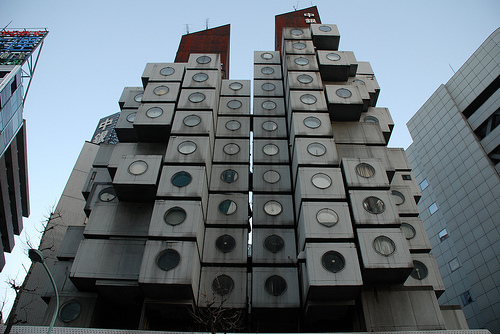
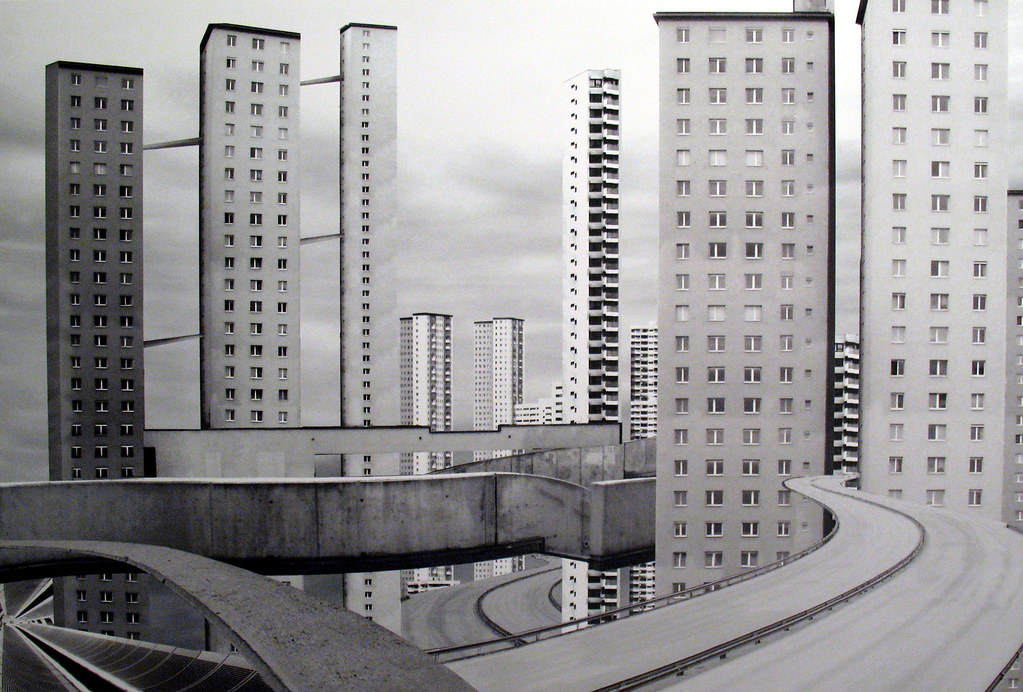
I've been reading a lot of articles lately, and as wrong as it may sound, it seems as though poor is the new black in the Western World. Now I don't mean more people are becoming poor, because that's obviously true, but it seems that lately a lot of professionals have drawn inspiration from the condition. For example, the Times ran an article about architect Teddy Cruz and his social housing experiment in the Hudson River Valley. The development, which features a modern day mesh of architectural elements, draws inspiration and, at times, form, directly from favelas.
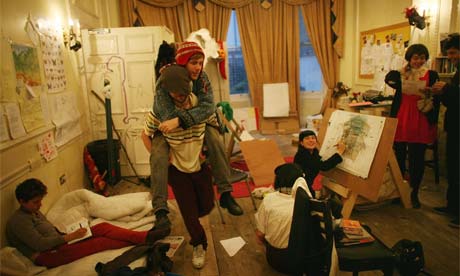

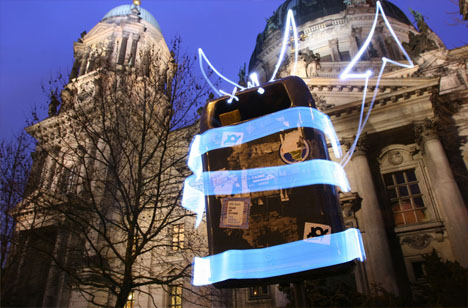
Another prime example is seen in the press that a group of British artists received when they essentially hijacked a vacant multi-million dollar mansion. Late last year, the artist collective Da! moved their group into 18 Upper Grosvenor Street, one of London's more exclusive neighborhoods. They lived and worked here for at least a month with no word from the owners and no word from the cops. I can see this becoming a trend in America, with so many mansions going into foreclosure or sitting on the open market. Perhaps there will be a slight role reversal, where the homeless end up taking over these huge mansions because nobody can afford them or to maintain them. I mean, you can already get 3000 sq ft of 1920's craftsmanship for under 100k in Detroit, why even waste your time with money anymore? Just move in! Some cities are even working on programs to move the homeless into foreclosed homes, according to Fox News. If you want a mansion for nothing, now just may be your chance.

Finally, one of my favorite artists/designers just released a transportable abode for the homeless. I know this has been an ongoing project in every architecture school in the world for the last 50 years, but nobody does it quite like James Westwater. There is something compelling about his project, "homeless chateau," and the idea of living in a rectangular prism in an abandoned warehouse. How different is this from living in a warehouse loft? Having neither heat nor electricity would be rough, but you're not paying $3000 a month. Anyways, I'm not really suggesting these are real lifestyle choices that will become widely popular anytime soon; I'm simply suggesting these ideas are growing in popularity.

In order to dig further into this idea that we are being inspired by the conditions of being poor -- conditions that will increasingly affect the middle class worldwide -- I will investigate 3 divisions of urban planning which directly connect to choices in lifestyle and are dictated by income. Those divisions are Transportation, Food, and Shelter. Over the next 2 weeks I will dive into each category and explore the trends that are leading to a more frugal lifestyle for citizens of big cities.


(Photo from NYT, Gurdian, and James Westwater. The original full-sized color version can be viewed by clicking the photo.)

Thursday, October 23, 2008

The Ads Are In the Air

In case you were wondering, the answer is no; nothing is sacred anymore. At least not to advertisers. A Dutch company called Geotronics recently launched a re-branding campaign by staging a full-blown musical number in the busy concourse of a train station in Utrecht. While there are plenty of ways to read this (the least entertaining of which is not that we'll finally have an answer for people who say musicals are unrealistic because "no one bursts into song and dance routines in real life"), it seems to set a troubling precedent. Long since unsatisfied by innumerable billboards and neon signs, advertisers have been aggressively acquiring pieces of the cityscape (ceilings, stairs, escalators, trees, sidewalks, benches, busses, etc.) over the past few decades. With this latest move, it seems, even the physical space -- the very air around us -- is fair game for splashy advertisements.


Observe above: an image of Charing Cross Station in London. Below, the same image with green filters highlighting existing advertisements:


Here, as in most contemporary public and quasi-public spaces, people are bombarded with ads for food, real estate, toiletries, and events. The advertising has become so ubiquitous, that it seems abnormal to pass through an urban space without ads on every flat surface (think back to the media bonanza in late 2006 when São Paulo banned all outdoor ads). And now, we can't even count on the people we're sitting next to, or the janitor sweeping up litter a few yards away, not to be a part of some grandiose sales pitch just waiting to erupt. The advertisement space in public spaces starts to look a bit more like this:


There's a fundamental problem with being told by your environment that you are merely a consumer. Yes, we are consumers living in a capitalist society, and I don't intend to argue the merit or value of that. But there is something to be said for maintaining the dignity of public space, and keeping some places free of advertisements. If we merely see each other as fellow consumers we are, in an odd way, pitted against each other. I have to buy what you can't buy if I want to feel successful. Ads do nothing to reinforce the fundamental building blocks of any harmonious human settlement: community, interdependence, and civic engagement. Those are the values that public spaces should strive to promote.

But what's the big deal with the Geotronics musical performance ad, you may be asking? If we are already bombarded by ads everywhere we go, what's the difference adding the occasional flash-mob-esque song and dance routine hawking toothpaste or the newest Barbie doll? It might even be fun -- certainly moreso than any billboard. But advertising has a way of growing, cancer-like, taking over new nooks and crannies without us noticing. In some cities, storefronts are now more profitable with windows boarded up to shoulder more posters and billboards.

Jump ahead a decade or two, to when these performance ads have become more commonplace. What happens when civic officials see more value in a park as a place for elaborate performance ads? Just imagine your city's parks, transit stations, and civic plazas as dozens or even hundreds of little Disneylands. And what would a child who grows up riding the Citibank Train to Coca Cola Park instead of just 'the local playground' think of the city once they were grown? The only value a place has once it's been bought is what the company that bought it was willing to pay for it.

(Original photo from Flickr user annabelb. The original full-sized color version can be viewed by clicking the photo.)

Tuesday, October 21, 2008

Housing in Wartime

I've been reading this biography of Ove Arup (who was the hot-shit engineer, for what that's worth), and while it contains all of what irritates me about the biography genre -- who really cares about the minute relationship details of an angsty 20-something, even if they go on to Do Great Things? -- it also has a fascinating history of the architecture and politics of WWII-era British bomb shelters which are an example of the ways in which design matters.

During WWI, there were no private shelters and the London tube stations were used extensively, with some success ('only' 670 deaths to aerial bombing in the city). For the second act, uninterupted tube service was desired, so they were ruled out. Dedicated underground shelters were judges too costly to universally provide, so they were ruled out. Trenches in public parks were found to save burial costs, but few lives. Instead, Sir John Anderson, the Home Secretary, promoted the shelters you see below.

family buries corrugated metal Anderson Shelter
They were cheaply made corrugated iron and steel structures, typically placed in domestic gardens, and capable of holding half a dozen adults: conscientious families half buried them in the earth and covered them with vegetation.
-Peter Jones in Ove Arup


Yes, the pictured shelter features a gasmask-clad stuffed animal hood ornament -- who says building your own bomb shelter can't be a hilarious? Anderson's government distributed several million of these structures during the early war years, all the while fought by Arup (among others), who argued for deep concrete shelters at the neighborhood-level. "Engineer advocates massive infrastructure project" is not exactly a shocking headline, but this time there was justification.

The Anderson shelters chief virtue was cheapness, but they were not particularly effective at life safety (relative to the tubes) or comfortable to use. As a partially buried structure with no waterproofing or even finish floor, a few inches of water would collect at the floor, making any extended stay in the shelter cold and wet. This may seem beside the point given the circumstances - surely, the end user's sole concern here is avoiding death!

However, bombings are not constant. Given a lapse, there is an understandable tendency to flee miserable dwelling and return to the exhorbitant luxury of floors and dryness. What protection Anderson shelter's did offer was proportionally reduced whenever tenants opted out, placing themselves at risk of a surprise assault. By the late 40s Sir John was promoted out of his post and the shelters that bore his name abandoned in favor of other options.

The important conclusion here, other than concrete >> corrugated metal, is that design is important! Even during air raids - especially during, when violence compresses decision-making -- design affects behavior, so it should be consciously considered. In the extreme case, it can save lives. Or at least keep your socks dry, which is almost as important.


(Photos from Flickr user Richard Parmiter and Ove Arup: Masterbuilder of the Twentieth Century. The original full-sized versions can be viewed by clicking the photo.)

Wednesday, July 23, 2008

Tuesday, May 6, 2008

New York, Paris, London...Vegas?

Fast-forward a bit. Let's say that it's 2050, since that seems to be a popular year for speculation these days. You're living in a stylish downtown penthouse a few blocks from a gleaming transit station servicing three different high-speed lines. You work in an office building as a Chief Innovation Officer -- not a light title to carry, by any means -- for a major technology firm. One day after work, you take a train a few miles west of the bustling commercial hub where you work to a rapidly-gentrifying neighborhood to meet a friend at a sunny sidewalk cafe on a dense street filled with shops and new condos. You are living the American Dream, with a beautiful home and a fantastic job in the heart of a dynamic urban center with its finger pressed firmly against the pulse of globalized culture. You are a proud resident of one of the world's Great Cities, capital letters required.

Now, imagine that that city is Las Vegas.

It sounds like science-fiction, no? But, in a recent post written from the American Planners Association convention in Sin City, California Planning & Development Report contributor Bill Fulton argues that Vegas is on the track to claiming a spot on the shortlist of the most exciting urban places on our already highly-urbanized planet. While your initial reaction may be something along the lines of "Say whaaaaat?" (mine certainly was), there is something very refreshing -- even inspiring -- about this idea.

Fulton's argument, in a nutshell: "Vegas is a not-too-subtle reminder to planners about how great cities are really created: You stuff vast amounts of money into a tiny space for decade after decade until the mixture of wealth, commerce, entertainment, and culture becomes so combustible that it finally explodes. Paris, London, Tokyo, San Francisco, Chicago, New York – all were built on this model."

There are so many ways to poke holes in this idea, which is oversimplified almost to a fault, and in fact this post was intended to do just that. But soon after the writing began, I realized that Fulton's speculated future for Las Vegas was far more interesting (not to mention uplifting) than much of urbanism discussion today. Contrast the idea of Vegas, one of the least sustainable cities in the country, as changing its tune and reinventing itself with the Die-or-Be-Drowned harping of James Howard Kunstler, a pundit whose bullheaded pessimism and truly shocking lack of imagination have just about made him a caricature of himself. Mr. Kunstler's tireless drumbeat: "Our gigantic metroplex cities will prove to be inconsistent with the energy diet of our future. I think our smaller cities and towns will be reactivated. We are going to be a far less affluent society."

Perhaps what's missing from the debate over how cities will deal with climate change is something as simple and extraordinarily difficult as optimism. After all, the combination of wealth, commerce, entertainment, and culture is, when you boil it down, mostly what accounts for the rises of cities like New York, Paris, London, and Tokyo. But there was more to it than just a healthy skeleton; there was meat on them bones, so to speak. These Great Cities were places that generated potential as much as they generated wealth. Many millions of people moved to these cities not on the promise of a better future, but on the hope thereof.

The city of Indianapolis is easily one of the least-interesting large cities in America, if not the world. But there is a pride of place there nonetheless, and on several occasions I have read or heard discussions about how to make Indiana's capital a "world-class city." What if talking the talk is an effective way to learn how to walk the walk? The verdict is still out on Indy, but look a little to the west for an idea of what could be. After all, a good deal of Chicago's greatness came from early residents, who were famous for their ability to bluster and boast, claiming greatness long before it was actually achieved (which, incidentally, earned Chicago its most famous nickname: The Windy City). These boosters and bright thinkers pushed and shoved their city into greatness, and without them Chicago would likely be a very different place today.

So who says that Vegas can't become, as Fulton suggests "the next New York?" While it would seem like a miracle to most of us living today, stranger things have certainly happened, and in less time. Thomas Friedman wrote in a recent column for the NY Times that "[Americans] want to do nation-building. They really do. But they want to do nation-building in America...They want our country to matter again. They want it to be about building wealth and dignity — big profits and big purposes. When we just do one, we are less than the sum of our parts. When we do both...no one can touch us."

There is a palpable desire in this country for very real and serious change (notably reflected in the presidential candidates' impassioned adoption of that very term in the current election season). Who are we to look to to shape how we think about the future? People like Fulton...or people like Kunstler?

(Photo from Flickr user Christopher Chan. The original full-color version can be viewed by clicking the photo.)

Links:
APA Conference: Love It Or Hate It, Vegas Is A Great City In The Making (CDPR)

Suburbia's End? (Richard Florida)

Who Will Tell the People? (NY Times)

Sunday, April 13, 2008

Urbanffffinds 026

So what I actually meant when I said "no new posts" was "no new long, fancy-pants psuedo-philosophical ramblings." Urbanffffinds is too fun to put on hiatus. Besides, the crop this week is hot. And so:


Sunday, April 6, 2008

Urbanffffinds 025

Urbanism revelation of the week: cities need more giraffes. And camels.


Friday, April 4, 2008

WEEKEND READING: March 29-April 4, 2008

First things first: MONU has put out a Call for Submissions for their upcoming issue on "Exotic Urbanism." Sounds freaking brillaint. Now, on to this week's cream o' the crop.

ITEM ONE: New-ish blog Boredom Is Always Counter-Revolutionary with a cutting rant about advertisements, architecture, and envisioning the city of the future.

ITEM TWO: Lee Bey has his own cutting rant this week, this one zeroing in on race, crime, and public housing in Chicago. Spot-on.

ITEM THREE: Switching gears a bit, MNP's post on suburb-eating robots will blow your mind and tickle your funny bone. (Photo credit)

ITEM FOUR: Interchange blogger Scott Page on DIY Urbanism and the upcoming Wicker Park Bucktown workshops in Chicago.

ITEM FIVE: CS Monitor examines Hugo Chavez's plan to build a Venezuelan Brasilia of sorts. Welcome to Caribia, the 21st Century Socialist City.

ITEM SIX: Some eye candy from The Map Room -- a collection of late 19th and early 20th century maps of Latin American cities.

ITEM SEVEN: More humor to cap things off this week. The Onion features an hilarious exposé on the aristocrization of gentrified neighborhoods in American cities (via Super Colossal).

Adios, compadres. See you next week!

Friday, March 28, 2008

WEEKEND READING: March 22-28, 2008

Sorry for the slow week. Regular posting should resume after this weekend. In the meantime, there's always plenty of weekend reading to go around!

ITEM ONE: First off, a bit of self-promotion. I have a new post up at Next American City projecting some possible outcomes of the rise of online virtual worlds and increased advertising in Western culture. The French Quarter as an export? Perhaps...

ITEM TWO: WorldChanging with a stirring piece on the powerful political act of optimisim.

ITEM THREE: Is your city a "Paris" or a "London"? Read this Economist piece comparing the two euro-glam-capitals and ponder that question for a bit. (Via Pittsblog)

ITEM FOUR: PlannersWeb takes an in-depth look at the role of urban planners in a Chavez-led Venezuela.

ITEM FIVE: Core77 reports on the book containing the radical designs generated by participants in eVolo's '06, '07, and '08 Skyscraper Competition. Flashy stuff. (Photo credit)

ITEM SIX: Speaking of radical architecture, Richard Florida posted news of a massive floating city-cum-cruise ship. This definitely falls under "You gotta see it to believe it."

ITEM SEVEN: Over at Interchange, Barbara Faga looks at the somewhat comical tug-of-war in public perception of which is worse: density or sprawl.

Hasta luego; enjoy your weekend.