
Why is it that so many of the people out there studying/analyzing/writing about new urban trends, new technologies, new social configurations, etc. are either well past or fast approaching midlife?
xxx
Watching academics (or worse: bureaucrats and business gurus) try to keep up with the frenetic pace of our present-day spatial, cultural, social, etc. milieus can be a sad sight. Pro Thinkers struggle like parents or marketeers or morning TV hosts to stay current and swank and therefore (allegedly) relevant.
They are quick to embrace buzz working concepts, and just as quick to dump them.
xxx
To make matters worse, even regular people like you or me have a hard time upholding concepts, just like we do keeping relationships, tastes, personal aims, political allegiances and attention spans. We consume our concepts like we consume our everydayness.
xxx
The problem is that a number of these concepts could actually be useful and significant. They are unfairly — even irresponsibly – deemed tired, passé, fizzle; superficially exhausted and then dumped.
xxx
One of the poor bastards in this bunch is the notion of "informality". After a brief, guilt-driven stint of Western academic and media focus on the subject, at the moment informality sounds as old and worn as French Theory. Something to roll your eyes over.
xxx
I don't want to redeem anything or anyone here. I just don't think ideas should be treated as disposable objects. Ideas always linger and creep back up when you least expect it.
It's only fair that we're tired of hearing the same stuff from the same people, over and over again. OK. But that doesn't mean that everything that needs to be said has been said.
xxx
Right now, more than anything else, I have some basic, intuitive, poorly-shaped questions. I guess they're mostly questions for myself (given my comment track record on this blog):
- Can anyone actually pin-point "informality"? Or is the notion simply elusive and any attempt at this futile?
- Is the concept itself inadequate? Particularly considering there isn't an actual divide between formal and informal, that they are both the same thing: reductive categories that try to organize and make sense of functional and active by-products of our (Modern, global) development schemes and efforts.
- Do we really have to keep opposing the "informal" to the Western-developed-organized-etc.-etc. or can we maybe start understanding it as a mirror modernization, as the crooked limb of Modernity or its bad twin?
- Instead of considering it an absence of logic, can we accept informality as a logic in itself, with controls and hierarchies and orders and struggles and changes and growths?
- If we want to emphasize the historical breach and inequality of modernizing processes, why not simply try to analyze and describe how unequal types of development are crashing up against each other and invading each other as a result of globalization, instead of making it an Us vs. Them thing? There is no Us vs. Them. We've all been smeared.
- Beyond aesthetics, isn't informality ugly (scary even) because it reveals too much about our dirty, insecure, two-faced Modern selves?
- How about picturing an enhanced version of the informal? One that isn't primitive or picturesque or exotic, or at least not in its entirety. One that is inextricably related to whatever happens elsewhere: interconnected, active (sometimes aggressive), efficient and significant in its own right. One that we need not pity or fix, but understand.
Would anyone like to take a shot? 
(Photo by Pablo León de la Barra. José Rojas at House of Gaga in Mexico City. From the Centre for the Aesthetic Revoluction).
Showing posts with label network culture. Show all posts
Showing posts with label network culture. Show all posts
Friday, July 3, 2009
Informality, Enhanced

Friday, June 19, 2009
Don't Miss: My Space @ NAC
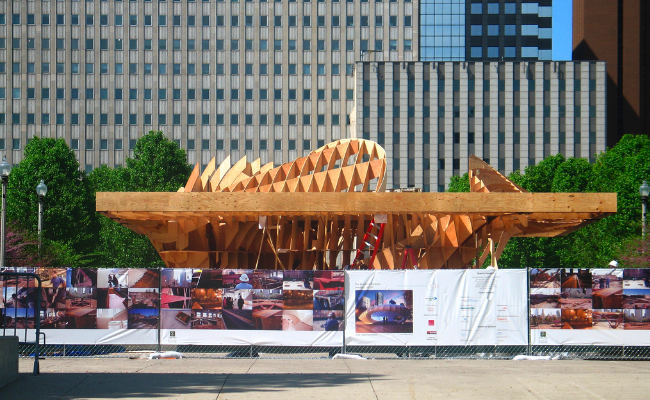
There's another Whereblogger-authored post up over at Next American City's Daily Report...I'm a little late getting this one up, as it went live over a week ago, but later is better than never, as they say. The post takes a look at three Chicago-based urban planning non-profit orgs' attempts at interactive websites, and their various levels of success at engaging users. Below, a teaser, and here, a link. If you're so inclined, do take a look!
In cities—especially densely-populated cities, where open skies are a precious commodity—getting people to use public spaces isn’t usually a challenge. But getting people to talk about public space is another issue altogether. These days, the Internet is allowing planners and architects to reach out to Average Joe citizens to generate discussions about the built environment in new and increasingly creative ways; in Chicago, a number of recent public space-related initiatives have used the web to get people talking about the city’s public realm—with varying degrees of success.
This past week the Metropolitan Planning Council launched a region-wide search for Chicago’s best public spaces. Placemaking Chicago challenges Chicagoland residents from southeastern Wisconsin all the way down the lakefront to northwestern Indiana to send in photos and videos hosted at Flickr, YouTube, and their ilk, in order to determine the metro’s most enjoyable and successful public spaces. MPC is offering users various prizes, and winners will be determined by several rounds of judging, including an MPC-selected panel and a final public vote...
Once more with that link.
(Photo from Flickr user John Zacherle. The original full-sized version can be viewed by clicking the photo.)
Thursday, June 18, 2009
Networked Urban Politics

"Participation is war. Any form of participation is already a form of conflict", says architect and activist Markus Miessen, following Chantal Mouffe: "It is very important to envisage the task of democracy in terms of creating the institutions that will allow for conflicts between adversaries." Mouffe, a Belgian political theorist, has theorized on the notion of a "conflictual consensus", in which only a minimum common aim (democracy, equality, justice, etc.) needs to be settled and agreed upon within a society. The means for reaching this aim and even the meaning of the aim itself, on the other hand, can and should be disputable.
Miessen is more concerned with the spatial effects and possible materialization of these conflictual consensuses, particularly by way of everyday urbanisms: "When participation becomes conflict, conflict becomes space. Re-inserting friction and differences into both the scale of the institution and the city bears the potential of micro-political forces that render conflict as practice. In this context, participation becomes a form of non-physical, productive violence. Micro-political action can be as effective as traditional state political action."
- - -
Technologies that enable participation have become a staple of contemporary life, overcoming distance, economic limitations and even political constraints. Teens in Ciudad Neza are glued to their cell-phones just like their counterparts in Midtown Manhattan (though they might be planning a stickup instead of a cocktail soiree). ICTs have become so important to the functioning of societies that mobile phones are being handed out by governments along with food stamps and the One Laptop Per Child project seems demure compared to the aggressive downward pricing spirals of the netbook market. Today, 24/7 global connectivity is closer to practical reality than to some outlandish fiction.
- - -
From the nineteenth-century barricades to the revolts of 1968 to the social disruptions of the early 1990s, The Street was always an ideal escape valve for urban tensions and the preferred site of high profile (spectacular) political and social demonstrations. The Street was the perfect set for frictions. But if, as we’ve said before, The Street has systematically been loosing relevance, doesn't it make perfect sense that The Web take its place in this sense too?
- - -

The political perceptions and consequences of The Web and networked urbanisms differ intensely according to specific geographical contexts.
Here in Spain — not quite the First World, but still — there is a bubbly enthusiasm over new technologies and the promise of what they might deliver: salvation from impending economic fallout, a new dawn of proactive citizenship, gaining a steadier foothold in the Developed Nations club (after the brick-setter, real-estate-speculator and tour-guide triad has been widely acknowledged to be a flop as far as development schemes go), etc. Lethargic institutions, burned-out public universities, covetous town halls and ailing private companies are all eager to jump on the digital bandwagon here. The government is lending money for laptops, funding mediateques and data centers, talking Citizenship 2.0, etc. Hopes are high and the atmosphere is cheery, but approaches remain largely superficial or are limited to insiders, specialists and bureaucrats.
This is not the case in the Third World.
- - -
My browser is stuffed with Tehran bookmarks. Just like Cuban bloggers sneaking into Havana hotels to post their thoughts and opinions on the web or massive reactions to government corruption cases prompted by unofficial on-line reports in China, web activists and connected common-folk in Iran are opening channels for a new understanding of urban (networked) politics — proving at the same time that networked urban realities are far from being pretty or easy to grasp. The Street (Web) resistance that is shaking Iranian cities along with our reductive and jaundiced perception of Iran (Remember the days when thanks to George W. Bush — and to a lesser degree, Sally Field — Iran rarely evoked something other than a helplessly closed and traditional society?) is one of those events that change people’s gut perception of history in the making. But there is an additional element here. Like the Obama election or the global response to the Swine Flu affair, the unfolding of these fundamentally urban episodes and our reactions to them cannot be separated from the presence of digital technologies.
(Photos from Flickr user misterarasmus. The original full-sized color version can be viewed by clicking the photo.)
Thursday, April 23, 2009
Review: Buckminster Fuller at the MCA
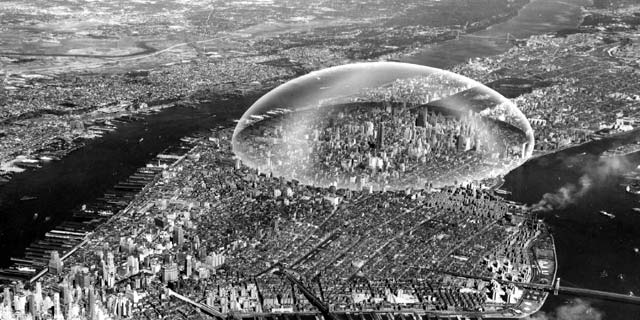
In a corner of the soaring lobby of Chicago's Museum of Contemporary Art sits an inconspicuous screen cycling though a series of quotes. "Don't fight forces," one suggests, "use them." A few seconds later: "Do more with less." And then: "Real wealth is ideas plus energy." These are the words of Buckminster Fuller, the great American thinker and designer famous for his geodesic domes and his pragmatic idealism. Fuller was a colorful man, and extraordinarily wealthy if measured by his own standard: his thoughts were abundant and bright, and his energy seemingly boundless. In the exhibit Buckminster Fuller: Starting With the Universe, the MCA has crafted an impressive overview of Fuller's life and work that brings into focus his prescient worldview and, more importantly, the thought process behind it.
It was after his failure as a businessman and the death of his daughter in 1927 that Fuller resolved to turn his life into an experiment to see how much one man could contribute to society in a lifetime, labeling himself "Guinea Pig B." The exhibit opens with several rooms filled with a diverse selection of objects that recount the beginning of this experiment. Models, drawings, maps, notebooks, and other objects show the evolution of Fuller's early work into his development of the World Game and the Dymaxion map during and after World War II.
 Fuller prided himself on his comprehensive thinking; he approached each problem as part of a larger system of problems. Humanity's great challenges were all interlinked, and to consider solutions for one, it was necessary to consider the others simultaneously. Nowhere in the Starting With the Universe is Bucky's way of thinking on display more clearly than in the two rooms that detail the evolution of the Dymaxion Map into the development of the geodesic dome. It was his work on creating a map that eliminated the distortion of the planet's land masses that led to Fuller's fascination with polyhedrons. His engineer's brain latched onto the structural integrity of the icosahedron form that his map created when folded into a "globe," and by the 1950s he was working with his students at the legendary Black Mountain College in Asheville, NC, on developing the dome that would define the later part of his career.
Interestingly, it is a rather inconspicuously-placed video of Fuller at the mid-point of the exhibit that offers the clearest glimpse of how his industrious mind processed information about the world. His demonstration of how a flexible polyhedric structure shifts form is underlined by his emphasis on its uniform contraction and expansion. Throughout his life, Fuller worked on devising comprehensive solutions to myriad problems; his fascination with a flexible structure in which each part was equally responsive to all of the others is hardly inconsequential.
 Beyond the geodesic dome, the maturation of which is explored in the second half of the MCA show, Bucky Fuller is arguably best remembered for his prescience. His ideas about environmentalism and the consequences of man's actions on the planet presage the contemporary Green movement by decades; he is also remembered for his early conceptualization of the internet and his musings on the growing importance of mass communications. Fuller understood everything as being part of a system, a network. In Buckminster Fuller: Starting With the Universe, the MCA has created an exhibit that presents Fuller's as a visionary worldview that remains relevant more than twenty years after the great thinker's death. Like any good museum exhibit, this one makes the visitor re-think they way that they look at the world. Bucky would be proud.
----
Buckminster Fuller: Starting With the Universe is on display at the Museum of Contemporary Art in Chicago until June 21st, 2009. For more information about the museum and its other exhibits, click here.
(Photos from ArchNewsNow, OSEarth, and PentaMil.)
Thursday, April 2, 2009
Technology: Personal or Public?

“Any technology tends to create a new human environment... Technological environments are not merely passive containers of people but are active processes that reshape people and other technologies alike.”
Marshall McLuhan
Marshall McLuhan
* * *
It’s a worthwhile exercise to periodically consider why the much-maligned personal automobile is, in fact, maligned. The effort will likely yield such adjectives as expensive, dangerous, pollutant, isolating, frustrating and sprawl-inducing. Amazingly enough, however, the advantages of cars used to get all the attention. One hundred years ago, the car’s invention started a transportation revolution while becoming the symbol of American freedom, convenience and progress.
Today, most people have been around cars their whole lives. The magic has largely worn off and the auto industry currently epitomizes the deepest woes of the US economy. Computers and their accompanying innovations, on the other hand, have seized the mantle of progress that cars once proudly possessed. The benefits of computing, and especially the Internet, have produced a worldwide cultural shift that’s at least as enormous as the one cars created.
Computers and cars have plenty in common. Both have an isolating effect—one removes the traveler from the public realm while the other replaces (and simulates) many forms of face-to-face contact. Both cost plenty of money—a lump sum for the initial purchase and a limitless series of repairs, upgrades and modifications. And finally, both became, in different eras, a form of personal expression and a virtual extension of self for their owners.
Cities can’t avoid expressing the effects of widely-adopted technologies. The impact of cars on cities is obvious and well-documented; the impact of computers and global connectivity less so (interest in the latter is booming, though—see Kazys Varnelis and his Network Architecture Lab, for example). Despite their behind-the-scenes nature, one manifestation of computers in urban landscapes seems more visible than the rest—the internet café.
Internet cafés abound in European, Asian and Latin American cities, but are curiously scarce in the United States. They offer a bustling, communal (if not exactly social) alternative to a city full of people inside their homes, alone in front of their computers. It’s a bit of an exaggeration to say, but the internet café’s urban presence appears inversely related to individual car ownership and usage. In a society as affluent and individualistic as the United States, it makes sense that many would prefer owning something and fully controlling it instead of paying to use it in public. Like mass transit, internet cafés offer the benefits of use without demanding the steep costs of ownership or the hassle of maintenance, and in a public setting to boot. Reaping those rewards just requires that we relinquish total control of the item in use. In an age when a single hard drive, iPod or email account can store all the data most will ever amass on their computers, we’d do well to recognize that ability as the privilege that it is.
(Photo from Flickr user thw05.)
Thursday, January 22, 2009
Wherever you go, there you are.
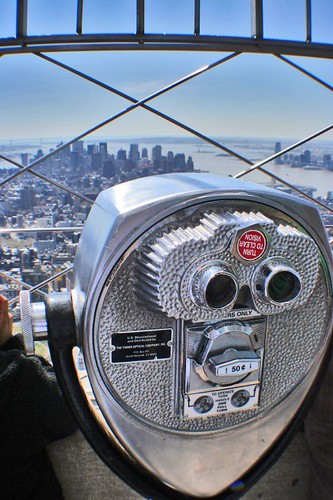 It struck me the other day, while reading one of Springwise's increasingly frequent posts on the mass customization of travel, that the types of travel apps and sites being developed right now to personalize the urban travel experience could have a profound impact not just on how we visit cities, but on how cities themselves function, as well.
Urban travel has long been a two-sided coin, with time in a new city being divided (in different ratios, depending on the tourist) between the standard landmarks like the Empire State Building, or the Forbidden City, and the day-to-day urban world that exists on the edges of guidebooks; think of Brooklyn back in the 1990s, or Beijing's fast-evaporating hutongs today -- places to which people are drawn to observe the day-to-day lives of other people, to experience the spectacle of the extraordinary-ordinary.
The Postcard City and the Real City are inevitably pitted against each other in a battle for the urban tourist's limited time. But as cities grow bigger and bolder on our increasingly urban planet, it seems fair to assume that greater and greater numbers of tourists will make their way down the streets of cities that they do not call home; as such, the traditional landmarks and attractions become more and more crowded, making the prospect of tooling around a lesser-seen part of the metropolis an increasingly attractive option for visitors.
The aforementioned trendblog has spotted some real doozies lately; a site that allows you to navigate cities by mood (Could Yelp-like testimonials about certain blocks, streets, parks, or even whole neighborhoods define or even change the mood of a given place?); another that uses personal data to create personalized guidebooks (Would the diversity of interests force travel publishers to re-think the meaning of the term "attraction?" I.E. cyclists' internationally competitive quests to speed up the steepest slopes could reboot the way a whole subculture navigates hilly cities like San Francisco, Pittsburgh, Guilin, and Lisbon); and yet another that helps you track down a hot scene at the last minute with crowdsourced GPS data (Anybody up for an impromptu, flashmob-style block party?)
 The customization of the urban tourism experience not only makes wandering off the beaten path more common, but more enticing as well, and has the potential to distribute visitors more evenly around the city than old-school printed-paper guides, with their hyper-selective map insets and restaurant listings.
But does this dispersal of small-time explorers legitimize or cheapen the Real City? It seems like an echo of the ongoing argument about gentrification; after all, while tourists themselves are a temporary presence in a given location, their combined influence can be very powerful over time. (You could make a strong case for the influence of tourism in speeding the process of gentrification, itself.) And, while the carving of initials into a famous landmark is a time-honored tradition (as old as the very idea of "landmarks"), the tourists of tomorrow could soon be able to carve their very presence into the city in the unpredictable paths that they cut through it, shifting not only the way that other visitors, but the very citizens of the city in question, navigate and experience a place.
(Photo from Flickr users LondonSLR and neiljs. The original full-sized versions can be viewed by clicking the photos.)
Tuesday, July 8, 2008
Sunday, March 9, 2008
Weekend Reading Addendum
 While cleaning out the email inbox, I stumbled onto some links that I have been meaning to add to Weekend Reading for some time now, and keep forgetting precisely because they're in my email inbox and not saved in my reader. Oh, my poor addled brain, unable to keep track of all these internets. Without further ado...
The website of the Hand Drawn Map Association (Photo credit)
A new blog called Variable Interest
Another from PlannersWeb
The new Monu on "Border Urbanism"
Enjoy, compadres.
Tuesday, January 15, 2008
Bite-Sized City
 The bite-sized book is an idea being pioneered by a site called DailyLit, where, according to Trendwatching.com's blog Springwise, "books are sent by email or RSS in individual instalments on the days and times selected by the reader—for example: every weekday at 7:45 a.m.—and each instalment is small enough to be read in less than 5 minutes."
This format strikes me as a particularly interesting (and easy) way for a person to explore the urban environment. Imagine that you've just moved to a new neighborhood. You go to the neighbors' association's website and subscribe to a free daily mini-tour. Each Saturday at 1:00 pm, you receive a text message with a starting point. Once there, you open a temporary audio file on your Blakberry or iPhone or whatever wired mobile device you're carting around, and you're talked through a 15- to 20-minute exploration of another corner of your new surroundings. The tours could even be recorded by a variety of people who are active in the given neighborhood, and could seamlessly integrate opportunities for community involvement into what might otherwise be aimless walks by highlighting local events, organizations, and landmarks.
Now imagine that you're a tourist on a first-time trip to New York. Subscribe in advance to a feed like this and have bite-sized neighborhood tours sent to you every three hours. These tours could even be sequentially linked to start you off in each neighborhood, allowing for a few hours of independent exploration between tours. Heck, with the ubiquity of GPS technology, you could download a series of geo-coded tours in advance that would be triggered when you passed from one neighborhood to the next. As you walk north across Houston Street from SoHo to the Village, your phone rings. You answer, and a voice suggests that you walk three blocks east to Houston and Thompson to begin the Greenwich Village tour.
With this sort of technology, unfamiliar territory becomes a bit less intimidating. Recent transplants get out and meet more of their neighbors. Tourists get a boost in confidence that would likely encourage them to cover more ground and venture farther off the beaten path than if they were wandering about with nothing but a street map and a dated copy of Fodor's New York. Perhaps part of the reason that there are so many people in Times Square is that people can recognize where they are; they understand their position in the city. For the intrepid urban explorer this may seem superfluous, but any city hoping to increase tourism or revitalize a neighborhood is woe to underestimate the power of the sense of disorientation.
Making cities and neighborhoods more friendly, inviting places -- for visitors and locals alike -- is an important step in the struggle to improve urban conditions. People naturally avoid places where they feel uncomfortable. Encourage them to expand their understanding of their surroundings, and half the battle is won.
(Photo from Flickr user morethanreal. The original full-color version can be viewed by clicking the photo.)
Links:
DailyLit
Books in bite-sized portions (Springwise)
Thursday, December 13, 2007
The Dream Remains the Same
 A recent post over at TNAC's blog, The Street, suggests that it may be time to change the American Dream. But what is the American Dream, exactly? It's a well-worn turn of phrase (were it a turn in the road, the guardrail might be out from being hit so many times), and while people usually use "American Dream" as slang for "house in 'burbs, lawn, two cars, spouse, 2.5 kids, dog," I would argue very strongly against this interpretation. The American Dream is not about houses or property or ownership -- heck, it's not even about money; it's about "new hopes, new dreams, and a better way of life for the future."
That quote was taken from an animated short produced by the Walt Disney Company in the 1950s. The subject was, surprise surprise, the future of superhighways. The Disney folks imagined a tomorrowland where automobiles provided the ultimate in high-tech freedom and mobility, populations were dispersed over "vast metropolitan regions" and the family unit was supported and enhanced by the great amounts of leisure time left over from avoiding the hassles of urban existence. On top of that, a global system of superhighways was to connect all nations and peoples and increase cross-cultural communication and collaboration. Oh, how glorious it looks on that little YouTube screen.
The present, as we are well aware, looks slightly different. Private vehicles do provide freedom and mobility, in a way...even if much of that free time is spent in the car, staring at a bumper. As a result, we've given up on that whole "extra time with the family" thing; in fact, divorce rates have soared as our population has spread out, stretching marital relationships to their breaking points by removing the basic social frameworks that might allow spouses to have some much-needed time apart outside of the workday (since both work full-time to pay for the oversized McMansion and the two SUVs).
Then again, that scenario is as well-worn as the term "American Dream." Still, the Dream itself is in no need of an overhaul. We would do well, perhaps, to wrestle it out of the arms of marketing-types still using it to pitch the 1-Acre Lots For All, Ford Chevy Ram MegaCharger bullshit. But the American Dream is as honest and straightforward and bright today as it ever was. You can see it in the modern sustainability movement in the same way that you can see it in Disney's adorably retro vision of the superhighways of tomorrow: the American Dream is about change. More specifically, it's about things changing for the better, and about people having the freedom to enjoy and participate in the process of change. Society and culture are driven -- and have always been driven -- by the masses. The dream of a brighter future took the "American" moniker from the fact that the United States was the first modern nation to do away with the European monarchal system. Change will always happen since the people will demand it; the US was one of the earliest countries to make that its raison d'etre.
In the eternal quest for the elusive "brighter tomorrow," we will continue to make mistakes. We will have disasters and wars, and terrible things will happen. People will die, dictators will rise and fall, and the oceans might rise up to claim some of our cities. But we will continue to evolve with the world around us. So the American Dream is in no need of modification. It is always a good idea to stop along the path and shake off some cobwebs, but hope for something better is the essence of what makes us congregate, collaborate, and create.
Cities are based on this principle; at their core, they rely on change. Cities lose buildings and parks and whole districts; much like any living organism, old cells must be shed to make way for the new. While it is sometimes painful, change will always happen, and as the largest, most interactive manifestations of mankind's ambition, cities will have to change for the good and the bad, just like we do. In short, you can't curse the suburbs; you'll just run out of breath. Instead, try to imagine what the next batch could look like. Try to imagine a brighter tomorrow while accepting that the suburbs will be a part of it.
More on this soon, as a review of Paul Lukez's Suburban Transformations is forthcoming.
(Photo from Flickr user brassplayer. The original full-color version can be viewed by clicking the photo.)
Links:
Changing the American Dream (The Streets)
Magic Highway USA (Part IV)
Magic Highway USA Publicity Stills (Paleo-Future)
Thursday, November 8, 2007
WEEKEND READING: November 3-November 9, 2007 (Guest Post by Colin Kloecker)
 Hi, I'm Colin and I usually write over at Blog Like You Give A Damn. But this month you'll find me here, curating Where's Weekly Reading segment. Brendan has graciously allowed me to break from his standard format for something a bit more casual. Let's call it a stream-of-thought meditation on a theme.
This week -- Near future urbanism: how an ubiquitous and multi-layered network might effect our urban environment. Photo: OiMax (via Flickr)
Moore's Law tells us that computing technology is advancing exponentially – essentially doubling every two years. With Rainbows End, mathematician, computer scientist, and science-fiction writer Vernor Vinge extrapolates on Moore's Law and envisions a near future where the physical world can be reinterpreted through "contact lenses that can overlay what the wearer sees with skins that redress the environment to your taste." [Check out this smallWORLD podcast to hear Vernor talk at length about the concepts and technologies behind Rainbows End] A similar concept is explored in William Gibson's recent novel Spook Country, in which locative artists create incredibly complex site specific geo/virtual mashups, tied to specific locations through GPS and wi-fi technologies [see gpsdrawing.com or this video for some real-world examples].
Both of these authors and their recent works are proposing a malleable virtual/ urban environment where user generated content meshes seamlessly with concrete and grass [see CSI:NY's recent foray into Second Life for a not-so-seamless example]. Essentially, if you don't like the looks of that new condo going up across the street - simply design a new facade, upload, and share with your social network of choice.
In a world where the net is everywhere and we are always online, geographic locations will be linked in as well. It won't be long before we are going about life tagging locations with keywords or personal stories like we would a page on the web (imagine geo.del.icio.us or MySpace taken literally). As technology advances and life-caching becomes more robust, you could feasibly go back to the location of your first kiss, bring up the appropriate file, and project that exact moment in real-time. Hackers and artists will upload pirate landscapes, momentarily hijacking reality for thousands of people at a time. Communities with similar belief systems might organize around a shared perception of reality or aesthetic sensibility - and then actually make that their reality.
So all of this speculation begs the question: in this media-rich user-generated landscape, what role is there for the architect and urban planner? Will cities be reduced to the skeletal equivalent of a wire frame 3D model, designed to be dressed up with an infinite and interchangeable architectural wardrobe? This is to say nothing about questions about privacy or invasive marketing strategies... phew!
As you can probably tell, I've been on something of a futurism kick. Check out futuretalks.com if you're digging it too. They recently started broadcasting an interesting series of conversations with futurists Gerd Leonhard and Glen Hiemstra. Until next week, Happy Friday!
Tuesday, October 9, 2007
Civic Crowdfunding
 As technology becomes increasingly ubiquitous, the internet is fast becoming the new Agora. The social functions of the public square are being transferred into cyberspace, and we are being forced to come up with new ways of doing things in cities. Public discourse is the perfect example; urbanites, once able to voice their opinion in the public square, are finding a new voice online. City governments have a real opportunity, then, to tap into public opinion and get to work on citizens' real concerns.
One of the most interesting web 2.0 developments has undoubtedly been the rise of crowdsourcing, and now by extension, crowdfunding. A particularly interesting and grassroots-y example of crowdfunding comes from the site Sellaband, which allows music lovers -- whom Sellaband refer to as "believers" -- to pool their money with other believers to help artists, who submit their music to the site, fund a trip to the recording studio. This method breaks a band down into 5,000 "parts," which are each sold for $10. Once $50,000 has been raised through the sale of these parts, Sellaband provides the artist with an A&R professional to guide them through the recording process. The full amount must be raised before the recording process can begin, so this turns both artists and believers into music evangelists, spreading word of the fund-raising effort to friends, neighbors, co-workers, etc.
It would be great to see something like this applied to neighborhood, or even city-wide improvement projects to create a kind of civic crowdfunding. The Sellaband method makes a great deal of sense since it pools money from a large number of people who then provide free marketing and PR. By tapping into peoples' passion for where they live, city officials and even developers can enliven the civic discourse by using internet technologies. Just imagine the potential of a site where people didn't just complain about local problems, but offered feasible solutions and invited their neighbors to get involved in getting real results. City Hall could even have an agreement whereby it provided a city official in a related office to help guide a fully-funded neighborhood project through the implementation.
If it sounds pie-in-the-sky, you might be surprised to hear that there are already somewhat similar programs in several cities. Seattle, for instance, has its own Department of Neighborhoods, a city department that deals with neighborhood projects and services. The SDoN even has a matching grant program that helps groups of Seattleites to fund projects that address the problems they have identified within their own neighborhoods. From their website: "Funds are limited so it's a competitive program. Applications are considered during specific funding cycles and the highest rated applications are awarded funds." From the sound of it the ratings come from a government body, but this looks like an early form of civic crowdfunding.
Next we turn to Minneapolis' Neighborhood Revitalization Project (NRP), which is "an investment program based on truly empowering residents by bringing them into the priority-setting process of the city. It is based on the belief that the empowerment of residents and the mobilization of untapped resources, energy and creativity can make our collective desire for a better future a reality. Neighborhood based priority setting, planning, and implementation are NRP's core. Residents and other neighborhood stakeholders create Neighborhood Action Plans (NAPs) that describe the neighborhood they want in the future and the goals, objectives and specific strategies that will help accomplish their vision. NRP completes the empowerment process by providing funding to each neighborhood to help implement their approved NAP."
The Neighborhood Action Plans seem to be another form of primitive civic crowdfunding. While the funding structure is still traditional (read: external), it is neighborhood residents that are creating the plan for their neighborhood (I knew someone had to be doing this already) and setting the priorities of the plan. Will everything that these plans address work out as residents had hoped, or even in their favor? Probably not. But it would be foolish to suggest that developers and/or City Hall always gets it right when trying to "fix" neighborhoods. There is a certain amount of risk involved in a program that asks lay citizens how their neighborhood should be improved -- but there is a wealth of unprofessional expertise, as well. After all, planners may know best how to move traffic efficiently through a theoretical neighborhood, but residents understand the idiosyncrasies and unplanned tics of their neighborhoods better than anyone who doesn't live there.
Springwise, the bloggy arm of Trendwatching.com, had this to say in a recent profile of a software crowdfunding site: "In addition to a marketplace for software development, microPledge reckons its site will come to be viewed as a free market-testing service to gauge the reception for new software products and features. Interesting example of the intention economy at work: when consumers have to put their money where their mouth is, it's a pretty good bet you can believe what they say." If you extend this argument to neighborhood crowdfunding in cities, it holds up quite nicely. The risks of trusting what some might term "non-experts" are mitigated in crowdfunding by the wary wisdom of the consumer. Neighbors are more likely to ignore flashy-but-ineffective revitalization projects, choosing instead to fund the kinds of improvements that will raise an area's quality of life in all of the little ways that legacy-laden city officials can overlook.
Little bits add up. That's what crowdfunding is all about.
(Photo from Flickr user djpiesas.)
Links:
Sellaband
Seattle Department of Neighborhoods
Minneapolis Neighborhood Revitalization Project
Crowdfunding software projects (Springwise)
Tuesday, October 2, 2007
Questioning the Creative Class Logic
 Sometimes I can't help but wonder if maybe the whole Creative Class phenomenon is doing more to harm cities than it does to help them. Not in all cases, of course...certainly many cities are benfitting from the investment in their artistic and recreational infrastructure. But the primary purpose of a city is to provide high-quality services to all of its citizens, and at times it seems like this responsibility falls by the wayside as civic governments try to focus on building Creative Class-friendly amenities.
Gentrification happens because neighborhoods throughout a given city are unequally supported. And while this isn't the fault of the Creative Classmates, they appear to be exacerbating the problem by attracting a disproportionate amount of attention -- and funding -- from mayors who think of their presence as a silver bullet. With rich creative people comes an increased tax base, and with an increased tax base, more problems can be solved in less privileged areas, right?
Portland, Oregon, is seen as one of the capitals of the Creative Class. The city's arts and cultural scenes are thriving, with artists flocking to the once-granola metropolis to be a part of the scene. As a recent article in Slate pointed out, "it's rare to meet a young, creative Portlander who's from Portland." Its success in drawing talent from other cities is, in fact, one of the reasons that Portland is held up as model of the Creative Class metropolis. The CC is all about migration, after all; it could not exist without the internet, which allows for artists to live in cheaper cities while still participating in the larger artistic fields in which they are interested and/or employed.
Jump to the other side of both the country and the spectrum, to New York City. Manhattan and Brooklyn (and, to some extent, Queens) have become inordinately expensive. The city -- or The City, with caps, as it's known Stateside -- has become what airoots recently described as "a networking platform and marketplace for established creative people from all around the world, [but not] much of a place for emerging artistic production within the city." NYC is a popular city with the Creative Class as well; in fact, it is the sun to their universe, around which all things (in some way) orbit. In effect, New York has become the City of Art, while the artists have fled to the hinterland.
But what has made Portland -- or Boston, or Boise for that matter -- a hub of activity for those who have fled New York's rising rents? One of the things that a large chunk of the Creative Class' centers of production share is a strong public services network that pre-dates the city's popularity. They are cities with well-maintained parks, strong transit systems, and clean and affordable utilities (water, electricity, etc.) Cheap space must be available -- again from airoots, the new creative cities "are open and messy enough to provide artists with interstitial spaces they can takeover and make their own."
Walkability, density, urban character -- all of these things are supposedly important to the Creative Class. Yet there are cities much closer to New York (aka the Center) than Portland that offer all of these things in larger helpings yet have failed to tap into the Creative Class boom as effectively as the Rose City. To name a few: Philly (which is starting to benefit from NY's overflow but is still limping considerably), Washington DC, Pittsburgh, Cleveland, Cincinnati, Milwaukee, Richmond. It seems to me that the advantage that Portland had over these places was strong, well-maintained infrastructure. After all, if you don't want to live in New York but you can live pretty much anywhere else, you're going to choose a city that can provide you with the most comfortable life with the lowest amount of stress.Milwaukee is a perfect illustration of the benefits of maintaining strong basic urban infrastructure -- and what happens when that maintenance falls by the wayside. The city managed, against all odds, to remain in the black into the 1930s while other cities across the US struggled with the Great Depression. This was largely due to the civic integrity of the city government (socialists, for the record) and the fact that they had not been extravagant in their spending during the Roaring Twenties. Milwaukee eventually suffered from the depression like the rest of the country, but anyone who has followed the history of the Midwest can tell you that the Brew City never suffered the kinds of blows sustained (or not) by Saint Louis, Detroit, and Cleveland. After the depression passed, the industrial city roared, and its services remained strong and well-maintained until the 1980s. Slowly over the past twenty-five years, the city and county have been chipping away at Milwaukee's utilities, infrastructure, and once-legendary bus and parks systems. Even with the Creative Class leading a renaissance in parts of the city, crime is at an all-time high and the racial segregation is some of the worst in the nation.
The importance of creativity in the modern economy is nothing to sneeze at. While basic services are something that cities need to focus more heavily on, it is important that they bolster the creativity of their populace. But it seems to me that spending city funds on cultural amenities, building artist housing, and hosting snazzy (and pricey) festivals might not be the best way to go about incubating a culture of innovation and artistic aspiration. If anything, they seem likely to create a dangerous "us and them" tension between the Creative Class and their fellow city-dwellers. In a way, this could even be seen as the institutionalization of the overprofessionalization of art.
So how can cities create a dynamic, creative culture without overreaching? I have some ideas, but this post is starting to get long, so I'll save them for tomorrow.
(Photos from Flickr users gonebiking and Digital Trav.)
Links:
The Indie City (Slate) (via Brand Avenue)
New York Rollercoaster City (airoots)
Urban Fictions: The Toolhouse (airoots)
Friday, September 7, 2007
WEEKEND READING: September 1-7, 2007
 It has been a busy week at Where. The last couple of days have been slow news days, but there was a glut of good stuff earlier in the week. Here are the highlights...
ITEM ONE: Airoots has posted the most eloquent lament of New York's homogenization yet...
ITEM TWO: ...and the authors' following post, on the fluidity of Tokyo nightlife, confirmed that airoots is, in fact, the best urbanism blog that you're not reading yet.
ITEM THREE: A new urban issues zine, The World Edition, is up and running this week with articles from founder Alexander H. Johnstone, Archidose's John Hill, and (in the interest of full disclosure) me. Heh.
ITEM FOUR: Gran Raccordo explains why New York is actually Pittsburgh.
ITEM FIVE: The AHI blog takes a look at what the recent presidential election in Turkey will mean for affordable housing in that country.
ITEM SIX: Mark the date - Wikicity Rome takes place tomorrow (Saturday, September 8th).
ITEM SEVEN: BoingBoing covers the fascinating Homeless World Cup, which is exactly what it sounds like.
Have a great weekend!
(Photo from Flickr user diebmx.)
Thursday, May 17, 2007
Community 2.0 and the Built Environment: Neighborhood Futurism
"The Long Tail may prove to be a problem for another reason, what Robert Putnam calls 'cyberbalkanization'...Given the vast number of possible clusters one can associate with, it becomes possible, ultimately, to find a comfortable niche with people just like oneself, among other individuals whose views merely reinforce one' own. If the Internet is hardly responsible for this condition, it can exacerbate it while giving us the illusion that we are connecting with others. Through portals like news.google.com or my.yahoo.com and, even more so, through RSS readers, Nicholas Negroponte' vision of a personalized newspaper freshly constructed for us every morning, tailored to our interests, is a reality. Even big media, under pressures of post-Fordist flexible consumption, has itself fragmented into a myriad of channels. But this desire for relevance is dangerous. It is entirely possible to essentially fabricate the outside world, reducing it to a projection of oneself. Rather than fostering deliberation, blogs can simply reinforce opinions between like-minded individuals. Conservatives talk to conservatives while liberals talk to liberals. Lacking a common platform for deliberation, they reinforce existing differences. Moreover, new divisions occur. Humans are able to maintain only a finite number of relationships and as we connect with others at a distance who are more like us, we are likely to disconnect with others in our community who less like us. Filters too can lead to grotesque misrepresentations of the world, as in the case of happynews.com ('Real News. Compelling Stories. Always Positive.')."
This passage, from the conclusion of Kazys Varnelis' forthcoming book The Rise of Network Culture, absolutely sets my brain on fire. The (theoretical) process examined here -- this "Cyberbalkanization," as it were -- strikes me as having the potential to cause one of the most radical and fundamental shifts in urban demographics over the coming few decades. Human beings have always formed local communities by seeking out familiar neighbors. In America, the ethnic clustering caused by massive waves of immigration in the eighteen and nineteen-hundreds carved the social geograpies of major cities into the familiar, nationality-coded neighborhoods that now serve, more often than not, as tourist attractions in a country that is increasingly obsessed with the "other." We have a whole slew of Chinatowns and Little Italys scattered across the nation that allow us safe passage to foreign countries without ever requiring us to bother getting a passport. Or actually leave home.
It seems very possible to me, then, that as Community 2.0 technology creates increasingly mobile and focused networks of people, it has the possibility to shift the emphasis from ethnic demographics to lifestyle-based demographics. Think "Gayborhoods" multiplied on a massive, society-wide scale. Imagine Lower Manhattan, the proverbial "melting pot" of ethnic neighborhoods, reorganized into new, hyperbranded communities: the Bowery as a center of the Dungeons & Dragons community; Little Italy as a robust enclave of Birding-types; the streets of Chinatown filled with immigrant Map Enthusiasts digging through bins of fake antique sextants and folders of illegal knockoff designer topographic charts to decorate the exposed-brick walls of their loft apartments.
If the internet and C2.0 tech turn out to be the great economic equalizers that some hope they are, our city neighborhoods could become intensely focused, dismantling the current, socioeconomically segregated landscape in favor of these types of interest-based communities. Marketing would become less about influencing decisions and more about directing entire social networks (which is already happening, in some ways.) As culture was sliced and diced into ever-smaller, more specified pieces, block numbers would become the new brands. To be from the 300 block of Broome Street in Manhattan would make one instantly identifiable as a Level Three Dungeon Master of Fire...or something. (My apologies to D&D enthusiasts.)
Or think about the potential nightmare of the post-net neutrality real estate market in a world of internet-organized neighborhoods, with users living in server- or website-centered communities. New Yorkers might choose to live in TriBeYa (Triangle Belonging to Yahoo!); San Franciscans could buy trendy lofts in The ComCastro; across the pond, Londoners would flock to the clean-scrubbed, hypernetworked streets of Mayfairspace. Just imagine the advertising fustercluck...no, on second thought, don't.
All of this fantastical speculation leads me to this question: if the internet has the power to reshape urban demographics, what power, if any, does urban design have to combat this kind of ideological, hypercommercialized isolation? I should probably have at least some semblance of an answer to close out this post. But I don't.
Any ideas?
Series Posts: Introduction; The New Agora; Communeconomics; The Phil Tadros Interview
Links:
Conclusion to Networked Publics (Varnelis.net)
This passage, from the conclusion of Kazys Varnelis' forthcoming book The Rise of Network Culture, absolutely sets my brain on fire. The (theoretical) process examined here -- this "Cyberbalkanization," as it were -- strikes me as having the potential to cause one of the most radical and fundamental shifts in urban demographics over the coming few decades. Human beings have always formed local communities by seeking out familiar neighbors. In America, the ethnic clustering caused by massive waves of immigration in the eighteen and nineteen-hundreds carved the social geograpies of major cities into the familiar, nationality-coded neighborhoods that now serve, more often than not, as tourist attractions in a country that is increasingly obsessed with the "other." We have a whole slew of Chinatowns and Little Italys scattered across the nation that allow us safe passage to foreign countries without ever requiring us to bother getting a passport. Or actually leave home.
It seems very possible to me, then, that as Community 2.0 technology creates increasingly mobile and focused networks of people, it has the possibility to shift the emphasis from ethnic demographics to lifestyle-based demographics. Think "Gayborhoods" multiplied on a massive, society-wide scale. Imagine Lower Manhattan, the proverbial "melting pot" of ethnic neighborhoods, reorganized into new, hyperbranded communities: the Bowery as a center of the Dungeons & Dragons community; Little Italy as a robust enclave of Birding-types; the streets of Chinatown filled with immigrant Map Enthusiasts digging through bins of fake antique sextants and folders of illegal knockoff designer topographic charts to decorate the exposed-brick walls of their loft apartments.
If the internet and C2.0 tech turn out to be the great economic equalizers that some hope they are, our city neighborhoods could become intensely focused, dismantling the current, socioeconomically segregated landscape in favor of these types of interest-based communities. Marketing would become less about influencing decisions and more about directing entire social networks (which is already happening, in some ways.) As culture was sliced and diced into ever-smaller, more specified pieces, block numbers would become the new brands. To be from the 300 block of Broome Street in Manhattan would make one instantly identifiable as a Level Three Dungeon Master of Fire...or something. (My apologies to D&D enthusiasts.)
Or think about the potential nightmare of the post-net neutrality real estate market in a world of internet-organized neighborhoods, with users living in server- or website-centered communities. New Yorkers might choose to live in TriBeYa (Triangle Belonging to Yahoo!); San Franciscans could buy trendy lofts in The ComCastro; across the pond, Londoners would flock to the clean-scrubbed, hypernetworked streets of Mayfairspace. Just imagine the advertising fustercluck...no, on second thought, don't.
All of this fantastical speculation leads me to this question: if the internet has the power to reshape urban demographics, what power, if any, does urban design have to combat this kind of ideological, hypercommercialized isolation? I should probably have at least some semblance of an answer to close out this post. But I don't.
Any ideas?
Series Posts: Introduction; The New Agora; Communeconomics; The Phil Tadros Interview
Links:
Conclusion to Networked Publics (Varnelis.net)
Subscribe to:
Posts (Atom)


