Showing posts with label entertainment. Show all posts

Thursday, August 14, 2008

Air Show

It's Air Show Weekend here in Chicago, which means the US Air Force's Blue Angels are "practicing" overhead for the next few days. "Practicing," of course, translating to "flying so ridiculously low and fast over one of the most densely populated areas in the country that the noise they make sets off car alarms and makes pictures tilt on their wall hangars."

Seriously, who thought this up?

Any thoughts on urban air shows? They're a blast to watch, but really...do they have to practice over the 'hoods for three days? Listening to the roar of the jets flying overhead, I feel a bit on edge...I have to wonder if an event like this has some sort of subtle psychological effect on people.

Monday, July 21, 2008

The Outquisition and Urbanism Camp

Prolific greenblogger Alex Steffan wrote a post last weekend about an idea spawned during a late-night coffeetalk with the equally prolific and fantastic Cory Doctorow (which sounds like maybe the most thoroughly awesome way to spend a weeknight, ever) that Doctorow dubbed "The Outquisition." The idea is grand and audacious in just the right way, and the comments that follow the initial post are well worth a read. But this post is about an offshoot inspired by a footnote in Steffan's post.

The dynamic e-duo's Outquisition involves sustainability-minded urbanites trekking out to failing suburbs and shrinking cities around the world, bringing with them innovative, site-specific solutions to the slew of new problems being brought on by the collapse of the oil-based economy. In his litany of suggestions, Mr. Worldchanging mentions "running holistic programs for kids" as a possible method of green evangelism. This re-ignited an idea I'd been going over a few months back: urbanism camp.

There are all kinds of camps for kids. There are outdoor adventure camps, sports camps, art camps, and plain old-fashioned away-from-home summer camps, with their crafts and campfires and capture the flag tournaments. Kids learn a lot at camp; not only do they build social skills, they are able to hone their interests and be exposed to new activities and ideas. With families increasingly looking at cities as a solid alternative to suburban picket fences, it seems like camp would be the perfect way to teach kids how to appreciate the urban environment.

Indeed, life in the city is very different from life in the suburbs for a youngster. A city-focused camp could feature games that took advantage of urban neighborhoods, sneaking in lessons about street safety amidst the fun. Trips to different neighborhoods, museums, community centers, parks, and public spaces could not only expose kids to a variety of subjects, but also introduce them to the many different creative outlets provided by a dense urban core.

This poses all sorts of interesting questions; architecture, public space, sustainability, diversity, mass transit -- can these things be entertaining to an eleven-year-old? It's kind of fun to ponder. Maybe someday, somebody will actually come up with an affirmative answer.

Tuesday, April 29, 2008

The Next Street Art

Say there was a place that had some special meaning to you. It could be the alcove where you had your first kiss, the alley where you were mugged, the square where you participated in an important rally, or the location of an historic uprising. Good or bad, we all infuse places with our memories. This is what makes physical places so powerful, and why peoples' opinions and experiences of the same place can be vastly different. Places are what people make of them. Now, technology could be making it easier for tech-savvy street artists to etch their own experiences and opinions onto physical places, communicating the artists' own sense of a place to others who pass through it.

Barcodes are most commonly used in retail environments, but their size and informational storage capacities make them ripe for adaptation for more inventive uses. In Japan, barcodes are now being applied to gravestones to store and transmit information, when scanned, about the deceased. The idea here is that family members will, through videos, photos, and stories, be able to reconnect with the deceased in a less mournful, more celebratory way. Imagine "a sort of gravestone based, family fueled, wiki of the dead."

This technology could easily be used in public spaces to represent a political viewpoint or a historical event. Imagine walking down a street for the first time and noticing a bright green barcode sticker affixed to the facade of a building. Using a scanner-enabled mobile device, you could access a website loaded with the history of the building site, or a series of short stories about the surrounding blocks, or photos of a lifechanging event that a stranger experienced in the very spot where you are standing. Reading or viewing material like this would give the place a new gravitas, and would change your perception of what might otherwise be a mundane stretch of asphalt and brick.

RFID tags are another method of remote-storing information that, thanks to increased range, provide the opportunity for a bit more mischief. With the technological know-how, a clever street artist could program a chip to send a text message or photo to any wi-fi enabled mobile device passing by. Imagine again: you're walking down a street and you pass a hidden RFID tag; your phone rings. You answer. An audio recording plays, recounting a woman's personal account of a riot that took place across the street a decade earlier. Later, walking through a park, your text alert sounds. You open the message to find a set of coordinates and the time of an upcoming event, perhaps a flash mob or a constructive riot. Or, perhaps, a photo of the view from the very place that you are standing, hyperlinked to a database of stories and photos of places around the city (along the lines of Invincible Cities, linked below).

While they would only be accessible to those with the proper devices to read the information that they stored, RFID tags and barcodes have distinct advantages over more traditional forms of street art like posters, graffiti tags, and murals. For one thing, they are smaller, and less intrusive. While this could be seen as a weakness (especially for barcodes, which require direct interaction), it is also a strength in that RFID tags and barcodes are less likely to prompt their own removal than more readily noticeable artistic interventions. These tiny storage units can also provide more vivid, personalized accounts of events or viewpoints, and have the potential to be more impactful on their viewers.

RFID and barcode street art has the potential to turn the urban environment into a virtual minefield of information. While the potential for abuse by malicious hackers or marketing drones is there, the idea of being able to literally "tag" a place with multimedia information is an exciting one. Perhaps it's already being done. Anyone know of some examples?

(Photo from Flickr user cloverst. The original full-color version can be viewed by clicking the photo.)


Links:
Barcodes on tombs to connect with the dead (The Inquirer)

Invincible Cities (Thanks, Pete!)

Sunday, April 13, 2008

And the Winner is...

"As a way of improving safety and bridging the gap between the city core and the bulging periphery, the city has launched a Defense of Modern Ruins program, stringing together blighted sights that range from industrial sights to downtrodden art-déco buildings to bureaucratic baroque whales. The program includes low-rent housing schemes, urban wilderness tours and itinerant party circuits."

Congratulations to H.B., whose entry in the Blogedanken contest recieved almost a full 50% of the public vote.

Many thanks to all of the participants for making this a fun impromptu blog-event. Note to the winner: shoot me an email and your copy of Hyperborder will be in the mail.

Friday, March 28, 2008

WEEKEND READING: March 22-28, 2008

Sorry for the slow week. Regular posting should resume after this weekend. In the meantime, there's always plenty of weekend reading to go around!

ITEM ONE: First off, a bit of self-promotion. I have a new post up at Next American City projecting some possible outcomes of the rise of online virtual worlds and increased advertising in Western culture. The French Quarter as an export? Perhaps...

ITEM TWO: WorldChanging with a stirring piece on the powerful political act of optimisim.

ITEM THREE: Is your city a "Paris" or a "London"? Read this Economist piece comparing the two euro-glam-capitals and ponder that question for a bit. (Via Pittsblog)

ITEM FOUR: PlannersWeb takes an in-depth look at the role of urban planners in a Chavez-led Venezuela.

ITEM FIVE: Core77 reports on the book containing the radical designs generated by participants in eVolo's '06, '07, and '08 Skyscraper Competition. Flashy stuff. (Photo credit)

ITEM SIX: Speaking of radical architecture, Richard Florida posted news of a massive floating city-cum-cruise ship. This definitely falls under "You gotta see it to believe it."

ITEM SEVEN: Over at Interchange, Barbara Faga looks at the somewhat comical tug-of-war in public perception of which is worse: density or sprawl.

Hasta luego; enjoy your weekend.

Tuesday, March 18, 2008

It Takes a Video Game to Save a Village

Most cities have a love-hate relationship with tourists -- civic officials love them, and residents hate them. Tourism generates billions of dollars in revenue for cities across the globe each year. The number of traffic accidents caused by tourists not watching where they're walking? So far, no reliable estimates have been made.

Still, tourism is a vital part of any urban economy. Even moreso, it can be a powerful factor for a neighborhood that is trying to lift itself up. Tourism As Economic Strategy is a well-worn path. But with all of the emerging technologies related to the web and wireless communication, it seems like the old urban tourism formula (cleaned up historic buildings + quirky neighborhood attraction + Starbucks and/or Cold Stone Creamery and corresponding independent cafe/gelato bar = success!) is due for an overhaul.

Let's start by thinking small, with the traditional Japanese village. Japan's demographic woes have been well-reported over the past few years; indeed, as young residents of this highly urbanized island nation put off having families and move to the cities in droves to pursue fast-paced careers, the raw population number isn't the only thing being affected. Culturally, Japan is seeing the evaporation of its small villages, and the slow death of ancient rural and cultural traditions.

Enter: mixed-reality gaming. An explanation, c/o Very Spatial: "One of the areas of convergence for location-based applications and gaming is the idea of mixed reality, where places in the game correspond to real-world locations, and actions in one lead to events or consequences in the other." A recent Nintendo DS game, Treasure Quest: Enoshima, follows this very blueprint, using a small island north of -- surprise! -- Tokyo as the setting for a handheld video game. Players have to visit and explore the actual island to play the game. The DS unit acts as the mixer, blending the fictional and real worlds, literally with the push of a button.

The problem with Treasure Quest, though, is that it's over. The software could be downloaded off of the internet, and the game only ran until February 19th. Makes sense, considering that Nintendo doesn't own the island, and thus can't stake any real claim to it. But what if they could? What if, as a way to draw in tourists, a rural village somewhere in Japan agreed to sell off a large number of its abandoned buildings to Nintendo in an agreement to become the permanent setting for a mixed-reality video game?

It sounds crass at first, but with the right amount of finesse, it just might be a win-win economic development strategy. For instance, to prepare the town for guests (players), Nintendo would agree to upgrade local utilities. It would also take on the responsibility for upkeep of public areas. Streetscaping, garbage collection, and parks maintenance would be taken care of by the entertainment giant. Villagers would enjoy a higher quality of life at a lower rate of taxation (though I'm assuming the American system there since I know very little about the governance of rural Japanese villages). In return, residents would agree to coexist peacefully with players. A particularly savvy game designer would craft the game as a cultural experience, creating some sort of mystery or adventure plot that made use of the area's native traditions.

The argument could be made that Nintendo (or whatever company helmed the project) was being given too much power over a municipal entity; it could also be said that cultural traditions were being bastardized and pillaged in the name of commerce and fleeting entertainment. But when the options for the village are Sink or Swim, the picture becomes less black and white. After all, don't most -- if not all -- preservation efforts (architectural or cultural), on some level, tokenize the very things that they aim to preserve?

So assume that Nintendo creates a mixed-reality game around a rural Japanese town, and it becomes a wild success. Players start booking rooms at a nearby hotel months in advance for their chance to play. The villagers find new opportunities to pass along their cultural history and traditions. Nintendo makes a buttload of cash. Everyone's happy. A small town in rural Portugal hears of the success and decides to give it a try. Sony's European headquarters gets a call from the mayor...

Ten years later, mixed-reality gaming has become an economic silver bullet. Hundreds of villages in countries around the world have mixed their realities with fantastical virtual counterparts. The trend goes big-time when the city of Detroit sells a square mile of its infamous "urban prairie" to the Walt Disney Co., which painstakingly re-creates the neighborhood circa 1930 to stage a depression-era mob mixed-reality urban epic. The arts & crafts bungalows are the hotel. Visitors live in the game. A month later, Blizzard Entertainment announces a joint deal with CCTV and the city of Shanghai to buy up hundreds of defunct surveillance cameras and create the world's largest multi-player mixed-reality on-and-offline mega-game. The setting? Pudong.

Of course, it must be asked: when is the reality in question no longer considered to be mixed? When does "mixed" become simply "augmented?"

(Photo from Flickr user Mathias M. The original full-color version can be viewed by clicking the photo.)


Links:
Mixed Reality Gaming In Japan (Very Spatial)

Monday, March 17, 2008

Exploring the City of Tomorrow

A hypothetical Aura Map of Istanbul's Golden Horn.


Google Transit wants your city to get on their bus. At the American Public Transportation Association's recent TransITech conference the web giant's mass trans-tracking maps app (say that five times fast) challenged every transit agency in attendance to upload their schedules and information to the site by Earth Day of 2008. If Google's effort at TransITech is successful, live, up-to-date GPS-powered transit tracking for every major city in the country (and beyond) could be a reality much sooner than one might imagine.

It's a bit freaky at first; there's a whiff of Big Brother, and a dash of 1984. But once the knee-jerk paranoia passes, the benefits begin to sink in. With live-feed transit information, Google Maps and Google Earth could eliminate the need for standing on a windy or snowy street corner for twenty minutes, waiting for a late bus. Outside it could be pouring rain, but you'd know exactly when to leave the house to catch your train. Even making connections could be more easily choreographed. Suddenly, one of mass transit's biggest drawbacks -- unreliability -- is eliminated. Overcrowding becomes less of a problem, and the whole system runs more smoothly. Everyone wins.

Online mapping technology has come a long way since the basic click-navigation maps of MapQuest hit the web back in the 1990s. Nowadays you can easily access street-level views, satellite images, and highly-detailed maps of buildings and amenities of dozens of cities. Certainly, this makes the prospect of taking an exploratory walk through a new part of town less daunting; you can preview your route, get a feel for landmarks, even decide where you want to stop for lunch. But there's still a dimension missing. Online maps are still very much stuck in the 3D-level, at least as far as the masses are concerned. We're still figuring out how to map the most important factor in cities: people. Not individuals (again with the creepy 1984ishness), but crowds, traffic patterns, and even emotions.

Think back, once again, to the SimCity game franchise. In later versions of the game, players could open up maps that charted everything from traffic to crime to the general happiness (aura) of the entire city. Live. Can you imagine the potential of people-mapping technology as a tool for planners and policy-makers?

A scenario: it's 8:00pm on a Friday in the year 2015, and you're looking for something to do. You grab your wi-fone and fire up the GoogleCity live maps app. There are three parties within a ten minute walk of your house being advertised on GoogleSocial (a convenient MeetUp/Bebo-powered mashup), a wifi-gallery showing one of your favorite artists from deviantArt four subway stops to the south, a restaurant opening on the corner where that hookah bar just closed last spring, and a band whose iSpace page you just subscribed to because you heard one of their songs on Pandora's new Loc:Audio channel. There's no excuse to be bored. And oh, look -- if you leave now, you can catch the next bus, but it'll be at least five minutes for a train. Perhaps tonight will be a concert night? The e-stars have aligned...

You're happy. You're entertained. You click a button on the screen that tells Google that someone on your block is in high spirits. The block's aura jumps up one point. At City Hall a few weeks later, the general happiness trend of your neighborhood is noticed to be on the rise. Civic officials study the area to learn why this spike in aura has been occurring, and use this people-powered live information to liven up some less brightly-colored spots on the map. Repeat this process with any resource, tangible or otherwise. The places that need something get it more quickly, and the decrease in wasted funds leaves more tax money to be distributed wherever it's most needed.

Now you, as a citizen, have every right to see this information if your elected officials are looking in. So the aura map overlay is available via GoogleSocial. You tap the screen, pull it up. There's a spike near your friend's apartment building downtown. What's the deal? Street fair. You are so there. You lift the phone to your ear, call the friend, and then check a transit map. You just missed the train, which means 10 minutes of waiting. But oh, there's a cab around the corner. You ping it with the push of a button, and you're on the road a few seconds later.

The next day, you're ready to go for a run. You check out air pollution and crowd overlays. The wind is blowing everything to the south today, so air quality will be best on the north side of town, which is good, because that's where you live. The big orange blob in the middle of the park closest to your house suggests some kind of festival is going on. Not wanting to deal with people-dodging, you check out the riverfront. Clear as crystal. And you're off!

The full potential of maps, in terms of improving the quality of life in cities, is just beginning to be realized. Soon, maps won't just tell you where movie theaters are; they'll tell you which ones are less likely to be crowded, dirty, or noisy. Get ready for the cartographolution.

Links:
Get Your City On Google Transit (WorldChanging)

How Google Earth Ate Our Town (Time)

Sunday, March 16, 2008

Joie de Vivre Urbaine

"...And joie de vivre [joy of living] may be seen as a joy of everything, a comprehensive joy, a philosophy of life..."

Long ago, writers disparaged cities like London, New York, and Paris, labeling them as hives of disease and destitution. But over time, industrialization and economic growth powered by these urban centers lifted hundreds of millions of people out of poverty, creating a prosperous and secure middle class like the world had never seen. Over the past few decades, we have seen this happen again in China and India. With the rise of ideas like common wealth and the urban planet, it seems less naive each day to believe that this trend could continue moving upward, creating a globalized standard of living (not to be confused with a singular global culture, which would be intensely boring).

But the current model of urban living, with its sprawl, auto-dependancy, and tokenization of nature, is unsustainable at best. If economic development in developing world-cities is to diminish poverty at any notable rate, everyone -- in worlds both "first" and "third" -- must work to bring about the evolution of their cities into healthy, green, globally-minded places. The City As Solution to Climate Change and Globalization Pains has been a popular topic of conversation of late. But how can people in developed countries be persuaded to agree?

As we step into this new Urban Age, those of us arguing for the City As Solution must focus on the joie de vivre urbaine. For cities to reach their full potential as engines for change, the urban chorus will need to grow louder and brighter. The masses should be reminded of the joys and conveniences of living in vibrant, eqitable urban neighborhoods, not guilt-tripped out of their McMansions and driven into gentrifying neighborhoods to exacerbate socioeconomic inequality. Only when a person believes that they will enjoy something -- and that they deserve to -- will they make a real effort to change their way of life.

This week, as Where wraps up its first year in the urblogosphere, each day will feature a post that celebrates the excitement, promise, and possibility of the urban environment. It's Urbanism For Fun (but no profit). A preview:

Monday: EXPLORE
We'll start off by looking at how Google Earth and online mapping sites are making urban places more exciting by helping urbanites develop a better understanding of their cities, and how this type of technology could affect urban culture and society in the future.

Tuesday: PLAY
Taking another look at mixed-reality gaming, Where will consider this emerging form of entertainment as a possible catalyst for economic development in the near future.

Wednesday: IMAGINE
If you could rethink how cities are built, how would you do it? It's a question many of history's most famous architects have taken on with relish. In a guest post by SOM design associate Ella Peinovich, who participated in an architecture studio that took on this very daunting challenge, we'll learn more about what it's like to go through the process of radically reimagining the urban form.
(This has been edited to reflect a change in content).

Thursday: LEARN
Thursday will feature Where's full review of the buzz-heavy book The Endless City, compliments of Phaidon.

Friday: CREATE
March 21st marks the 365th day since Where's first post. To celebrate this blog's "birthday," a special edition of Weekend Reading will look back on the top ten posts of the past year.

--

DON'T FORGET
The Blogedanken game will be open to entries through 11:59pm CST, this Saturday, March 22nd. Go play and submit your favorite results for your chance to win a copy of PA Press' Hyperborder.

(Photo from Flickr user Shimrit&Yaar. The original full-color version can be viewed by clicking the photo.)


Links:
Joie de vivre (Wikipedia)

Hyperborder (Princeton Architectural Press)

Wednesday, February 13, 2008

Living in SimCity

SimCity, one of the most popular electronic games of all time, played an undeniable role in the return to the popular consciousness over the past few decades of urban planning. While the original game succeeded by breaking cities down into their most basic elements (residential, commercial, industrial, institutional, infrastructural, recreational), subsequent versions have become more complex, and more nuanced. And with the most recent version of the game, SimCity Societies (the first version not developed by creator Will Wright and his team at Maxis), came and went with barely a whimper, the franchise is ideally poised for a thorough revamp.

I recently read two posts at Very Spatial that got me thinking about SimCity and its potential for revival. The first of these posts was about mixed reality gaming, and it discussed a Nintendo DS game that allows players to visit a real island north of Tokyo and participate in a treasure hunt, with the handheld gaming system acting as an interface between the real island and the electronic version of the same place. This technology literally breaks down the walls between the player and the game, blending reality and fantasy. The second Very Spatial post focused on using online mapping technology to record personal histories or memories. The rise of mapping as a customizable, highly social tool should not be ignored by anyone interested in developing a city simulation game. Collaboration and customization are powerful selling points when trying to grab the interest of today's young people.

Mix quasi-reality and personalized cartography together and what have you got? Enormous potential. Consider the possibilities: a game could be created that allows people to create an alternate reality version of their neighborhood or their whole city and then upload that alternate reality onto a central server. Using a handheld device, they could then venture out into the city to interact with alternate realities created by other users. Games could cross paths and interact, teams could be built, and stories could intertwine. Social media and a wiki format could allow users to modify games created by other users, and whole alternate mythologies could be built, each one intrinsically tied to the place where it was developed. Gamers could travel to other cities to take part in other games. It's virtual reality without the stupid headgear.

The truly ingenious part of SimCity is that the game is disguised as a simple simulator that allows one to play God by building (and/or destroying) a city. Entire regions become customizable, and whole worlds and cultures imagined. Meanwhile, the game is also teaching players valuable lessons about how and why cities work: houses and factories don't do well next to each other; large buildings create more traffic, but well-planned transit alleviates that pressure; parks and recreational facilities are vital to morale (or "aura" as it was called in SimCity 3000) and public health. These lessons are still important today, but with advanced technology this type of simulator has the ability to teach an entirely new set of lessons.

In truth, the most basic building block of urban civilization -- more basic than residential, commercial, or industrial -- is social interaction. And by looking at cities at this most basic (and, at the same time, complex) level, we see an entirely new set of problems. Gentrification, segregation, resource distribution, community -- all of these issues could be explored through a SimCity game that mixed reality and personal fantasy.

An example: there is a triangular plaza in my neighborhood in Chicago. While it has a fountain and some trees, this scrappy public space has long been a source of frustration for some of my neighbors, who wish that the "Polish Triangle" would be better cared for, and that it could serve as a beautiful public gathering place. In an existing version of SimCity, a player could cover an empty triangular plot with parks and watch the land value of surrounding blocks rise. Imagine a SimCity that allowed users to completely re-design the Polish Triangle so that any player walking through the area could access this visionary public space and interact with it. The lessons learned would not only be more resonant -- they would be more personal, more real, and might actually affect public sentiment and, eventually, political will.

Another recent phenomenon suggests that this kind of gaming technology could be extremely successful if implemented: the Japanese cellphone novel. These novels, written by teens and young adults on their mobiles, have become a major literary movement in Japan, with half of the Top Ten bestseller list from the last year being made up of cellphone novels that were turned into actual print novels. A striking fact about the genre: most cellphone novels eschew details about the setting of the story. “If you limit it to a certain place," an author explained in a recent NY Times article on the subject, "readers won’t be able to feel a sense of familiarity.” Thus, while a core group is creating personalized content -- for free, unless and until their novels are printed -- massive demand is coming from outside of that core. It is a community that anyone can be involved in, and one where you can very easily make the switch between producer and consumer at your leisure.

The same could be done with a hyperlocal, mixed reality version of SimCity. You could import buildings to your neighborhood from around the world. Stick the Eiffel Tower in the middle of Central Park. Walk through Shibuya in the suburbs of Buenos Aires. Ultimately, the most compelling and useful alternate realities would rise to the top, whatever the reason for their popularity. In the future, you might be able to walk up and down your block several times and see it in a completely different way on each lap.

And, if you didn't like any of what you saw, you could change it in an afternoon.

(Photo from the Centre for Education in the Built Environment. The original full-color version can be viewed by clicking the photo.)


Links:
Mixed Reality Gaming In Japan (Very Spatial)

Creating Memories Using Maps (Very Spatial)

Wicker Park's Dirty Doorstep (Chicago Reader)

Thumbs Race as Japan’s Best Sellers Go Cellular (NY Times) (via Smart Mobs)

Wednesday, January 9, 2008

Conscious Urbanism: The Game?

I'm toying with an idea for a new feature, and I'm hoping for some reader feedback. If you're a regular, an occasional reader, or even a drop-in checking out Where for the first time, I hope you'll weigh in on this concept, as the reader response will determine its future.

I read posts on two blogs recently that have started my brain a-thinkin' about how effective a good game can be. (Monday's post on the X Prize, and the value of competition, served as part of the inspiration as well). The first post, over at Inhabitat, talks about a new board game called Play Rethink, in which players use a spinner and product cards to create a variety of environmentally-friendly design challenge scenarios which they must then address. The intent is to get normal people (non-professionals) thinking about eco-design and issues like local vs. imported materials, sustainability, and adaptive re-use. It does so, rather ingeniously, I think, by making the process fun and entertaining. It's public engagement through play.

Play is a powerful method of communication. When we are playing (on a playground, a sports field, a computer, etc.) our guard is down. We are having fun, and that makes us more receptive to the ideas that we are being exposed to through the game. Thus, it seems like play would be an excellent way to address seemingly intractable urban problems. Make policy and urban design fun, and we might start coming up with some interesting answers to exhausting questions.

Enter inspiration #2: a recent post at Brand Avenue spotlights a 100-day-long game called "Future City," being facilitated by the Hamilton Spectator, a newspaper in the city of Hamilton, in Canada. In the game, the paper poses scenarios in the city's imagined future and asks readers to vote on the outcomes. There's a fun interactive map of the evolved version of the city that Spectator readers are creating, and the whole thing seems to be quite the little success. It's getting Hamiltonites actively thinking about and participating in their city's future, which will (hopefully) translate to these citizens becoming more politically active and aware at the local level.

Where's "Conscious Urbanism" series has, for whatever reason (I suppose I should know, but I can't come up with anything solid), fallen by the wayside over the past several months. I find this unfortunate, since the discussion of active citizenship and innovative neighborhood-based solutions was part of my original inspiration for starting this blog. As stated in the inaugural post, I have always hoped that Where might be able to spark some interesting conversations about urbanism, but I have admittedly had little success in encouraging such activity thus far.

Thus, Conscious Urbanism provides us with a possible jolt of conversational energy. I would very much like to create some sort of game, as a recurring feature at Where, that takes urban problems found in news items or submitted by readers and challenges readers to create, discuss, and debate potential solutions. The idea is, of course, to start something constructive -- and fun. (It is intended to be a game, after all). But I'm not yet sure exactly what form the game should take...there would need to be some framework of rules and instructions -- nothing too limiting, but enough to give the game some direction. And, certainly, there would need to be a clarification of what, exactly, "Conscious Urbanism" really is. (Admittedly, it's been a bit vague in the past). Whatever it is, it's about people working together, socially, to solve urban problems, so it seems logical to re-think the feature in a more participatory way.

So this brings us to a crossroads, and to an invitation. I hope that you'll sound off on this little seed of an idea. If you have an idea for how the game might be structured, or how participation might be encouraged, or even if you just want to voice your interest in participating once the thing gets off and running, I do hope you'll take a moment to contribute. If you think this sounds utterly inane, say that, too. I'm open to suggestions as to why it shouldn't be done. At this point, I'm open to suggestions, period.

Of course, if there is no response, I'll let this one slip quietly by. There's no need to push the idea if there's no interest in participation, as reader involvement would be critical to this feature's success. Of course, if you have nothing to say, by all means, say nothing! :-) I do hope you'll participate, though. We'll see where things go from here...

(Photo from Flickr user colampearson. The original full-color version can be viewed by clicking the photo.)


Links:
Play Rethink: The Eco-Design Game (Inhabitat)

Dreaming Big (Brand Avenue)

AuntieLandraslibrary.com - Online Store for Black Children

AuntieLandraslibrary.com
The world largest online collection of Educational and Entertainment Black - African American Books, Dolls, Videos, DVD's, Cd's, Action Figures, Games, Computer Software for Black Children - African American Children and the Entire Black Family. Antie Landra's Library is a new featured site on Afrocentric Learning Tools.

Wednesday, December 26, 2007

The Suburbanization of Walt Disney World

"It was really nice. I loved being able to walk around to everything and not have to worry about traffic or parking. We could just leave the hotel and catch a bus and ride it right to the parks, and then if we wanted to go somewhere else we could take the monorail. Everything was just really easy to get to."

That is an (imperfectly reproduced) comment from my mom during a conversation we had about y family's recent trip to Walt Disney World in Orlando, Florida. I've been home for the holidays, and it was the first chance I'd had to really hear about their trip. It's certainly not the first time they've been to WDW -- in fact, it was their fourth (I was along for the first two trips, for the record). But this time -- and I have a feeling that blogging over this past year had something to do with this -- I found renewed interest in hearing about the same parks I'd visited and heard described so many times before.

What struck me, as you may have already guessed, was how very...urban WDW sounded in her description. For those who aren't familiar with the resort, the Disney corporation's largest theme park is located on a sprawling megalot southwest of Orlando. Four theme parks, three water parks, a huge shopping center, golf courses, a sports complex, and an obscene number of hotels are sprinkled around this huge land reserve, with everything of interest to tourists being conveniently connected to public transit. Well, "public" for paying resort guests.

WDW is often considered a poster child for the kind of dull, controlled, paternalistic environments that urbanists rail against. The word "Disneyfication" refers to a renovation which scrubs up and de-authenticates an existing place. Disney is soulless, and its theme parks are the most blatant manifestation of this. There is a megalomaniacal insistence -- nearly palpable when you're visiting the parks -- that your every move is being anticipated and manipulated.

Still, there are some interesting parallels between these theme parks and the urban environment. The walkability and transit connectivity certainly mimic the benefits of urban areas. There is also a diversity of experience that is often lacking in suburban places. As mentioned above, Disney is extremely careful to make sure that you only see and hear what they want you to see and hear in their parks, but that is not to say that there aren't variables in what you decide to do and see. In a way, this is true of all cities. Cities offer a wider range of experiences than a theme park, but there is always a limit on what you can see and do, whether they are legal, physical or otherwise. You can't climb a mountain in Chicago; the city is as flat as paper.

It was interesting, then, to hear that Disney had implemented yet another constraint on guests' experiential variety and the experience of some very loyal guests -- the 'rents, again -- had been less satisfied with their overall experience. While they still had a great time, the resort's new pre-paid meal plan system was apparently taking some of the excitement out of this already super-controlled environment. Mom again:

"With the meal plan, you have to reserve your spot in a lot of restaurants, especially for dinner. We saw a lot of people getting turned away from restaurants because they were booked up months in advance. It used to be fun, when we'd go, to be able to just walk around and enjoy the park and, if we found a place that looked interesting, just eat there. Now, you have to book your meals 180 days in advance, which isn't as exciting."

In an effort to make things easier for guests, Disney has actually made their parks a little less pleasant. Especially with a theme park, controlling a guest's experience of a place -- through as many of the five senses as possible -- is important to creating a memorable themed experience. But if there is too much effort on the part of the party controlling that experience, it can actually be detrimental to the guest's overall impression. It's a delicate balance that urban designers and planners could likely learn from. For certainly, the same thing must apply to cities. So how much of a city should be controlled (through zoning, height restrictions, traffic controls, and other legislation) and how much should be left up to residents to shape? Cities are a much more participatory place than theme parks; this only makes this question of balance more important.

Friday, November 30, 2007

WEEKEND READING: November 16-November 30, 2007 (Guest Post by Colin Kloecker)

Fair warning: this installation of Weekend Reading is kind of one huge shameless plug for a project I'm involved with called Solutions Twin Cities.

The project was born out of what I think is a very common frustration in our hyper connected online world: we have so much access to great work being done all around the world that it is easy to loose sight of the great work happening right in our own backyards. Being junkies of great websites like WorldChanging, TED Talks, Inhabitat, and others – we were constantly inundated with inspiring projects, but living smack in the middle portion of the United States, we hardly ever had a personal connection to them. This made us sad.

So after one too many alcohol induced pity fests, we decided to do something about that. We set out to find our very own world-changing neighbors and figure out how to celebrate their work while connecting them to other people yearning for a more personal connection to their sources of inspiration. The event we created takes inspiration itself from the Pecha Kucha model: short presentations (each under 7 minutes) comprised of both visual and spoken input. We put together each show with an eye towards conveying the full spectrum of projects happening in the Twin Cities and as you'll see below, it's all about diversity. We throw in live music, good food, and cheap drinks and… well, people show up, over 300 at our last event.

So this is the meat and potatoes of this weeks WR. I'd like to introduce you to some of my neighbors:

ITEM ONE: Ramy Selim just opened Minneapolis' first one stop eco-shop, Sunny Day Earth Solutions. More then just selling eco-friendly home products, Ramy is the guy to go to if you want the dirt on photovoltaic panels, solar water heaters, straw-bale construction, and bio-diesel auto conversions. See video here.

ITEM TWO: Chuck Olson and The Uptake are enabling citizen journalists nation-wide to better cover the stories that are meaningful to them. Their next project? Putting 100 citizen journalists with video cameras on the streets of downtown St. Paul for 2008's RNC Convention.

ITEM THREE: Chris Wegscheid and Corrie Zoll started RoofBloom with the simple goal of bringing green roofs to the Twin Cities en mass. Rather then encouraging consumption of any particular commercial green roof system, they empower individuals with the knowledge and materials needed to install green roofs themselves. See their presentation here.

ITEM FOUR: Stephanie and Kelly Kinnunen sold all of their possessions and invested their lives in the creation of NEED Magazine. With smart design and beautiful photography, NEED Magazine showcases the work of humanitarian organizations around the world and provides readers with the information needed to get involved and make a difference. They also just got hugged by Bill Clinton. See their presentation here.

ITEM FIVE: Jennifer and Jessica own the Smitten Kitten, a feminist sex toy boutique in Minneapolis. They also started the Coalition Against Toxic Toys (click to find out why they heart Arnold Schwarzenegger), because if we really care about what we put into our bodies, why should sex toys, a notoriously dirty industry, be any different?

ITEM SIX: Arlene Birt is a young graphic designer whose Background Stories project might just revolutionize the way socially and environmentally conscious companies package and market their products.

ITEM SEVEN: Christian Trifilio & Jacqui Belleau work for the industrial design firm Worrell, Inc. A connection made through NEED Magazaine led them to FilmAid International and a very cool collaborative project designing a mobile movie theater for refugees. This project was a 100% volunteer effort. See their presentation here.

ITEM EIGHT: Cathy Ten Broeke is the Coordinator to End Homelessness in Hennepin County and the city of Minneapolis. She is spearheading a fresh, solutions based movement to end homelessness in the county within the next 10 years. See her presentation here.

So who are your neighbors? When was the last time you were inspired by somebody face to face, did you get to meet them? Solutions Twin Cities is looking for partners to help spread the event to other cities around the world. Please don’t hesitate to email us if you’re interested. And please check out our website for more on Solutions Twin Cites and to watch more videos from our first event last May.

Thanks for reading, and Happy Friday!

Wednesday, October 3, 2007

(Re)Building Intellectual Infrastructure

Richard Florida, Dr. Creative Class himself, spent a good deal of time in a post today on his blog responding to some of the concerns raised in yesterday's Where post on questioning the logic of the CC. I'll admit that I haven't yet read Rise of the Creative Class (yesterday's post was about the phenomenon, not specificlly the book that started it), so reading his thoughts taught me a lot that I didn't know about his argument. As it turns out, I agree with him on more than I had originally thought. From Dr. Florida's post:

"My bottom line is that every human being is creative. And the creativity cannot be forced into the social categories we have imposed on ourselves...The real task is to build pathways to a creative society in which all can contribute and be rewarded [and] in which all engage their creativity at a much fuller level, thereby contributing to economic growth...The key to the future will be to extend the creative force into the service and manufacturing economies - across all segments of the population. The logic of the creative economy is such that the further development of the economy requires the further development of human creative capabilities. We need to shift from a creative economy and a creative class to much fuller and broader creative communities and a creative society."

This plays directly into the follow-up I had planned to last night's post. If cities hope to strengthen the creativity of their citizens in order to secure their economic futures, the officials holding the purse strings need to realize that coffee shops and bike paths aren't going to cut it -- they're the icing, not the cake. As illustrated in the Slate article referrenced yesterday, the creative class will seek out existing creative societies. Cities looking to invest in their creative infrastructure, then, should focus on building up the skills of those who already live there instead of looking to bring new folks in. To paraphrase City Comforts, brilliance innovates, genius follows.

Cities looking to build a creative populace can do so if they are willing to invest in what we'll call their intellectual infrastructure. Civic leaders' first step here would be to create the strongest school system possible -- a major responsibility that many cities illogically refuse to take seriously. That sadly overpoliticized issue aside, cities must find innovative ways to encourage their citizens to develop their own creative skills. It's time that politicians stop looking at citizens as "constituents" (read: votes) and start seeing them as what they are: the city's greatest assets.

In a recent post at atlas(t)'s Galleon Trade Edition, blogger Claire Light waxed nostalgic about the proverbial days of yore: "Once upon a time, before art was professionalized (insofar as people are willing to pay artists, that is to say) folks stayed at home a lot and made art themselves. Every middle class home had a piano, every working class one a fiddle, or a jew's harp. Young ladies drew each other for sport. Young men drooped from the forks of tree branches shouting, 'Beauty!' Jigs were danced, and danced well, on homemade wooden heels, family theatricals taught children the fine art of crying at will, [and] a blank wall was excuse enough for interpretive dance..."

As Dr. Florida (and several readers who commented on yesterday's post) pointed out, creativity is about a lot more than what we traditionally think of as the arts. Creativity and innovation, especially in terms of economics, must be valued in all fields and industries. What the atlas(t) post illustrates particularly well is the way that art used to be intregrated into society; these kinds of activities were much more accessible to the general public. Art-for-fun had no social stigma; it was just something that everyone did. In this way, artistic endeavors served as both social activities and intellectual stimulation. When you gathered around a piano and sang songs with your friends, you got some beneficial social juju and you gave your brain a workout. While you may not have been able to use your piano-playing skills or your ability to sing a high G at work the next day, your musical exploits sent you to the office or the factory with a fresh and slightly-stretched mind.

So what policies or public projects could a city undertake to try to rebuild this kind of intellectual infrastructure that makes creativity a common civic value? One idea comes from a recent airoots post (them again!) about a kind of dwelling in the Dharavi area -- best known as Asia's largest slum -- in Mumbai known as the "tool-house." When is a house a tool-house? "When every wall, nook and corner becomes an extension of the tools of the trade of its inhabitant. When the furnace and the cooking hearth exchange roles and when sleeping competes with warehouse space. A cluster of tool-houses makes for a thriving workshop-neighbourhood and its public spaces emerge as a dynamic by-product of such an auto-organized habitat."

To attempt the transformation of a contemporary Western (or Westernized) city into a tool-house city would be both disingenuous and impossible. What we can learn from these places is a social principle, not a building practice. Tool-house cities are innovative by necessity, but they illustrate "the relationship between production, livelihood and spaces." This relationship is vital to creative cities, where production -- not consumption -- is the primary economic mode of the citizen (think "prosumer").

Cities, then, should invest in projects and policies that reinforce the production-livelihood-space relationship and encourage citizens to apply the skills that they learn on the job to the world around them in new ways. Citizens should also be encouraged by civic leaders to build off-the-job skills as well, as these can also be applied to urban problems and will likely be more potent and flexible when combined with work-related knowledge.

But what, physically, might this kind of thing look like? Perhaps cities could organize and/or facilitate neighborhood skill-shares or tool-sharing programs, sponsor a job-shadow program for adults, or subsidize classes that could teach arts and trade-related job skills (how about a graffiti club that teaches teens masonry skills so that they can learn to build walls to paint on -- and how to clean them off) There are ten times as many solutions as there are problems. Any ideas?

(Photo from Flickr users pbo31 and Soumik.)


Links:
Creative Class Debates (Creative Class Group)

Manalo Juan (atlas(t) Galleon Trade Edition)

Urban Fictions: The Toolhouse (airoots)

Friday, September 7, 2007

WEEKEND READING: September 1-7, 2007

It has been a busy week at Where. The last couple of days have been slow news days, but there was a glut of good stuff earlier in the week. Here are the highlights...

ITEM ONE: Airoots has posted the most eloquent lament of New York's homogenization yet...

ITEM TWO: ...and the authors' following post, on the fluidity of Tokyo nightlife, confirmed that airoots is, in fact, the best urbanism blog that you're not reading yet.

ITEM THREE: A new urban issues zine, The World Edition, is up and running this week with articles from founder Alexander H. Johnstone, Archidose's John Hill, and (in the interest of full disclosure) me. Heh.

ITEM FOUR: Gran Raccordo explains why New York is actually Pittsburgh.

ITEM FIVE: The AHI blog takes a look at what the recent presidential election in Turkey will mean for affordable housing in that country.

ITEM SIX: Mark the date - Wikicity Rome takes place tomorrow (Saturday, September 8th).

ITEM SEVEN: BoingBoing covers the fascinating Homeless World Cup, which is exactly what it sounds like.

Have a great weekend!

(Photo from Flickr user diebmx.)

Tuesday, July 31, 2007

Expotecture


World's Fairs and Expositions have produced some of the most memorable architectural statements in history: The Crystal Palace, the Eiffel Tower, the White City, Buckminster Fuller's geodesic dome, the Atomium, and the Seattle Space Needle are all excellent examples. While the general idea behind these events is to bring everyone together, there has always been a very competetive undercurrent. Every country comes dressed to impress, and the host has to work extra hard to out-do the guests. Hence the landmark centerpieces.

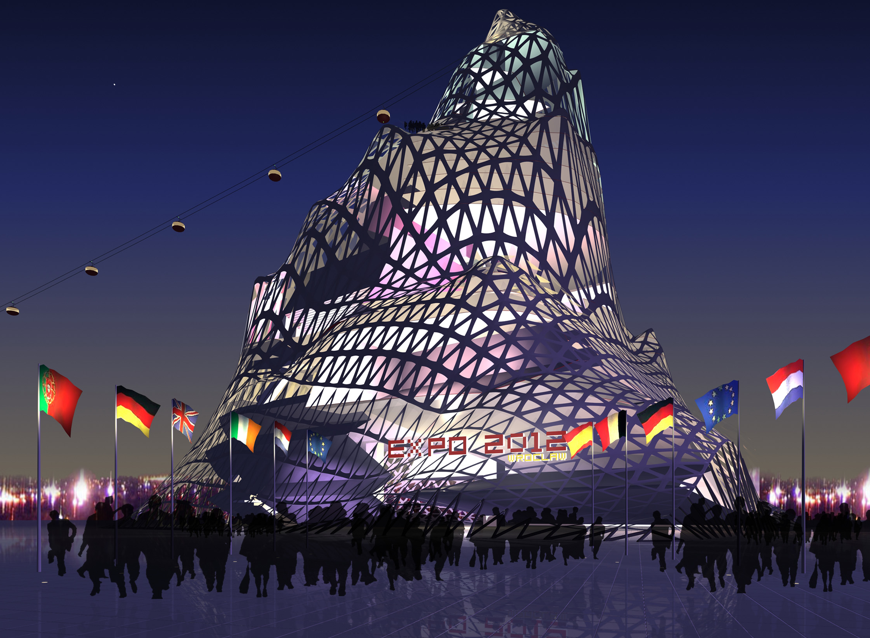
An announcement from the people who run ExpoMuseum (a site that is most certainly worth a long rainy day's visit) popped up in my inbox tonight. The topic was the selection of the central building for Wroclaw, Poland's bid for Expo 2012. (If you live in North America and are surprised to hear that these things are still going on, it might have something to do with the fact that there hasn't been an expo here since 1988.) It's fun and it's funky, and it kind of looks like what Fuller's dome might have looked like after falling down a long, winding flight of stairs. Or if it were wrapped around the Matterhorn in Disneyland; the building is, in fact, intended to look like a mountain.

After all of that talk about the Tower of the Sun yesterday, I could try to draw some nifty parallels or make a witty observation about Expo architecture and how expos use deliberately overwhelming architecture to create a heightened sense of place, but for once I'll just shut up and let you oggle the architecture -- click the b&w image above for a larger, full-color version.

Tonight, we end with this passage from the announcement: "The subject proposed by Wroclaw for the Expo is 'The leisure culture in world’s economies'. [Guallart's] building is a mountain of activities of one hundred meters high, and contemplates auditoriums, administrative zones, offices, restaurants, a viewpoint and a cableway in its top. The building was inspired [by] the Centennial Hall, built by Max Berg in Wroclaw in 1913 (when [it] was still part of the German land) and was the biggest concrete cupola of the world [at the time]. Guallart's proposal contemplates its use during the Expo, as its transformation [into] a leisure and business centre before the event."

(I can't for the life of me find the announcement or the image anywhere online, so until I do I'm rehosting the image...if anyone knows where it is being officially hosted, please let me know and I'll correct the link.)


Links:
ExpoMuseum.com (If you're into Expos, check out their blog.)

Vicente Guallart