Showing posts with label blogosphere. Show all posts

Monday, January 26, 2009

Become a Whereblogger!


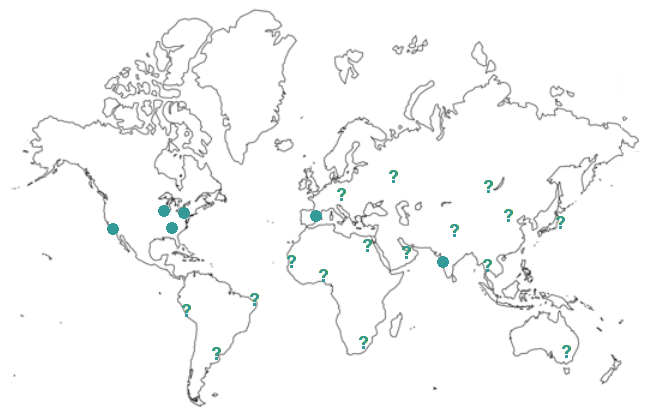
Where is looking to add some new international flavor to our blogging team. We're looking for bloggers based outside of North America who are interested in contributing posts about urbanism 3-5 times a month. If you're interested in becoming a Whereblogger, send a quick email with a bit of background info: who you are, where you're based, what you do, why you're interested in blogging for Where. But first, please read the following:

Two important qualifiers: to be considered, you must be able to write in reasonably clean English. Knowledge of Chicago Style or AP or what-have-you is not needed, but we like to keep language consistent around here, so unfortunately that rules out posts written in otros lengues. You must also actually live in a city. Small cities are ok (though as a general rule, bigger is better), and ultimately the quality of your writing is more important than your personal geography, but writing well about cities requires regular interaction with the urban environment. In other words, Farmer Brown-types need not apply.

Also, while there are several spots to fill (there's a max of 10 contributors, myself included, at any time; currently there are six of us) selectivity will be exercised. Building a strong team requires looking for quality over quantity, so there's no hurry to fill the roster for the sake of doing so. Ultimately, we're looking for people who can answer the question "Can you consistently produce well-written, thought-provoking blog posts?" with a confident "Yes." (And, of course, with whom we agree on that point.)

And while we're on the topic of contributors, I'm pleased to introduce you to another Chicagoan who will be joining the team today:

Drew Austin (Chicago) plans mass transit for a living and passes through his favorite Chicago building, the Merchandise Mart, five days a week. He grew up in Indianapolis but has since moved on to larger Midwestern cities. In addition to transportation, he's fascinated by public space, good architecture, bad architecture and urban morphology. He once wrote about those topics on a short-lived blog called The List of Dorms. His favorite grid-based city is, of course, Chicago, and his favorite grid-based game is Scrabble.

So, to wrap up, here's that email again if you are interested in joining the team Hopefully there will be a few more introductions to make over the next few weeks. Perhaps one of them will be yours.

Wednesday, December 31, 2008

Considering Urban Retail: A Re-post at the Crossroads

As we head into 2009 with economists predicting the closing of as many as 73,000 retail locations across the United States due to dismal holiday sales, it seems like a good time to look back at one of Where's most popular posts from last year, "The Possibilities of the Post-Retail City," originally published in August of '07.


I just had my first exposure to Reverend Billy, the leader of the Church of Stop Shopping. After reading a Polis post about the Reverend's anti-consumerist group, I thought it was an actual church. To which I said: "Oh, excellent.

Of course, the CoSS is actually an act, with the "Reverend" being the stage persona of NYC performance artist Bill Talen. It's a send-up of streetcorner preachers and televangelists, and it sounds hilarious. Better yet, there's a point! Reverend Billy preaches against corporatist architecture and urbanism, advocating for sustainable, walkable communities with local economies. And while the site does pay lip service to independently owned local businesses, it is the Church of Stop Shopping, and one of their taglines is "Love is a Gift Economy!" Obviously, these people think that there are better ways for us to use all of that street-level retail space.

And that got me thinking: if there were no major retail chains and independents had to hold up the local economy, what would we do with all of that ground-floor space? Indeed -- and my upbringing in a capitalist society may shine through right here -- but where would we walk to? Certainly, there are plenty of places that we walk every day, but a large amount of pedestrian traffic is genereated by shoppers. And while it's not a requirement for these ground-level spaces that make up our streetscape be places of commerce, their presence is utterly vital to functioning neighborhoods. Often (these days) even moreso than upper-level residential windows, storefronts are the Jacobsian "eyes on the street" that act as a natural deterrant to crime.

Shopping is also a huge part of the social life in many (if not most) contemporary cities; in fact, that's just what Reverend Billy and his fake church take issue with. And whether or not you agree with the Church of Stop Shopping (or, as I'm sure many do, find it outright offensive), it's interesting to imagine a world in which shopping took a back seat to other social spaces as the dominant street presence. Imagining Paris without the Champs-Elysées or New York without Park Avenue sparks a giddy, no-holds-barred creative energy akin to imagining those cities in a work of science fiction or postapocalyptic literature.

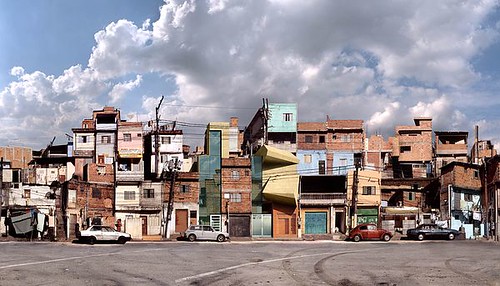
To get an idea of what might fill the void, it might be interesting to see how social space is structured in places where gift economies (or at least barter systems) often already exist and retail strips are few and far between, at least in the traditional sense: slums.

An article from Forbes, mentioned briefly in a previous post at Where, described the socioeconomic situation of many older, established slums in Asia and South America thusly: "Many slum dwellers are in fact entrepreneurs, albeit writ very small. They recycle trash, sell vegetables, do laundry. Some even run tiny restaurants and bars for their neighbors." So while there are no Ginza Districts in the favelas of Rio, there is a social commerce to such places. Restaurants and bars remain important components of the neighborhood, which makes good sense; people have always come together over food and drink, and will continue to do so regardless of any freak evaporations of the retail sector.

Another thing that brings people together is knowledge -- or, more specifically, the exchange thereof. Another recent post covered McGill University's Edible Cities project in Kampala; the site for the students' project "includes a low-lying wetland area...where a youth cooperative practices brick-makings, providing work for otherwise unemployed youth...and a sloping dryland area where farming is [practiced]." While this is a very rural area being discussed (albeit in the context of a larger city), the Kampala site illustrates two more possible uses for a retail-less streetscapes: public workshops (which could cover a variety of topics in addition to brickmaking) and storefront hydroponic community gardens.

Heh.

If the second option seems somewhat far-fetched, the first is hardly at all; in fact, in the face of looming irrelevance in the digital age, libraries around the world are starting to take on a more social role in their respective cities, staging various events and programs to encourage public discourse and teach skills that cannot be learned with a mouse and keyboard. One of the most innovative library programs that I've heard of recently is in Medellín, the second city of Colombia.

Once the so-called Kidnappping Capital of the World, Medellín has made more news recently for building five spectacular modernist libraries (like the one in Santo Domingo Savio, pictured above) in its most impoverished barrios. One of the programs to utilize these new libraries -- which are equipped with computer labs full of brand spankin' new computers -- is HiperBarrio, which teaches teens in the barrios how to use blogging and other social media tools as a creative outlet for self-expression. Juliana Rincon, one of the founders of HiperBarrio, spoke of the program's inspirataion in a recent interview with Global Voices Online, saying, "It was amazing...telling these kids about blogs and finding out that they had no idea that there was something like a blog, that they existed. [Or even] that you could write online and have a virtual space to keep your writing, the videos you like, and pictures." Libraries, in this case, serve not just as containers for information, but as catalysts for the creation of new information and new ideas. Certainly, this kind of social space, the place of public learning, will play an increasingly important role in cities as we continue through the Information Age.

Whatever we come up with to fill storefronts and social spaces, shopping districts and neighborhood retail strips are unlikely to disappear within the lifetime of anyone reading this blog post. Still, imagining a world without retail can tell us a lot about how we use cities, why we do things the way that we do, and how we can improve urban places without courting Starbucks and Barnes & Noble for civic salvation. In fact, picturing your neighborhood without any shops selling anything other than necessities might be a great way to fall in love with the place all over again. That is, of course, assuming that you love your neighborhood -- and that you don't live off Rodeo Drive.

----------

That's all for now, folks. Best of luck to everyone in 2009. Let's hope it's not as bad as we're all worried it's going to be.

(Photo from Flickr user galitagreeneyes. The original full-sized color version can be viewed by clicking the photo.)
Wednesday, December 10, 2008

Notes about the Future of Urban Journalism, Part 2


Bloggers and citizen journalists don't have all it takes

As local newspapers die or shrink into specialized magazines and web sites—as they shed reporters, editors, librarians and other staff to cut costs and adapt to much smaller revenue streams—it seems reasonable to anticipate that cities will experience a net loss in coverage of local news.

But maybe that’s wrong.

It’s possible bloggers and citizen journalists will pick up the slack.

They are, after all, already a major presence in many localities. In fact, I’d be surprised to find a city anywhere that didn’t have a network of local-issue bloggers and citizen journalists. In some places, a few of these volunteers probably out-hustle and out-write the paid print journalists.

City residents also have access to lots local information through aggregator web sites like Yelp, outside.in, CrimeReports.com and EveryBlock.

(I’m ignoring local television news coverage, which is—as far as I can tell—universally very thin when not actively harmful. Local radio is a bit more promising, though many stations have been cutting or eliminating local news coverage for years.)

Despite bringing enthusiasm and talent to local news coverage, the volunteer online media corps and its aggregator helpers just don’t have—in my view—what it takes to replace what newspapers provide (or used to provide) for a city: a daily package of comprehensive and credible coverage of local issues and happenings.

It takes a lot of resources, skills and experience to put together such a package every day. Volunteers—even networks of them—can’t do it reliably every day for years and years.

OK, so volunteers can’t replace professional newspaper people. What about local news web sites—such as, for example, Chi-Town Daily News and Urban Milwaukee (both of which got picked as examples because I happen read them every so often)—that employ (and pay) professional reporters and freelance journalists? Aren’t these sites already doing what local newspapers do for cities?

In part, they are.

On some issues, they seem to be doing a better job of covering the news than their local newspaper competitors.

But in general neither—from what I can tell—has the volume, breadth or depth of coverage as their local papers. And neither seems able to fund in-depth investigative reporting, though Chi-Town Daily News—a non-profit organization—has done some focused, smaller-scale investigative reports.

Sites like these could evolve into what I’d consider full-fledged replacements for local newspapers. But because they’re not there yet, I think cities are likely to suffer from the loss of newspapers as we know them now.

If you care about cities, you should care about the post-newspaper future. You should—I think—not expect too much of bloggers and citizen journalists, but instead hope for--and perhaps help to build--a well-funded and professional future for urban journalism.


The résumé of an urban journalist

The sample résumé that follows illustrates (with slight exaggeration for purposes of emphasis) the skills, experience, education and interests the new breed of urban journalists should have.


Clark Kent
101 S. Hero St.
Metropolis, OH 00007
(555) 666-7777

Objective

Position as a paid reporter for a major city news and information hub.

Skill highlights

  • My writing brings clarity to complex subjects, and is fun to read.
  • I can conceptualize and create a variety of infographics.
  • I know how to create and use many kinds of databases.
  • My command of statistics, including multiple regression, is impressive.
  • I am a master of applications commonly used online.
  • I know how to get around a library, and how to search online.
  • I understand urban economics, government budgeting and the process of policymaking.
  • I smile and interview subjects melt, and tell all.
  • My ability to see through lies is amazing.
  • I am an excellent digital photographer, videographer and voice recorder.
  • I grok every point Jane Jacobs made about what makes cities tick.

Employment history

Daily Planet, Metropolis, OH
Part-time reporter, 2007 to present
Reported on variety of local government issues.

Justice League, Happy Harbor, RI
Research analyst, 2005 to 2007
As part of team, helped research and write a major report about overburdened juvenile justice system in Gotham City.

Legion of Super-Heroes, Comics, D.C.
Web designer, 2003 to 2005
Developed an online interactive timeline of all the Legion’s members and their exploits.

Education

Bachelor of Arts, History, 1998 – Great Little Liberal Arts College
Master of Public Policy, 2001 – World Class State University
Journalism Training Certificate, 2002 – Mass Media Trade School

Personal information

Interesting fact: I was raised in Kansas, but born on another planet.
Favorite authors: Jane Jacobs, Edward Tufte and David Macaulay.
Hobby: aerial photography of cityscapes.

--30--

This is the second part of a series of posts I’m writing about the future of urban journalism. The next post will be about how to fund the kind of urban journalism that cities need and deserve. Read the rest of the series: Part 1, Part 3, Part 4.


(Photo from Flickr user arellis49. The original full-sized color version can be viewed by clicking the photo.)

Monday, October 13, 2008

LWB Scores Kaufman Interview

Holy mother of pearl, archiblogospherites: Jimmy over at Life Without Buildings just put up a severely rad interview with the one and only Charlie Kaufman, who penned the landmark films Being John Malkovich and Eternal Sunshine of the Spotless Mind. Where is in awe, and bows down. From LWB:

Life Without Buildings recently had the chance to sit down and speak with Charlie Kaufman, who generously answered this excited-yet-slightly-nervous interviewer’s questions about film-making, the search for truth, and the role of architecture in his movies. Discussed: Synecdoche, the practicalities of first-time directing, Paul Auster, the lost art of wood carving, and the infinite potential of Las Vegas.

Read the interview here. Do it.

Sunday, August 24, 2008

Blog Action Day 2008: Poverty

The big bloggy day with the unfortunate acronym is fast approaching, and Where will be participating again this year. On October 15th, 2008, thousands of bloggers around the world will post on the subject of poverty in an effort to raise awareness and, as the BAD website says, "change the conversation." Where has a bit of a surprise planned, so if you haven't already, make sure to add this blog to your feed reader of choice!


Blog Action Day 2008 Poverty from Blog Action Day on Vimeo.


Tuesday, June 10, 2008

Information Overload

Hyperlinks, RSS feeds, Google News, Wikipedia, Technorati...

The amount of information that flows through a web savvy person's brain these days is staggering when you take a step back and observe. Eventually, one can get to a point -- a sort of "information overload," if you will. It gets to be too much to take in. There are too many interesting tidbits, too many convenient coincidences, too many inputs, period. Blogging, as a form of writing that takes that constant stream of information and tries to somehow decipher or make sense of it (albeit a tiny bit at a time, while, ironically, adding to the tsunami) can literally become overwhelming.

Scratch that. This is not a hypothetical. Blogging has become overwhelming. I hope you'll bear with me through this rather indulgent post; perhaps I'm just as narcissistic as the general populace seems to believe bloggers to be, but I feel a strange urge to explain why this blog has, despite several promises to the contrary, remained mostly dormant for the past two months.

In short, the constant flow of media got to be too much. At some point, sifting through hundreds of news items and blog posts and articles and videos every day stopped being enjoyable and started to feel like a heavy weight on the shoulders. Blogging, when not for profit, should at least be fun, and Where became more of a responsibility than an exciting project, for a while.

Excuses aside, I do intend to get things up and running again, but every time I try, the thought of putting together a long post with multiple sources gets a little...exhausting. No joke. Perhaps I started to take this all too seriously. That's always a surefire way to make yourself miserable, isn't it?

So I ask Where's little community of regular readers to bear with me over the next few weeks as I try to sort things out and get back on the blogging horse. I'm taking a cue from BLDGBLOG, Pruned, and Landscape Urbanism, and Where will be featuring more short, informal posts (though they will be titled and archived in the sidebar) while I work back up to 1000+ word entries.

Where's coming back. It's just taking longer than anticipated...

Friday, March 21, 2008

Happy Whereday!

Well la-de-da. Exactly one year ago today, Where's first post went up. The site looked a lot different...no logo, basic Blogger format, very...yellow (not sure what I was thinking, there). And here we are, 365 days later, with the 250th post. Plus, since four regular weeks = one full year in blog-years, that makes today Where's 13th anniversary! Hip hip hoo-ray, and all that jazz.

For a bit of self-indulgent celebration, I've put together a list of the Top Ten posts (and series) over the past year. Each header links to the original post. The date of publication follows a brief sample quote, and the posts are listed in chronological order. Without further ado...

Open Spaces, Non-Places
"People have idealized 'open' space when what they should really be focusing on is 'quality' space...[And when] the distinction between 'open' and 'quality' public space is ignored, it allows not only for the types of ridiculous arguments used by the 'concerned neighbors' mentioned above, but on a more subversive level it devalues public space in general." (4/10/07)

Community 2.0 and the Built Environment
"Just as each technological revolution has had to prove its mettle over time, so has the internet; at first, there was a great deal of fear surrounding the dot com revolution...Physical communities, we feared, would become a thing of the past. But now, it seems, we have reached the critical point at which people trust the web -- trust it enough to really take control of it." (5/13-18/07; weeklong series)

Speeding Succession
"Why not help along the process of ecological succession? As urban areas around the world begin to reimagine and reconfigure themselves as more localized, sustainable places, people stranded by a fuel crash or a series of eco-disasters could get work replacing suburban communities with trees. For every house torn down and mulched, ten trees could be planted." (5/29/07)

A True Alternative
"Of late, we have been plagued in our building and planning practices by an intense mediocrity, a society-wide indeciciveness. What we want, of course, is the best of both worlds: the convenience, community, and culture of the city, and the peace, privacy, and pastoral scenery of the small rural town. What we've wound up with is suburbia: the best of nothing." (6/21/07)

The Dawn of Digital Urbanism
"'Who will watch the watchers?' This, I think, will be the most fundamental challenge of Cyberspace: in a universally connected world, the unwatched watcher has more power than ever, as they will have unprecedented access to the masses." (6/28/07)
(Also: from the response post a few days later, Everyone is Watching You: "To paraphrase that famous line: when everyone is a watcher, who's watching the watchers? Everyone.")

Resident Experience Master Planning
"New advances in crowd simulation technology are making Resident Experience Master Planning more and more possible and, with the economic potential of such a development so high, indeed more probable...If urban planning could figure out exactly how to get people to do specific things or behave in specific ways, it would give new and rather intense meaning to the term 'master planning.'" (7/13/07)

Eat Your City
"Urban farms could become for the 21st Century what large, elaborate central parks were in the late 19th and early 20th. Frederick Law Olmsted famously described Central Park in Manhattan as the lungs of the city, but with new green technologies these farms could become more than lungs -- they could be the heart and brain of the city as well." (7/25/07)

The Possibilities of the Post-Retail City
"It's interesting to imagine a world in which shopping took a back seat to other social spaces as the dominant street presence...To get an idea of what might fill the void [left by retail], it might be interesting to see how social space is structured in places where gift economies (or at least barter systems) often already exist and retail strips are few and far between, at least in the traditional sense: slums." (8/13/07)

World Urbanism Day
"[Presented here] is a simple visualization of the landscapes of twelve major coastal cities around the world in three imagined futures: red overlays represent areas that will be submerged after a 50 foot (15.2 m) sea level rise; orange overlays represent areas submerged after a 150 foot (45.7 m) rise; and yellow overlays represent areas submerged after a full 250 foot (76.2 m) rise. The colors represent the fire-like spread of the ocean inland." (11/8/07)

Living in SimCity
"In an existing version of SimCity, a player could cover an empty triangular plot with parks and watch the land value of surrounding blocks rise. Imagine a SimCity that allowed users to completely re-design the Polish Triangle so that any player walking through the area could access this visionary public space and interact with it." (2/13/08)


Have a wonderful weekend. Thanks for a great first year!

Friday, March 7, 2008

WEEKEND READING: March 1-7, 2008

Let's shake things up a bit this week. Instead of summaries of the seven Weekend Reading items, how about some teaser quotes?

ITEM ONE: "It's interesting to see the major changes in our urbanism - as well as to see the fact that the inherent nature of place is difficult if not impossible to erase."

ITEM TWO: "Now that the George W. Bush era is almost over, the world needs a place to archive the legacy of the 43rd president...If you felt your vote didn't count in 2000, it will certainly count here." (Photo credit)

ITEM THREE: "As February gives way to March, Brand Avenue begins its third year online! A few highlights and/or personal favorites from the last year."

ITEM FOUR: "The New City YMCA, where Jeremy played sports for free after school, has come down, and the basketball courts—the great equalizer, where rival factions of the Gangster Disciples would come together to play—have been replaced with a Blockbuster, two Starbucks and a grocery store that has its own sushi station. 'Those courts brought the community together,' says Jason. 'All of this thrown out for condos.'"

ITEM FIVE: "Eventscape's Kapsel is a multisensory functional space that can be set up anywhere in a busy office or elsewhere to create an oasis of relaxation and calm. Based on a lightweight tubular frame, the space can be skinned in any material, with no restrictions on size or form."

ITEM SIX: "Is there an architectural paranoia? And, if so, what would the treatment be – walking tours of all the unmarked buildings downtown? Nights spent alone with your psychoanalyst in empty suburban houses?"

ITEM SEVEN: "Active Social Plastic takes on cultural ephemera, turning its lens to architecture, urbanism, design, interaction, landscape, music and literature, among other leanings."

Have a great weekend!

Monday, March 3, 2008

Where Joins Brazen Careerist

It's been in the works for the past few months, and today BrazenCareerist.com finally went live. Where is proud to have been invited to be one of the 50+ blogs included in the launch of this new site, a Gen Y-focused career advice aggregator from internet freelancer extraordinaire Penelope Trunk and Employee Evolution founders, Ryans Healy and Paugh.

Where might seem, at first, like an odd choice to be included in a career advice site...this was acknowledged by both the BC team and myself at the outset. However, this blog was selected as an example of a young professional (ahem) using blogging as a tool to begin building a career and a professional identity within a specific field. w00t!

Congrats to the Brazen Careerist team for today's launch. Show your support, friends and neighbors. Click the above image or the BC logo on the sidebar and check out the fancy new digs!

In related news, the end of this blogger's Americorps service year is fast approaching and my job search is officially on, so if anyone's looking to hire a good urbanist come mid-April, shoot me an email. ;-)


Links:
BrazenCareerist.com

Penelope Trunk's Brazen Careerist

Employee Evolution

Wednesday, February 27, 2008

Page 123

Where was "tagged" today by the web's slickest Larch blog, Pruned. The rules of the tagging game are as follows:

1. Pick up the nearest book (of at least 123 pages).
2. Open the book to page 123.
3. Find the fifth sentence.
4. Post the next three sentences.
5. Tag five people.

The following is a passage from p. 123 of the book Michael Palin Diaries 1969-1979: The Python Years. Monty Python movies are big in my family; I got the book from my cousin for Christmas. Haven't started reading it yet, but it's been on my bedstand for two months. And today, it found an unpredicted purpose...

When we arrived there, about thirty people were sitting around tables in a dark basement, drinking. Slowly but surely, it became obvious that we could not get away without some sort of cabaret. Eric and Tony took the microphone and, after some opening banter, asked for questions.

And there you have it. Five victims: BLYGAD, Line of Sight, Brand Avenue, Landscape+Urbanism, and Social Practice. Have at it, folks.

Wednesday, February 20, 2008

Dispatch From Across the Blogosphere

This week is turning out to be unusually busy here at Where HQ, so while I get my proverbial shit together, take a gander at this post that Dan, the author of the urbanism-focused blog Flipping Pencils, emailed over this morning. It's an interesting question he's posed here. Any ideas?

A law professor I know is looking for a novel that celebrates the virtues of city life. She can't think of one. Neither can I.

In the law and literature course that she teaches, her students read—among other works and writers—Fidelity: Five Stories by Wendell Berry. Like many of Berry's stories, these take place in Port Williams, a fictional rural community in Kentucky. I haven't read these particular stories but they are, I'm told, complex and subtle and celebrate what Berry thinks are the virtues of life in a small farming community.

Is there fiction that does the same thing for big cities?

"I've combed through my book shelves," the professor says, "and I can't find anything that treats an urban community as the kind of 'value' protective environment that Berry seems to have created."

Cities play important roles in lots of fiction. As settings, of course. As characters in their own right—think of Dublin in Ulysses or Dubliners by James Joyce, for example. As metaphors and images. But, like the professor, I can't think of any novels or stories that explicitly celebrate the moral and community virtues of city life.

There's got to be something, doesn't there?

Tell us what we're missing by adding a comment to this post.


Please direct any commentary on this one to the original post, linked below.


Links:
Wanted: Novel that Celebrates City Life (Flipping Pencils)

Saturday, January 12, 2008

Happy 200: A bunch of little notes.

200 posts. Yippee.

Elsewhere in the urblogosphere...

Civic Nature recently added an RSS feed, making it all the easier to keep tabs on in this crazy, constantly-updating, online world. (Where *hearts* RSS, y'all).

After almost a year-long hiatus, the excellent Magical Urbanism blog started updating again back in October (when I wasn't paying attention). Posts are still spare, but it's worth a look.

The east coast Architecture review -- better known as ecAr -- recently named Where the #1 urbanism blog on the web...which led me to realize that ecAr, which I had thought was linked to on Where's blogroll already, was in fact not. This has been remedied. (Bonus: ecAr has a tumblr, too!)

Blog Karma. It's a good thing.

Friday, December 7, 2007

WEEKEND READING: December 1-7, 2007

Back to business as usual this week for Weekend Reading. Thanks again to Colin for taking over during November, and thanks once more to all of the guest bloggers who helped to keep Where chugging along during NaNoWriMo!

ITEM ONE: It's BLYGAD 2.0! Tumble Like You Give a Damn, folks.

ITEM TWO: The Architectural League of New York has put out a call for entries to its Young Architects Forum competition for 2008.

ITEM THREE: In the past, little attention was paid to South America and its blossoming cultural scene. Not much has changed, there, but Line of Sight dug up a great article from a 1916 New York Times on the subject.

ITEM FOUR: Subtopia has a post called "Squatter Imaginaries" that contains some of the coolest images you'll ever see. (photo credit)

ITEM FIVE: Giant scale model of a partially destroyed downtown = kickass display for your living room.

ITEM SIX: The Future of Cities on what Jane Jacobs might have thought of Facebook.

ITEM SEVEN: Things Mag starts a recent post off with some interesting ruminations on destruction and redevelopment in the UK. Much link love follows.


'Till next week, happy surfing.

(Photo from Flickr user shadeofmelon. The original full-color version can be viewed by clicking the photo.)

Wednesday, November 14, 2007

A Quick Burst of Humor

Found on Metafilter -- the best unused name for an urban planning-related blog: Where Should We Put All This Shit?

Quick; someone go start that blog. I want to read it.

Thursday, November 1, 2007

Nov@Where

And as quickly as I returned, I shall leave again...

November's going to be a little crazy for this blogger since I'll be writing 1,667 words each night for National Novel Writing Month (and working during the day, of course). The objective is to write a 50,000 word novel in 30 days. It's kind of daunting and I'll probably never let anyone read the thing, but what the hell, right? It's worth a try.

In the meantime, some of Where's blogosphriends are stepping up to the plate to keep things around here buzzing along. In addition to Festival of Maps reviews from me (November is going to kill me, I swear), Where will feature guest posts from the writers behind airoots/eirut, HiperBarrio, The Burgh Diaspora, Brand Avenue, Jersey City mag Conveyer, and even a few non-bloggy folk. Starting next Friday, Colin from Blog Like You Give a Damn will be taking over as guest curator of Weekend Reading for the month. It's a freakin' Guest Bloggerama!

So stick around, and tell your friends. Oh, and don't miss November 8th, when Where will have what I hope will be a really cool post for World Urbanism Day. What would the world's major cities look like if the ice caps melted? Check back next week for the answer...

Thursday, October 25, 2007

Dear Blogosphere...

I miss you.

Things with the laptop aren't going so well. There is hope that the information on the hard drive can be salvaged, but it looks like the machine itself is pretty much shot. I have been cursing and and gnashing my teeth quite a bit these past few days.

So Where is still out of commission, at least for a few more days. I will hopefully be able to get repaired or new hardware by next Thursday, when I'm supposed to start National Novel Writing Month. Luckily, since I had planned ahead for that absence, there will be a number of guest bloggers and other exciting fun things coming up at Where in November. More on that next week.

In the meantime, if you are looking for some fun bloggy reading, a few new links have been added to the Otros Blogos feature on the sidebar. Take a look:

Civic Nature

deputydog

Global Voices Online (Development Page)

The Contemporary Grand Tour

The Creativity Exchange (aka Richard Florida's daily musings)

There will be Weekend Reading tomorrow. Along with death and taxes, it's one of the only constants in this crazy world. Hah.

Friday, October 19, 2007

WEEKEND READING: October 13-19

It has been a busy week in the blogosphere. That makes for a fat WR list!

ITEM ONE: Wikipedia's impressive list of urban squares ranked by area. This is the kind of thing that the internet was invented for.

ITEM TWO: A post at Line of Sight covering the delightfully wacky buildings of Argentine architect Francisco Salamone. (Photo credit)

ITEM THREE: BLDGBLOG's got a crush on Los Angeles...

ITEM FOUR: ...and over at Spacing Wire, an Angeleno has a crush on Toronto.

ITEM FIVE: Kazys Varnelis with an interesting take on the city vs. suburb debate.

ITEM SIX: Interesting post at IAdotO about Emotional Architecture (with the added bonus of a link to a free online version of the book The Emotion Machine).

ITEM SEVEN: Antonio Gaudi's got a Brazilian doppelgänger.

ITEM EIGHT: International Listings' take on the Top 100 Architecture blogs -- a good resource with lots of blogs both old and new. Where comes in at #100 thanks to good old-fashioned alphabetization. ;-)

Have a great weekend, everyone!

Thursday, October 18, 2007

Speculative Urban Blogging

I came across two great new blogs this week that do what you might refer to as "speculative urban blogging" in two very different (if equally innovative) ways. So consider tonight's post sort of an in-depth lead-in to Weekend Reading, if you will.

Audacious Ideas takes a look at how things are going in Baltimore and makes some rather audacious suggestions as to how these problems might be addressed more effectively. Here's the catch: the entries are written by Baltimore professionals who work in fields that deal directly with the problems that they are writing about. Audacious Ideas takes big questions and provides answers sized to match. And even with only five posts (not including the introduction), AI has provided audacious[ly pragmatic, in most cases] suggestions for policy reform in the areas of public health, the city budget, childrens' safety, drug treatment, and education.

Even better, the audacity is apparently just what the doctor ordered, so to speak. Every topic has spurred a discussion at least a dozen posts long. Baltimoreans are taking inspiration from this new public forum, and from everything that I've read the readers are taking the discussions seriously -- a rare occurence on the internet. It certainly helps that these discussions are being started and led by community leaders with experience and wisdom. Online conversations almost always benefit from having a curating presence, and as this blog continues to build a body of posts and public discourse, it stands a better chance of becoming a real engine for change in Baltimore. Speculating on the future of the city opens up possibilities and puts some 2.0 juice into public policy.

The Blurgh looks at Pittsburgh's future from an entirely different angle: the writers are already living in it. Written in an imagined 2027, The Blurgh is a rather audacious blog, itself. "Frank" and "Gretchen" are two twentysomethings, a student and a writer, making their way in the now-resurgent Steel City. Written as a simple journal-style blog, The Blurgh is coy. The bloggers mention massive changes in the city's physical and economic environments -- Pittsburgh's status as a hub of sustainable technology, the city's impressive literary scene, an über-extensive mass transit system -- in passing, stopping only occasionally to do a sort of "gee, whiz" look back at the past (aka our present) and comment on how glad they are to be living in the "new" Pittsburgh (aka the one in 2027).

It's the realism that is so clever. If this very blog were being written in 2007, it would be wholly unremarkable, another drop in the massive bucket of naval-gazing public journaling that has earned the field blogging its currently somewhat uneven reputation. Well, okay...it is actually being written in 2007, but you get what I mean. The writer(s) of The Blurgh seem to know exactly what they're doing and, while it's too early to tell, they could turn this blog into a very important forum for the discussion of Pittsburgh's future, and how the city got/could get there. At the very least, it will be interesting to see how The Blurgh -- and its community of readers -- evolves.

So much of urblogging is focused on keeping tabs on what's going on right now in a neighborhood or a city. The local everyday politics of potholes, homelessness, new construction, and Starbucks are important to local discourse, and this is not a knock against of-the-moment urblogs. But it certainly wouldn't hurt, I don't think, if bloggers in a few more cities took on the challenge of trying to imagine a better and brighter future for the places they live. The hyperlocal movement is very much tied to the immediate present, and sometimes this means that urbloggers can't see the forest for the trees. A better future for our cities is something worth speculating about, and blogging provides those interested with the perfect medium to address rapidly-changing problems. As Audacious Ideas and The Blurgh show us, there are many different ways to use this technology to speculate on a brighter urban future.

(Photo from Flickr user joey kennedy. The original full-color version can be viewed by clicking the photo.)


Links:
Audacious Ideas (via CEOs for Cities)

The Blurgh (via The Burgh Diaspora)

Monday, October 15, 2007

Addressing the Sub/Urban Divide

The following post is part of Blog Action Day 2007, in which more than 15,000 bloggers around the world are posting about the environmental challenges that we face today as a society. For more info, follow the link at the end of the post.

---------------------


These days, cities and suburbs are locked in a seemingly intractable struggle. Cities are understood to be the dense urban cores bustling with pedestrians and laced with mass transit lines, while suburbs are viewed as the stomping grounds of the wicked and immoral Sprawl Monster that devours land at alarming rates and drives up demand for auto traffic and freeway construction, adding untold millions of tons of carbon into the air and accelerating global warming. It's a typical Western dichotomy: dark vs. light; right vs. left; good vs evil.

What often gets brushed aside as a result of this oversimplification is the fact that urbanity has little to do -- especially in the United States -- with political boundaries. The average densities of American cities and suburbs are almost the same. In fact, if you look at the 43 American municipalities with a density above 10,000 people per square mile, only six of them -- New York, San Francisco, Chicago, Boston, Philadelphia, and Miami -- are the central cities in their metropolitan areas. (That number rises to eight if you include Trenton and Newark, both in New Jersey, whose smaller metros are usually absorbed into the CSAs of Philadelphia and New York). Granted, some of the suburbs that reach this density are far more auto-centric than some of the less densely populated central cities, but the point here is that questions urbanity cannot be boiled down into easy, diametrically opposed sides. Density, sprawl, city, suburb -- all of these things are involved in the equation, but they don't always line up as neatly as we might hope.

It is often said nowadays that cities produce the majority of carbon emissions (roughly 80%) and therefore these areas must be the solution to the problem. This is entirely true, but we have to realize that "city" in this instance refers not to central urban areas, but entire metropolitan regions. One of the greatest challenges that US cities face, then, is how to undo the damage that poor land use policies and auto-dependancy have done to our suburbs. Many of the suburbs in the 10K+ density range are older places that were established before or during the early years of the automobile age: Paterson and Jersey City across the Hudson from New York; Somerville and Cambridge across the Charles from Boston; Cicero and Berwyn on the western edge of Chicago. These suburbs often have their own commercial areas, neighborhood shops and restaurants, and immigrant communities priced out of central cities. They are densely populated and often less reliant on cars than postwar suburbs. Many are connected to transit systems. In short, these suburbs are very urban places.

In the same stroke, some very large cities can be very sparsely populated places. San Jose, the center of Silicon Valley, is half as dense as Lakewood, Ohio, an historic streetcar suburb of Cleveland. Alexandria, Virginia, a suburb of Washington, DC, is twice as dense as Las Vegas. And how about this one: the most densely populated municipality in the US, Union City, New Jersey, has a population density 54.5 times higher than that of Jacksonville, Florida, one of the country's largest cities.

Numbers and boundaries have never been very good ways of defining places. They're too clinical, and they often substitute statistics for the human element. This has led to a critical misunderstanding on the part of the general public in the US of terminology pertaining to the built environment. As a result, people here are having a lot of trouble figuring out how cities should address climate change. There is a consensus that something must be done, but people can't seem to agree on what that might look like. City-dwellers pat themselves on the back and blame climate change on amorphous "sprawl," anti-urbanists twist stats to try to turn the tables on urbanists who are ill-equipped to deal with public perception, and suburbanites guard their turf rather fiercely, fearing that "density" will translate to more hellish commutes and the loss of "local character" that often doesn't exist in the first place. As a result the US plods along slowly toward a drastic change in the coastline with no solution in sight.

There is a near-total lack of vision in how we deal with urbanization and development in this country. However, this is starting to change. Hopefully, a rather damning trifecta of recent reports will give urban planners and civic leaders the tools they need to redirect the conversation.

First, it was revealed by the New York City Department of Health that New Yorkers lived, on average, nine months longer than the average American -- a fact linked to New Yorkers' more active lifestyles and the city's dense, walkable streetscape. Next came a report from Smart Growth America with the claim that "the projected 59 percent increase in the total miles driven between 2005 and 2030 will overwhelm expected gains from vehicle efficiency and low-carbon fuels." Finally, the American Public Transportation Association announced that "when compared to other household actions that limit carbon dioxide (CO2), taking public transportation can be more than ten times [more effective] in reducing this greenhouse gas." It was a three-strike, rapid-fire attack on auto-centric development patterns. The message was made very clear: if we want to seriously address climate change in the United States, we must walk more, improve our public transit infrastructure, and drive much less often. All of this is reliant upon the existence of one thing: an urban environment.

At some point it must be acknowledged by a majority of Americans that if we want to change the way we impact our climate, we have to change the ways that we build and live. Making the switch from regular light bulbs to CFLs is all well and good. But understanding the way that land use and transportation actually work, and accepting the fact that we must be more responsible in these areas, is critical to finding a real solution. If the public is to come to this better understanding, recognizing and explaining the difference between straight statistics (city/suburb, density/sprawl) and genuine urbanity should be the first items on the urban agenda.

(Photos from Flickr users jimheid and mirkob. The first shows Cambridge, MA, rising across the river from Boston's Back Bay neighborhood; the second is an image of Jacksonville, FL's hollowed-out core and the sparsely populated surrounding neighborhoods.)


Links:
Blog Action Day

US Municipalities Over 50,000:
Ranked by 2000 Density (Demographia)


Why New Yorkers Las Longer (NY Magazine) (via All About Cities)

Less Auto-Dependent Development Is Key to Mitigating Climate Change, Research Team Concludes (Smart Growth America)

Taking Transit: The Most Effective Route to Cutting Carbon (WorldChanging.com)

Friday, October 12, 2007

WEEKEND READING: October 6-12, 2007

It's been a busy week for this blogger, so the Weekend Reading list will be a bit shorter than usual.

ITEM ONE: Part IV, aka "The World's Worst Blog," put up a public poll to determine the three Best Archiblogs of 2007. Where has been nominated. Feel free to vote for it, if you so choose. ;-)

ITEM TWO: The new issue of The Next American City features this great article about the ripple effect war causes on crime, which happens to be available online.

ITEM THREE: City of Faded Elegance points us to the new edition of the Virginia Quarterly Review, which has a ton of great content on contemporary South America.

ITEM FOUR: Aussie blog Pigs Will Fly reports on so-called Sustainability Streets. The formula is quite fun: Mulch (learn), Sow (plan), Grow (do), Harvest (teach).

ITEM FIVE: Planetizen features a great post about a new museum in Salt Lake City that focuses on the ever-changing nature of the city.

Have a great weekend!

(Photo from Flickr user LeggNet.)